
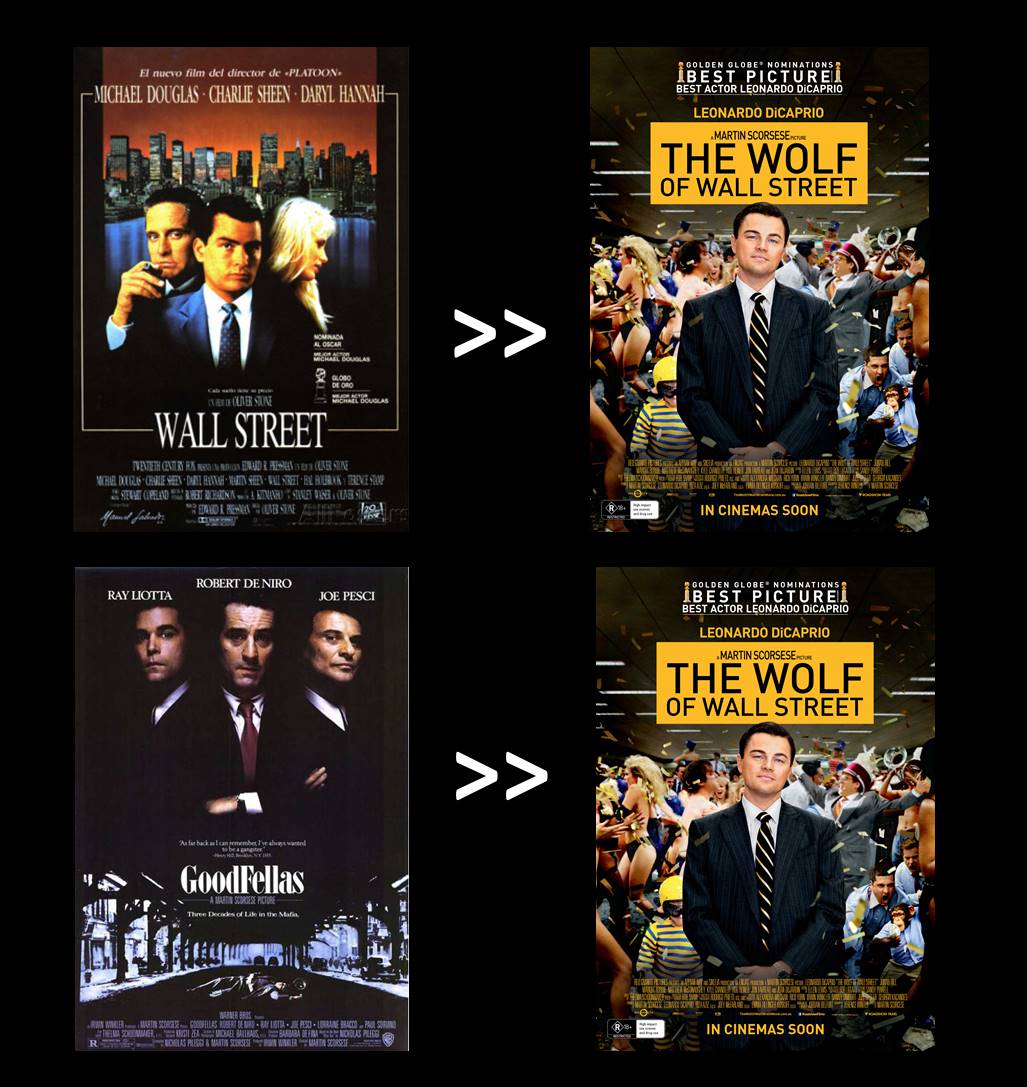
Layer the stylings of Martin Scorsese’s GoodFellas over Oliver Stone’s Wall Street and you have Scorsese’s 2013 treatise about greed in America, The Wolf of Wall Street. Unfortunately, where this should have been a wonderful blending of two great films, it was instead the mutated step-child.
Briefly, the movie follows the adventures of real-life stockbroker Jordan Belfort as he rises from the ashes of Wall Street to lie and cheat his way to fame and fortune from the then despised penny stocks market. Through a haze of booze, drugs and female flesh and relying on balls the size of the tri-state area, he pulls a fleet of nobodies into the middle of the financial maelstrom, becoming everything for which Wall Street is despised. Throw in a little money laundering and he, of course, becomes the target of an FBI and SEC investigation that ultimately brings him down.

If, from the synopsis, you don’t immediately see the influences of Wall Street and GoodFellas, you’re not really trying or you need to go back and watch them again.
I wish I could say it was just the 3-hour running time that interfered with my enjoyment of the film, but GoodFellas was 148 minutes and Wall Street was 126 minutes. Rather, I think the problem was that it felt like the movie was 6 hours long. Time seemed to drag out as though I was getting a contact high from all the Quaaludes the characters were consuming, but without the peaceful overtones.
I appreciate it was based on the life of Jordan Belfort, so perhaps the screenwriter Terrence Winter felt he had to be careful tiptoeing around the contents of Belfort’s book of the same title. But for the love of God, there was no place that Winter felt he could simply skip ahead?
When Leo DiCaprio would narrate the scenes, in some cases turning directly to the camera to do so, my mind immediately jumped to Ray Liotta in GoodFellas. Never more so than when he would try to explain how Wall Street functioned, almost mimicking Liotta’s explanation of the mob, down to the vocal cadence. The two examples below show both men introducing the troops.
And when DiCaprio would try to rally the troops, he became a bombastic Gordon Gecko (Michael Douglas), enthusiastically letting people know that greed was good…or in his case, that there was no nobility in poverty. Hell, in his narrative voice-over, he even mentions Gordon Gecko in an obvious homage that simply highlights how pale an imitator this movie is.
So I am left asking what exactly does The Wolf of Wall Street offer that the other two films didn’t.
Wealth, opulence, greed, excess? Been there, done that.
Booze, sex, drugs, violence? Watched that, saw it.
Illicit business, FBI investigations, wire taps? Old hat, nothing new.
Hubris, hedonism, idolatry? Biblical, but done and doner.
It made almost $400 million worldwide and was nominated for five Academy Awards (winning none), so people liked it.
For comparison, Wall Street earned $44 million globally in 1987 and won Douglas the Best Actor Oscar, while GoodFellas managed $47 million in the US in 1990 and won Joe Pesci the Best Supporting Actor Oscar (of six nominations).
DiCaprio has charm…and so did Liotta and Douglas.
Interestingly, I didn’t feel this one had the cinematographic snap of Scorsese’s earlier works…it didn’t feel like the camera was dancing with the actors as it did in GoodFellas.
Maybe it was simply a matter of timing. Wolf showed up just as the United States was truly starting to recover economically from the banking scandals and burst real estate bubbles, and in an almost self-abusive way, Wolf reminds Americans (and the rest of the world) of a time when money was cheap and easy. It’s definitely not a morality play, for no one is seen to suffer for their excesses.
It is the American dream seen through a tumbler of Scotch. The manifest destiny of anyone willing to gamble with the weaknesses of others. A sign that nothing has changed. That nothing ever changes.
Wall Street was a warning. GoodFellas was the rise and fall of Man. The Wolf of Wall Street is a love letter to unbridled greed.


 createdbyrcw