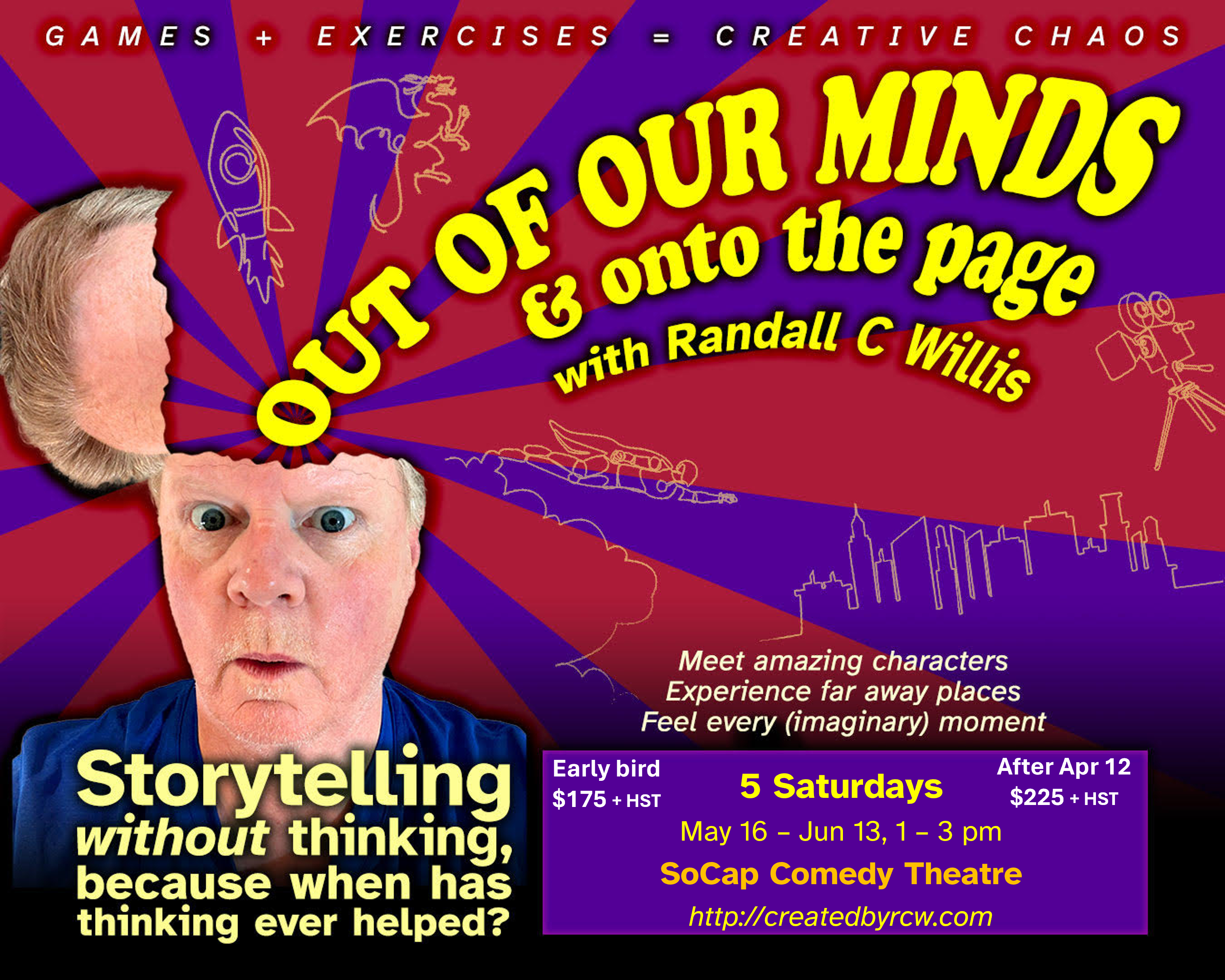
Has the blank page ever intimidated you? Do you wish you could write or tell entertaining stories with abandon? Do you write but wish you could do it better?
OUT OF OUR MINDS (& onto the page) is the perfect workshop to get those creative storytelling juices flowing. Thinking is overthinking, so we’re going to remove the pressure to get it right by simply playing with whatever comes. Playing improv games and using prompted writing exercises, the workshop helps make writing spontaneous and freewheeling. No preparation. No homework. No inhibitions.
Just be ready to be silly and open. Oh, and bring something to write with (e.g., pen & paper, phone, iPad, stone tablet & chisel, semaphore flags).
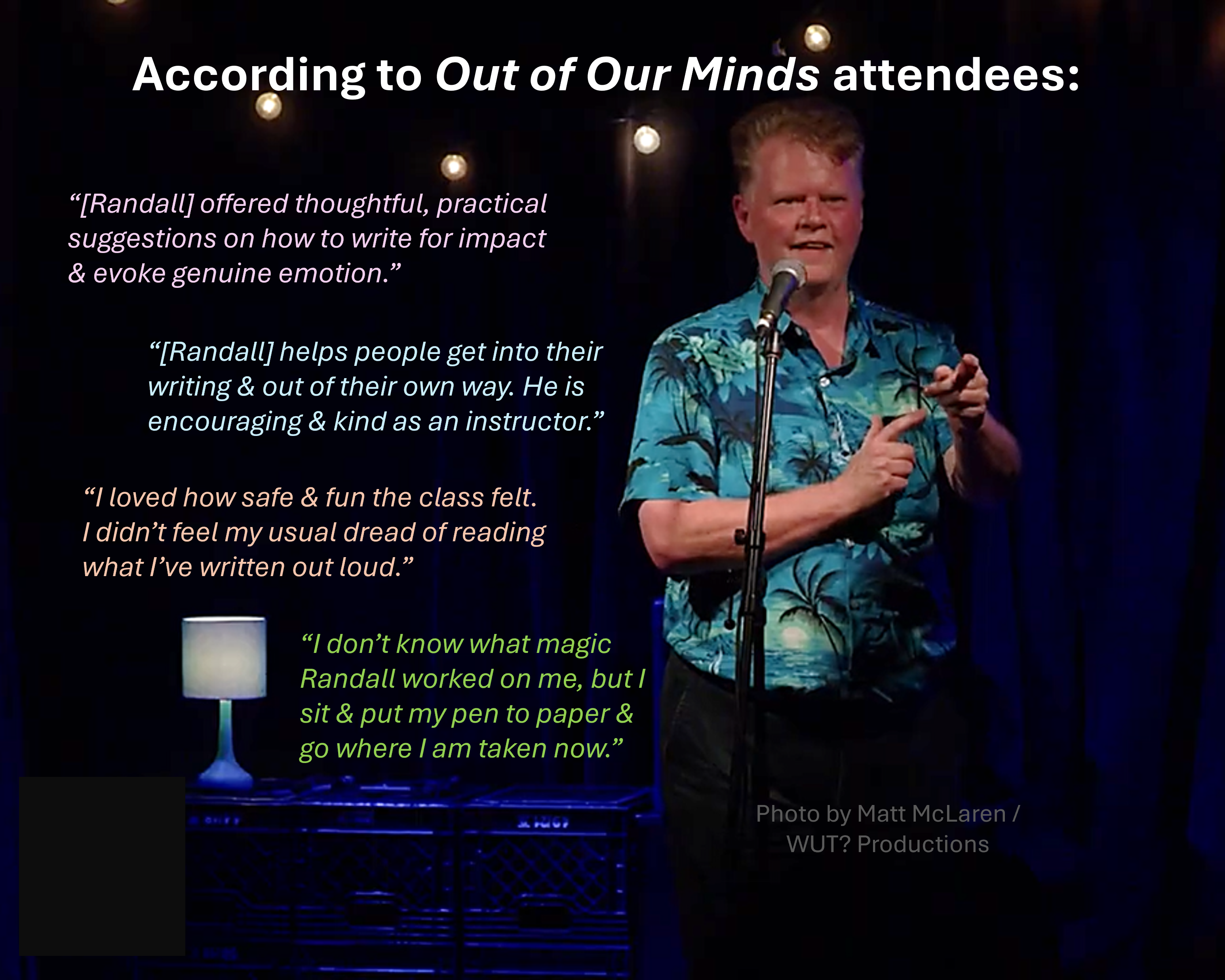
Past workshop attendees have said:
“…thoughtful, practical suggestions on how to write for impact & evoke genuine emotion.”
“…I was able to go to places I didn’t know I needed to go to tell the stories I needed to tell.”
“…I now sit & put my pen to paper & go where I am taken.”
“…I didn’t feel my usual dread of reading what I’ve written out loud.”
“…helps people get into their writing & out of their own way.”
“…Randall is a great storyteller, very inclusive & attentive to everyone.”
Six-week workshop ($250): Six 2-hour sessions, Saturdays, Sept 19 – Oct 31 (excl Oct 17), 11am – 1pm
TO REGISTER:
Please send an e-transfer to createdbyrcw@gmail.com to reserve your place. Spaces are limited.
ABOUT THE INSTRUCTOR:
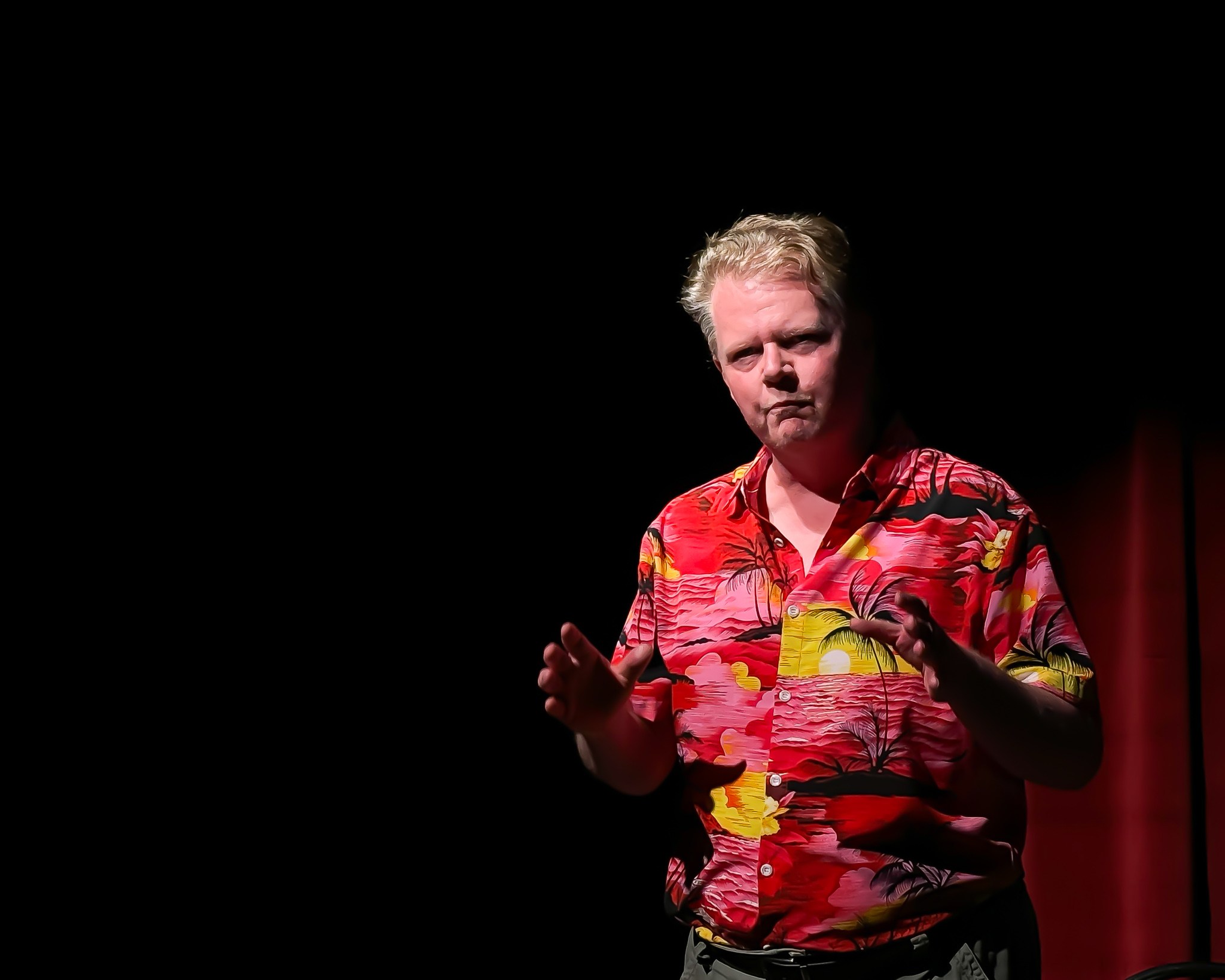
Randall C Willis is an award-winning screen and comedy writer and filmmaker, who regularly performs in Toronto’s storytelling community. He is also a seasoned science and medicine writer, but hey, nobody’s perfect.
A perpetual student of the storytelling arts, Randall has 25+ years of training in improv, stand up, puppetry, sketch comedy, and monologues. If Randall has a motto, it’s “You have permission to suck”, which fits nicely with his fully improvised life.
Do you have a story or several roiling inside you, aching to be unleashed on the world? Do you watch the chest-burster scene in Alien and think “Yeah, I get that”?
Want to share your thoughts but terrified that you’ll suck at it? Already writing, but want to explore deeper characters, more evocative description, and more intense action? Interested in translating your performance arts to the page?
OUT OF OUR MINDS (& onto the page) is the perfect workshop to get those creative juices flowing. Over 5 Saturdays at SoCap Comedy Theatre (May 16 – Jun 13), we’ll play with improv games and prompted writing exercises to help you make writing spontaneous and freewheeling. Thinking is overthinking, so we’re going to remove the pressure to get it right by simply playing with whatever comes. No preparation. No homework. No inhibitions.
Just be ready to be silly and open. Oh, and bring something to write with (e.g., pen & paper, phone, iPad, stone tablet & chisel, semaphore flags).
TO REGISTER: Early-bird pricing of $175 (+ HST) ends April 12 when prices rise to $225 (+HST). Please send an e-transfer to createdbyrcw@gmail.com to reserve your place. Spaces are limited.
ABOUT THE INSTRUCTOR:
Randall C Willis is an award-winning screen and comedy writer and filmmaker, and he regularly performs in Toronto’s spoken-word storytelling community. He is also a seasoned science and medicine writer, but hey, nobody’s perfect.
A perpetual student of the storytelling craft and arts, Randall has 25+ years of training in improv, stand up, puppetry, sketch comedy, advertising and publishing. He also writes a killer eulogy. If Randall has a motto, it’s “You have permission to suck”, which fits nicely with his fully improvised life.
Learn more about Randall’s approach to creativity and his style via his YouTube channel.
As someone who works and recreates in the Arts, I have struggled to make sense of the current conversations about the roles or sins of artificial intelligence in the creative arts, however you might personally define those.
Like many in my fields, I have worried that AI tools were going to pick my pocket or put me out of work. And I have worried about the dumbing down, the dilution, the commoditization of the Arts.
What a load of egotistical bollocks on my part!
As I said, I work and play in the creative arts. For me, that involves writing pretty much anything that can be written, live storytelling, and improvisation, and I dabble in filmmaking, drawing, and even singing. And I consume most of the creative arts in one way or another.
But is any of this Art, deserving of the capital A? I’m not sure that I care.
I enjoy what I enjoy and don’t what I don’t. I hope the same is true for you. If our choices overlap, great. If our choices completely conflict, great. I am just happy you have found things that make you happy.
At the risk of offending the artists I follow, I suspect that The Establishment – that mysterious arbiter of acceptable tastes – would call most of what I like pedestrian – as if there’s something wrong with walking – or outright trash.
I read thrillers and Shakespeare. I follow and own prints and paintings by street artists. I love The Three Stooges and The Flying Circus. And my musical tastes range from Gregorian Chants and Bizet to The Monkees and Ray Stevens (YouTube “The Streak”).
For its part, can anything I create be described as Art? Again, I am not sure that I care about the uppercase A or that I am truly in a place to judge.
Some of my writing has been brilliant, says me and, on occasion, others. Most of my writing has been serviceable, passable, or utilitarian. And quite a bit of my writing has been weak, bad or downright embarrassing. (I leave your opinions of this piece to you.)
I enjoy my live storytelling and improv, but not every story or set comes off or is received as I might hope. The same is true for my other artistic efforts.
And most of the planet’s population will never experience any of it. (Thank you for experiencing this.)
So, what does my creative resume have to do with AI?
Two things: One, the concept of “big A” Art is hubris of the highest order and exclusionary. And two, the artistic merit of anything is a personal decision rather than something with tangible metrics.
Art evolves with every passing generation because tastes evolve with every passing generation. In some ways, Mozart was the Ray Stevens of his era and The Abduction from the Seraglio is his Gitarzan, a piece of music considered frivolous by “those who know” and yet highly successful in its time.
Charles Dickens and Arthur Conan Doyle were newspaper serialists long before their works were considered classic literature. And most famous crime and science fiction writers published chapbooks – aka “cheap” books or pulp fiction – before they became known as Masters of their genres.
AI, like the printing press, is simply a tool that facilitates the production of creative arts on a scale not previously imaginable. Whether the output of that production is “good” rests soundly in the eyes and ears of the beholders, just as communities once warned of the sins of comic books and English translations of The Bible.
I do not actively use AI tools in my creative arts – I even avoid the AI results of a Google search – not because I think AI is evil but because I have not found a use-case for AI. The typical reasons most use AI, it seems, actually serve to replace the steps that I find make my creative artistry most enjoyable.
That said, I appreciate that not everyone thrills at the sight of a blank page like I do. Not everyone has the same confidence in their passions or themselves that I have developed. I meet many of these people when I teach a screenwriting class or improvised writing workshop. And I personally know the hesitation of self-doubt in attempting creative arts I consider outside my natural skillset.
If AI tools serve as a gateway for self-expression for these souls, I am all for it, and I will support and encourage them just as I would support and encourage those who choose to experiment and risk failure under their own steam.
And if AI tools are used to mass-produce materials – aka Content – to be consumed by the seemingly bottomless pit of the online world, so be it. People, including possibly me, who want it, will consume it. And maybe it will whet consumers’ appetites for creative arts produced by humans. Maybe even for mine.
Although there remain environmental and intellectual property factors to consider in choosing to use AI tools, the artistic (or Artistic) merits and values of what it produces seem trivial and egocentric to me.
Over my lifetime, I have consumed trillions of words by seasoned and novice writers. I have seen pens, pencils, and keyboards used to stunning effect, in both the positive and negative sense. I expect no different of the words generated by AI tools.
I wish any creator, any artist using any tool much joy in the creative process, whatever theirs might be. And I look forward to making up my own mind on their end product, however it came to be, no capital A required.
Who is this guy?
An award-winning screenwriter and filmmaker, Randall C Willis has told stories his entire life, writing for every medium, but has recently caught fire live on-stage. He describes himself as a story evangelist, a practice that he preaches as a screenwriting instructor at George Brown Polytechnic. In January, Randall launched the workshop Out of Our Minds and Onto the Page, which fosters freewheeling creativity and spontaneous storytelling using improv games and writing sprints. And through his company So, What’s Your Story?, he helps storytellers of all media to find their voices and explore their ideas.
Do you have a story or several roiling inside you, aching to be unleashed on the world? Do you watch the chest-burster scene in Alien and think “Yeah, I get that”?
Want to share your thoughts but terrified that you’ll suck at it? Already writing, but want to explore deeper characters, more evocative description, and more intense action? Interested in translating your performance arts to the page?
OUT OF OUR MINDS (& onto the page) is the perfect workshop to get those creative storytelling juices flowing. Over 5 Saturdays at Sweet Action Theatre (Jan 10 – Feb 7), we’ll play with improv games and prompted writing exercises to help you make writing spontaneous and freewheeling. Thinking is overthinking, so we’re going to remove the pressure to get it right by simply playing with whatever comes. No preparation. No homework. No inhibitions.
Just be ready to be silly and open. Oh, and bring something to write with (e.g., pen & paper, phone, iPad, stone tablet & chisel, semaphore flags).
TO REGISTER: Early-bird pricing of $150 (+ HST) ends December 20 when prices rise to $200 (+HST). Please send an e-transfer to createdbyrcw@gmail.com to reserve your place. Spaces are limited.
ABOUT THE INSTRUCTOR:
Randall C Willis is an award-winning screen and comedy writer and filmmaker and he regularly performs in Toronto’s spoken-word storytelling community. He is also a seasoned science and medicine writer, but hey, nobody’s perfect.
A perpetual student of the storytelling craft and arts, Randall has 25+ years of training in improv, stand up, puppetry, sketch comedy, monologues, presentation, advertising and publishing. He also writes a killer eulogy. If Randall has a motto, it’s “You have permission to suck”, which fits nicely with his fully improvised life.
Learn more about Randall’s approach to creativity and his style via his YouTube channel.
Always wanted to tell stories but are terrified you’ll suck at it? Already writing, but want to explore deeper characters, more evocative description, and more intense action? Interested in translating your performance arts to the page?
OUT OF OUR MINDS (& onto the page) is the perfect workshop to get those creative storytelling juices flowing. Over 6 Saturdays at Toronto’s Sweet Action Theatre, we’ll play with improv games and prompted writing exercises to help you make writing spontaneous and freewheeling. Thinking is overthinking, so we’re going to remove the pressure to get it right by simply playing with whatever comes. No preparation. No homework. No inhibitions.
Just be ready to be silly and open and bring something to write with (e.g., pen & paper, phone, iPad, stone tablet & chisel, semaphore flags).
TO REGISTER: Early-bird pricing of $200 (+ HST) ends June 14 when prices rise to $250 (+HST). Please send an e-transfer to createdbyrcw@gmail.com to reserve your place. Spaces are limited.
ABOUT THE INSTRUCTOR:
Randall C Willis is an award-winning screen and comedy writer and filmmaker, as well as a seasoned science and medicine writer. He regularly teaches screenwriting at George Brown College and formerly taught at Raindance in Toronto. Through his company So, What’s Your Story?, story specialist and storytelling evangelist Randall helps clients bring life to their visions and breath to their unique voices. He also routinely judges screenplays and films for film festivals across North America.
A perpetual student of the storytelling arts, Randall has 25+ years of training in improv, stand up, puppetry, sketch comedy, and monologues. If Randall has a motto, it’s “You have permission to suck”, which fits nicely with a fully improvised life.
You can also follow Randall’s storytelling thoughts on Instagram and YouTube.
I must qualify that Frank Herbert’s feudal sci-fi story had a huge influence on my life, including an upcoming project I am developing. I have read no book more frequently than I have read Dune.
Thus, I had great anxiety about Denis Villeneuve’s adaptation as I entered the theatre. Within the first two minutes, that anxiety was replaced with exhilaration as this 57-year-old man once again felt the upwelling of emotions that he experienced as a 13-year-old boy seeing Star Wars for the first time.
Villeneuve has done an amazing job staying faithful to the novel, including scenes that I had almost forgotten were in the book. But that also means that the movie is long and will require several installments to complete the saga.
At moments, some of the performances felt a little over-wrought, but as the movie progressed, the performances became more nuanced and subtle, as though the actors finally got into their roles & began to understand the characters more clearly. By the end, Timothee Chalamet was Paul Atreides. (I reserve any comments on Zendaya as Chani, as her role is still quite limited.)
But more than the performances, this is a movie of scale & spectacle. I nearly wept at the first worm sign, & I am confident my chin was on my chest when the first worm appeared. These worlds are real. Villeneuve & his team have done an amazing job bringing these planets & their inhabitants to life. And those alien places & family conflicts are given greater life with the soul-resonant score by Hans Zimmer.
For those who haven’t devoted their hearts to Frank Herbert’s ecological fever dream, Dune may not be all that. They may see it as slow & ponderous. They may consider the characters melodramatic & hyperbolic. They may consider tedious the need for multiple installments.
You do not need to know the novel to enjoy this film. The story plays out coherently without inside jokes or Easter eggs to the informed.
For people like me, however, people whose pulse matches the throbbing Zimmer score, whose lungs breathe the Spice melange, whose DNA is infused with Bene Gesserit mythos, Dune is our homecoming. We are the Fremen.
A wonderful thing about the stage show Puppet Up! is that like all good improv shows, the lights go up, then good or bad, the sketch happens, and then the lights come down.
There is a window for the jokes to live or die, for the story to succeed or fail, for the characters to evolve or not.
And then the window closes, and we move on to the next sketch.
The Happytime Murders is what happens when that window refuses to close, or at least takes 91 minutes to close.
The plot is classic film noir. [NO SPOILERS]
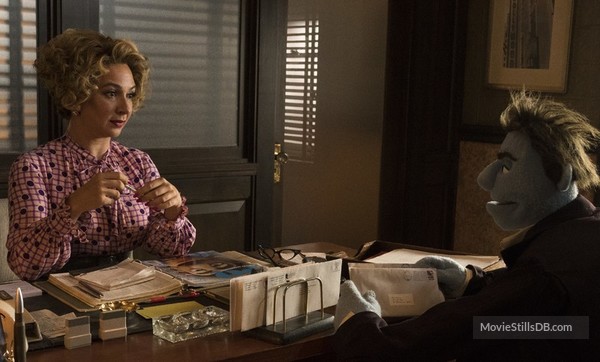
The world is modern day Los Angeles, but it is now populated by humans and puppets, only the puppets are considered second-class citizen. The story centres on the exploits of Phil Phillips (Bill Barretta), washed up cop and now puppet private eye, and a sudden killing spree that forces Phil to work with his old human partner Connie Edwards (Melissa McCarthy).
Old wounds run deep. Pain and distrust drips from the walls.
And then there’s this dame with a body that literally just won’t quit.
Now, atop that film noir scaffold, you can layer…no, trowel…no, backhoe 1000 sex jokes, puppets saying “fuck” every few seconds, and a rather unnerving cowsturbation moment and you have The Happytime Murders.
There is no doubt that Henson Alternative can do puppetry, and this film is ALL about the puppetry.
[Disclosure/Bragging: I personally know some of the puppeteers who worked on this film. (See Puppet Up! visits Toronto)]
The skill with which this movie was made is astounding, particularly if you watch the behind-the-scene videos on YouTube. These are seriously talented and amazingly funny people.
It was obvious in Puppet Up! It is obvious in The Happytime Murders.
As expected, the human actors simply cannot keep up with their frenzied felted friends. Even Melissa McCarthy at her Melissa McCarthy-est cannot compete on screen with these little monsters…seriously, she might as well have been Jenny McCarthy. (Note: Not intended as a slight on MM.)
The lone human performer who stood out and more than held her own was the delightful Maya Rudolph. I have always had my suspicions about that lady…that she is not fully human…this performance may have proven me right.
So, if the puppetry was so brilliant, why didn’t this work for me?
Aside from lights cutting scenes off, the one thing that Puppet Up! has that the movie doesn’t is an emcee (ringmaster? Nurse Ratchet?) of the stage show.
As funny as the emcee is as a performer, he grounds the show. He keeps the performance from getting crazy…well, crazier…well, stupid. And he serves as a connection to the audience, joining us in our confusion or surprise.
There was no such grounding force in the movie, literally or metaphorically. There was little to emotionally connect us to the characters, and what little that was there was quickly swallowed by the next fellatio joke.
Speaking of which, where was the cleverness and the wit, the cutting satire and insightful playfulness that we routinely see in Henson outings and even in the raunchiest of Puppet Up! sketches?
From a comedy perspective, they took the best of The Muppet Show and rewrote it with the worst of Beavis & Butthead and Dude, Where’s My Car?
I’m not trying to point a finger of blame as I’m not sure blame is necessary or relevant. It was an experiment, and not all experiments are successful.
To that end, I hope there are more outings with these characters—again, particularly when you see what is possible from these talented people—I just hope in future efforts, they simply let the characters be real and don’t feel that they need to center all of the humour on their puppetness.
Otherwise, it is a felted minstrel show, and there would be the greatest irony in the world given the central conceit of The Happytime Murders.
Giving something a label, ultimately, is about trying to define a thing, an activity, an individual, whether you are outside looking in or inside looking out.
On one level, this makes sense as it gives us the tools and resources of common language.
Where this is a problem for me is that it tends to establish boundaries in our minds of what something is and what something isn’t.
My cousin and friend, Ian MacDonald, just published a blog post about the labels craftsman and artist, and the semantics game that swirls around those terms in his music and photography.
In my own teaching experience, I have witnessed innumerable students striving and struggling to achieve Art; in some cases, frozen in sheer terror at what they believe is unachievable and ironically, unwilling to work on the craft of writing. Unwilling to create dreck on the way to Art, however they define either.
To minimize these boundaries and yet still be able to communicate with people, I strive to use the broadest terminology I can. This is why, when pressed, I refer to myself as a storyteller.
I tell stories with my writing. I tell stories with my photography. I tell stories in my social interactions. I tell stories when I am alone. I tell stories with my body language. I tell stories when I sleep.
Are my stories a craft? There is an element of that, particularly when I tell stories for money.
Are my stories an art? That is a personal choice of whomever experiences my story, including me.
Am I more than my stories? Most certainly. I am not my stories.
My stories are how I interact with my universe. They are a vehicle of communication.
Storyteller is just a label, a definition; but I do not let it limit me or my sense of self.
I lived a large portion of my life in search of the next label. I am now content to be.
My thanks to Ian for his blog post. Even if you’re not interested in photography, his web site is worth checking out. At the risk of labeling him, Ian is quite the philosopher.
Thank you for showing me that there’s a place for all of my thoughts & feelings to go. I was overwhelmed by emotion for almost the entirety of our class.
— Student
The urge to create is a powerful one. It can be so all-consuming that it overwhelms our senses.
At the same time, so few of us are born equipped to know where to begin with these feelings, how to convert that urge into positive, constructive energy. And if left untapped, we are prone to quell the noise, contain the chaos, if only to move forward with our lives in ways that we do understand, in ways socially acceptable.
I truly believe that all of us are born with this urge to create, and that it is as much the environment into which we are born and grow as it is our innate interests that determines what happens next.
For the many, the need to conform, the need to be good citizens, the need to normalize—often initiated by outside forces—leads them to confine those urges in a tightly packed container, left on a dark shelf deep in the lost recesses of their psyches.
For the few, however, those whose urges refuse to be contained, where the pressure to normalize is not so severe, creation is given voice, whether from the earliest days or later in life. Timid hesitant steps of interest give way to running vaults of passion, and creation floods ourselves and our worlds.
I am one of those lucky few; someone whose passions have been supported and nurtured from my earliest days. The hesitations and uncertainties of my past were largely self-imposed and have long since been removed and forgotten.
The need to create and to seek creation consumes and replenishes me. My world is one of possibility and opportunity; and if it is limited, it is only by my time here.
If I have been given the opportunity to act as nurturer and supporter to others—through teaching, social contacts, simple engagement with my universe—then I accept and welcome that function both enthusiastically and humbly. In the exercise, I receive as much and likely more than I could ever hope to give.
The urge to create is a powerful one. But it is nothing compared to the act of creation.
Truth is relative. Truth isn’t about facts so much as believability. Something can be objectively factual, but if I do not believe it, it is not true (to me).
And while this position can complicate social interactions and any discussion of politics, its corollary is vital to creativity:
Something can be objectively fictional, but if I believe it, it is true (to me).
I stumbled across this concept years ago, while studying improvisation at Second City.
I entered the school thinking I was there to be funny, but rapidly learned that despite the appellation “improvisational comedy”, the discipline is more about being fully engaged with the other performers and your environment rather than being funny.
Despite the lack of props, despite the lack of costumes, despite being confined to a stage, improv is about truth. If it isn’t, if the audience doesn’t believe you, then your performance is ineffective.
Without truth, the audience will not engage emotionally, they will not invest in the characters, and at best, the performance becomes an intellectual exercise. At worst, it becomes boring.
The same is true for writing.
As part of my everyday life, but particularly as a screenwriting instructor, screenplay competition reader and story analyst/coach for So, What’s Your Story?, I digest a lot of stories that cover every medium and genre. In analyzing these stories, teasing out what works and looking for ways to improve what isn’t working, I find that most of my feedback ultimately drills down to the truth of the story.
All good stories are true stories, but not all true stories are good.
Who are these characters? What do they want? What do they need? Why are they acting that way?
The world can be completely fantastical; it doesn’t have to look or function like any place I have experienced. The characters don’t have to be human or even corporeal.
But both must have a truth that I, as a reader or audience member, can believe in, something I can connect to.
Except with possibly the most Art House of work—where the thwarting of inherent truth is often the whole point—the world must have consistent laws by which it functions, even if those laws are completely alien to my real-world experience.
And, although I may not agree with a character’s motivations and reactions, I must on some level understand them and recognize them as true and consistent for the character and the world in which that character exists.
From my perspective, this is reason why Arrival works, and Valerian doesn’t.
Yes, there were plotting challenges in Arrival, its mixed timelines presentation often confusing things (and yet, ironically, that was the overall point of the story), but the characters made sense, their actions were believable, their world consistent if only in hindsight.
In contrast, the world of Valerian seemed to shift as required by the plot, a deus ex machina around every corner. And most of the characters seemed to suffer from erratic multiple personality disorder (respect to those challenged by the actual disorder) that invalidated each motivation and reaction as soon as it happened.
For me, Arrival had an inherent and universal truth, whereas Valerian was little more than artifice, an intellectual exercise in which I chose not to participate.
Consider your favourite stories from whatever medium—the page-turner novels, the lean-forward movies.
What pulled you into the story? What kept you enthralled? What made you forget there was a world outside?
Perhaps it was good writing. Maybe, an excellent plot. Possibly, interesting characters.
Whatever the intellectual rationale, you believed. If only for a brief period, the story was true (to you).
As difficult as it sounds, that is your target in writing. And because of your proximity to the story, it will be a challenge. But truth is the difference-maker.
Mother, Nehiyaw, Metis, & Itisahwâkan - career communicator. This is my collection of opinions, stories, and the occasional rise to, or fall from, challenge. In other words, it's my party, I can fun if I want to. Artwork by aaronpaquette.net