Miss Sloane misses mark – review

sloane-poster

I am a sucker for politics and intrigue, shows like The West Wing and House of Cards (British & American versions) forming a regular staple of my creative diet. Thus, it was with great anticipation that I lined up to see Miss Sloane (trailer), an inside look at the cut-throat world of DC lobbyists, whom many consider the parasitic infection that Washington just cannot (and will not) shake.

Sadly, Jonathan Perera (writer of Miss Sloane) is no Aaron Sorkin or Beau Willimon. In his defence, however, it is likely that neither were Sorkin and Willimon on their first produced screenplays.

The movie follows the string-pulling machinations of Elizabeth Sloane (Jessica Chastain), an ice-water-in-her-veins win-at-all-costs lobbyist who works for one of the most powerful firms in Washington. This woman has no scruples and is willing to get behind anything that earns a paycheque and raises her status inside the Beltway. Anything, it seems, except for the gun lobby.

And when she is presented with an opportunity to make guns more appealing to women in the hopes of killing gun control legislation coming to the floor, she instead jumps ship to a boutique firm (read “poor”), run by Rudolpho Schmidt (Mark Strong), and takes up the opposing cause.

sloane-pairing

More could have been made of Strong’s moral angst over hiring nuclear weapon Chastain

Once the ball starts rolling down hill, it steamrolls over everyone in its path, and the story becomes a ballet between Sloane’s new firm and her old one, led by a very angry George Dupont (Sam Waterston) and his lead hitman Pat Conners (Michael Stuhlbarg). Until recently, Conners was Sloane’s partner in larceny. The rest of the movie is simply watching puppeteers pull strings.

Thus, this movie is a character study of people without character; a morality play completely lacking in morals.

As such, it is incredibly dark and even with its climax and moment of supposed triumph, you leave the theatre positively suicidal at the prospect that this story even starts to approximate reality.

In one way, it is fascinating to watch completely manipulative characters toss around human lives and feelings as though pieces in a game of Risk or Stratego. I think it strikes at our voyeur nature, tying in with the modern fascination in so-called reality television and amounting to little more than emotion porn. This movie could easily have been titled 50 Shades of Sloane.

sloane-puppetry

The strings may be invisible, but the puppet dances

At the same time, with no shred of humanity in these characters, it is difficult if not impossible to invest in the main combatants. At best, we mourn the cannon fodder that litters the field of combat. It is like watching a movie about the invasion of Normandy and really only being able to appreciate the kid who is killed as he steps off the landing craft.

And this is precisely where Perera’s developing skills let him down and his contrast with the current political masters is at its most notable.

Despite the sheer malevolence of Francis and Claire Underwood in House of Cards, there is a vulnerability that helps us understand their razor-clad shells. Go further back to the true master of political intrigue—William Shakespeare—and you see the frailties of the otherwise horrific Macbeth and his Lady. Or perhaps my favourite: Iago from Othello.

frailty-in-venom

Underwood, Macbeth and Iago: Human frailty lies behind the face of a monster

Despite the play’s title, Iago is the true hero of Othello. It is his story that unfolds as he manipulates all those around him, working their weaknesses and frailties against them, truly uncaring of the destructive impact his actions are likely to have on even his own future. And yet, for all the venom and disturbing glee with which Shakespeare imbues his malevolent beast, the Bard is also sure to insert short references to why Iago is so morally misshapen.

To his credit, Perera refused to go in the opposite direction and give us some long-winded sob story of a slight or wound from Sloane’s past to explain her motivations, and in fact, makes it a point, several times, to complain about just such an approach.

But in the absence of any contextualization for the character, even the climax itself comes across as academic exposition rather than revelation. At best, the climax has audacity rather than soul.

There is no moment to cheer the outcome of the story because the outcome is as soul-less as the morass that preceded it.

sloane-perils

That which cannot be controlled must be destroyed

As though sensing this, the final scenes of the movie felt like a bit of a negation of what came before, attempting to soften the edge of Sloane and the story itself. I really wish the movie had ended with the climax.

Given these character challenges, the stellar cast performed well despite being largely wasted.

Chastain does ice well, her face and mannerisms giving away little. Mark Strong was mostly missing in action, through no fault of the actor. His character simply had little to offer. And Stuhlbarg is quickly making a name for himself as malevolent toady, and for that very reason, really needs to find another role to utilize other aspects of his obvious talent.

Miss Sloane was a great idea that suffered in the execution, and I am perhaps being a bit unfair to put the onus on Perera. Director John Madden—best known for Shakespeare in Love and The Best Exotic Marigold Hotel—would have had some influence on how this story played out, and given the pre-diabetic sweetness of his other movies, this story was a surprising choice.

As an academic exercise, I would love to see what Sorkin or Willimon would do with this concept. Each would create very different movies, I think.

In the meantime, I will be interested in seeing where Perera goes next.

See also:

Chastain enlivens political thriller ‘Miss Sloane’ (Lindsay Bahr, Metronews)

Jessica Chastain dominates as a Washington power player (Nigel Smith, The Guardian)

Richard Crouse (video, CTV News)

InterOkay – review of Interstellar

interstellar-movie-banner

I can forgive writer-director-producer Chris Nolan for naming his movie Interstellar as few would be inclined to go see a movie entitled InterOkay and yet, that is what I thought of the movie. It was okay.

Not brilliant. Not amazing. Not a cinema-changing moment. Just okay.

Set in the near future, the Earth has suffered through a variety of crop blights and other unnamed disasters that has humanity at the brink of extinction. As one school principal puts it, the human race has become a caretaker generation, simply trying to manage the status quo in the hopes that something better might show up later.

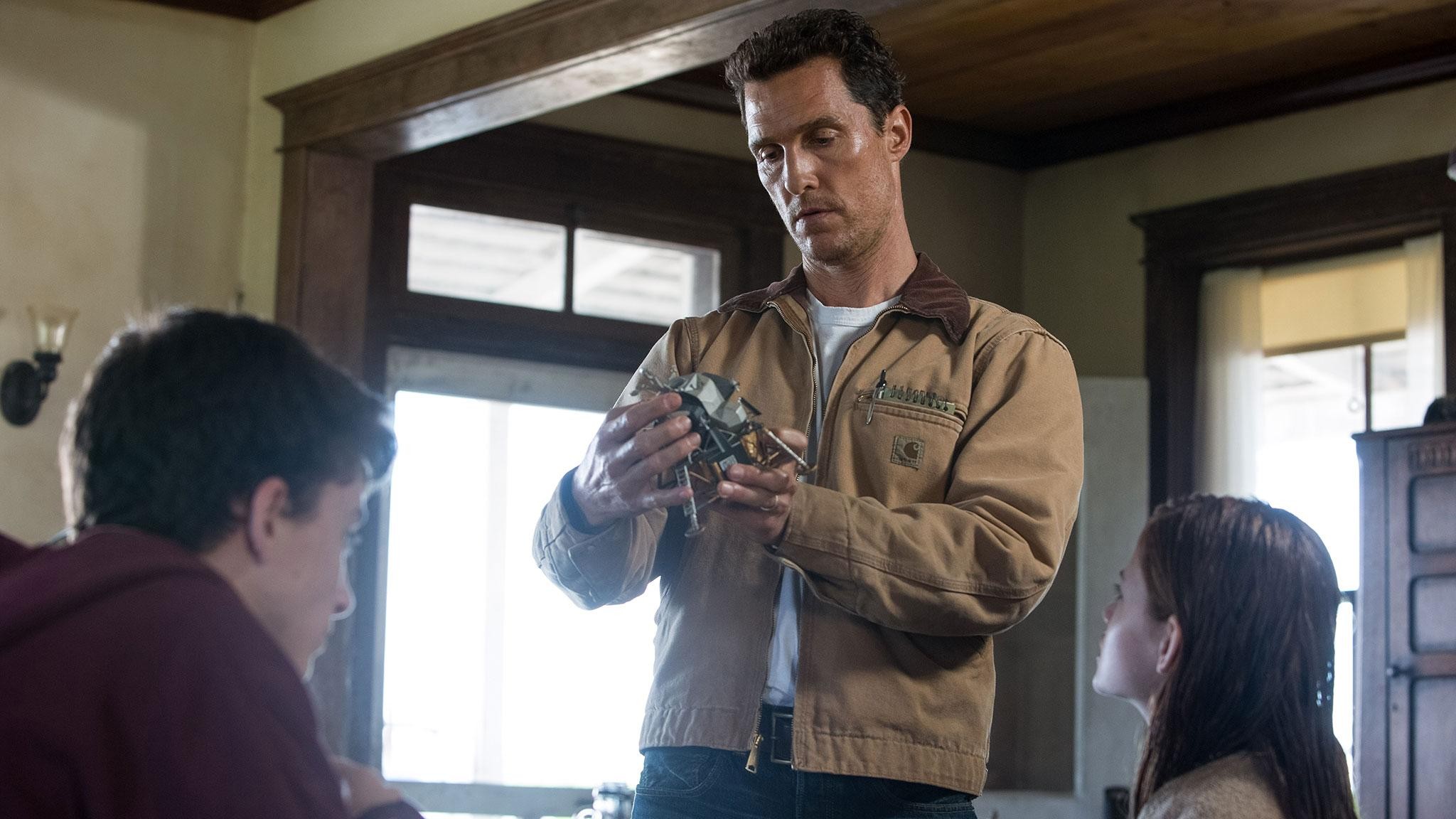
Failed astronaut Cooper struggles to keep his family whole

Failed astronaut Cooper struggles to keep his family whole

Drop into this failed world the character of failed-astronaut now failing farmer Cooper (Matthew McConaughey) who struggles to protect his family—dutiful son, frustrated pre-scientist daughter, sage father-in-law—from the ravages of dust storms and drought. Through a series of odd events, driven by daughter Murphy, Cooper learns of a mission to explore planets in other galaxies in hopes of finding a new home for humanity. They will get there via a wormhole that suddenly appears near Saturn, sent by a mysterious ‘They’.

To get deeper into the plot of the movie here would be to trip all over spoilers and I don’t want to do that. It would also require that I better understand the various plot points, which would likely take a second or third viewing…call me when Interstellar makes it to Netflix.

In an acknowledged homage to every movie that has come before it—Grapes of Wrath meets Top Gun meets 2001: A Space Odyssey meets Close Encounters of the Third Kind meets The Right Stuff meets Waterworld meets Prometheus meets The Black Hole meets…you get the idea—Nolan and his cowriter brother Jonathan Nolan have woven together a vision of human spirit that is broad in scope, deep in meaning and soul-defining in spirit. Or at least that seemed to be their intention.

The ones left behind search for a way out (Jessica Chastain)

The ones left behind search for a way out (Jessica Chastain)

On paper, the most meaningful speeches seem to come across as cliché, trite or in the most offensive cases, Pablum. And it is only because the Nolan boys have put these speeches into the mouths of some great actors—e.g., John Lithgow, Michael Caine, Jessica Chastain—that the movie is not laughed off the screen. Only actors of this quality could breathe life into these leaden lines and hoary speeches.

For me, possibly the worst example of this is scientist-cum-astronaut Amelia Brand’s (Anne Hathaway) attempt to explain love as a higher dimension of existence, as something that transcends space and time and should thus be counted as at least an equal in making logistical decisions. I’m not saying that her argument is wrong (or right) but rather that the material comes across as angst-riddled teen melodrama, made all the worse because it’s coming out of the mouth of an adult.

Ferris Bueller with lipstick? (Anne Hathaway)

Ferris Bueller with lipstick? (Anne Hathaway)

Where I have to give the movie massive credit, however, is in the visual treatments. (Thank you, Director of Photography Hoyte van Hoytema and Production Designer Nathan Crowley.)

This is a visually stunning film where each image is inspired. You feel parched while witnessing the death of the American heartland and your eyes itch with the approaching dust storm. The other worlds are crafted with such realism that you sense the dampness or the cold. And for all its darkness, a black hole seems anything but black.

Without getting into spoilers, I found the story line challenging in some respects because it felt like the Nolans wrote a relatively short screenplay and then every time they asked someone to read it, they were asked “Yeah, but what about…?”

At least three times during the film, I caught myself thinking that this must be the end, only to have Nolan scream “plot twist” and have the movie spiral in another direction to tie up a loose end. Even as the credits rolled, I had the sneaking suspicion they would get half-way done and we’d have more scenes.

And the very last scene before the credits was either “Oh shit, we forgot about…” or was a ham-fisted attempt to set up the sequel (of which I have heard nothing).

bridesmaids_screenplay02

As friend and fellow blogger Danny F. Santos suggested to me recently, he thought the movie might have been better served by converting it to a mini-series and I can definitely see his point. Some aspects of the film seemed rushed, despite its lengthy running time of 169 minutes. (Danny’s blog)

Given the importance of the replacement Earths to the conceit of the story, however, amazingly little time was spent on these worlds. I appreciate that the Nolans may not have wanted to make it longer, but that just lends credibility to Danny’s idea (or they could have done a Peter Jackson-Hobbit impersonation).

To their credit, the Nolan boys have woven an incredible tapestry of plots and subplots, tapping into several deep questions about humanity, the explorer’s heart, interpersonal commitment, abandonment, the purpose of science and complicity in our own demise.

Unfortunately, they used so many strings that they seem to have suddenly found themselves with a lot of loose ends that they either tied off with a bow or tied to another string. For the latter of those methods, I am confident that they wanted me to experience a revelatory “Oooooh!” but too often I was left with a confused “Eh?”

For all my issues with plot points and dialogue, however, I do have to admit that the movie passed my butt test. At no point did I find myself squirming uncomfortably. As the credits rolled, I found myself comfortably rested and satisfyingly entertained.

Unfortunately, for a movie of the scale and scope of Interstellar, “rested” and “entertained” are an indictment, not praise.