From perspective to perception

A railway track is perspective trying to make a point

A railway track is perspective trying to make a point

What makes your writing unique from all others is your perspective, the way thoughts, words and actions are interpreted in your mind.

If 10 people witness the same collision between two cars, each one will recount a slightly varied story from another. Some may gauge the speeds of the vehicles differently or not remember the same car braking first.

Less what you remember and more how you remember is influenced consciously and unconsciously by your personal experiences, your beliefs and your moods. As good a reason as any for the police and court system not to rely on a single eye witness account whenever possible.

The same is true for your writing.

Although our imaginations give us some ability to write fanciful stories and characters outside our day-to-day scope, a close examination of our oddest creations will show that they are largely reinterpretations of things we have read or experienced in other stories.

Dragons, for example, are likely an amalgamation of flying raptors (e.g., eagles), strange lizards (e.g., monitors) and giant fossilized remains that humans have dug up for millennia. How else to explain the similarity of a T. rex skull and monitor lizards?

How to make a dragon with 3 simple ingredients!

How to make a dragon with 3 simple ingredients!

At the same time, it was the unique experience of these three factors in combination that may have resulted in the first dragon description. A truly unique perspective.

To consider it another way, think on the meaning of perspective in the visual arts:

The art of drawing solid objects on a two-dimensional surface so as to give the right impression of their height, width, depth, and position in relation to each other when viewed from a particular point.

Giving the right impression of [facts]…from a particular point [of view].

But what if you changed that point of view?

3-Point Perspective

Changing perspectives is perhaps the easiest way to approach cliché writing and makes the predictable unexpected.

If you want to tell a love story that is essentially Romeo & Juliet, tell it from the perspective of rival street gangs in New York. Oh, but wait; they already made that one.

Then how about from the perspective of fish in a pet shop and instead of rival families, it is the divide between fresh and salt water? Crazy, hunh? (NOTE: I already wrote this one, so please go write something else.)

The same holds true whether you’re considering an entire story, a single scene, an individual line of dialogue or a character trait.

How might the floor of a dance club look if you changed your perspective from that of an evening reveller to that of an observer seated on a ceiling rafter? Probably like one of those wild life documentaries describing the mating habits of some ridiculous animal.

Or what might your backyard “look” like if your only sense was touch?

By changing your perspective in even the smallest of ways (you don’t have to blind yourself), you can dramatically alter your perception of the world.

So, the next time you find yourself stuck for an idea or facing a cliché moment in your writing, try looking at your world upside-down or through another character’s eyes.

Take a new perspective and you’ll reach a whole new point.

(Drawing is property of owner and is used here without permission because I take a different perspective on these things.)
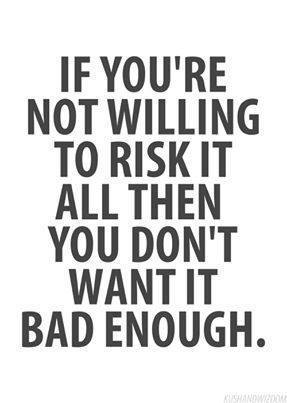

Risking it all

Risk

A friend of mine recently posted the above sign on her Facebook page, and I had no choice but to share it with my Facebook community (and now you). Although I find the sentiment a little negatively toned as worded, I completely agree with it.

As many of you know, I jumped off a cliff about 18 months ago, completely turning my life upside down in pursuit of the dream of being a screenwriter. To do that, I have made a large number of sacrifices to the way my life was, but in the interim, I have discovered some wonderful things—about me and my friends—that I might never have learned if I hadn’t.

Last week, I had drinks with another friend, someone who had made a similar jump to mine. Like me, he has had some wonderful times during this phase of his life, but he is also struggling with doubt and the sense that the years of effort haven’t paid off as he would have liked. Doubt is a thing I understand.

At this moment, I have no doubt or at least not about my dream. It seems as real and viable as ever. Its realization is simply a matter of time in and work on my part. I revel in these moments and wish my friend could feel the same way right now.

When doubt does creep in, however, I do my best to give it context.

The doubt: Can I afford this conference? Is this screenplay any good? Have I made a mistake? Am I a fraud?

The context: What is the alternative?

I look back at my life before I made the jump and I realize that I can’t go back to that. This is not to say that it was all miserable…I had love and support; I enjoyed aspects of my jobs; I met wonderful people. But in many ways, all of those positives were for naught back then because I was miserable.

I was living my life for other people. I based my identity on my job and what I did for other people. I was only as good, as valuable, as loved as other people told me I was, and deep inside, I truly suspected they were lying. Through no fault of theirs, I couldn’t have faith in them because I didn’t have faith in me.

So, when I finally jumped off the cliff, I realized that what I was risking was a life of well masked misery and distrust. Hardly much of a risk from my perspective.

I understand that others cannot always jump as wholeheartedly as I did. They have responsibilities that I did not have.

I have no children. My wife and I were separating for other reasons (nice to say she remains my strongest and most loving advocate and supporter). My family responsibilities had all but disappeared. My jumping would leave no one in the lurch.

So, maybe you can’t jump like I did. I’m not suggesting that it is right for everyone. But to not jump at all in pursuit of a passion is folly.

Every day you maintain the lie, whatever your personal lie is, is another day you risk it all.

It will be scary. You will have doubts. But you’re not doing anyone any favours, least of all yourself, by continuing to pursue activities, attitudes or a life that is crushing you.

I hope my friend relocates the wonder in what he is doing and continues to explore his adventure. If he will let me, I am happy to help him in any way I can.

He is a very lucky man because he is surrounded by love and support from a community of people who adore him and want him to be happy. I hope he can take energy from that. I know I do.

Thoughts on thinking

Thinking is over-rated. And by that, I am not espousing advocacy for unthinking, so much as non-thinking or as it is known in some circles, doing.

Think before you speak is an admonishment often heard (or at least by me) and perhaps there is some wisdom in this. More on that in a future post.

But I worry that too often, people think before they write and for many, thinking means never writing. These individuals become so encumbered by or enamoured of their thoughts that they are unable to commit anything to paper.

To me, writing or any other form of creation is a spiritual thing. I personally don’t feel that I create so much as simply channel or act as conduit for creativity itself—the good, the bad and the ugly. I bring into being that which was no so moments earlier. Thus, my pretentious tagline of “Seer of the invisible, scribe of the unwritten”.

I worry that people spend way too much time mulling things over, trying to come up with every angle and waiting until they find the perfect angle. Pen hovers over paper. Fingers hover over keyboard. And nothing happens as the writer becomes paralyzed in thought.

As I’ve written before, I set a destination, but I revel in the journey. I let the road dictate my next step and feel that I discover more wondrous things than I could ever have pre-conceived.

Sure, the road can lead me to a cliff or into a wall that I cannot surmount, but what of it? If I have discovered one thing in my life, it is that the return journey from a place is so much more than simply the backsides of things you saw on the forward journey. Perspectives change and so therefore does the story your journey provides.

Take the thinking out of your writing and see what happens. Sit at a table with your laptop or notepad and write down the name of the first thing you see. Let that be the first word in whatever follows, no matter how short or nonsensical that might be.

The story will tell its story. You don’t have to.

(I don’t know what’s on your table, but this was on mine!)

Image