Unintended misogyny

According to the Cambridge Dictionaries Online: misogyny (n) Feelings of hating women or the belief that men are much better than women.

Image

Let me state for the record that I do not hate women, but over the last decade or so, I have come to realize the insidious ways in which I felt (or made it appear that I felt) men to be superior to women.

As a male writer, I have historically written stories from the male perspective. My protagonists were male. My antagonists were male. My peripheral characters were predominantly male. And when I did include a female character, she tended to be rather two-dimensional (see also my blog post For my friend Emma).

Several years ago, I had the fortunate happenstance to take a sketch comedy writing class at Toronto’s Second City Training Centre under the guidance of actress and writer Aurora Browne, best known locally as one of the actors from the show Comedy Inc. and former mainstage performer at Second City. Perhaps not surprisingly, the class was mostly comprised of men. And to a man, we wrote sketches about guys.

After the first couple of classes, however, when we had each produced a few sketches, Aurora challenged the men in the room to either rewrite one of their existing sketches or write a completely new sketch with a woman (or several) in the lead.

It was at that moment that I realized my unintended misogyny.

Aurora was tired of trying to find material with strong and/or well-defined female characters. She was tired of simply playing the girlfriend, the ex-wife, the nurse, the teacher. Not that there was anything inherently wrong in playing any of these roles, but more that they were almost always written as two-dimensional…if they could even be said to aspire to a second dimension.

This was her opportunity to put her heels into the dirt in moulding the next generation of comedy writers.

From my perspective, the task was amazingly daunting and very surprising, as I found myself breaking down walls and obstructions I never realized I had put in place. I had to think how might a woman character function differently in this scene, without getting cliché, and how would that change the dynamics of the scene. Or even would it?

In the years since, no matter what I write—sketch, screenplay, teleplay, poem—I watch for places where I might fall into gender bias. The minute I decide on my main characters, I ask myself if the protagonist or antagonist could be a woman (sadly, I still typically default to males). If the answer is yes, then I take a second run at my idea to see which way would make for a better story.

As a result, I have both dramatically increased the repertoire of characters I can bring to life and greatly enriched my stories. In fact, the two most recent screenplays I am developing have female protagonists, as do a couple of my television pilot concepts—not out of a sense of political correctness or fairness, but because those choices made the most sense for the story.

So thanks, Aurora, for the creative kick upside the head.

(Illustration used without permission.)
I can do better than that

Almost a year ago, I had the opportunity to substitute teach a class of would-be advertising copywriters at a local community college. I was quite excited because it would give me the chance to talk to people at the beginning of their careers, while they were still fresh with anticipation and ready to take on the world.

Out of the gate, I let them know a little about myself and background, and then went straight for the “So, what made you decide to become a copywriter?”

To a person, the response was largely the same: “Well, I saw so many terrible advertisements and knew I could do better than that.” I am extremely happy to report that this was not all that they had going for them. Each was amazingly talented in his or her own way and it was a great couple of weeks.

But their original motivation hangs in the air, like a persistent echo that refuses to die.

No matter what our art, I would not be surprised to find that out that we have all said at some point in our lives “I can do better than that”. It’s only natural. It is how society has raised us.

I would like us to stop, however, because I fear it is killing our spirit and therefore threatens our art.

First, it’s just negative thinking on a topic for which we do not have a full understanding.

Having worked in advertising for a few years, I have a much better understanding of the great divide between what we came up with creatively and what finally made it to the magazine page or television screen. Trust me, the average ad you watch bears almost no resemblance to the original concept.

And even if my head exploded a little at the thought of the movie Piranha 3DD, I have to give the writers and producers some credit for getting it made and into theatres. They’re well ahead of where I am with my screenplays, which currently sit on my laptop computer and in a few competitions.

But more important than simply being the “why can’t we all just get along” guy, I think we denigrate our own efforts by focusing our attention downward.

Art should inspire and the artist should aspire. We shouldn’t look down and sneer. We should look up in awe at works that truly stir our hearts; that shake us to our artist core and make us strive to be better.

If all we do is attempt to be slightly above the dirt, then we merely set ourselves up to be the target of the next person in line.

If, however, we push ourselves to reach further, attempt more, climb higher, then there is every reason to believe that we will be the one who inspires the next person to stretch beyond our grasp.

I don’t want to write a screenplay that’s slightly better than Walk Like A Man. I want to write one that surpasses The Usual Suspects.

I want to write sketches funnier and more pointed than Sid Caesar and Monty Python.

I want to take the most beautiful photos that tell the most intricate stories, using every other photo as my muse.

By looking up, we become a lightning rod for our art, attracting the energy and inspiration that drives our passion. Looking down, we shut ourselves off from those same spirits, blocking out the positive input that surrounds us.

Simply in aspiring to something greater, we raise our art and therefore ourselves to new levels. And as difficult as each incremental step may be, the rewards are exponentially greater.

When we look up, we are bathed in the light of our truth. Looking down, we see only the threatening abyss of failure.

Aspire or expire, the choice is yours.

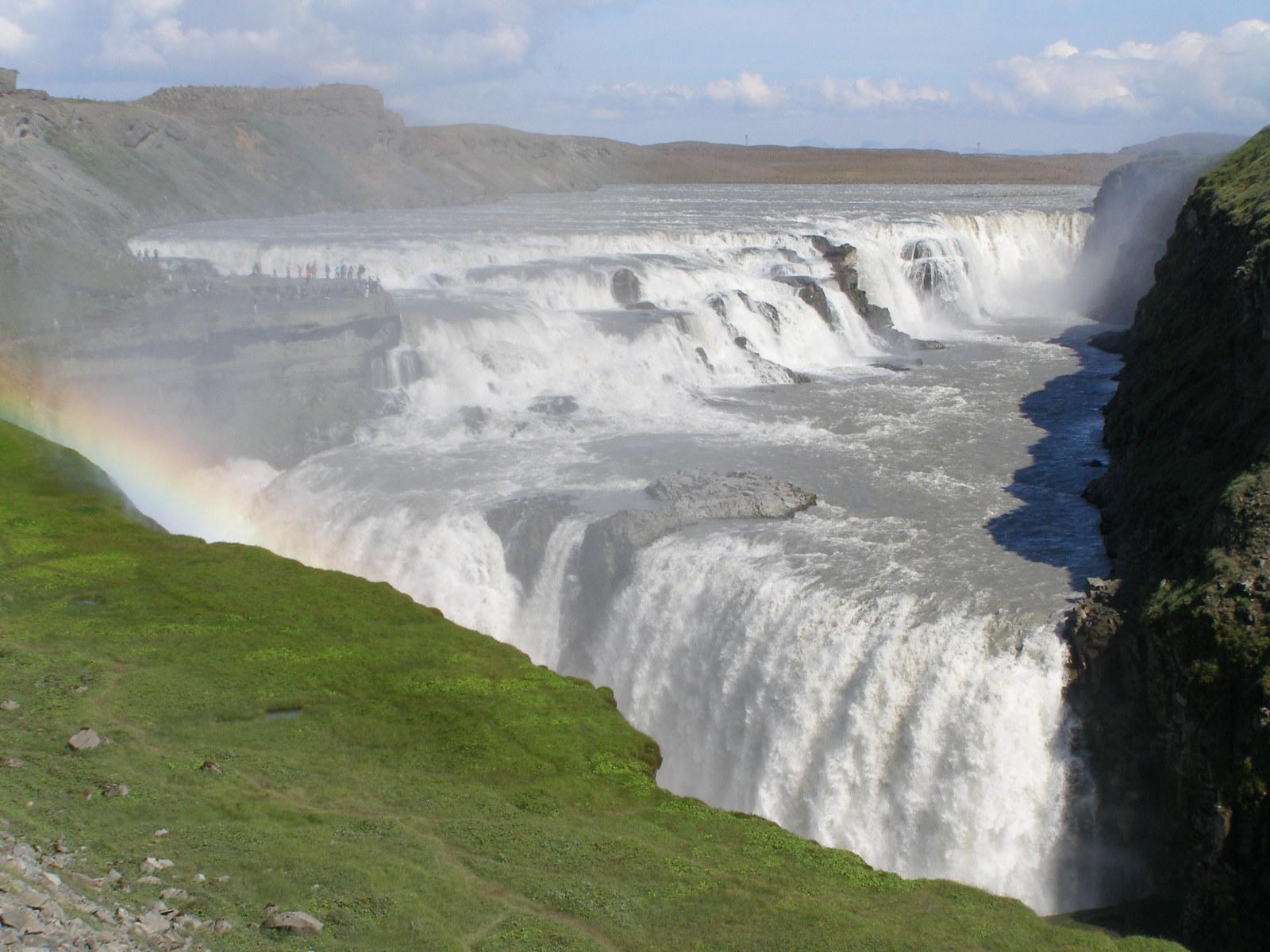
The sheer scale of these falls was only overtaken by the thought that they followed a geologic fault separating Europe from Greenland.

The sheer scale of these falls was only overtaken by the thought that they followed a geologic fault separating Europe from Greenland.