It’s my 47th birthday and the excitement is tangible

Some ancient guy drooled this earlier today, but within all the spittle is some interesting stuff about having a support network. Wade on in! (oh, no!! the exclamation point thing is catching!!!)

Ned's Blog's avatarNed's Blog

This week’s edition of Ned’s Nickel’s Worth on Writing is brought to you by a 47-year-old man! [Please note the exclamation point! (Hey, there’s another one!)] Why am I excited about this? And why am I not calling in sick while lining up shot glasses on the kitchen table?!? Because, in addition to my birthday falling on an NWOW Friday, I feel GREAT!

I’m in my PRIME!

And I want the whole world to know how, through positive thinking and the repetitious use of exclamation points, you can believe it too!!

To celebrate, I dressed in my favorite AC/DC T-shirt, jeans and smokey grey Vans. Oh, and Dos Equis underwear. Um, to clarify, those are underneath my jeans, not on top (I haven’t had that much to drink). I also took a moment to record the occasion for posterity by taking a photo. Which isn’t to say I took a…

View original post 645 more words

Falling in love…again?

Keep your story options open

Keep your story options open

So beautiful. The fullness. The curves. You make me smile. I want to be with you forever. You’re perfect. I love you.

This is the greatest paragraph ever written. The most beautiful dialogue ever conceived. A scene that will be remembered for eternity.

Many of the posts I’ve written have been about cutting yourself some slack, about overcoming the inner demons of doubt. Giving yourself permission to fail. That perfection isn’t your goal.

Well, now we need to remember that not only is perfection not your goal, it is not even possible. There is always room for improvement, so please don’t ever fall in love with your work.

When creating a new work—a novel, screenplay, whatever—it is important to leave yourself as many options as possible, to keep all of the doors open until you reach a combination that works best for you.

Too often, however, writers jump into their work, pursuing the idea that offered the first blush of love. In their zeal to express that love, they put on blinders to other possibilities. Perhaps it is a pure love, but I’m confident for a few of us, it’s also probably fear of never finding another love.

And once we express that love, we are loathe to question it, even when presented with another option. This is the only way the scene can be written. This is the best way to achieve the point of the scene. Everything else is weaker.

Maybe you’re right, once or twice in a work (or career), but rare are those moments. So let me recommend something scandalous.

Start seeing other options.

I’m not asking you to fall in love with them or to fall out of love with your original idea, but infidelity can be healthy. It may even make you appreciate your first love all the more. (Why do I suddenly feel like Silvio Berlusconi?)

Just dip your toe in the water, if this idea makes you nervous.

If your lovers currently meet in a restaurant, explore what would happen if they met in a post office, a house of mirrors, a sanitorium.

Too much too soon?

Then change the type of restaurant. How would your scene change if they were at an expensive restaurant, McDonalds, a hot dog cart, on a picnic?

Try this with any and every aspect of your story, and do it as early as possible. The longer you work on a project, developing its specifics, the harder it will be to change any aspect of it beyond cosmetic editing.

That path you see to your goal may be less of a path and more of a cavernous rut you’ve worn by running over the same idea time and again. Wait too long and you don’t see anything else. You can’t see beyond its limits.

Don’t let that happen to the concept that you love and more importantly, to the creative spirit you continue to nurture. It may be painful. You may have to walk away from the one you love, but trust me, you will fall in love again. I promise.

(The image is property of the owner and is used optioned here without permission.)

A Bug(gy) Life

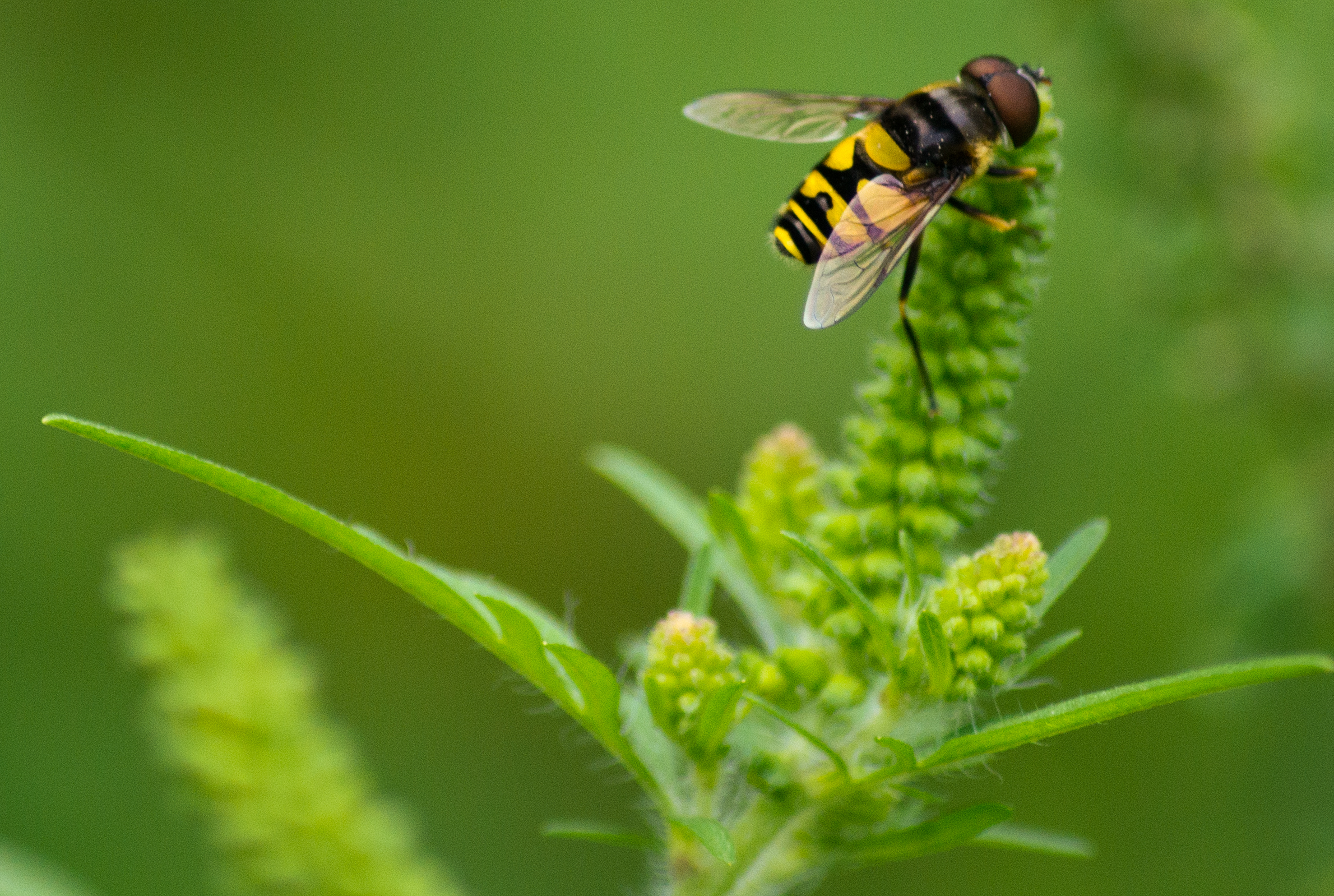
I run toward bees, not away...and they me, it seems

I run toward bees, not away…and they me, it seems

There is a scene early in the film Ace Ventura: Pet Detective where Ace calls out to all of the animals living in his apartment and they swarm from every crevice to give him the world’s biggest group hug (scene was totally ripped off in Evan Almighty). Well, every once in a while (aka daily), I feel the same way with insects.

Insects—and here I also include arachnids—love me. I don’t know why, they just do.

The best I can figure is that there is something in my personal chemistry—blood, sweat, breath, pheromones—that drives bugs wild.

When I go to the local beach to work—hard life, I know—I cannot sit on a bench for much more than an hour before I become a buffet for biting flies. And when I get home from the local park or ravine, I invariably find a couple small beetle hitchhikers somewhere on my clothing. That I have not yet contracted Lyme disease eludes me, although I am grateful, because that shit’s nasty.

When my grandmother’s seniors’ complex became host to a bed bug invasion, I became the canary in a coal mine. After her place had been sprayed, it was my duty to sit on her couch and see if the fumigation had worked. If there was a bed bug within 1 km of her apartment, it would find me within 10 minutes and leave its mark as a large red welt. I was bed bug fly paper.

As luck would have it, I also seem to attract spiders, which is fine as long as they focus their attentions on the various flies and other critters and not on me. So far, so good.

Perhaps this life-long attention from creepy crawlies has made me immune to the sociological ick-factor and has in fact turned into a fascination with them, as my many photographic blog posts would attest. In short, I like bugs. (I’m not quite ready for a love connection.)

On one of my recent walks through a local ravine, I ran into a young gentleman who also wandered the woods with a camera. As the conversation proceeded, we shared our interests—his was birds. When I told him mine was bugs, he was confused. It made no sense to him that anyone would be interested in insects. He wasn’t questioning my sanity, just my logic.

Other people who wander with me, however, do question my sanity as I approach a flower bed covered in bees rather than run the other way as they do. Or as I walk into a swarm of dragonflies rather than swat them away as a nuisance.

I wish I could explain my interest. As I believe with all other life forms, I believe there is an inherent beauty in the specialization of bugs to their environments—their shapes, decorations, behaviours. It probably doesn’t hurt that they will also stay still when I’m trying to examine them, rather than scatter as most other animals will.

Having recently moved into a basement apartment (as mentioned in the previous post), I will have the opportunity to test the limits of my fascination…and undoubtedly of my camera lenses. Should be fun!

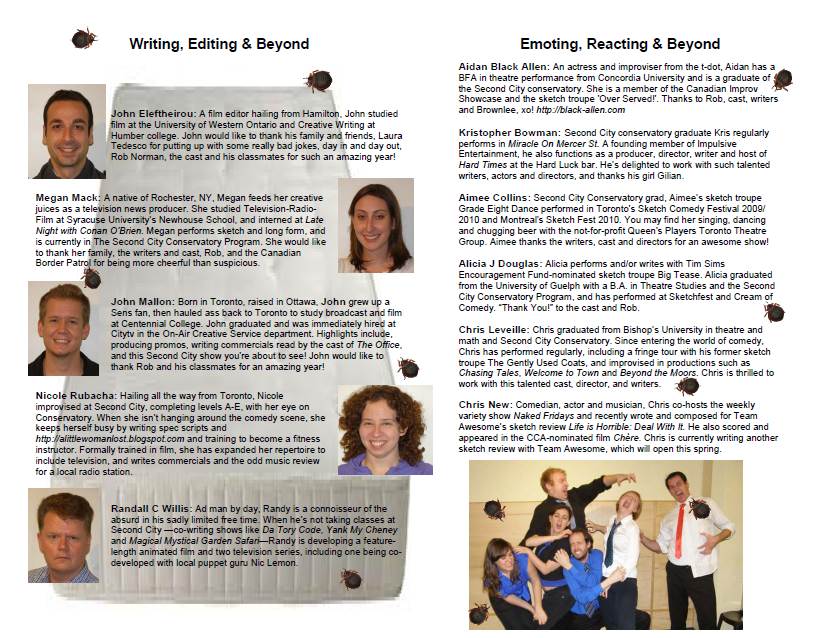
Ironically, I co-wrote a comedy show that became known as Bed Bugs & Beyond

Ironically, I co-wrote a comedy show that became known as Bed Bugs & Beyond

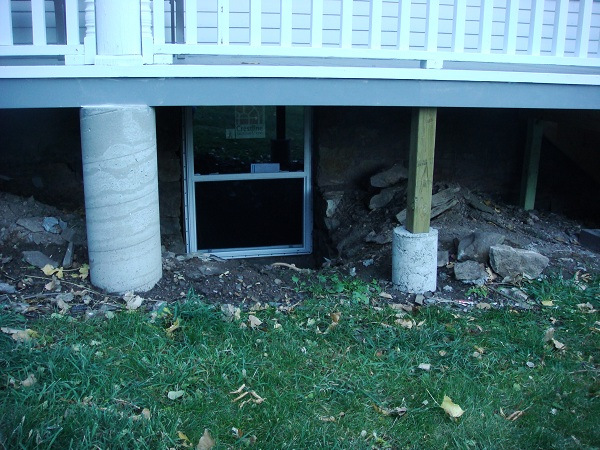
How to know if you live in a basement…

While taking off your t-shirt, you have punched the ceiling.

You open the refrigerator door in the middle of August not to feel cooler but to find your shoes.

You instinctively flinch while passing under bridges on the highway.

Your ears pop whenever you ride a double-decker bus.

You get vertigo while climbing a step ladder.

You can tell the make, model and year of a car by its hub caps.

You just found out those sit ups are actually called crunches.

Your refrigerator is nothing but crisper.

Your neighbour’s schnauzer knows its raining before you do.

(Image is property of owner and is used here without permission because I couldn’t crawl out to ask.)

Winged warriors

As I continue to live without a telephoto lens, I find my winged colleagues in the nearby ravine are doing their best to help me with my photography. I could still use a bit more help…or at least a closer vantage point.

I know I wood

Another lovely morning and another traipse through a nearby ravine, checking out the flora and fauna (as well as a few protists, dirt and water).

Feel this, would you?

I used to stare at this poster trying to gauge what I felt...sometimes it worked, sometimes not

I used to stare at this poster trying to gauge what I felt…sometimes it worked, sometimes not

I have to admit I find it difficult to write characters. No create them, but to actually make them come alive on the page.

To develop a truly realistic character, you need to be able to give a sense of his or her emotional state, and this is where the wheels tend to fall off for me.

For most of my life, you see, I have focused on facts, not feelings. I might even go so far as to say I have completely shut feelings out of my life—or at least as completely as possible without (yet) ending up in prison as a socio- or psychopath. Thus, I have been ill-equipped to deal with the myriad emotions that form the human condition.

If I look or think back to the writing of my youth, I seemed to be able to manage moral outrage and on occasion, actual rage, but any other emotions, no matter to what extreme, came across as flat. And forget any of the subtle shades in between. I did not do subtlety.

About the only character I could develop was the noble stoic who was a tad self-involved. Hmmm. Seems familiar somehow.

Lacking experience with these various emotions, how could I hope to bring them to my characters?

I’ve never believed emotions were something you could study in the traditional sense.

If I want to understand a polar landscape, I can go online or check a variety of books. Determine the behaviour of a jet that loses one engine? I’m sure there’s a Wiki for that. But emotions, by their very nature, preclude such an academic approach.

Ah, but what about other books and movies?

Good in theory, but without a personal foundation, you run the risk of simply reproducing Glenn Close’s interactions with the rabbit or Peter Lorre’s fear of Moroccan Nazis.

No, to be able to realistically reproduce emotions in my characters, I needed to have experienced them to some extent in my life. Call it Method Writing, if you wish.

Luckily, for a variety of reasons having nothing to do with screenwriting, I have been accessing my emotional centre over the last couple of years. Through a challenging process of self-examination and “coaching”, I have started to feel—allowed myself to feel—emotions like sadness, irritation, pleasure, enthusiasm, boredom and the like. And the impact in my writing has been immediate, if continuing to develop.

When my character is angry, I find myself getting angry. When my character feels loss, I can remember when. Ecstasy? I’m all over it (the emotion, not the chemical).

And I’m not the only one who notices this. As friends, colleagues and classmates read my material, I sense they too experience the emotional rainbow. And sometimes they introduce feelings I never envisioned for a scene.

This isn’t a threat to what I wrote. It is a bonus prize I receive for paying attention and sharing, for they have found something in my words that I did not see or did not know I was channeling.

Maybe it’s gold. Maybe it’s lead. But always, it is valuable.

Like my characters, I am still a work in progress, but at least I feel like I’m progressing.

(Image is property of its owner and is used here without permission. I don’t know how I feel about that.)

Anybody home?

The house was dark, which made Helen worry all the more. As long as she could remember, her neighbours kept at least one light on in the house.

“You never know when someone will show up for a visit,” Jackie would explain. “Would hate for them to think they’re not welcome.”

The funny thing was, Helen never saw any visitors at the Jarrols. Maybe that’s why the house always seemed to drip in melancholy.

Helen took the first step on to the porch, making sure not to lean on the railing that more than once abandoned poor Ned to the garden below. Jackie finally planted decorative cabbage just to cushion the blow.

Each step felt spongier than the next as Helen ascended. She wasn’t sure if it was the wood or her trepidation, the silence of the house growing more oppressive the closer she got.

Helen didn’t bother with the doorbell, it never worked, but instead rapped heavily on the door before turning the handle.

“It’s just Helen,” she called into the darkness, the weak light of blinded windows helping her make out the living room. “Jackie? Ned?”

Her words hung in the air, the warmth of her breath buoyant in a house unnaturally cold.

Helen hesitated at the door, afraid to proceed but worried about her neighbours. She really wished Sarah was with her right now, but she wouldn’t be home until tomorrow. Helen was on her own.

“Hello,” Jackie’s voice called from the kitchen.

“Jackie, it’s—“

“We’re not home right now, but if you leave a message, Neddy and I will get right back to you.”

Ned had long ago turned off the phone ringer because it always startled Jackie, who had a weak heart. Helen actually thought it was because Ned hated talking on the phone.

Helen searched the main floor, but the Jarrols were nowhere to be found. Upstairs it was.

As though pulling off a bandage, Helen vaulted the stairs to the second floor, but her hand froze as it came to rest on the bedroom door handle.

Knocking would have been respectful, but Helen just turned the knob and pushed. The door showed no resistance.

Jackie and Ned lay next to each other on the bed, eyes closed. Jackie was under the covers, hair bound in that all-too-familiar brown kerchief, while Ned was atop the covers.

Helen didn’t call out. She didn’t even check them. It was just like Ned to turn the heat off first. He wouldn’t do anything to hurt the potential resale value of the house.

How to accept your inner idiot

Because we all know we have one

Tracy's avatarThe HeSo Project

Recently, a dear friend confided in me that he feels stupid and way over his head whenever he talks to people who are in the field he wants to switch into. This is mostly because he doesn’t know all the jargon or references yet. Here are two tips I gave him:

1. Write down the words and references you don’t know.The first time I told someone I wanted to be a writer, she started listing all of her favorite authors and asking me what I thought of them. I didn’t know a single one of them, and I felt like a fraud who had just been caught. Since that day, I always carry around a notebook (now I use the Keep It app on my phone), and when someone mentions an author I don’t know, I simply write it down and tell them that I will check it out…

View original post 182 more words