The Voices gets a hearing (a review)

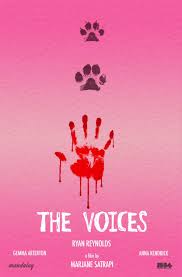
poster

Not one to generally participate in the Toronto International Film Festival, it was a rare evening in which I found myself standing in a rush line to see a movie, but a friend of mine wanted to see the latest Ryan Reynolds film called The Voices. This is not your typical Ryan Reynolds film.

Reynolds is Jerry Hickfang, a good-natured if skittish guy who works in the shipping department of a bathroom fixtures company in Milton, the derelict remains of a town in Nowhere, USA. Jerry is a nice guy, who lives above a derelict bowling alley with his dog Bosco and cat Mr. Whiskers. And of course, Jerry has the hots for office cupcake Fiona, a misplaced Brit with a craving for bigger things, played by Gemma Arterton. For her part, Fiona finds Jerry a little creepy, but is not above using his puppy lust to get a lift during a rain storm.
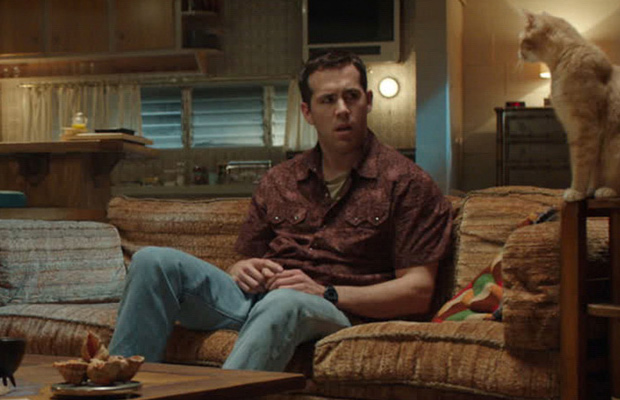
Jerry Hickfang (Ryan Reynolds) struggles to understand Mr. Whiskers' advice

Jerry Hickfang (Ryan Reynolds) struggles to understand Mr. Whiskers’ advice

Oh, and the other thing you probably need to know about Jerry is that he is in court-appointed psychiatric treatment, isn’t really good about taking his meds, and has a family history of hearing voices, but that’s not something he likes to talk about.

So far, so harmless. But after a literal run-in with a deer who begs Jerry to finish him off, the blood-letting never really stops and the rest of the movie becomes a giant slip-and-slide of mostly implied blood and offal.

So, The Voices is a thriller…and a drama…and a comedy…and a farce. You squirm in revulsion (never really reaches horror) as often as you LOL.

Director Marjane Satrapi (who brought us Persepolis) attended the screening and describes the story as completely fucked up. She said she was mesmerized by the screenplay and desperately wanted to meet the man who penned it to see what messed up human could conceptualize such a story. So she was surprised when she met Michael R Perry, a tall normal-looking fellow.

Marjane Satrapi

Marjane Satrapi

As Perry explained, he wanted to look at the life of someone of multiple personality disorder from their perspective rather than society’s. And in that, he succeeded.

With Satrapi’s help, the two clearly crafted the oddly idyllic yet troubled world within Jerry’s mind, giving the audience only the briefest glimpse of how the rest of the world saw things. With Jerry, it was all perfect love and butterflies. To the rest of us, it was squalor and pain.

Where the story fell down for me was in explaining why everything went wrong so suddenly. In writing circles, we talk about “Why today?” Why does your story begin today, at this moment, and not 6 weeks ago or 5 months from now? In this case, what was the event that caused Jerry to go from lovable schmuck to… Some might suggest it was the deer accident, but even Mr. Whiskers called that bullshit

The other place I felt let down was that the conflict never escalated, it merely accumulated. Rather than find interesting ways for Jerry’s mania to manifest itself, the writer simply repeated the same event over and over, as though each of the characters voluntarily walked into a wood chipper.

And I don’t know if the ending was presented as written or was something that blossomed out of Satrapi’s mind, but it was lazy and bordered on the ludicrous. It was a bad after-taste on a film that had merits.

Ryan Reynolds, Gemma Arterton, Anna Kendrick

Ryan Reynolds, Gemma Arterton, Anna Kendrick

On the plus side, Ryan Reynolds was amazing to watch…this was not the charming goofball romantic comedy, although Jerry was sadly charming when he wasn’t obviously tortured by his snarky brogue-spewing cat. (NOTE: Bosco and Mr. Whiskers easily have the funniest lines in this film.)

Gemma Arterton’s Fiona was a delight. She was delicious to watch as the voluptuous vixen whose biggest fear in life is being bored. Problem solved!

Anna Kendrick (Up in the Air), as tier-two love interest Lisa (see, the writer even repeated this beat), was largely wasted. Her character was pretty two-dimensional. As nice girl looking for a nice guy, her function was to have Jerry explain his condition to the audience (exposition disguised as opening up).

The Voices is definitely worth seeing, if only for what it attempts to do. I can’t help feeling, however, that if they had rewritten the screenplay a few more times, they would have achieved their goals much better than this.

My recommend (and that of my friend) is that this is a Cheapie Tuesday movie (or whatever your local half-price day is).


PS I was unable to find a trailer for this movie, so I offer the following interview with Satrapi at Sundance London…I will warn you, however, that it does include a lot more info about the plot than I gave above.
The job you hate is killing your creative spirit

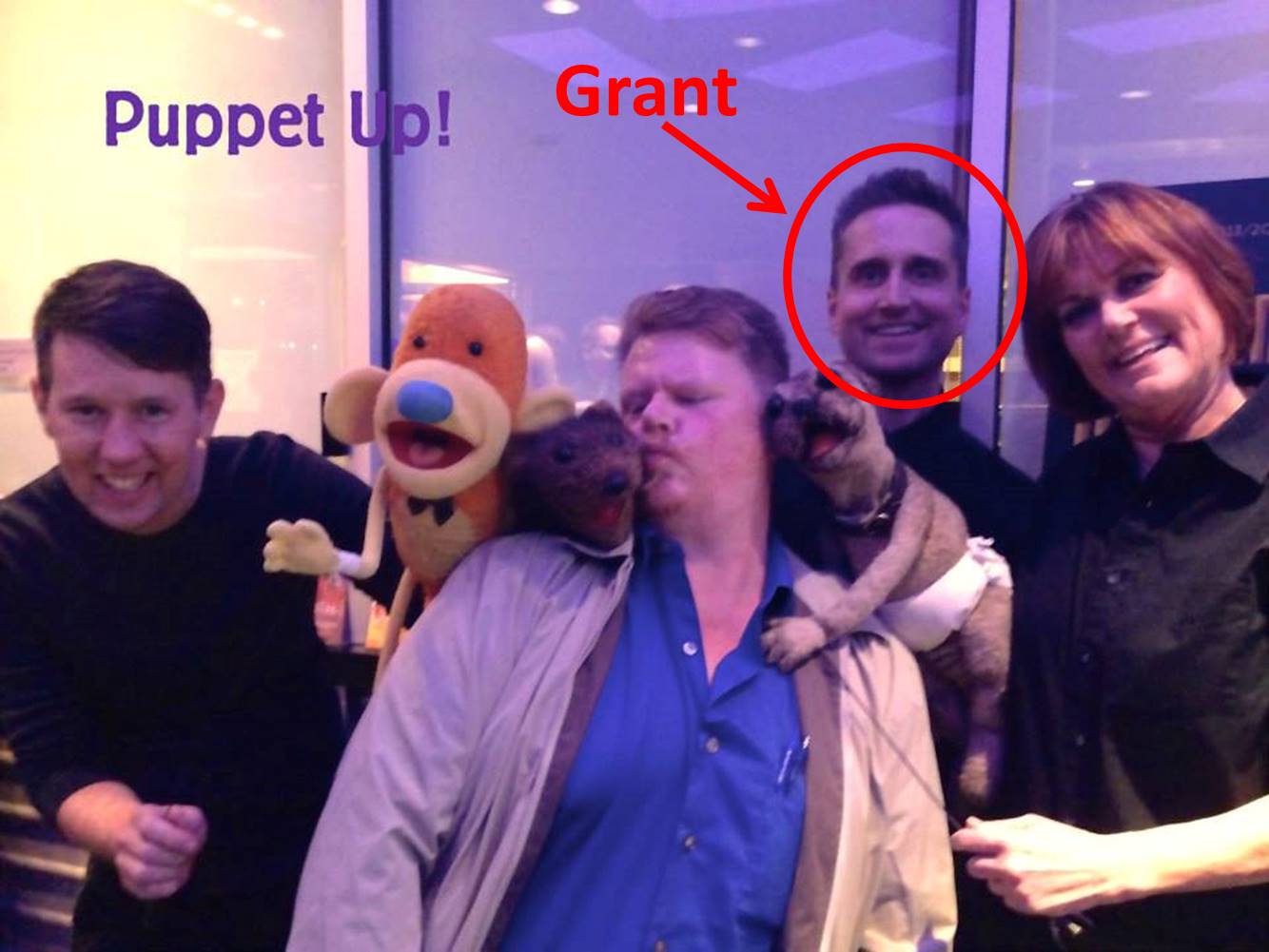
The wonderful Grant and his weasel buddy join me for a post-show photo (also shown Peggy Etra and Brian Clark).

The wonderful Grant and his weasel buddy join me for a post-show photo (also shown Peggy Etra and Brian Clark).

Grant Baciocco is an amazingly talented actor and puppeteer I had the good fortune to meet online and then in person when he came to Toronto with the improv puppetry show PuppetUp! (about which I have raved extensively elsewhere).

Well, aside from his amazing talent, he also has a wonderful creative spirit, both in the sense of what he creates and how he tries to inspire others to be open to their own inner creative spirit. To this latter point, he has a wonderful blog Grantblog: Ruminations & Pomposity that I heartily recommend.

At the beginning of each week, he posts Creative Mondays and today was no exception. Today he talked about “A job you hate”, which I excerpt below:

For years after college, about ten in fact, I worked as a substitute teacher.  It was an okay job, certainly flexible enough and I was making money, but by the end of those ten years I was starting to burn out because it was not the job I wanted to be doing.  I was good at it and several times I was told I should get my teaching credential because I was such a good teacher.  But deep inside of me I could feel a darkness building up because I was doing a job I absolutely hated.

The moment I made the decision to stop subbing and focus on The Radio Adventures of Dr. Floyd, it felt like a weight was instantly lifted from my chest.  I attempted, for the millionth time, to lose weight and it was actually working (lost 80 pounds).  I was just a million times happier than I was when I was subbing.  And guess what?  I became more creative!  This was the creative boom era for Dr. Floyd, because I was doing something I love.

Grant’s is a lesson too many of us learn very late in life (NOTE: I did not say “too late in life”…it is NEVER too late).

In my case, I was fortunate enough to have a series of occupations I loved for a period…scientist, science writer, media relations, advertising copywriter…but with each, I stayed in the occupation long after I had fallen out of love with the choice. I had to be a certain amount of miserable before I was brave enough to jump.

But two years ago, I completely jumped ship to pursue my true love: story telling (screenplays, novel, sketches, short stories). I’m still not making money off any of this, so I live on freelance magazine writing and ad copywriting. But to Tiffany’s point, it is what I do to eat and sleep under a roof.

If you are fortunate to know your passion—it can take time to figure out what it is—then you must make it happen to find happiness (hunh, “happen” and “happiness”…so similar).

And if you haven’t fully defined your passion yet, go with your gut until you do. Explore the universe of opportunities, until you do. You may not end up the financially richest person on the planet, but you’ll definitely be one of the spiritually richest.

If you don’t want to take it from me, then take it from Grant. Find your happiness and pursue it with everything you have. Despite appearances, you really do have nothing to lose and everything to gain.


You can follow Grant on Twitter: @ToasterBoy

Besotted Voce – A few (hundred) words on character voice

Voices-graphic-2

No matter with whom you speak, to an outside observer, the two of you sound different.

I’m not talking about the pitch or timber of your voices—although those likely are different—but rather those other factors that make your speech distinct: cadence, word choice, sentence structure, etc.

For five years, I worked as an editor and writer on a couple magazines in Washington, DC, and over that time, I found that I could tell which of my workmates wrote which articles without looking at their bylines…even without our names, the pieces had our fingerprints all over them.

How Mark Lesney opened an article was very different from the way Nancy McGuire would.

Mike Felton explained his thesis very differently from David Filmore.

And the two Randys were polar opposites in sentence construction: Mr. Frey being pithy, while Mr. Willis would wax poetically at the drop of a proverbial hat.

Some might argue that these differences reflect variations in style, but I believe the situation is less superficial than style. Instead, it reflects who we are as individuals; our personalities, our experiences, our beliefs, and our feelings both emotional and physical. We speak/write as the people we are at that particular moment. I as me and you as you (this sentence screams for a “Goo-goo goo-jube”).

Ideally, this same variety of voice should occur in the fictional characters we create, whether for screenplays, novels, short stories, sketches or whatever.

With all but the shortest lines of dialogue, a reader or listener should be able to tell which lines correspond to the same speaker even in the absence of any overt identifying marks such as the character’s name.

A simple example: Despite achieving the same goal in response to another person, the following lines say them differently:

“You’re nuts.”

“You are insane.”

“You’re one crazy motherfucker.”

“That, sir, is the most ridiculous thing I have ever heard.”

* silent stare *

With these five lines, we see differences in:

  • Relative status (e.g., tone)
  • Degrees of personal control (e.g., length, use of contractions)
  • Emotional state (e.g., length, word choice)
  • Possibly educational or social background (e.g., vocabulary, use of jargon)

It can be a challenge for one mind (the writer’s) to create several distinct voices. It is a form of consciously willed multiple personality disorder. Thus, early drafts of a literary work may sound flat because too many of the characters are speaking with the writer’s voice rather than their own.

In theory, this is an easy thing to fix during revisions. Simply take the sentence and knowing what you do about your character—his or her emotional and psychological state, status, social and educational background, life experiences, physical challenges—make the line more accurately reflect how the character would speak.

One complicating factor is that a seemingly simple change in response by one character may elicit a change in the response of the dialogue partner(s). I am likely to respond very differently if presented with any of the five reactions above. And thus, the writer has triggered a change-reaction that reverberates through the scene.

A second complicating factor is that the change in dialogue may also need to be paralleled with a change in physical action. A high-status character is more apt to be purposeful in her actions and responses, whereas a low-status character may be more physically erratic or perhaps flinching in his response. And again, the change-reaction echoes through the scene.

This may sound daunting. It isn’t…but it is a lot of work.

The trick is becoming comfortable with the many voices you need as a writer. We all start with our own voice, the omnipotent godhead that creates the fictional universe; but the trick comes in developing the skills to inhabit other bodies, other souls as you create other characters and then being able to shift back and forth as required without going insane (well, not fully insane, at any rate).

My best advice to any writer who struggles with this is not to take yet another writing class, but rather to take an improv class or several. Despite the terror that this advice may elicit in some (most?) of you, I can think of no better way of understanding—and more importantly, exercising—the differences between different characters.

You’ll quickly find improv is not about funny; rather it is about truth. And once you’re comfortable with experiencing the truth of a character, the rest of this is much less daunting.


As seems to be a routine now, today’s post was prompted by the amazing words of Marsha Mason and the Why The Face blog she posted earlier today.

PS The magazines from my Washington days were Modern Drug Discovery and Today’s Chemist At Work (because Today’s Chemist in the Boudoir was already taken).

BoJack-sh!t (a review)

bojack-horseman-bar-640

Unless this is a satire about satires, I don’t get the new Netflix Original Series BoJack Horseman.

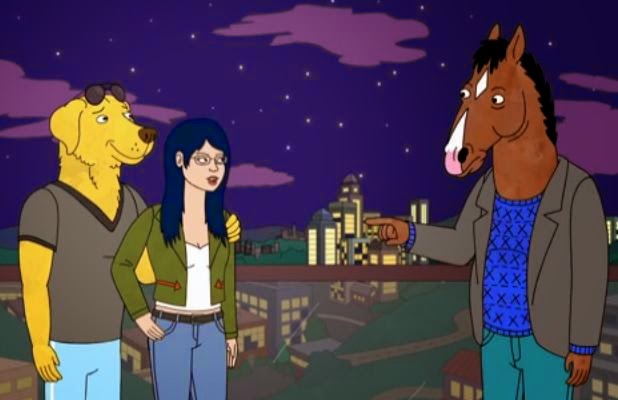
Ostensibly, the zany life of a washed up sitcom star from the 90s, who also happens to be a horse, who is trying to find meaning in a life of idle emptiness, the show is instead an endless string of really bad puns and lame jokes about anthropomorphic animals and Hollywood, punctuated with long speeches to highlight the irony of a scene or episode.

I am surprised the character giving the speech doesn’t hold up a sign reading “Ironic part” or “Satirical condemnation of status quo” just in case the audience was too stoned to realize that’s what the speech was about.

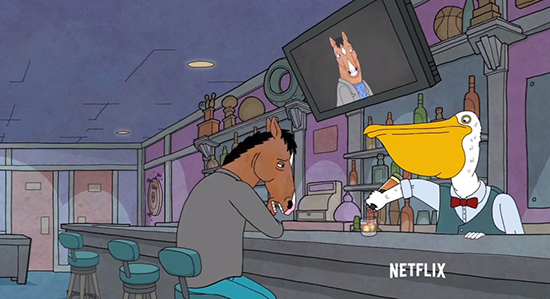
Episode 3 starts with an establishing shot of a bar called The Pelican. We then cut to BoJack sitting at the bar which is being tended by a…wait for it…pelican. Or in Episode 2, BoJack has a run-in with a Navy Seal who is a…here it comes…actual seal. Oh, and at the apex of humour, whenever BoJack’s girlfriend/agent puts him on hold, he listens to music from Cats…oh, did I mention his girlfriend/agent is a cat? Them’s the animal jokes, my friends.

pelican

There are attempts at social commentary, of course. In Episode 3, BoJack’s memoir ghost writer tries to make him feel better about a friend by claiming she was a victim of her circumstances and the pressures of society. But silly BoJack…he misunderstands this to mean that no one is responsible for their actions and that the fault universally lies with society, so he can act like a jerk and it’s not his fault. Silly BoJack.

HORSE

The voice talent is, well, talented. Alison Brie (Madmen, Community), Aaron Paul (Breaking Bad), Amy Sedaris (Strangers with Candy), Paul F. Thompkins (No You Shut Up!) and Will Arnett (everything else)…these people can act.

Show creator Raphael Bob-Waksberg is a mystery to me. An actor and writer, all I can really find out about him is he a member of a sketch comedy group called Olde English.

And the more I read about him, the more I wonder if my original comment wasn’t dead on…this may just be an amazing meta joke perpetrated by a very funny man. Or it’s just not very good.

person_11613

Because I only lose 25 minutes of my life at a go, I will continue to watch to see if it gets better…dear God, let it get better…or let me in on the divine joke of this comedy.

Anger after Robin William’s passing

robin_williams_01

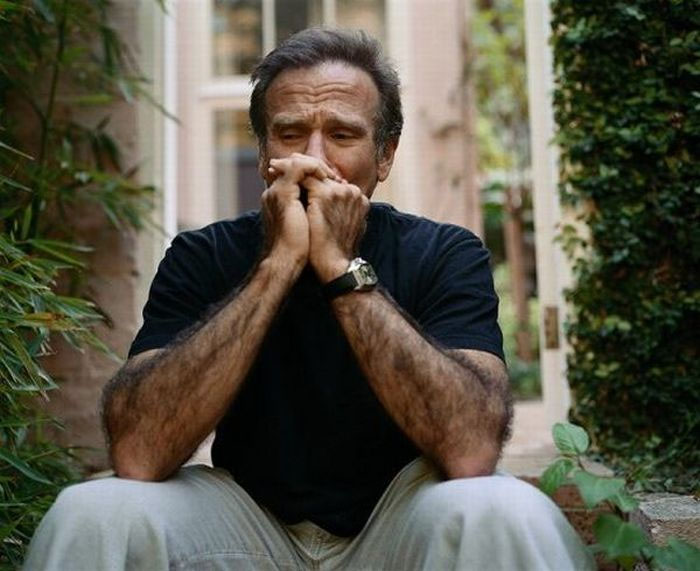
A couple of days have passed since Robin William’s death and although I still cannot accept the truth of it, I have somewhat resigned myself to that truth.

Shortly after the event, as I watched the public response, I found myself getting upset. The following post, written the night of his passing, explains those feelings. If you read on, please read all of the post as I don’t want to hear anyone’s comments unless they have read all that I have to say below. 


I’m angry. I’m angry at all of the people who want to turn my grief into some sort of life lesson.

The death of Robin Williams from depression isn’t a parable, it’s not a morality play, it doesn’t serve a purpose; so stop throwing literature and comments about depression and the availability of help at me.

This is a man who made millions laugh. A man who struggled throughout his life with demons and who worked with and around those demons to make beautiful art. A man who had loved ones and raised children.

A man who touched my heart and mind and soul. A man who taught me that it was okay to misbehave, to act out. That to be frenetic could also be to be focused. That you can love and be livid with the world and its people at the same time.

And now that man is gone, and I want to mourn. I want to wallow in my memories of the joy and tears that he brought to my life. I want to remember the man.

I don’t want to rationalize his passing. I don’t want to find meaning in his death. I don’t want to learn a lesson.

I want to grieve, to storm, to wail, to laugh, to love.

But I am not the only one in mourning.

I know the people who post information about depression and mental health, who list hotlines and web sites, are doing that as part of their grieving process. They are doing what they have to do to process Robin’s death.

They are doing what is right for them as I am doing what is right for me. Pain is a self-centred thing.

Perhaps in a day…or two…or ten, I will be able to see their side a little better, but for now, I just want to hurt…and remember…and smile.

In the meantime, forgive me if I snarl.

Robin

Robin-Williams-1999-robin-williams-19521877-2048-2560

Laughter has died,

But for a moment,

As the jester reposes

Into tranquility.

Frenzied fantasies

Silenced of a sudden,

Cut off from a world

Unable to keep up.

Rest frightened clown;

Be still and be whole;

Clap hands with peace,

As we clap hands in mourning.

The hurricane is stilled;

Black clouds soften;

Yet we will laugh anew

Bearing scars of ache.

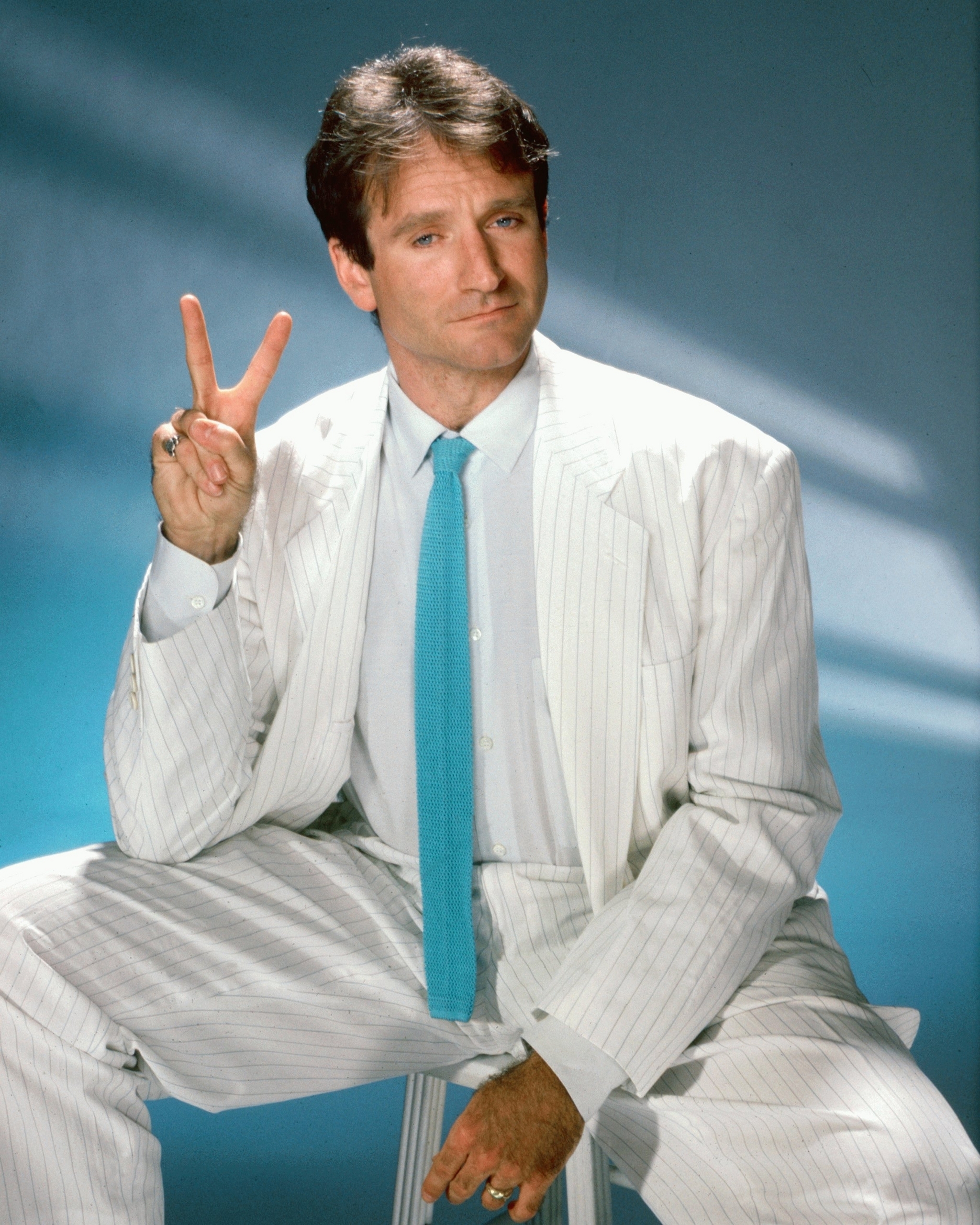
Robin Williams meant the world to me. A supernova of mirth and tears, bravery and anger…and always, just a man.

Today, the man found his end, as so many of his ilk have.

But his legacy will echo for eternity to brighten our nights and nourish our souls.

Sleep, noble prince, assured that we are better for knowing you.