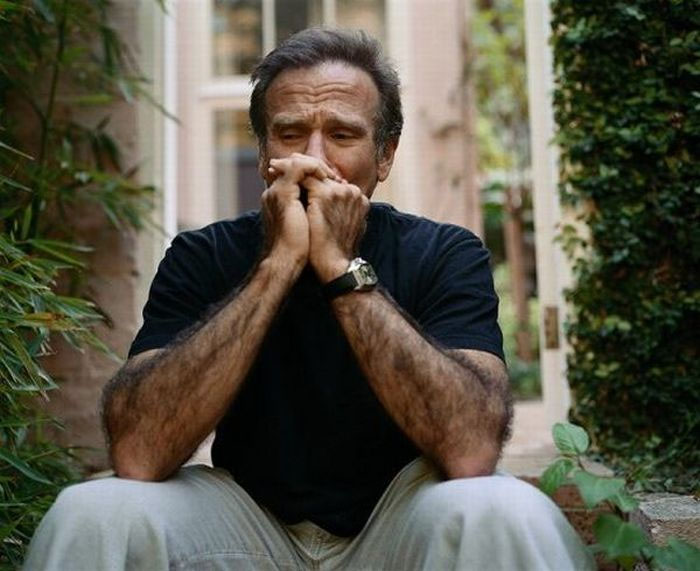
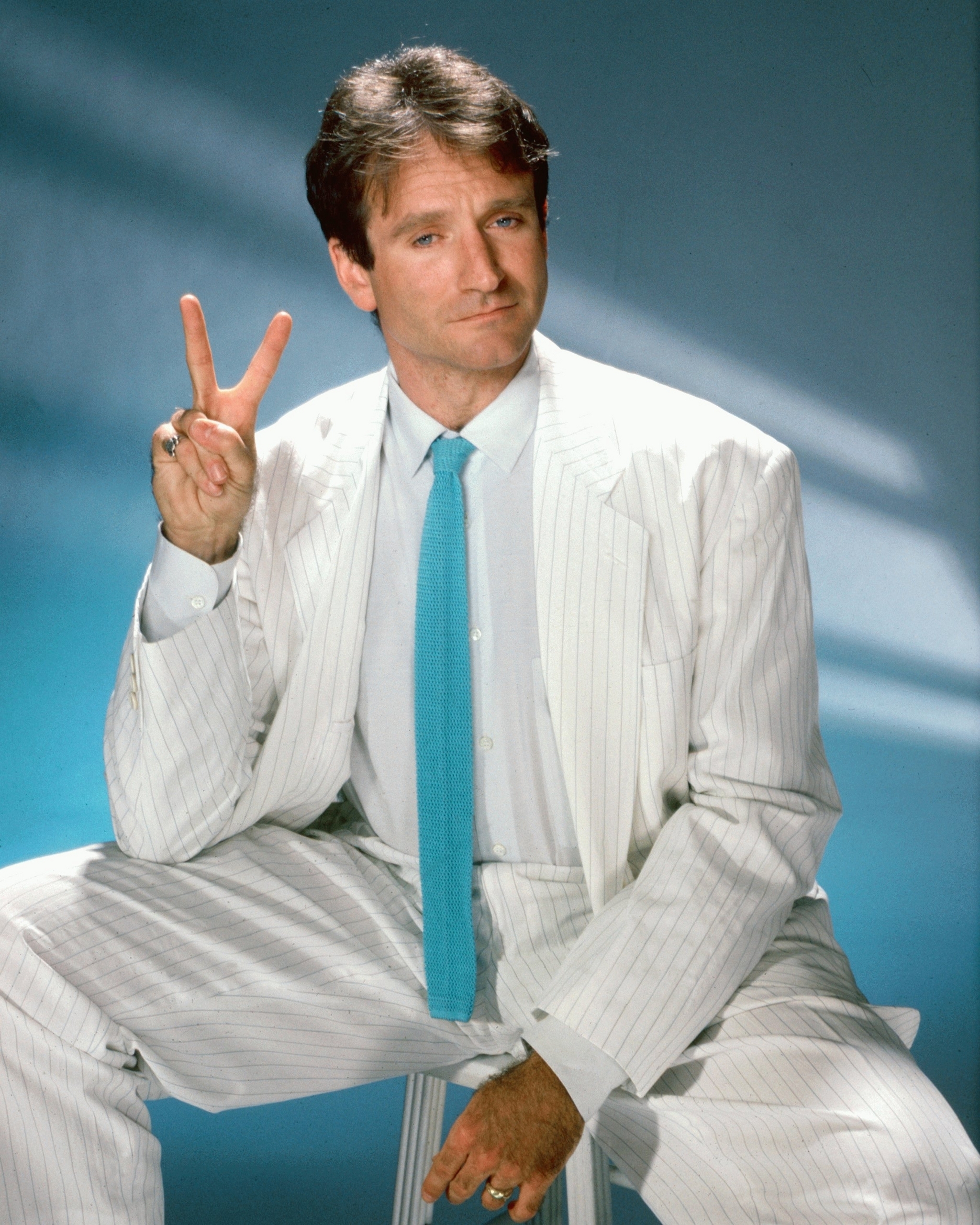
A couple of days have passed since Robin William’s death and although I still cannot accept the truth of it, I have somewhat resigned myself to that truth.
Shortly after the event, as I watched the public response, I found myself getting upset. The following post, written the night of his passing, explains those feelings. If you read on, please read all of the post as I don’t want to hear anyone’s comments unless they have read all that I have to say below.
I’m angry. I’m angry at all of the people who want to turn my grief into some sort of life lesson.
The death of Robin Williams from depression isn’t a parable, it’s not a morality play, it doesn’t serve a purpose; so stop throwing literature and comments about depression and the availability of help at me.
This is a man who made millions laugh. A man who struggled throughout his life with demons and who worked with and around those demons to make beautiful art. A man who had loved ones and raised children.
A man who touched my heart and mind and soul. A man who taught me that it was okay to misbehave, to act out. That to be frenetic could also be to be focused. That you can love and be livid with the world and its people at the same time.
And now that man is gone, and I want to mourn. I want to wallow in my memories of the joy and tears that he brought to my life. I want to remember the man.
I don’t want to rationalize his passing. I don’t want to find meaning in his death. I don’t want to learn a lesson.
I want to grieve, to storm, to wail, to laugh, to love.
But I am not the only one in mourning.
I know the people who post information about depression and mental health, who list hotlines and web sites, are doing that as part of their grieving process. They are doing what they have to do to process Robin’s death.
They are doing what is right for them as I am doing what is right for me. Pain is a self-centred thing.
Perhaps in a day…or two…or ten, I will be able to see their side a little better, but for now, I just want to hurt…and remember…and smile.
In the last couple of weeks, I have spoken with many friends about the concept of happiness as it pertains to life’s pursuits, which has forced me to give thought to my past experiences and the reasons why happiness eluded me for so long in my life. The following is the sum of my thoughts.
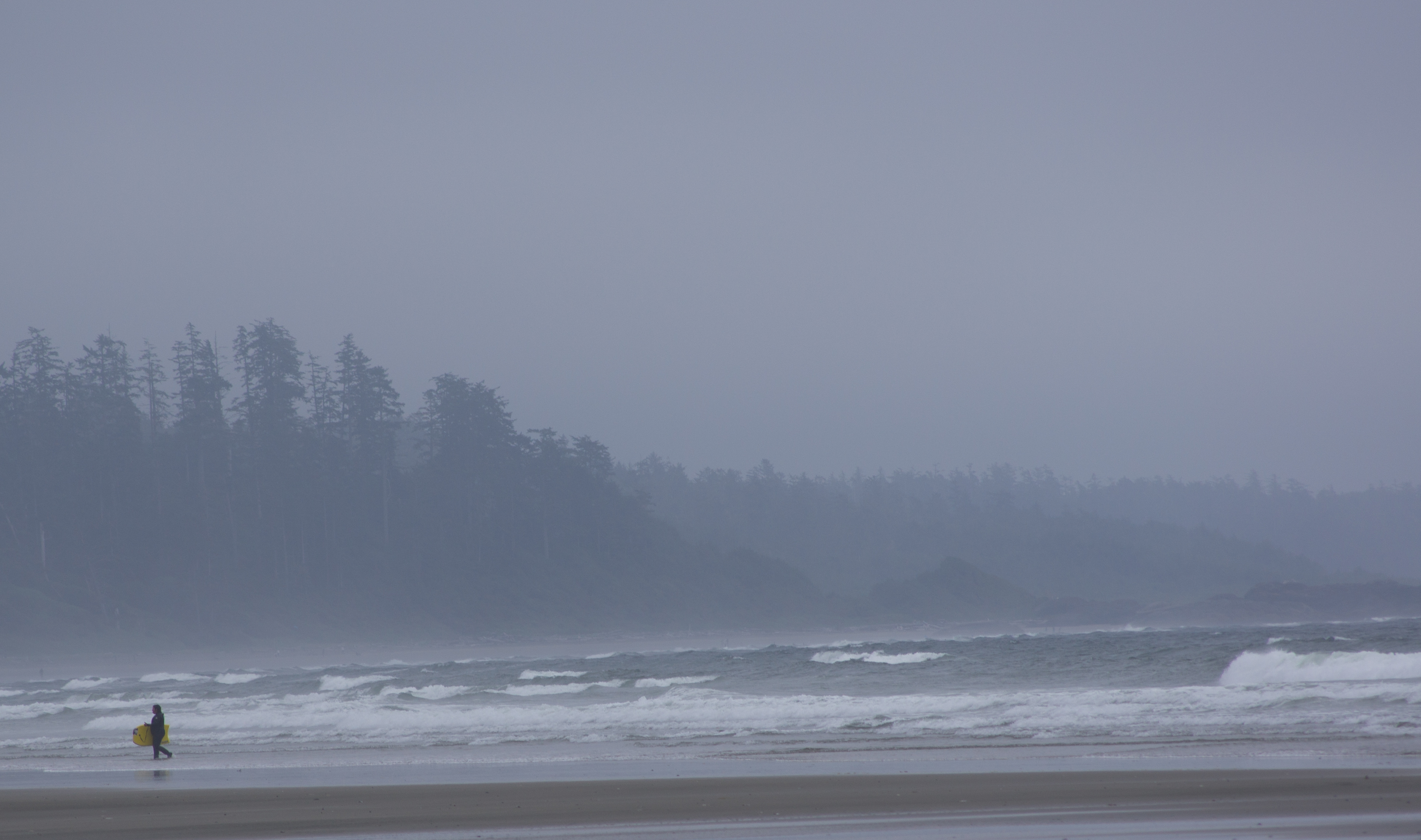
A surfer finds joy on a blustery day in Tofino, BC
Life is not about destinations. Or perhaps I should argue that a happy or satisfying life cannot be about destinations, because destinations are temporary at best and completely illusory in truth.
We have been taught that it is important to set goals, to aim for a destination, and to a limited extent, I agree. Where I struggle, however, is in the assumption, the programming that suggests the goal will bring happiness, that at your destination, you can rest.
For most of us, this sets up a couple of problems.
If we do not succeed in achieving our goal or reaching our destination, then not only have we failed, but more insidiously, we see ourselves as failures.
But even in those situations where we achieve our goal, arrive at our destination, we are faced with the daunting and disheartening revelation of “Now what?”
In Costa Rica, when you finish exploring the jungle, there is still the mountain to climb
For despite the momentary glow of success, we cannot rest. We must seek the next goal, identify the next destination. And the cycle repeats, ensuring that for all but the rarest of us, we will fail, we are failures.
Part of the challenge is that for many people, the idea of a goal or destination presupposes that we are not sufficient in the now, that our lives are incomplete and would somehow be better over there.
We don’t make enough money. We are alone. We have not achieved the heights for which we are destined. We—as we are today—are not good enough.
It is good to push boundaries. It is good to strive.
And while those two statements may sound contradictory to the questions I raise above, to what I have decried, I don’t think they are.
Pushing. Striving. These are actions, not endpoints. And that makes all the difference in the world.
A goal or a destination, a predetermined endpoint, is fine, but only in so far as it gets you moving in a direction. After that, it is meaningless.
Life is in the movement. It is in the process. It is in the journey, regardless of where that journey takes you.
Destinations and goals give us opportunities to shift the direction of that journey, but they are not the point of or the reason for the journey.
We are like photons in the universe of our lives. Without movement, a photon has no mass. When we cease to move, we cease to exist.
It is our movement that gives us life, and our interactions during that journey that gives that life meaning.
Feel free to set a direction, but be prepared for and welcome the changes that come along the way, for it is in that journey that we will truly live and ultimately find happiness.
It is enough to experience the world; you do not need to conquer it (Montezuma, Costa Rica)
An example from my life:
Early in my writing career, I worked for a magazine in Washington, DC. Every year, my boss and I would set goals for the next 12 months; e.g., 3 features, 10 department articles, 20 short pieces. And being a little Type A, I would accomplish my benchmark within 3 months. At the end of the 12 months, I might have tripled or quadrupled the expected output.
I would demand a promotion, and I would be told no…there were apparently other factors not included in my annual goals before I could be promoted. This pissed me off.
But surprisingly, even when I received the promotion, it was not enough. I needed the next one. I set the goals and again, felt held back despite achieving the goals.
And very quickly, the job I loved, the job I practically ran toward every morning in anticipation, became a leaden weight. I ceased to write for the love of writing. I was miserable.
In hindsight, I can see now how much I learned on that job—not the least of which was “office politics”—but at the time, all I could see was failure. It was the journey that helped shaped the man I am today, not the endpoints. I might have been happier had I realized that then.
The following video is a rather clever summation of my thoughts. Thanks to my friend Agah for pointing me to it!
You’re a really nice person for coming to read my blog, and I really appreciate it.
I just wanted you to know that. You deserve to hear nice things about yourself.
It’s been a really good week or so for me on the compliment front as two previously unknown people have taken a moment to offer nice comments about my magazine writing.
In reference to a past commentary, Diane wanted me to know:
You’re a superb writer—love the line “One need only look at any war-torn region of the world today to realize that in the middle of a conflict, bullets take precedence over bandages.”
Similarly, Martina offered me her thoughts on a recent interview I conducted:
This was a great interview and a pleasure to listen to it. I don’t hear too many interviews with writers and editors so well prepared.
I tell you this not to say that you should love my work too, but rather to note that it wasn’t that long ago when I would have completely dismissed these lovely comments. Not because I am a dick, but because I am not worthy of such praise.
Throughout my life, I have had a lot of self-worth and self-image problems…still do, to be completely honest. I couldn’t believe that anyone would like me or my work because I and it had no value. Anything nice they had to say was just an effort to…I dunno…I have no idea why they said it.
But it wasn’t true. If it wasn’t a lie, it was a mistake.
As I’ve gotten better with myself over the last several years, I’ve noticed a lot of other people share this problem. They can’t, or perhaps more accurately won’t take a compliment.
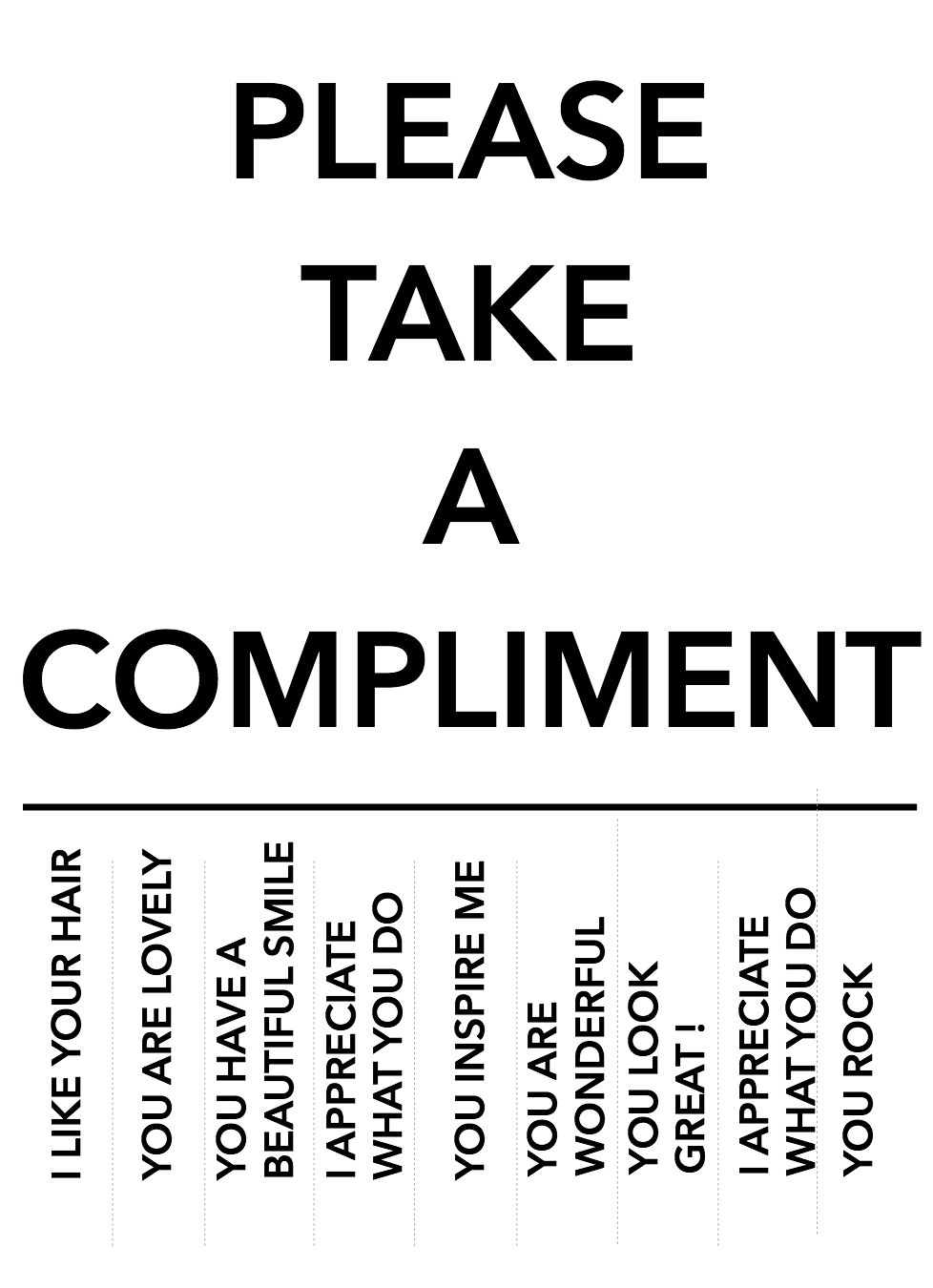
Please stop! Let people offer you their compliments. And then, say “Thank you.”
Simply say “Thank you” when someone gives you a compliment…no eye roll, no looking away or down, no self-deprecation. Just take it and acknowledge it! It sounds trite, but it isn’t.
A big part of being able to move past self-worth and self-image issues and slowly diminish their impact in my life has been the idea of accepting compliments from other people as more than politeness.
If it works for you as it did for me, at first you just go through the motions…but then slowly, as you take the compliments in and hear them more often–really, really hear them–you begin to think they may be based on something…they may be true. I’m sure they are.
I gave a dear friend of mine similar advice yesterday when she blogged about her vulnerability.
I then proceeded to give her about half-a-dozen compliments in short order to demonstrate my love and appreciation for her, to let her know she was worthy of praise.
Without knowing which of you is reading when, it is a little difficult for me to do the same right now, other than to let you know that you too are worthy of praise.
So let people praise you…and then, just say “Thank you”.
(These beautiful images are the property of their owners and are used here without permission, but deepest appreciation.)
Believe it or not, for several years, I worked in a hospital research lab. (Won’t mention which Torontohospital lest people stop taking their sickchildren there.)
What I hadn’t realized until one fateful day was that not only was I a pretty good biochemist, but I was also a damned fine engineer…when motivated.
And what better motivation than a plate of whipped cream to the face. Really, the old pie-in-the-face chestnut.
And the chortling culprit was a friend who worked across the hall. (I won’t name names because Andy, who was still quite green then, is now a medical practitioner.)
We laughed. Boy, I sure look silly. You got me. And now…you must die (of embarrassment)!
Doing my best MacGuyver, I set to work.
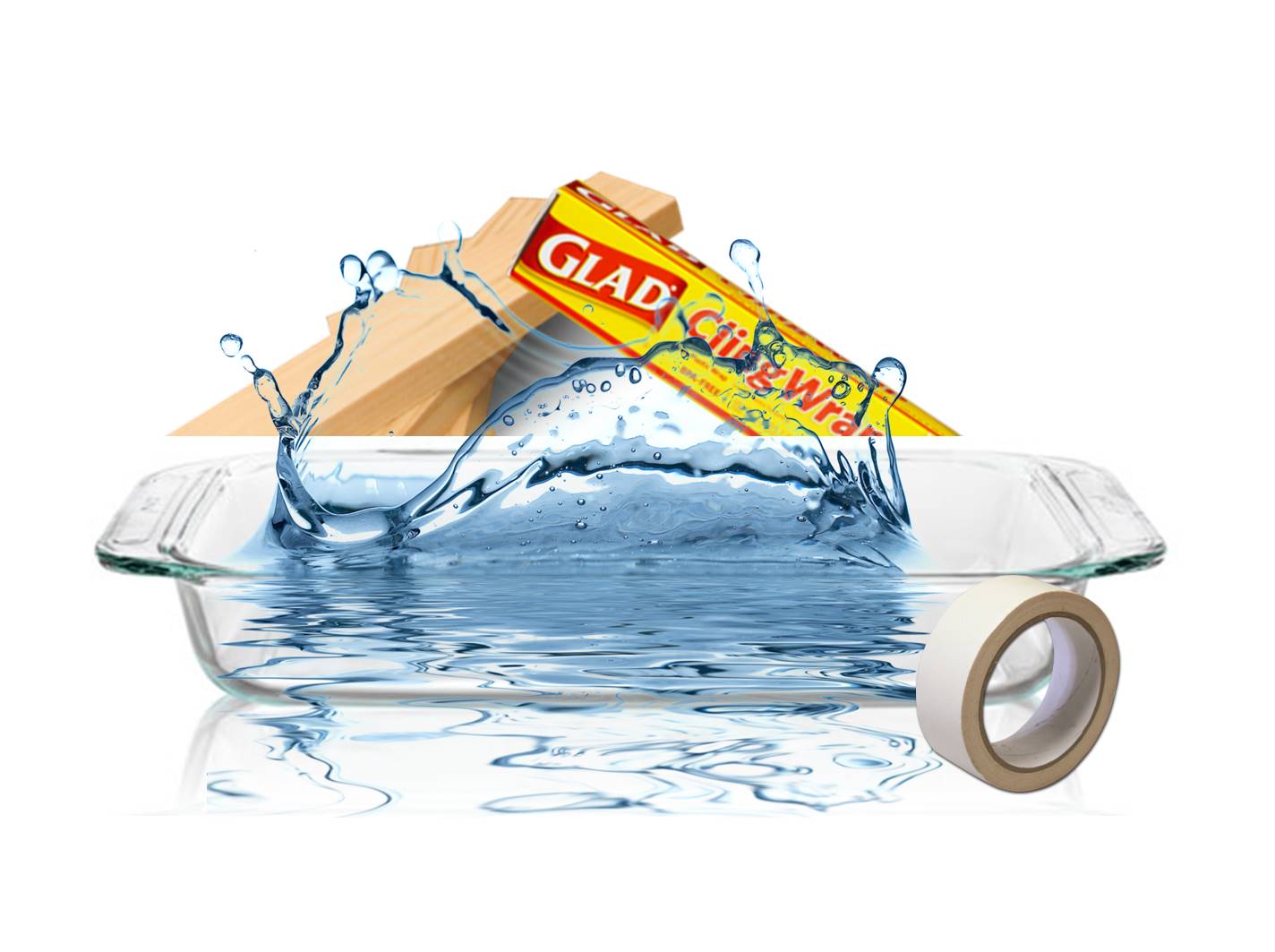
Pyrex baking dish? Check.
Cling film? Check.
Wood block? Check.
Masking tape? Check.
Water? Double check.
The plan was simple. Convince A.G. that he had a research paper we needed in his desk drawer, which we had booby trapped with a tray of water.
When he opens the drawer, AHA!
Oh wait, the tray will slide backwards.
Support the tray in the drawer so it doesn’t slide, and AHA!
Nuts, even if he pulls the drawer forward, Conservation of Momentum says the water will slosh the other way.
Cover most of the tray with cling wrap so the water has nowhere to go and sloshes back all the more forcefully, and then AHA!
Oh but why would he sit down to open the drawer…they slide so easily.
Stick masking tape under the upper rim of the drawer so he has to yank it open, and then… (Aha, right?)
Yes, Aha.
AHA!
To avoid suspicion, I had a mutual friend ask Andy for the paper…he sat at his desk and tugged the drawer, but it was stuck. Sitting at the desk, he pulled harder and yanked the drawer open. And was hit with a wall of water that completely drenched his lower half.
AVENGED!
He wandered the halls looking like the Lusitania went down in his pants.
It may all be quite silly to you, but to this day, this represents my greatest engineering feat…something that, for me, rivals the Pyramids of Egypt and those irritating metal ring puzzles.
(This silly memory prompted by yesterday’s post by Ned Hickson about his fake poo…you think it’s easy being this juvenile?)
For some of you, who have followed me from the earliest days, you are no doubt thinking: “500? Really? Seems like 5,000.” For those of you relatively new to the wonder that is my blog, please note closely the previous statement.
I dithered over what to write for my 500th post, and have decided I’m going to talk about you…well, some of you.
I “follow” quite a few blogs…I read many fewer…and I seek out even fewer. I’m sorry for those I don’t visit more regularly…hours in a day and all that. It’s some of that last group, I want to highlight here…those glorious few who make me stop whenever I see they’ve posted something new.
The paintings that this woman creates and the themes she explores by mixing media and mixing subject-matter blow me away. Rare is the image that doesn’t elicit some emotion in me. Hers is a style I have seen nowhere else and is worth exploring.
To read Jack’s blog is to have no clear idea as to who Jack is, and I mean that as a compliment. Jack takes on any subject it seems, but always in a thought-provoking and welcoming way that makes you want to contribute with a comment. His latest topics have been: monotasking, Veronica Mars, infectious pandemic readiness and phone addiction.
As the title suggests, Steph Snow is a no-holds-barred writer who likes to talk (or rant) about writing. With generous dollops of humour, she discusses the creative fortunes and practices that torture her soul on a seemingly daily basis. Misery truly does like company.
I list these two blogs together because they are both discussions of the written word—e.g., reviews of books and authors, discussions of book marketing—and because the bloggers (Ionia Martin & Julian Froment) are beautifully connected at the soul (I don’t ask questions about any other forms of connections). Amazing people whose love for words is only surmounted by their love for each other.
As a photo-hobbiest, I deeply appreciate the craft and skills that other photographers bring to the world. In this case, however, Schelley and I seem to share a greater fascination for the minute rather than the panoramic, as suggested by her regular feature “What is it?” where you only see an aspect of an object and are left guessing as to what that object is.
If I couldn’t have my life, I would want Ron’s. A world traveller and freelance journalist, Ron is an amazing photographer, capturing incredible aspects of life in the many places he has visited. I particular enjoy his collections of people photos, often taken at a festival or gathering, which are incredibly natural and inviting.
Ned Hickson is not right in the head. And that’s what I love about him. A journalist in the Pacific Northwest and volunteer firefighter (or latex-coat fetishist…can’t really tell), Ned brings an irreverent sense of humour to everything he writes, earning him several accolades including his own NSA file. Ned also has a book to his credit, which I believe he has to return to the library next Tuesday.
More a collective than a personal blog, Curnblog offers amazing insights into all things film, whether examining an individual film or genre from angles such as sociology, creativity or cinematography. Predominantly the work of James Curnow, the blog is like having your own little film school where you can access new and unusual topics on a weekly basis without the pressure of essays, theses or exams.
There are so many other blogs to which I would like to direct you, but I am happy that you made it this far down the page. Perhaps for my 1000th blog post!
My gratitude for your patience and enduring interest.
Friends and family hate walking up hills with me. I have no idea how they feel about the flat regions, but definitely the hills they hate. And it’s not that they are out of shape. To the contrary, I am the excessively shaped one…and I’m lazy.
Thus, when I reach the bottom of a hill, I want to get the climb over with as quickly as possible…I power my way up the hill, leaving them to trot along or simply do their own thing and catch up with me.
But the biggest challenge, once they catch up, is that they then have to wait for me to recover from my exertion. In my zeal to get to the top, I completely ignore the fact that the trip is not over once I reach the top…I leave nothing in my tank for the rest of the trip.
I’ve done the same whenever I’ve decided to change my shape with exercise or diet. I start out incredibly aggressively…not holds barred. And for a week or two, my goals are not only met, they are surpassed. I am incredible. I am a GOD! I am also exhausted and sore…and I slowly stop my program.
And as if this behaviour wasn’t already annoying enough, I find I also have a tendency to take the same attitude in my writing.
Prepare my work area. Cogitate on what I want to do. Research. Procrastinate. And then, WRITE LIKE THERE IS NO TOMORROW BECAUSE I REALLY WANT TO GET THIS DONE THIS WEEK OR AT LEAST GET AS FAR AS I CAN GET BECAUSE NEXT WEEK…
At the end of the process, whether it is a hundred pages of a novel, another feature article for a magazine, an outline and beat sheet for a new screenplay, I am exhausted and my brain hurts. The creative wheels come off (or wobble severely), and I lay up for a couple of days accomplishing nothing, except possibly another thousand games of Solitaire.
My ultimate goal is still way over there. Whether it is within sight or not, I can’t do anything about it because I am doubled over with my hands resting on my knees wondering why my (creative) lungs have shrivelled to the size of grapes.
I can drive a car by flooring the accelerator for 30 seconds and then releasing it until the car crawls to a stop, only to repeat the cycle again and again. I can. But the car will like it about as much as the other drivers and police. And whether due to a destroyed transmission or arrest, I will lose the car.
As I reminded myself on Twitter this past week, I am not writing a novel today. Rather, I am writing a scene, a paragraph, a sentence. But I am writing.
The top of the hill is not my destination, but rather is a way-station along the journey, a landmark I will pass. And for all I know—because despite my best efforts, omniscience has not yet occurred—the hill may be the most interesting and/or important part of the journey. The upward grade itself may hold the answer to the whole damned project
So here’s to my best efforts to ease into the next hill and enjoy the scenery along the way. I’ll reach my destination eventually and who knows, I might actually enjoy the trip (or at least, not drop of a coronary).
(Images are property of owners and used here with no destination in sight.)
I know you’re used to me babbling in these pages, but I am sure two of you have wondered, so how does he pay his bills? I know my landlord wonders that.
Below, I have reprinted my latest commentary from DDNews, a magazine for which I write regularly and for which, to my great surprise, the Publishers pay me. Thought it might make a nice change of pace for those tired of the current pace.
For those of you who read the article, there is a bonus at the bottom (worst fruit-in-yogurt tagline, EVAR!)
For a brief period of my childhood, I dabbled in model airplanes and model ships. And by “dabbled,” I mean I spent an inordinate amount of time with my fingers glued together. But aside from the medical agonies of modern chemistry, what struck me most about the exercise was how pale an approximation these models were of the real thing—about the only thing my miniature Spitfire had in common with the WWII fighter was the sheer carnage of the plane as it went from airborne to groundborne in its flight across the room.
More recently, my fascinations have turned to models of a more human variety, such as those found on the catwalks of America’s Top Model. (Let’s face it, after DDNews, I am all about the latest issue of Vogue.) And like the plastic variety described above, these models seem to be at best a glittery approximation of the actual thing.
It’s often hard to believe that I share about 100 percent DNA sequence identity with these mystical creatures. Now, 98 percent coherence with bonobo chimps, I have no problem believing.
All this to say that we are constantly surrounded with models that are poor facsimiles of the real deal upon closer inspection. So, it should probably should come as no surprise that the same is true in medicine and drug discovery.
Last week, I read a story in the newspaper that touted the life-prolonging properties of the diabetes drug metformin; a regular fountain of youth, the headlines implied. And yet, after coursing through the article, I eventually discovered that the rejuvenation experiments were performed on the worm C. elegans, which was shocking for two reasons.
One, I did not realize that there were largely untapped market opportunities in annelid diabetes. And two, the life-extending implications were being made based on a species that wasn’t even a chordate, let alone a mammal.
Now, I appreciate that this is an extreme example, probably overhyped by an eager press officer, but the literature is rife with examples of models that completely failed to live up to expectations when researchers tried to match success in model systems with success in actual humans.
As oncology god Judah Folkman once mused, we have become really good at curing cancer in mice.
Part of the challenge, I think, is that because we cannot experiment directly on humans, or at least not within the editorial reach of DDNews, researchers are often forced to study new compounds or therapeutic modalities on approximations of approximations of approximations of human disease.
We don’t study the impact of irinotecan on human colorectal cancer but rather extrapolate from its effects on an induced form (approximation 1) of murine colon cancer (approximation 2) in mice (approximation 3). Or we study new biologics against a chemically induced inflammation in dogs that bears a passing resemblance to rheumatoid arthritis in humans.
Within the realm of in-vitro models, the advent of technologies like 3D cell culture and microtissues is adding some biological context back into the completely artificial realm of 2D cultures of immortalized cell lines. (For more on this, see the special report “Life moves on” in this issue, on page 21). But in the absence of factors such as tissue vascularization and the like, even these advances result in weak approximations.
The goal of a better, more representative model may be getting a step or two closer, however, with the help of stem cells.
As we’ve reported previously in these pages, and as I am presently hearing at the ISSCR conference in Vancouver, stem cells are giving us enhanced opportunities to study human disease generated from the source material—human cells—potentially down to the scale of the individual patient.
The standard technical limitations of in-vitro analysis hold for stem cells—a lump of microtissue in a microwell dish does not a micro-human make—but we do have the opportunity to limit one or two approximations.
At ISSCR, for example, Daniela Cornacchia and colleagues at Sloan-Kettering and Weill Cornell Medical College describe their efforts to understand the inadvertent de-aging of cells transformed into iPSCs. Even when taken from older patients, the reversion process makes it difficult to use the cells to study late-onset diseases. The group is trying to identify factors that will allow them to induce natural aging into these cultures to improve models of such diseases as dementia.
Similarly, Rohan Nadkarni and Carlos Pilquil of McMaster University are endeavoring to produce 3D lung tissue from iPSCs that contain both conducting and gas-exchange zones mimicking normal lung function. If the model bears out, it may provide an even more realistic platform to study respiratory diseases in vitro.
Until we are in a position where we can do high-throughput human screening—in a 96-well cube farm, perhaps—the search for better model systems must be a priority. And given the challenges of translating preclinical success into clinical success, perhaps it should be a higher priority than the development of new therapeutics.
Look for more on this topic in a special feature on disease modeling in the November issue of DDNews.
Because my mother refuses to throw anything away, but prefers to store it in a drawer or cupboard until I come for a visit, I was reminded this past trip to BC about a phase in my writing career that kind of occurred sideways.
Several years ago, I was in desperate need of a job (wow, some things never change). So desperate, in fact, that I decided to take a flyer on and leverage my background in science writing and magazine editing for a job as editor of a manufacturing automation industry trade magazine published by CLB Media.
It should be noted, I knew and to this day know nothing about manufacturing. But I can write and I can edit and I have a good idea for design. I also have a fondness for money.
It was obvious throughout the interview with the magazine’s Publisher and Director of Sales & Marketing that I could write and knew magazines well, but that if I got the job, I would have to scramble to understand the issues and lingo of a completely alien industry. They were kind, but it was obvious the job and I were not a match.
When I finally got home, I was in the middle of discussing the interview with my wife when I received a phone call from the company VP, Publishing who said my interviewers had mentioned me and that the company had a medical humour magazine (Stitches) and companion consumer pub (Stitches for Patients) that were in need of a new editor. Would I be interested in talking to him and its Publisher the next day.
Uh, yeah!
The job didn’t last very long–the magazines had been in a steady decline for years before they found me and never recovered sufficiently to keep operating–but it was a great experience, and not only allowed me to write nerdy medical comedy but also allowed me to eventually add the title Associate Publisher to my resume.
And all because I was desperate enough to apply for a job for which I had few qualifications but showed general competence and a willingness to listen and learn.
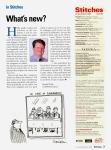
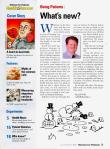
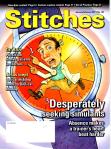
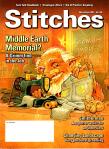
I offer the covers of my first three issues of each magazine below (thanks mom). The insane covers are the work of the amazing illustrator Max Licht under the direction of the equally amazing Art Director Graham Jeffrey.
Mother, Nehiyaw, Metis, & Itisahwâkan - career communicator. This is my collection of opinions, stories, and the occasional rise to, or fall from, challenge. In other words, it's my party, I can fun if I want to. Artwork by aaronpaquette.net












 createdbyrcw