A good conversation starter on a topic that is near and dear to many a writer.

What is work? Is writing work? If so, when, or at what point do you earn the right to call yourself a writer?
View original post 562 more words
Reflections on the use of words
A good conversation starter on a topic that is near and dear to many a writer.
What is work? Is writing work? If so, when, or at what point do you earn the right to call yourself a writer?
View original post 562 more words

A railway track is perspective trying to make a point
What makes your writing unique from all others is your perspective, the way thoughts, words and actions are interpreted in your mind.
If 10 people witness the same collision between two cars, each one will recount a slightly varied story from another. Some may gauge the speeds of the vehicles differently or not remember the same car braking first.
Less what you remember and more how you remember is influenced consciously and unconsciously by your personal experiences, your beliefs and your moods. As good a reason as any for the police and court system not to rely on a single eye witness account whenever possible.
The same is true for your writing.
Although our imaginations give us some ability to write fanciful stories and characters outside our day-to-day scope, a close examination of our oddest creations will show that they are largely reinterpretations of things we have read or experienced in other stories.
Dragons, for example, are likely an amalgamation of flying raptors (e.g., eagles), strange lizards (e.g., monitors) and giant fossilized remains that humans have dug up for millennia. How else to explain the similarity of a T. rex skull and monitor lizards?

How to make a dragon with 3 simple ingredients!
At the same time, it was the unique experience of these three factors in combination that may have resulted in the first dragon description. A truly unique perspective.
To consider it another way, think on the meaning of perspective in the visual arts:
The art of drawing solid objects on a two-dimensional surface so as to give the right impression of their height, width, depth, and position in relation to each other when viewed from a particular point.
Giving the right impression of [facts]…from a particular point [of view].
But what if you changed that point of view?

Changing perspectives is perhaps the easiest way to approach cliché writing and makes the predictable unexpected.
If you want to tell a love story that is essentially Romeo & Juliet, tell it from the perspective of rival street gangs in New York. Oh, but wait; they already made that one.
Then how about from the perspective of fish in a pet shop and instead of rival families, it is the divide between fresh and salt water? Crazy, hunh? (NOTE: I already wrote this one, so please go write something else.)
The same holds true whether you’re considering an entire story, a single scene, an individual line of dialogue or a character trait.
How might the floor of a dance club look if you changed your perspective from that of an evening reveller to that of an observer seated on a ceiling rafter? Probably like one of those wild life documentaries describing the mating habits of some ridiculous animal.
Or what might your backyard “look” like if your only sense was touch?
By changing your perspective in even the smallest of ways (you don’t have to blind yourself), you can dramatically alter your perception of the world.
So, the next time you find yourself stuck for an idea or facing a cliché moment in your writing, try looking at your world upside-down or through another character’s eyes.
Take a new perspective and you’ll reach a whole new point.
(Drawing is property of owner and is used here without permission because I take a different perspective on these things.)
A succinct piece on hazards of which to be wary!
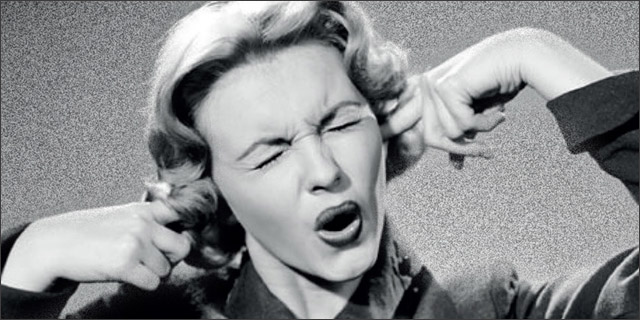
What if you could hear all of your friends conversing at the same time? And I mean regardless of whether they were in the same room with you.
Every thought. Every synaptic firing. Every vocalization. Pouring into your brain constantly.
The razor blades are under the sink. Try to be a good fellow and keep all of the blood in the tub, would you?
Welcome to Twitter.
I started on Twitter less than a year ago and I have noticed one thing about the people I hang out with: they fall into one of two camps. The constant pingers and the lurkers.
I, my apologies to everyone, am a constant pinger. I am one of those people who continues to post things throughout the day, and I never stay on one subject very long. I’ll hit themes and run with those for a while, or I’ll go through a period where all I do is respond to other people’s posts with “witty” ripostes. I’m not nearly the retweeter that most pingers are, but that’s mainly because I constantly feel the need to add to conversations rather than simply echo them.
In my actual social life, I have been referred to as “The Honest Ed” of comedy. Honest Ed, as the name would imply, was a local retail showman who had a large store at the corner of Bloor and Bathurst Streets in Toronto that fundamentally sold cheap crap to the masses under bright neon signs. Thus, the moniker given to me. Most of my humour is crap, but every once in a while, you’ll find something you like.
My brother Scott, in contrast, would be classified as a Lurker, if he had a Twitter account.
These are the people who patrol the social waters, largely unseen and shark-like, not interacting until they find just the right moment and then BAM!
At a family gathering, Scott would sit in the room, only slightly more animated than the wallpaper, while I rat-a-tat-tatted in all directions like a wind-up monkey with cymbals. He would wait for his moment and lay out a line, a joke, a comment that was smarter than anything I had said cumulatively. The room would collapse and he would dissolve back into the furniture, never to be seen again.
On Twitter, the lurker is the person whose icon only shows up rarely in your timeline. The person who catches your eye—when they catch your eye—only because you thought they were dead (or at least their account was dead). But catch you they do, and pay attention you must, because they have finally decided there is something worth saying and it should be good.
The pingers, I may only read about 1-10% of what they say at any given moment, making judgements on importance within the first two or three words (so much for 140 characters).
I have my favourites, those I will read more thoroughly, and those favourites change with my changing moods or their changing conversations.
So what is my point in this post?
I don’t have one. I’m a pinger. It’s never been necessary.
I merely observed something and felt I needed to comment on it…for more than 140 characters.
PS If you want to “hear” the Internet evolve, there is a really amazing site that monitors changes to Wikipedia and represents those changes visually and musically. Not surprisingly, it is called Listen to Wikipedia.

From their site: Listen to the sound of Wikipedia’s recent changes feed. Bells indicate additions and string plucks indicate subtractions. Pitch changes according to the size of the edit; the larger the edit, the deeper the note. Green circles show edits from unregistered contributors, and purple circles mark edits performed by automated bots. You may see announcements for new users as they join the site, punctuated by a string swell. You can welcome him or her by clicking the blue banner and adding a note on their talk page.
(Image is property of owner and is used here without permission because I couldn’t get a word in edge-wise)
Interesting thoughts on characters run amok!
I love this list…it is angled toward novelists, but it holds for all writing!

Artists in general are a different breed. I came across this list, and I thought it had some great points!
Honestly, I don’t agree with all of the points. I try to avoid writing about people I know, though occasionally, they do inspire me. And I have never at a party riffled through other people’s things, personally, I think that’s just an invasion of privacy.
But the others, I felt were head on.
Especially number 10. I have in the past dated people and been friends with people who didn’t understand how crushing a rejection letter can be. When you are already reeling from a rejection that logically you know shouldn’t be personal, but emotionally is, the worst thing you need is someone telling you to suck it up and that it isn’t a big deal.
I would add:
11) Don’t ask the writer how much money they have made…
View original post 19 more words
Ned is absolutely correct! So I wrote this and let him do all the heavy lifting!
 Because this week’s Nickel’s Worth on Writing happens to fall on Friday the 13th, and because undisputed Master of Horror STEPHEN KING was kind enough to send in a special accolade, we’re totally skipping my normal introduction about offering writing tips based on my 15 years as a columnist (stop yawning) so we can get right to Mr. King’s unsolicited accolade regarding the value of my weekly NWOW and how a run-on sentence can get people to read an entire opening paragraph before they even know it!
Comment from THE Stephen King:
“Ned, I visit your Nickel’s Worth quiet often. And so does my LAWYER. We’ll be in touch.”
— Sincerely, Stephen King (Undisputed Master of Horror)
Wow!
With that kind of affirmation, I could end this post right there — and my lawyer agrees I probably should. But my weekly NWOW isn’t about me; it isn’t about flaunting the…
View original post 737 more words

My favourite shot of Welles as I believe that smile and those eyes tell me everything I need to know about the man
Being a good writer necessitates having a good eye and a good ear.
The good eye is the attention to details that will help you paint a word-picture of what you have seen with your physical eyes and processed in your mind’s eye. It’s not necessarily about writing long-winded passages of backgrounds or going into minute detail of a character’s physical attributes (I’ve done plenty of that), but rather in choosing the most precise and meaningful words to describe the environment or the person.
The good ear is the attention to how people communication and how they speak, not always the same thing. Again, it involves finding the right words and inflections (at least implied inflections) that give the reader and actor clues as to who this person is. And perhaps just as importantly, it is about finding just the right cadence for your character’s speech patterns.
If you listen really closely to a conversation, you’ll realize that there is little difference between speaking and singing. There is a rhythm, a cadence to speaking. Conversation is an improvised duet sung a capella. But unlike a traditional song which may have a subset of arrangements, each of us sings to our own tune, with our own rhythms and inflections. It is one of the many things that sets us apart from each other.
When writing characters, it is important to keep this in mind as all too often, a group of characters can have a certain monotone, which I use not to imply flatness so much as sameness. Often, I believe, it occurs when the writer neglects to add variety to his characters’ speech patterns and instead writes them with one voice; his or hers.
The best writers don’t make this mistake…or at least minimize its occurrences. Each character he or she presents us is truly unique, jumps off the page or screen, provides his or her own internal musical accompaniment.
One of my favourite writers of the last decade or so is Aaron Sorkin whose overall writing has its cadence but whose characters also tango (or more often tarantella) across the screen. Read the pilot to The West Wing or the screenplay for The Social Network and you will know you’re reading Sorkin.
But for me, perhaps a better example is Orson Welles, the man who would be Kane.
Recently, someone discovered a long-lost unproduced screenplay by Welles called The Way to Santiago, written in 1940-41. Another blogger discussed the find recently, and provided a link to the actual screenplay (see link below). You only have to read a couple of pages to remind yourself (or educate yourself on) how Orson Welles wrote and the energies he imbued in his characters, each one a snowflake of facets and reflections.

The opening page of The Way to Santiago
Now, listen to the films or read the screenplays of The Third Man, The Magnificent Ambersons, Touch of Evil. Although you may question the choice of actors, you can clearly hear or see the distinctions in the characters. Bathe in the richness and depth of each one as he or she is captured for this brief moment. This is the stuff of which dreams are made.
It is also interesting to consider that Welles got his start on stage and in radio, where the human voice plays such a larger role in conveying a story than it does in film. There is much less to occupy the mind onstage or in radio and so dialogue carries a significant burden of not only informing but also entrancing the listener.
Although the stories I write are distinctly different from the Wellesian oeuvre, there is much I can and do learn from this master of the written word. He is worth the read and the listen.
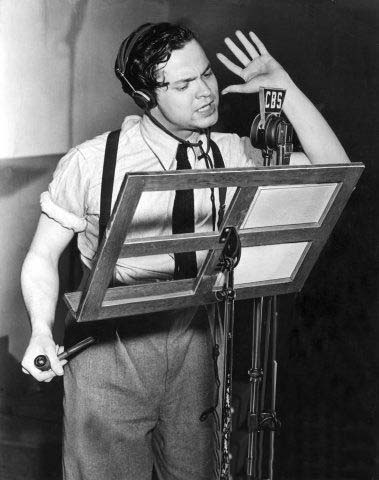
A classic image of Welles in his radio days
Links of interest:
The Way to Santiago at Cinephilia and Beyond
The Way to Santiago, starring Howard Hesseman on Vimeo (A valiant but not brilliant attempt)
“Thank You, Mr. Welles: Definitive actor, consummate director, and true auteur” at Curnblog.com
“Screenplays by Orson Welles” (listing) on Wikipedia
Me and Orson Welles A light but adorable movie that probably portrays Welles’ character better than Welles
Like a good turkey dinner, this is worth repeating
 (Today at Siuslaw News, we are short-staffed and on early deadlines, with many of us suffering the lingering effects of tryptophan and alcohol. The result is an extremely small staff of tired, hungover reporters trying to put out today’s edition. Being that I am the tallest and least hungover, I am suddenly an integral part of assuring today’s success — which is a stark contrast to the role I normally play in the newsroom. What does this all mean? For those who recognized the title of this week’sNickel’s Worth on Writing, you already know it’s a repeat from a year ago regarding what it means to be a writer. For those who never read this post or, for reasons of their own, blocked the experience from their minds, this will be new to you. In either case, whether reading this for the first time, a second…
View original post 1,070 more words

Where do you find inspiration? What causes one moment to pass completely unnoticed and another to trigger a flurry of activity?
Truth be told, I don’t think inspiration comes from outside but rather from within. The exact same moment viewed at different times by the exact same individual may result in completely different responses depending on the openness of the individual to inspiration.
When you are open to inspiration, you witness and experience life through a completely different lens, one that sees connections and patterns between events and objects that do not necessarily exist in the forms themselves.
The priests sitting in the bar become a foil for the man trying to pick up women. The dog urinating on a building becomes the unwitting initiator of the death of 275 people in an office tower. The crows on the telephone lines become dark angels surveilling the land, awaiting the arrival of a malevolent spirit.
The irony of inspiration coming from within, however, is that it is something you cannot really will into existence. You can easily sit for hours with pen poised over paper, awaiting inspiration’s wafting arrival, only to realize that days have gone by without result. And trying to force your way through artistic constipation only seems to worsen the situation as you strain against the blockage by forcing invisible connections. Rarely, if ever, will inspiration make itself known to you in this way.
All you can really do is till the soil in which inspiration will implant itself and hopefully germinate. Rather than clear away all distraction, you may find it better to envelope yourself in distraction. By allowing the mental and spiritual noise to flow over, under and through you, you remove the hard edges of the real world and let the boundaries criss-cross in chaotic flux, searching for new patterns that your mind’s eye can mark.
It may also be helpful to engage your mind in someone else’s art, whether of the same medium as yours or no, but remembering to also give your mind permission to wander.
There is no exam at the end of the novel you’re reading. No request to reproduce the painting you are viewing. No critical essay to argue once the concerto has ceased.
So let yourself go and let yourself respond—consciously and viscerally—to the art. Let a word, image or note ricochet through your mind until it attaches itself to an earlier thought or feeling. Don’t try to define or even understand the clusters that form but rather observe them until the need to create takes hold.
Inspiration is about the initial amount of discovery, not the final product. An ephemeral spirit, inspiration is likely to dissipate at your first attempt to put a leash on it. You cannot present inspiration with a road map and expect it to clear the path ahead. Rather, you must follow inspiration as it meanders, bearing witness to the miracles it triggers.
Where do you find inspiration?
Everywhere and anywhere, when you are ready to let it be seen.
PIECES OF ME...
Mother, Nehiyaw, Metis, & Itisahwâkan - career communicator. This is my collection of opinions, stories, and the occasional rise to, or fall from, challenge. In other words, it's my party, I can fun if I want to. Artwork by aaronpaquette.net
Life at any age can be amazing! We only need to grab hold & experience it!
The internet web log of Michael Cedarwood. I used to be a stripper. Now I'm a writer.
Thoughts on creativity, Pharma and whatnot
Mindfulness, Philosophy, Spirituality, Meditation, Awareness, Religion, Nature Photography
Living for Happiness
A perspective from the other side of the hockey ocean
Romance Author
Author of Kritsotopoula, Girl of Kritsa and Rodanthe's Gift
Our opinions don't stink!
Rantings and Ravings on all things Screenwriting and Movies
My Elicits, an Inception... Learning to Live in Perfection


 createdbyrcw