Not to be short…

That’s it! I’ve had it! I’m not going to wait any longer.

After waiting an eternity (okay, two years) for Steven Spielberg, Ron Howard or some lesser known film maker to discover the genius of my several screenplays, I have finally gotten fed up with waiting for one of my stories to become a movie or television show. So, I am left with one option: write a short and make it my bloody self.

All my friends are doing it. (And before you ask, only my fear of heights prevents me from jumping off a bridge if my friends jump off a bridge.) So why can’t I?

Weekend before last, I jumped in front of my laptop and cranked out a screenplay for a 15-minute short film, based on an idea that has been sitting on my computer for about a year.

36 hours. 15 pages. Done!

Is it perfect? No, but that’s what editing and rewrites are for.

Is it funny? Yes. Quirky? Yes. Unlike anything else out there? As far as I can tell.

Can it be filmed? Okay, now I have to get outside advice.

So, last week, I leaned on my friends further down the movie-making-business chain. Friends with expertise in film production (not sure if these are the jump-off-a-bridge type).

This week, I expect conversations to begin in earnest.

Next week, with any luck, will start the conversation of “How in the hell am I going to pay for this?”

I fully expect obstacles and challenges, but I don’t care. I’m not waiting around any longer.

I wan’ my Obi-Wan

Hello, Universe? I don’t mean to intrude on your eternity and vastness, but if you could see your way to sending me a mentor, I’d really appreciate it.

I’ve spent most of my life training for the next thing, taking classes, meeting other students, learning from teachers and text books, but now I want to try things a little differently. I want my Obi-Wan Kenobi.

To totally nerd out, I probably want a Yoda, because Obi-Wans tend to go off on some damn fool mission at the drop of a hat.

And I don’t mean mentor like some man or woman in the corner office who has an “open-door” policy and wants me to check in every now and again.

I mean a mentor who will kick my ass when I slack off; who will challenge me to do more, no matter how much I succeed; at whom I will stand and scream that he or she is being a real hard-ass. Because that’s what I think I need to get better at my writing.

Now, I can get any number of people who will do all those things, but what makes a mentor different is that I will respond to the mentor’s demands whereas I would just tell everyone else to piss off. The mentor is the one to whom I stand in awe for his or her understanding and accomplishments in the universe in which I am trying to excel .

The mentor is the one who will open windows and doors I do not yet know exist. Who will help me find facets and capabilities in me I do not know I possess. Who will rip apart my views of the universe and help me rebuild them in a manner that will let me achieve more than I even now conceive as possible.

A pretty heady task for any individual. A lot of me to ask.

But until I made the request, I was not yet ready to take the next step.

I am asking.

Story before structure

Over the last couple decades, I have taken classes at a variety of post-secondary centres teaching everything from magazine writing to sketch writing to screenwriting, and one thing has always amazed and frustrated me about the majority of my classmates: They all think they are going to finish the class with a template for success.

For some reason, they believe that there is an inherent structure for a successful story that they can just drape story elements over. If I can just map out the three-act structure, I will win that Academy Award.

When in your lives have you ever walked out of a class with a structure for success? Ever! Ever!

Even the alphabet was merely a building block to communication. Please let me know who has gotten a job and achieved a pinnacle of success through the strict application of the alphabet as taught in pre-K or kindergarten. The alphabet is useless unless you rearrange and duplicate some of the letters, and even then there is more to it.

Don’t ask the instructor on what page the Act I turning point should come because not all screenplays are 110 pages and not all stories have their Act I turning point at the 25% point of the screenplay. (If you want your head to explode, try figuring out the Act I turning point of the movie Memento.)

Write the story that demands to be written, regardless of the canonical film, novel or sketch structure. Let the story and its characters tell you when things should happen. Luckily, because few of us still spit charcoal onto our hands against rock walls, we can easily move the elements of our story around later.

You can have the strongest architecture in the world, but if your story sucks, your screenplay sucks. If your characters aren’t truthful to themselves and your story, no one will believe them. Much as a roadmap doesn’t a vacation make, neither does a story structure a story make.

We learn these elements, the points in our writing, as guiding principles for our own thoughts, not as immovable stone markers for what must be.

When used correctly, this information can enhance a beautiful story, but when used as a crutch, it destroys creativity; we focus too much on the next point and not enough on the journey.

Write your play. Write your novel. Write your screenplay. Write your poem. Write your story.

Once you’ve done that, then check the beams and girders of your construction to make sure everything is exactly where it needs to be for the sake of that story.

Now I’m her-o

It may sound incredibly self-centred, but I am the hero of my personal journey through life, and by that, I don’t mean a literal Hercules or Aeneas so much as the protagonist. Everything in my life is interpreted through my eyes in how it impacts me.

Sure, if I try, I can step outside of my ego and try to consider life and specific events through others’ eyes, but even here, if I am to be completely honest, I am still tempering those reflections through my own life experiences and biases.

And now to the controversial aspect of this vignette.

When creating characters for a story—a novel, screenplay, poem, excuse for lateness—each character in that story is the hero of the story, if only in their own eyes. The events you record as a writer are witnessed by the characters in your story from their own perspectives and their responses and reactions to events and other characters will be based on their individual experiences and biases.

Sure, the story you are trying to tell may only have a main protagonist, perhaps a secondary protagonist and an antagonist. Everyone else is just there for colour or to help your main characters rationalize their worlds and world views. But you have to be honest to those other characters if we, as readers, listeners and viewers, are to believe them.

When I read screenplays, I often get quite attached to the main characters, whether positively or negatively. More often, unfortunately, I end up watching minor characters for whom I have no opinion if for no other reason than I cannot believe they exist.

They are placeholders to keep me from watching 95 minutes of nothing other than antagonist and protagonist in earnest conflict. To call them two-dimensional would be a slight to some finely crafted animated characters I’ve watched in well written cartoons.

Even if a character has one line or is silent, I want to know in my gut, if not my head, that the character has a reason to exist, not for the sake of your plot, but for the sake of his or her universe.

I’m not asking for 37 stories for 37 characters. I’m asking for one story for 37 characters that matter.

A lot of people tell me that this over-complicates things—you may be thinking this right now. I obviously disagree, believing that a Who is a Who, no matter how small.

That character’s reality doesn’t have to be on the page, but it better be in your head, because the reader will know if it’s not. The character won’t pop, if it isn’t.

If it helps, think of this as another way of telling a story that’s been told a thousand times before. Rather than tell the story from the perspective of the protagonist everyone knows, tell it from the perspective of the character few people ever remember. The 100 bajillion Christmas stories are perfect examples of this.

The Little Drummer Boy was the story of the birth of Christ and yet it wasn’t.

What if you retold the story from Pretty Woman but from the perspective of the hotel manager?

Make every character in your story believe he or she is the hero of his or her universe, and they will live on beyond their few lines of dialogue.

The 12 Steps of Improvisational Screenplay Writing

Step 1. Write “FADE IN”

Step 2. Write a location, starting with “INT.” or “EXT.”

Step 3. Write a time of day after your location

Step 4. In two lines, write a description of that location as you see it in your mind’s eye

Step 5. Write down the name of a character.

Step 6. In a line, write a description of that character.

Step 7. In a line or two, write a description of what that character is doing at the location.

Step 8. Write the name of something with which that character is interacting, be it a person, object or something more ephemeral.

Step 9. In a line, write a description of that thing with which the character is interacting.

Step 10. In the middle of the page, write the name of your first character.

Step 11. Below that name, write an emotionally charged statement that this character says about the thing with which he or she is interacting, the nature of the interaction, or a total non-sequitur to confuse the hell out of people.

Step 12. In writing, rationalize these choices for the next 95 pages.

(I never said I’d help you make a movie, just a screenplay)

Shoot where the goalie isn’t

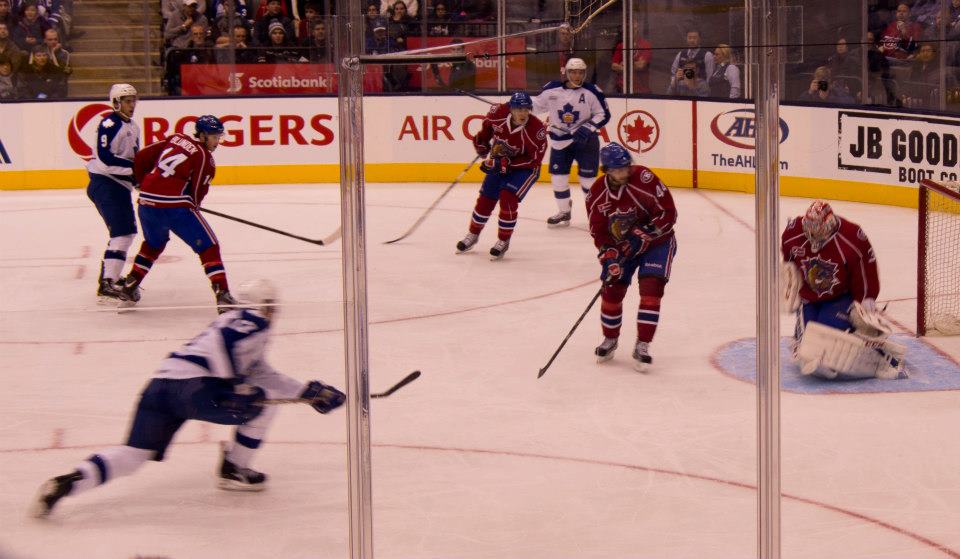
I’ve spent a lot of time in ice rinks watching beer-league and kids hockey and one thing that has amazed me is how often players will shoot the puck into the goalie’s chest. We all know that the object of the game is to get the puck past the goalie, but for whatever reason, our shot is drawn to the goalie rather than to the net. It is as though the goalie secretly inserted a small metal bar in the puck before the game and is now wearing a strong magnet under his or her pads.

Image


(American Hockey League; Toronto Marlies vs. Hamilton Bulldogs)

I’ve also decided that on a typical office trash can, the rim of the can generates a gravitational well. I say this because, no matter how often I throw a wad of paper into the can, from whatever angle or distance, I am more likely to hit the rim of the can than I am to sink the shot or miss completely. Something must bend space because if you look at the volume of the universe taken up by the rim and compare that to the rest of the frickin’ universe, it doesn’t make sense that I would hit the rim so often.

Of course, another explanation for both of these phenomena is that humans have an instinctive fetish for what we can see; that we are unconsciously drawn to the tangible to the detriment of the intangible.

The reason I wax on about this is because I believe what is true for trash cans and hockey games is also true for creativity.

After rehearsals for a sketch comedy show for which I write, I was drinking with some of the actors and one of them asked me how I came up the ideas for my sketches. How did I take a relatively mundane scenario and find just the right moment and way to skew it to elicit humour?

For me, I said, it’s about perspective and being able to ignore the hard edges of reality to see relationships no one else has bothered to see.

Image


(Photo taken in Barbados)

Too many of us get hung up on what we see, what sits before us in all its light-reflecting, retina-stimulating glory. We see reality and get stuck on that being simply what is. Reality just is. There’s nothing else other than it.

Sitting across from her, I described the wide-eyed reality I saw.

In the foreground was sugar packets, salt and pepper shakers, the table, my beer glass, her beer glass. Slightly behind that was her, the barely restrained frenzy of her hair, her facial expression, the curve of her neck, shoulders and arms, her clothes. Behind her, a table of four animated people sharing a night out (won’t go into details) and behind them, a window onto a busy Toronto street; sidewalks, pedestrians, traffic, storefronts.

I then squinted my eyes and all those hard edges faded away to be replaced with a visual melange. I could not tell where my friend ended and the woman behind her started. Vague shapes of pedestrians blebbed out of her head, like animated thoughts or alter-egos escaping into the night.

Image


(Photo of a fountain on Toronto’s Canadian National Exhibition grounds)

My perspective had changed, so my reality had changed. I no longer saw a goalie blocking my shot or a trash can rim siphoning wads of paper from the vaster universe.

However it is accomplished, I think this is what separates open creatives from the rest of humanity, and by creatives, I mean not just artists (writers, painters, photographers, etc) but also entrepreneurs and technology innovators. They understand the lowercase nature of realities rather than Reality.

The altered perspectives are there for anyone to see—and everyone’s perspectives are going to be different—but it is the creatives who choose to look for them. We can see where the goalie isn’t and choose to shoot there.

Image

(The Toronto Marlies beat the Hamilton Bulldogs at Toronto’s Air Canada Centre)


Words in other people’s mouths

I’m not an actor. I cannot act. Actually, that’s not exactly true.

I am an extreme introvert who has learned to live (and thrive) within an extremely extroverted world, so I can technically act aka hide my true identity behind a false façade.

But what I mean by acting is the theatrical form. Give me lines to memorize and my brain fries in mere seconds. I can say the line, I can emote or I can move my body across the stage…ask me to do any two of those at the same time, however, and we have issues.

I can do improvisation. I love improvisation.

The thrill of trying not to anticipate what your stage partners are going to do but instead simply react to what they have done and add to the reality of the situation is an adrenaline high of which I cannot get enough.

And the typical improv audience is a forgiving lot because they know you’re making this up before their very eyes. In fact, they will actually ask you how you prepare for an improv show and sit amazed when you tell them that you arrive at the venue slightly earlier than they did.

But even improv has its self-imposed pressures, because at the end of the day, you have to respond to your colleagues and say or do something. A couple of years ago, however, I found a work-around for that.

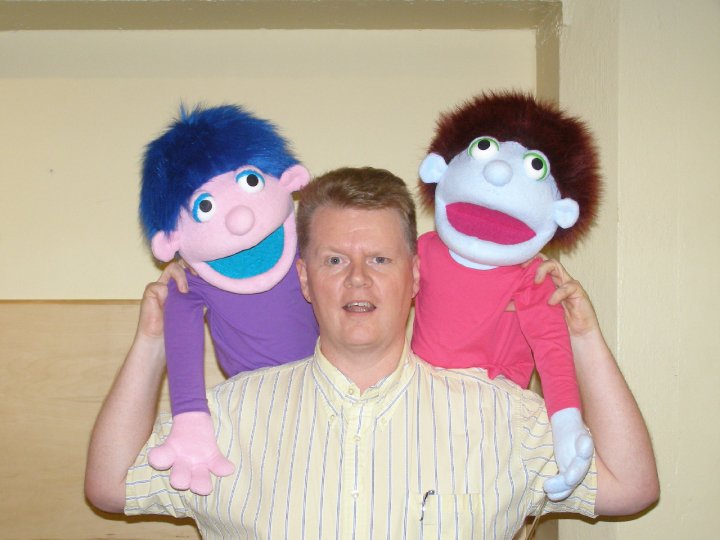
A friend of mine introduced me to puppetry improv. In this case, we put Henson-style puppets onto our hands and created amazing scenes with characters that didn’t exist until mere seconds ago.

It was magical.

Image

The minor act of picking up a puppet and letting it do the talking gave me enough distance that I was free to think and do anything I wanted without fear of recrimination. People stopped watching me and immediately followed the puppet. Whatever the puppet said was funny or poignant or shocking. Even saying nothing spoke volumes.

And if I thought improv audiences were generous, oh my God! Puppets can get away with murder! There are no taboos.

Which brings me to writing.

As it was with the puppet, so it is with writing characters for screenplays, stage plays or novels. I have the freedom to write anything, to say anything, because ultimately the words are the responsibility of the characters I create.

Maybe this is a sign of a need for medication, but when I write a character, I hear his, her or its voice in my head. Change the character and the voice changes.

By moving the focus off of me—my skills or lack thereof, my insecurities, my knowledge—I free myself up to pursue something bigger.

Or at least that’s what I’m telling myself. It seems to be working for me.

A great writers’ blog (by a great writer)

For those interested in reading some interesting perspectives on the creative process, I highly recommend a blog by one of my friends, actor and writer Marsha Mason (not the one from The Goodbye Girl).

Briefly known as WTF (which does not stand for what it may ask frequently), the Why The Face blog tackles a lot of the insecurities that most writers face; in Marsha’s case, from the perspective of screenwriting, but writing’s writing. But she also provides insights and answers gleaned both from her own experiences and those of others whom she has met.

Check it out.

My muse is a bastard

Okay, that’s not really fair, but it is fair to say that my muse and I have not always had a great relationship.

I have abandonment issues. I won’t deny it. I am working through them. But my muse has not been a lot of help in this department. For decades, I have sought inspiration in my writing and my muse has let me down. He was more “mute” than “muse”.

Image

For years, my pen has hovered over my notebooks, tantalizing close to writing, but ink doesn’t transfer. My fingers have hovered over computer keys, ever so close to making physical and spiritual contact, but the flashing black line in my Word document taps its virtual foot in anticipation of ideas yet to flow.

And even more frustrating, my muse can be a right royal inspiration tease—giving me glimpses of ideas that simply turn into moments of premature  ideation, leaving me feeling used as I clean my laptop.

What I realized recently, however, as that my muse isn’t my muse. He is, in fact, a muse—the irony of that phrasing is not lost on me.

Image

Inspiration isn’t something that comes to me. I have to go out and get it. Hunt it down. Leash it and bring it home. And in keeping with good psycho-eco-social practices, release it back into the wild when I am done.

Here I thought I had become so bloody advanced because I had an opposable thumb and personality that worked in clever union to produce written works of a certain majesty (more often than not, Ethelred the Unready, but majesty nonetheless).

Instead, I find I am still the hunter-gatherer of history. Leaving the comforts of home to find sustenance in the wilds of the universe or less melodramatically, a park bench watching people, the zoo watching animals watch people, a coffee shop watching the level of coffee in my cup recede.

Slowly, I am becoming a better hunter-gatherer. The threshold does not seem so high. I can generally snatch a muse without doing too much damage to it or myself.

Oh, it still doesn’t want to get caught, but what that means is I have to change my position slightly. ALL muses are bastards.

Image


(Photos taken at Minter Gardens outside of Chilliwack, BC. An amazing place to hunt muses!)