
Category Archives: Writing thoughts
Reflections on the use of words
Fresh eyes – writing tip

Heart of Coppola
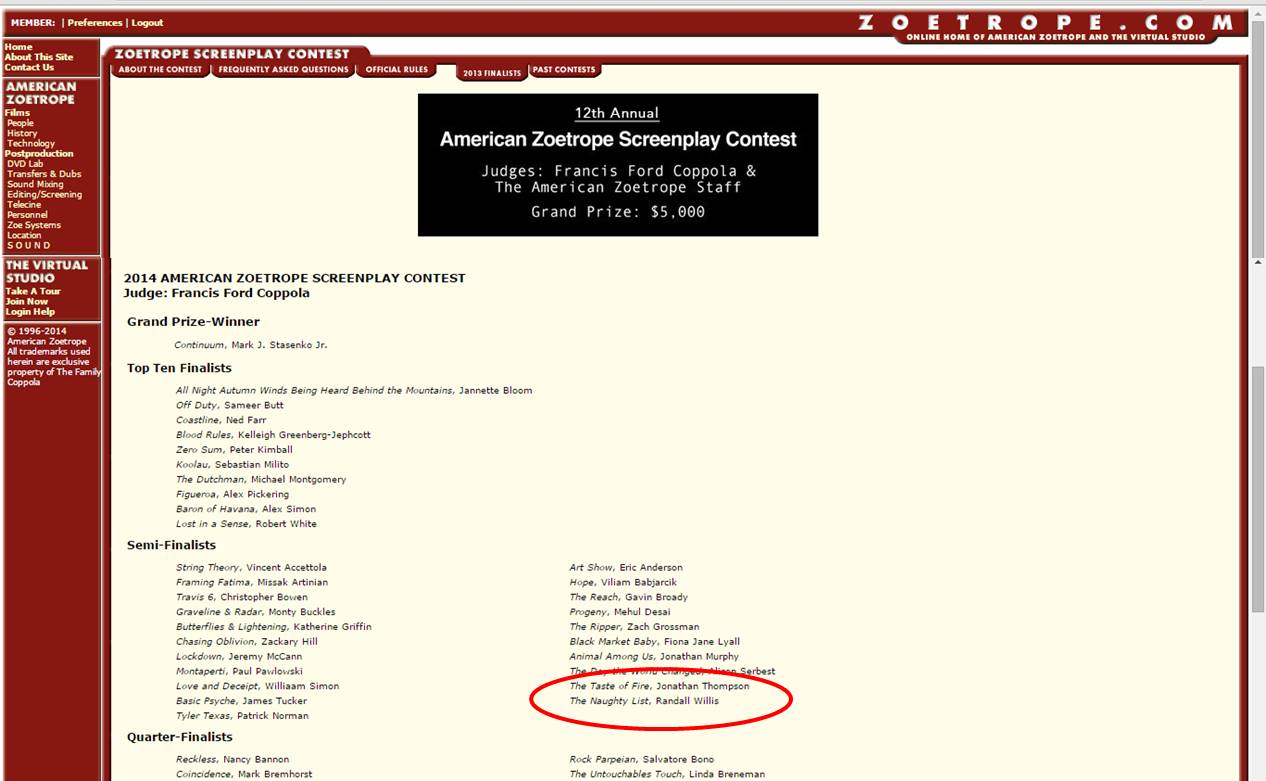
Francis Ford Coppola likes me! He really likes me!
So, no sooner do I finally get around to posting my laurels from Nashville than I find out that my screenplay The Naughty List was selected as a semifinalist in the 12th Annual American Zeotrope Screenwriting Competition, an organization run by Francis Ford Coppola (I seem to recall he was a director of geopolitical documentaries).
I had started to wonder if the screenplay was going to see any love in the competitive world…this is good!
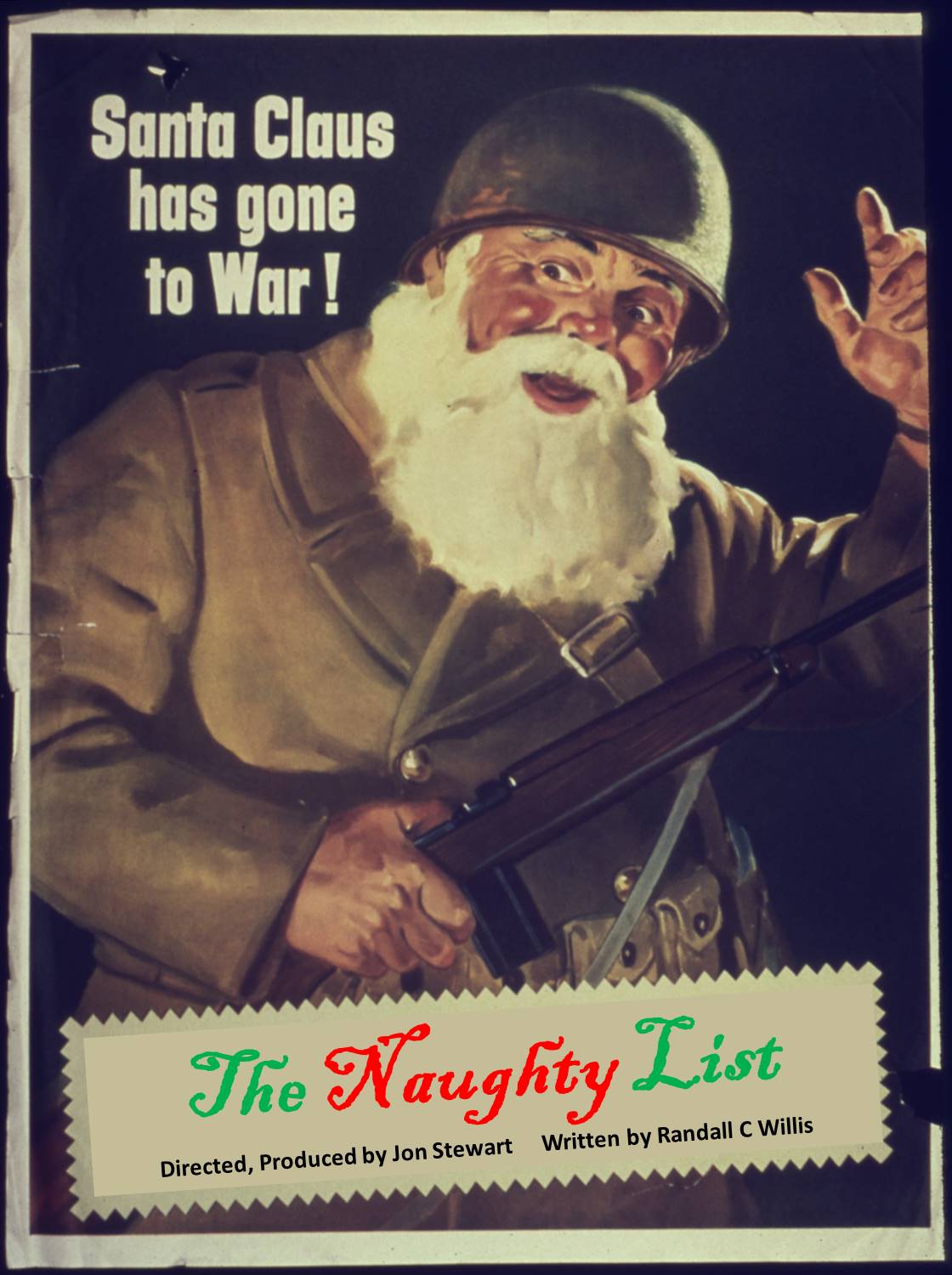
Coming to a theatre near you (please, please, please)
So, what is the story of The Naughty List?
What would you do if you learned decisions you make every year ruin the lives of millions of children?
Oh, and your name is Santa Claus.
After a brush with death just days before Christmas, Santa rescinds the Naughty List only to learn that for some kids, the lump of coal started a life-long downward spiral. In fact, two kids—now warlords—are about to unleash hell on each other and their people.
With a loving heart and snowy balls, child-like Santa dives into the fray. But his magical meddling only makes things worse.
He greases the wheels of war. More children suffer, including a girl desperate to save her family. As his magic fails, Santa knows he must face the oncoming storm as a mortal.
One man. Two armies. Can Santa stop the madness and save a crumbling Christmas?
Brain of a thousand voices

Do you become the characters you write as you write them?
Please understand, I’m not asking if you’re writing a serial killer, do you go out and take a few lives in the neighbourhood simply to get in the right frame of mind (or at least, I’m not asking you to admit it here). Rather, do you inhabit the thoughts and moods of your characters as you type/write?
I’ve often wondered what it would look like if I video recorded me writing my screenplays or novels. Do my body language and facial features reflect the inner turmoil of my characters? I know my typing does.
If I am writing people who are angry, my poor keyboard takes an absolute pounding as I act out all of the aggression that’s flowing through my characters’ actions and words. Likewise, if I am creating a scene that starts slowly and then builds to a crescendo, I find the mood of the scene is reflected in the tarantella of my fingers across the keys.
I have also noted some physical cues. The more tense a scene, the more my jaws hurt from all that clenching. My libido shifts in a love scene (sorry if that is TMI). A smile lights my face in humourous scenes. And I have actually achieved tears in particularly emotional scenes.
For the moment, I will assume that I am just emotionally in tune with my characters, but I cannot yet rule out a slow nervous breakdown.
Thus, I would love to hear other writers’ experiences in this area.

Things To Do When You Finish A Novel*
Some wonderful advice on taking a moment to celebrate your achievements
Does satire lead to social change?

I love good satire. I am a massive fan of Monty Python’s Flying Circus, The Daily Show, The Colbert Report and early seasons of This Hour Has 22 Minutes. I’ve always thought that satire was a wonderful way to point out the foibles of some aspect of society and thereby elicit change in that behaviour or belief.
The Merriam-Webster Concise Encyclopedia defines satire as:
“Artistic form in which human or individual vices, folly, abuses, or shortcomings are held up to censure by means of ridicule, derision, burlesque, irony, or other methods, sometimes with an intent to bring about improvement.”
But a recent video posted by a friend on Facebook has caused me to question the idea that satire can lead to real change. The video was a short piece performed by recently deceased Mike Nichols and Elaine May that mockingly celebrated the mediocrity of television.
The piece was performed in 1959…55 years ago…and yet I wonder if the piece isn’t more salient now in the multichannel, multivehicle universe.
Listen to the audience. They’re eating it up. They know it’s true and yet so few of them likely did anything to reduce the mediocrity of television.
Has The Colbert Report done anything to cut into the viewing audience of Bill O’Reilly? Or The Daily Show seriously impacted the rhetoric spewing out of Fox News?
After the first couple seasons of ambushing politicians on Parliament Hill with their satirical antics and challenges, 22 Minutes suffered through a period where politicians practically ambushed the performers. To be seen to be able to take a joke was good for political business, thus neutering the whole point of the satire.
In contrast, there was a recent piece on John Oliver’s Last Week Tonight about the Miss America scholarship program that showed the pageant was exaggerating in its claim to be the largest provider of scholarships to women. When it turned out that despite the bogus claim, Miss America still did provide scholarships to more women than several other pro-women organizations, those organizations stepped up their game. But such tit-for-tat examples are rare.
So, the question becomes, is satire anything more than entertainment for a group of common-thinking people who feel otherwise powerless? Has it ever been anything more than that?
I’m going to spend some time looking for examples where satire can be linked to social change, and I welcome input from anyone. So, please throw in your thoughts and come on back to see where I’ve landed.
And, even if I decide it really is simply a form of entertainment, I will likely continue to enjoy it as I would any other art form for which I have a fondness.
But I’ll be interested to see what I come up with.

Agenda journalism – Wendy Mesley v Jon Stewart

One of these people is a “serious journalist” (Wendy Mesley; Jon Stewart)
As I practice the art of writing (e.g., novels, screenplays), I pay my bills by writing for the pharmaceutical trade publication DDNews. I consider myself more of an essayist and commentator more than a journalist, mainly because I have too much respect for journalists and the tightrope they walk balancing the need to produce a story and discover a story.
With that respect, however, comes a certain level of expectation, and in too many high-profile cases, those expectations are not being met.
The most recent case for me (and the prompt for this post) was an interview between CBC journalist and anchor Wendy Mesley and film director and host of The Daily Show Jon Stewart, who appeared on CBC’s The National on November 14.
CBC The National interview with Jon Stewart (Nov 14) (video)

The interview used as evidence Bahari worked with spies (Jason Jones, Maziar Bahari)
Ostensibly, the interview was meant to discuss Stewart’s new movie Rosewater (trailer at bottom) and the events that led to the incarceration of journalist Maziar Bahari in Iran, the interrogation of whom involved video of Bahari’s discussions with a The Daily Show correspondent Jason Jones.
Ironically, the interview became an attempted interrogation of Stewart on his culpability in Bahari’s incarceration and torture, and the broader question of satire feeding the flames of fanaticism.
To his credit, while dismissing the questions as ridiculous, Stewart responded to them with logic and tried to look at the bigger picture. Mesley, however, could not be shaken from her belief that there must be guilt and culpability.
This is where I take issue.
Although I believe it is important for a journalist to know what she wants to talk about when interviewing someone, I also believe it is beholden on the journalist to let the conversation happen and see where it goes.
When I interview someone for one of my news articles, I start with a list of questions based on my research of the topic and the person/organization being interviewed. Going in, I have an agenda.
But when the interview starts, most of those questions fall by the wayside and are replaced by bigger, more important discussions that I didn’t foresee. In short, I listen to what the interviewee has to tell me and then adjust the conversation.
I completely understand that if someone is being evasive on a topic, a journalist may want to harder press a specific topic or series of questions, but in the Stewart interview, there was no evasion. He simply did not give the answers Mesley wanted, and she refused to accept them, as she is wont on many pieces throughout her years with the CBC.
Delightfully, toward the end of their conversation, Stewart called her on this, accusing her of not believing anything he said. She clearly did not do her homework on him, because she was uncomfortable with his challenge.
Sadly, this meant that the interview became about the interview and not the subjects that might have been vastly more interesting and were decidedly more important: political fanaticism, satire as a weapon, the erosion of journalism (ironically), human endurance.
An opportunity for insightful exchange was largely missed (Stewart did his best to talk about these things).
For anyone who thinks you might be interviewed at some point in your lifetime, study Stewart’s approach to this interview and any other.
For anyone who thinks you might become a journalist, study Mesley’s approach to this interview and pull a Costanza…do the opposite.
There are too many important issues to be discussed in the news to have the conversation high-jacked by a faulty agenda.
In the meantime, if Mesley wants to be an editorialist or commentator, do so. The CBC has several (e.g., Rex Murphy).
PS Some might argue that because I work for a trade publication, my questions are apt to be softball as the publication’s agenda is to suck up to the industry. One: I call bullshit. And two: read my stuff.

Happier times well after the events of Rosewater (Jason Jones, Maziar Bahari)
See also:
The passionate writer
InterOkay – review of Interstellar

I can forgive writer-director-producer Chris Nolan for naming his movie Interstellar as few would be inclined to go see a movie entitled InterOkay and yet, that is what I thought of the movie. It was okay.
Not brilliant. Not amazing. Not a cinema-changing moment. Just okay.
Set in the near future, the Earth has suffered through a variety of crop blights and other unnamed disasters that has humanity at the brink of extinction. As one school principal puts it, the human race has become a caretaker generation, simply trying to manage the status quo in the hopes that something better might show up later.
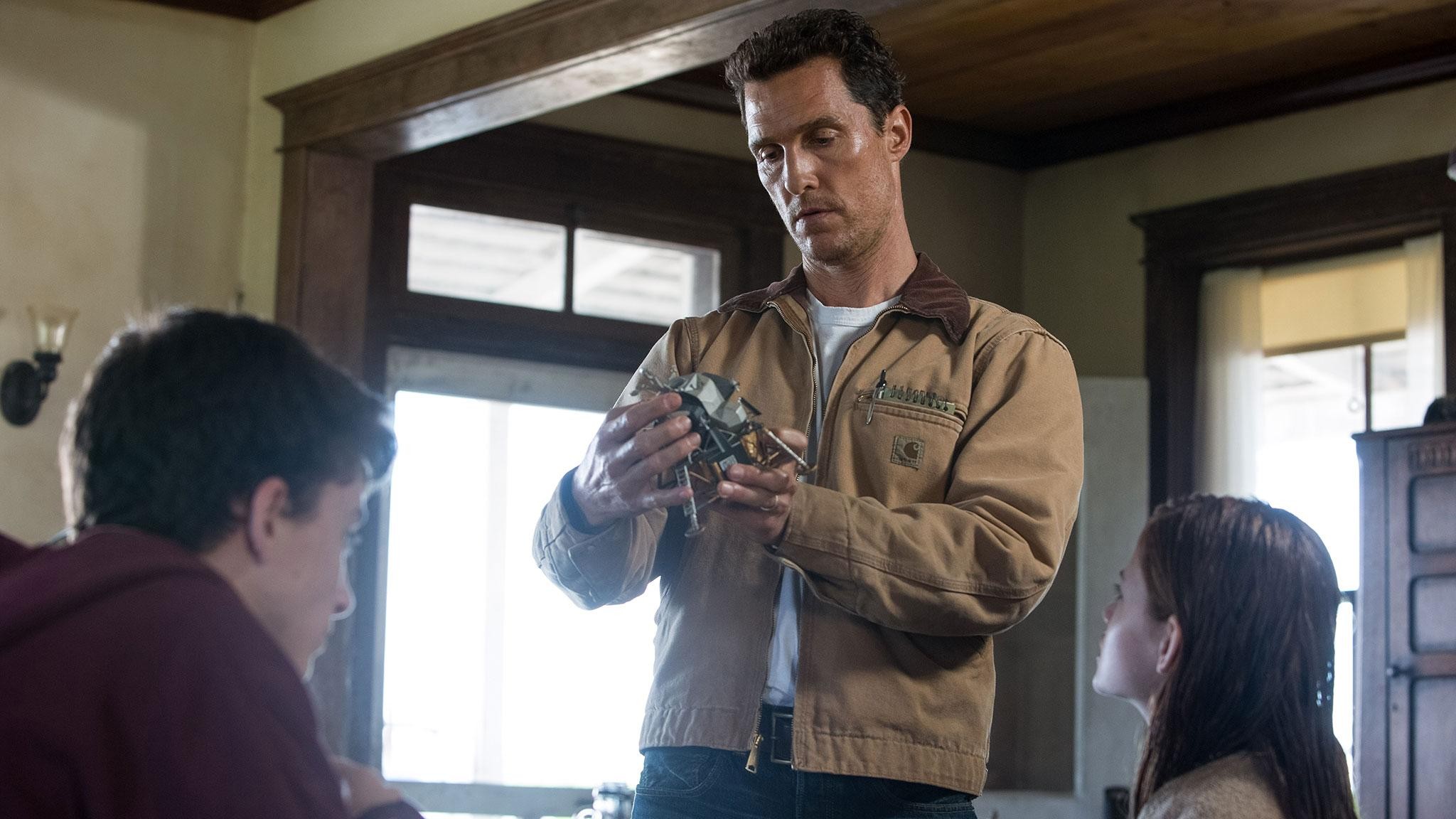
Failed astronaut Cooper struggles to keep his family whole
Drop into this failed world the character of failed-astronaut now failing farmer Cooper (Matthew McConaughey) who struggles to protect his family—dutiful son, frustrated pre-scientist daughter, sage father-in-law—from the ravages of dust storms and drought. Through a series of odd events, driven by daughter Murphy, Cooper learns of a mission to explore planets in other galaxies in hopes of finding a new home for humanity. They will get there via a wormhole that suddenly appears near Saturn, sent by a mysterious ‘They’.
To get deeper into the plot of the movie here would be to trip all over spoilers and I don’t want to do that. It would also require that I better understand the various plot points, which would likely take a second or third viewing…call me when Interstellar makes it to Netflix.
In an acknowledged homage to every movie that has come before it—Grapes of Wrath meets Top Gun meets 2001: A Space Odyssey meets Close Encounters of the Third Kind meets The Right Stuff meets Waterworld meets Prometheus meets The Black Hole meets…you get the idea—Nolan and his cowriter brother Jonathan Nolan have woven together a vision of human spirit that is broad in scope, deep in meaning and soul-defining in spirit. Or at least that seemed to be their intention.

The ones left behind search for a way out (Jessica Chastain)
On paper, the most meaningful speeches seem to come across as cliché, trite or in the most offensive cases, Pablum. And it is only because the Nolan boys have put these speeches into the mouths of some great actors—e.g., John Lithgow, Michael Caine, Jessica Chastain—that the movie is not laughed off the screen. Only actors of this quality could breathe life into these leaden lines and hoary speeches.
For me, possibly the worst example of this is scientist-cum-astronaut Amelia Brand’s (Anne Hathaway) attempt to explain love as a higher dimension of existence, as something that transcends space and time and should thus be counted as at least an equal in making logistical decisions. I’m not saying that her argument is wrong (or right) but rather that the material comes across as angst-riddled teen melodrama, made all the worse because it’s coming out of the mouth of an adult.

Ferris Bueller with lipstick? (Anne Hathaway)
Where I have to give the movie massive credit, however, is in the visual treatments. (Thank you, Director of Photography Hoyte van Hoytema and Production Designer Nathan Crowley.)
This is a visually stunning film where each image is inspired. You feel parched while witnessing the death of the American heartland and your eyes itch with the approaching dust storm. The other worlds are crafted with such realism that you sense the dampness or the cold. And for all its darkness, a black hole seems anything but black.
Without getting into spoilers, I found the story line challenging in some respects because it felt like the Nolans wrote a relatively short screenplay and then every time they asked someone to read it, they were asked “Yeah, but what about…?”
At least three times during the film, I caught myself thinking that this must be the end, only to have Nolan scream “plot twist” and have the movie spiral in another direction to tie up a loose end. Even as the credits rolled, I had the sneaking suspicion they would get half-way done and we’d have more scenes.
And the very last scene before the credits was either “Oh shit, we forgot about…” or was a ham-fisted attempt to set up the sequel (of which I have heard nothing).

As friend and fellow blogger Danny F. Santos suggested to me recently, he thought the movie might have been better served by converting it to a mini-series and I can definitely see his point. Some aspects of the film seemed rushed, despite its lengthy running time of 169 minutes. (Danny’s blog)
Given the importance of the replacement Earths to the conceit of the story, however, amazingly little time was spent on these worlds. I appreciate that the Nolans may not have wanted to make it longer, but that just lends credibility to Danny’s idea (or they could have done a Peter Jackson-Hobbit impersonation).
To their credit, the Nolan boys have woven an incredible tapestry of plots and subplots, tapping into several deep questions about humanity, the explorer’s heart, interpersonal commitment, abandonment, the purpose of science and complicity in our own demise.
Unfortunately, they used so many strings that they seem to have suddenly found themselves with a lot of loose ends that they either tied off with a bow or tied to another string. For the latter of those methods, I am confident that they wanted me to experience a revelatory “Oooooh!” but too often I was left with a confused “Eh?”
For all my issues with plot points and dialogue, however, I do have to admit that the movie passed my butt test. At no point did I find myself squirming uncomfortably. As the credits rolled, I found myself comfortably rested and satisfyingly entertained.
Unfortunately, for a movie of the scale and scope of Interstellar, “rested” and “entertained” are an indictment, not praise.
Is a Serial Serial Killer a Series Killer?

Okay. That’s it. I’m raising the red card on an issue I’ve been grumbling about—at least privately—for several years now.
To mix my sports metaphors, I am calling a double dabbling penalty on the television series Bones, which I am just catching up on via Netflix. (Spoilers coming if you’re not up to Season 9.)

I love procedural programs, and as a certified science geek, I particularly like forensic series such as Bones and CSI. If you want to piss me off really quickly, however, I recommend you start a story line involving a serial killer.
Now that may sound counter-intuitive, but I find most serial killer story lines to be incredibly lazy and highly repetitive. More often than not, the episode structure and format are completely blown apart and rather than being about solving a crime, the episodes devolve into a personal vendetta, where the lead investigator—cop or forensic scientist—goes off the rails and alienates his or her team for a few episodes (or season).
“Don’t you get it? He’s taunting me, testing me, letting me know he’s always one step ahead of me.”
Yes. We know this. So let’s move on and get back to solving crimes (aka puzzles). You know, the reason I watch your ruddy show.
Watching a procedural series turn into a psychological drama is like watching a pretty actor try to take on a meaningful meaty role. It’s typically painful to watch and not what I purchased. You’re reneged on our unspoken agreement.
[NOTE: Dexter is held outside as that always was a series about a serial killer hunting down serial killers.]
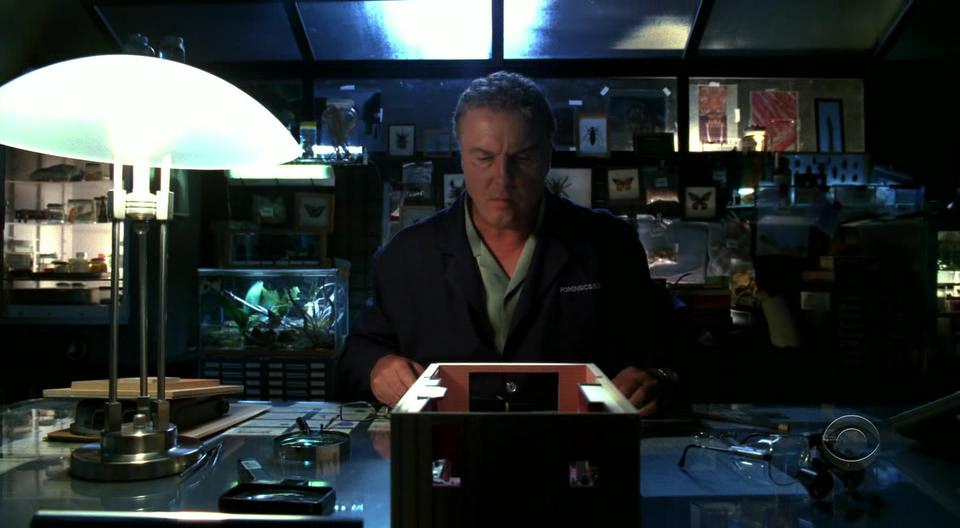
Up until recently, I’d believed that this was just an annoyance I would have to live through. God, how I struggled with Grissom’s Miniature Killer. But Bones just escalated that annoyance to a new level, which is why I raise the red card and call for an ejection…
(Last chance to avoid spoilers.)
…for Bones has used a serial killer to introduce a second serial killer.
Seriously? A serial serial killer?
It’s not bad enough that I had to watch a season or so of Christopher Pelant torment the Jeffersonian team, only to have him torment Bones herself with news that several unsolved murders are connected and that her negligence has allowed a serial killer (The Ghost Killer) to go unchallenged. And all just 24 hours before Pelant is killed by Booth, leaving everyone but Bones questioning if he was just lying to drive her nuts.

So now, as a fan of the show, I conceivably get to sit through yet another season of the Jeffersonian team getting torn apart by this second serial killer. Can you tell how excited I am?
Remember when Fonzie jumped the shark? Well, Bones just jumped not one, but two (so far only two) serial killers.
As an open note to television writers and showrunners, when you’ve run out of things to say, stop talking. End the series. Take your bows and move on.
I will keep watching Bones, if only because I’m an idiot and have invested 8.5 years of my life to these people. Also, I know there is a significant death coming in early Season 10, not yet on Netflix Canada.
We’ll have to see who outlasts whom, but I know which of us is on life-support.

 createdbyrcw