The life of anyone practicing an art form—whatever you do with passion is your art—is a continual balancing act between impassioned self-expression and self-questioning despair. For me, this duality revolves around my efforts in fiction writing (i.e., screen, novel, poetry, short stories, etc.).
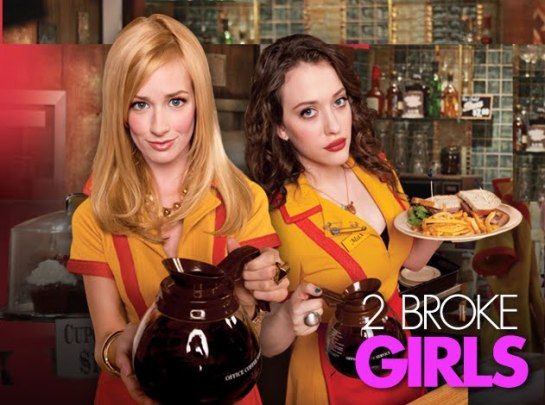
Earlier today, I learned that the television series 2 Broke Girls ended its six-season run on CBS, and the news briefly shifted my balance toward despair.
On a couple of occasions, I tried to watch the sitcom about two broke girls plying their trade as diner waitresses while targeting a dream of opening a cupcake shop. But each time, I had to turn the show off after a few minutes because I found the comedy so excruciating.
Every 15 seconds, there was yet another wink-wink nudge-nudge one-liner that I felt lacked any art whatsoever, dialogue that but for an incessant laugh-track would likely have been met with complete silence in front of a live audience.
And yet, the series aired for six seasons. It had enough of an audience for CBS to keep it on the air.
I like broad comedy; truthfully, I do. I even write it on occasion.
I live for Mel Brooks’ comedies, for Monty Python’s Flying Circus, for Blackadder, for The Muppet Show, for SCTV, In Living Color and Kids in the Hall.
Anyone who has followed me for any period of time—especially on Twitter—knows I am up for any joke-opalyse.
But the appeal of 2 Broke Girls and its ilk—looking at you, Two-and-a-Half Men—simply eludes me. It feels like one-liners in search of a higher purpose.
But here’s the thing I constantly need to remind myself:
This difficulty rests entirely within me, and has nothing to do with the creators or writers of any of these shows.
Celebrate, don’t negate
Getting ANY television show to air, getting any screenplay turned into a movie is difficult, even in this era of seemingly limitless venues and diminishing equipment costs.
That any show manages more than a pilot episode is amazing. So, six seasons of broadcast should be celebrated from every mountain top.
As an artist, I applaud 2 Broke Girls creators Michael Patrick King and Whitney Cummings for getting their show on the air. I congratulate the people behind the Sharknado series for continuing to produce films.
To denigrate these efforts simply because they do not suit my tastes is not only unfair, it is also blatant hubris.
Who the hell am I—a writer who has one television special to his credit (thank you, SomeTV!)—to say that these efforts are unworthy of attention?
For that matter, even if I were more routinely lauded and vastly more accomplished, it would not be my place to dictate what should be valued as Art.
And as an artist, as someone exploring my passions:
Dwelling on this topic is useless. More importantly, it is detrimental to me and the craft as I exercise it.
Remembering why
It would be naïve to suggest that trends in comedy and writing have no influence on my career as a writer, but honestly, my career is secondary to my writing; a beneficial side effect, if you will.
Comparing my efforts to those of others is therefore unimportant.
My only true comparator is what I wrote yesterday and any internal sense of whether I am getting better at making the points I wish to make, telling the stories I want to tell.
I write because I have something to say.
I write because I don’t know how not to.
I write because it brings me joy.
Certainly, part of understanding my craft is seeing how others approach the same challenges and opportunities I face.
Just as I must choose my path forward, so too must they theirs. Although I may not see the merits in their choices, they are doing what is right for them and I must honour that.
There is room enough for all of us.
Disclosure:
I own complete series collections of Get Smart and Hogan’s Heroes, which I appreciate others might consider as insipid as I do 2 Broke Girls.
When I have told a story well, I have merely put in place the elements from which you will create your own version of the story.
You meld these elements with your own perspectives, histories, moods and experiences to go places that I can’t begin to imagine.
In this way, Art is a communal exponential experience, and the Universe is as blessed by the one who receives the gift as by the one who first shares it.
I just finished watching the last episode of Tales by Light, a series originally produced by National Geographic but released in Canada on Netflix.
The series follows several different photographers (mostly of nature), and at least in the first season, spent a lot of time discussing their personal journeys of exploration and processes of photography, a subject close to my heart.
Although my personal interest is in nature photography, with a dabbling in other forms such as sports photography, the final episode of Season Two was particularly poignant, focusing on Stephen Dupont‘s exploration of death.
A documentary photographer, Dupont has covered many war zones and had developed something akin to PTSD from his years surrounded by carnage and mayhem. To cleanse himself, he set out to explore the more honoured rituals of death and the celebrations of lives lived.
I have no intention of photographing war zones, but one thing that struck me in Dupont’s episodes was a comment he made about photography and his reverence for his subject matter. The comment epitomizes my approach to photography, and I feel blessed to have heard it described so eloquently.
I’ve always seen photographs as gifts. You do not take them; they are given to you.
I agree and am eternally grateful.
I am routinely blessed by my subjects, who give me their time and patience as I fumble to capture a moment.
Blazing your own trail can be rewarding, but comes with risks. Photo by David Valuja via Pexels (bit.ly/davidvaluja)
If you read enough—screenplays, novels, articles, poetry—your mind can go numb to the sameness of storytelling, whether in subject, structure, narrative style or innumerable facets you no longer see.
As a storyteller, I dread the idea that my work falls into that category, and yet I know some of it does.
The urge, therefore, is to come up with ways to surprise the reader, to give their eyes, minds and souls something they have never experienced before.
We are creatives, so why should we not be creative?
How can I shake things up in my storytelling to dazzle the reader?
What if my characters all spoke in limericks? What if I wrote my action descriptions as music? What if I named my characters using the military alphabet (see M*A*S*H)?
Yeah, what if you did any of those things?
Novelty and expectation
The biggest challenge in going with your own style is that it absolutely has to work. There is no middle ground.
Out of the gate, you are going to piss off traditionalists: 1) they expect to read things in a certain way and don’t embrace change easily; and 2) they see your decision not as innovative, but rather as the act of a storyteller wrapped up in his or her ego.
Who are you to think of yourself as above the law?
(Very melodramatic, these traditionalists.)
Even with readers willing to go on a ride, however, you’re going to need to prove that your method is worth the effort, that it brings something to the storytelling experience that a more traditional approach does not or cannot.
In a recent Go Into The Story blog post, Scott Myers looks at how the writers of Wall-Eused a very unconventional, almost poetic style for their scene descriptions. Offering examples from the screenplay, Myers shows how simplifying the descriptions allowed the writers to focus on what the heart felt rather than what the eye saw. In the process, they created a very fluid and impactful read.
Descriptions more poetry than prose. (Wall-E, written by Andrew Stanton & Jim Reardon)
Up for the challenge?
So, should you rush back to your manuscript and do the same thing? Or do an equivalent that best suits your specific narrative?
The answer to those two questions is unfortunately two other questions.
Is there an appropriate equivalent? And can you pull it off?
Even if there is an alternative way to present your story, you may not yet be ready to effectively execute it.
Your writing skills may yet require some seasoning until you can effectively pull off non-traditional approaches to storytelling.
Alternatively, you may be approaching this challenge with the wrong (I hate to use that word) mindset; that you’re seeking novelty for the sake of novelty and not because it will enhance the power of your story.
That said, if you really want to try something new, if you really want to challenge yourself, then go for it.
Go for it
Nothing is permanent. Versions can be saved. You can always retell the story in a more traditional manner.
Even if it doesn’t work, you have improved your storytelling skills for the experience.
And ultimately, to counter my earlier point about others’ reactions, most of us tell stories because we have a passion for storytelling. The business of storytelling is secondary.
I welcome and encourage you to continue to explore that passion, both for your own happiness and because that is how you will create the truly remarkable.
To learn more about effective storytelling, as well as the power of story analysis and story coaching, visit:
Photo property of Iejano (www.flickr.com/photos/lejano/). Used without permission but undying appreciation.
There is a bridge that crosses Toronto’s Don River—the Queen Street Viaduct—that is itself bridged by an arch inscribed with the message:
“This river I step in is not the river I stand in”
The sentiment, I have learned, is an adaptation of the teachings of Heraclitus as handed down in Plato’s Cratylus:
“Everything changes and nothing stands still. You could not step into the same river twice.”
It is a concept that I have come to embrace deeply through my many walks around and across Toronto, my camera firmly planted in front of my face.
Although I regularly seek new routes to follow in the hopes of discovering previously unknown treasures (at least unknown to me), I also revisit well-trodden routes to explore the changes that occur from visit to visit.
As Heraclitus suggested, our world is one of constant transformation if we but seek to see it.
Every nature walk brings me new species of plants and animals to photograph and opportunities to better appreciate the ones I see regularly.
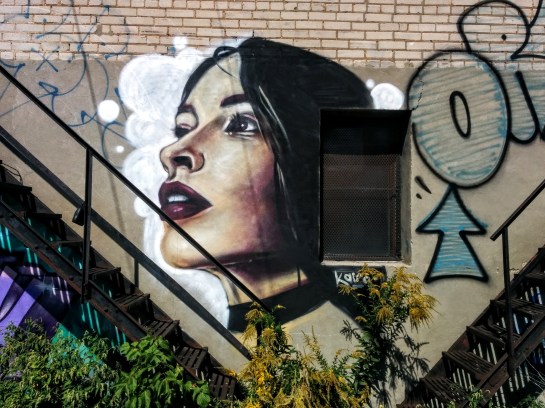
Every lane way and alley along the grid of thoroughfares that cross my city, offer me windows into the temperments of street artists and social commentators who splash their messages and visions on every surface in dazzling colour.
These displays and their constant revision is one of the reasons why I will never be bored on any of my walks. But there is another reason that resonates within me much more deeply.
I am constantly changing.
Just as Heraclitus suggested that the river flows and so is not the same from one minute to the next, my life and my experiences continually flow and so I do not greet my world in the same way from one minute to the next.
The same yellow warbler might sit on exactly the same branch at the same time tomorrow and I might never see it. And even if I did, I would appreciate it in a completely different manner for reasons I cannot begin to fathom and recount today.
Every experience—regardless of whether I am conscious of it—changes me and influences how I frame and absorb my universe. Acknowledging that helps ensure that I am open to all of these new experiences within supposedly familiar ground.
Thus, to paraphrase the Queen Street Viaduct:
“These eyes I look with are not the eyes I see with”
Believing this, I live in an amazing world and embrace every moment for its wonder.
Mother, Nehiyaw, Metis, & Itisahwâkan - career communicator. This is my collection of opinions, stories, and the occasional rise to, or fall from, challenge. In other words, it's my party, I can fun if I want to. Artwork by aaronpaquette.net
 Where are the troubadours?