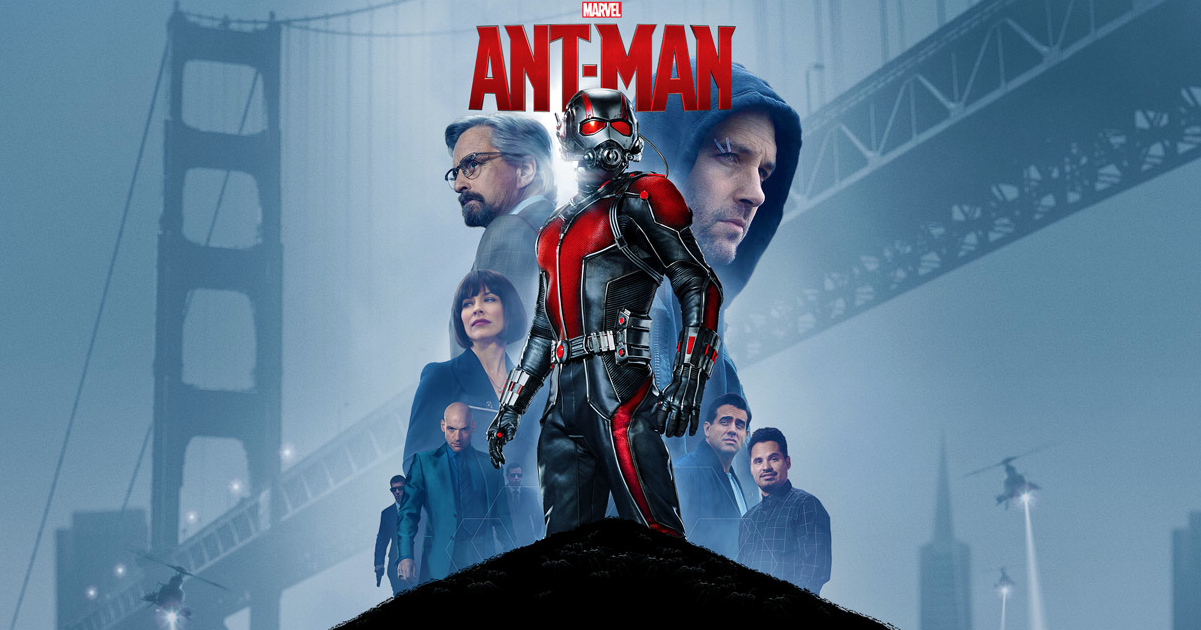
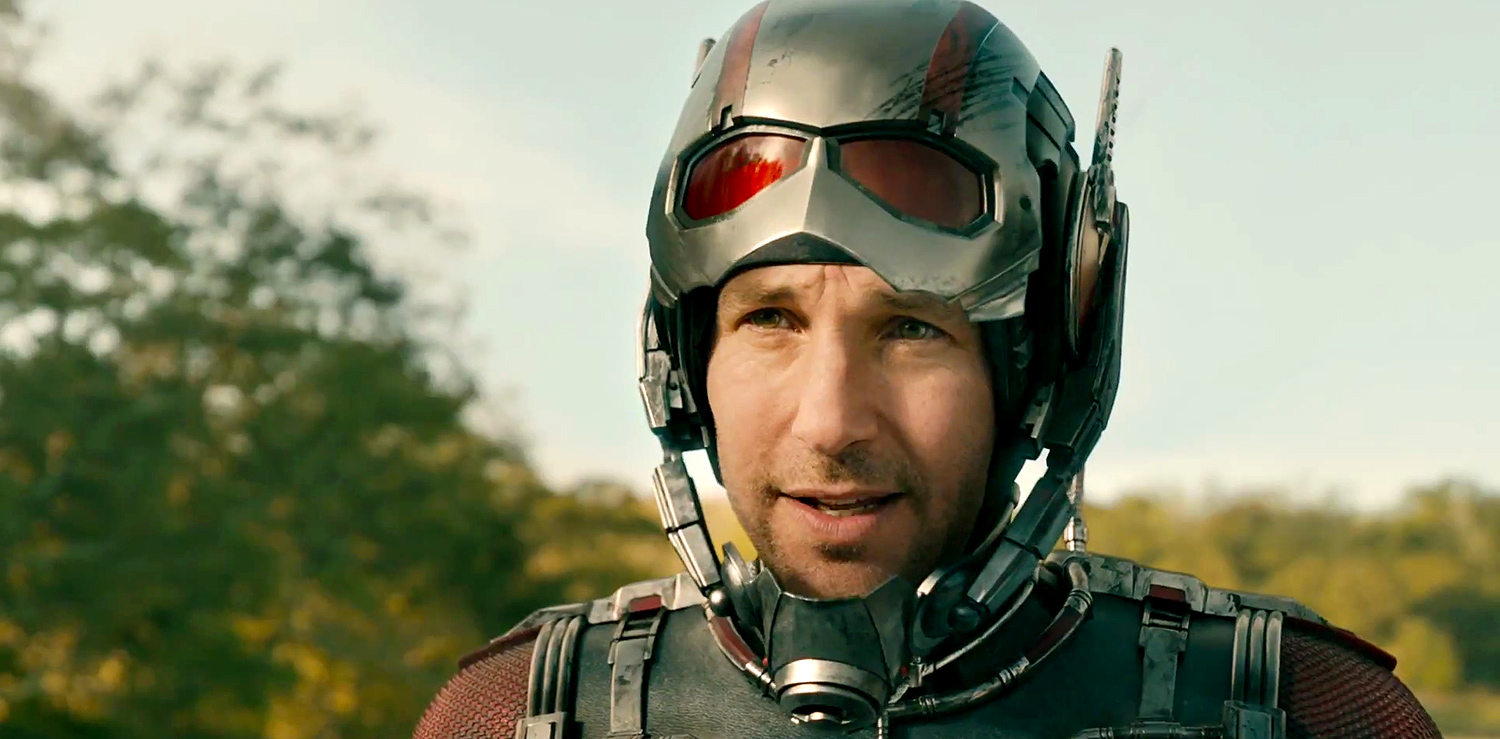
Paul Rudd and his dimples want to don a motorcycle suit and play superhero. Yeah, that’ll work, I thought with a ready batch of vitriol sliding around my tongue-in-cheek.
Thus, I went to Ant Man last night expecting a disaster…and was surprised. Not only was Ant Man not a disaster, it was actually a delight; easily becoming my favourite Marvel movie to date.
As my friends and I discussed over beers, Paul Rudd plays Paul Rudd. It is the only character he knows. The immensely likeable fuck-up doofus who somehow manages to do the right thing in the end. As such, Paul Rudd is perfectly suited to likeable fuck-up roles in movies like Our Idiot Brother (you’ll never guess which role he plays in this movie).
But a superhero? Really? I didn’t see it.
But it is the doofus that makes Ant Man work. And it is the doofus that makes this movie so approachable to a mass audience.
Sure, these are all comic book movies. You are asked to leave your credulity at the door as you make your way to your seats. These are gods, aliens, spirits and every once in a while humans with supernatural powers or genetic mutations.
Let’s face it. Tony Stark only gets to keep company with these guys because of his smarmy wit, which is his supernatural ability, brought to life deliciously by Robert Downey, Jr. The suit is just a nice-to-have.
How the hell did Paul Rudd and Ant Man get into this picture? Even the movie makes fun of the costumed crusader’s name.
Rudd manages to make Ant Man believable and by that, I mean both the character and the entire concept. The doofus brings a heart to this character, a grounded reality to this character that no one else has ever managed. He is what Peter Parker was supposed to be, but without all the angst.
Doofus as superhero? It works!
You could have a beer with Ant Man, and that is why this movie will do incredibly well.
Ant Man is also amazingly funny, rife with jokes and awkward moments that completely work. Even a sourpuss like me was heard to laugh out loud on more than one occasion. Some of that comes down to Rudd’s timing, but no character is left without laughs. Everyone contributes in this movie.
Another factor is that you don’t have to be immersed in the Marvel universe to get this movie. You don’t have to have seen every predecessor movie to understand what is happening—see my previous thoughts on Age of Ultron. Only in a couple of places would that knowledge have made the joke better, but even there, the jokes worked.
The story is a comic book story, and so has the depth one might expect of something aimed at 10-year-olds, but again, that’s the kind of story in which a doofus revels. And unlike the other Marvel films, this adds a touch of Wile E. Coyote, just to keep it light.
My only other notes of…well…note: Michael Douglas is amazing; Evangeline Lilly is gorgeous and fun; and I have never wanted a pet ant more in my life.
Earlier today, I had the opportunity to see the latest Pixar movie Inside Out in the company of one of the film’s writers and its story supervisor Josh Cooley (a very nice man). And aside from receiving a lovely lecture about story development at the famed animation house, the connection afforded me an opportunity to appreciate the movie much more than I did on simple viewing.
To briefly bring everyone up to speed, Inside Out tells the story of the emotions that rattle around inside the mind of 11-year-old Riley as she struggles with a move across the country. Although we are introduced to 5 main emotions in Riley Headquarters (get it?)—Joy, Sadness, Anger, Disgust and Fear—there is no mistaking that Joy is numero uno in this space.
Joy (voiced by Amy Poehler) sucks the oxygen out of any room she’s in and proves that even the best intentioned of assholes is still an asshole. Her goal in life is to make every moment of Riley’s life a happy one and is not worried about shoving aside the others (ever so happily) to ensure that.
But where Joy has developed a respectful détente with Anger (Lewis Black), Disgust (Mindy Kaling) and Fear (Bill Hader), she firmly but gently has no use for Sadness (Phyllis Smith), practically ostracising the poor creature to the periphery.
With the upset of the move from Minnesota to San Francisco, though, Sadness seems to want to be more involved and in a fracas with Joy, the two get sucked out of headquarters and into the long-term storage hinterlands of Riley’s brain.
At this point, the story basically turns into the Odyssey as the two emotions struggle to return home before Riley falls completely apart at the hands of the others. (To say much more would be to offer spoilers.)
Joy and Sadness wander the hinterlands of long-term memories
The challenge I had was in trying to figure out exactly at whom Pixar was targeting the movie.
Superficially, this is a pure kids movie (ages 6 to 10, maybe), unlike many previous Pixar concoctions, which had elements for both kids and adults. Inside Out doesn’t have the depth of Toy Story or The Incredibles to truly speak to adults, much as the most mature 11-year-old isn’t ready for the adult world.
I’m not saying there aren’t adult-focused jokes interspersed throughout the film, but rather exactly that. They are interspersed, like small granules of sugar designed to feed the parents accompanying the kids to the theatre.
Up talked about loss and aging
There is no real adult storyline to this film to touch adults as there was in Up or Wall-E. Instead, the film has sweet, adorable moments of baby bums and first goals that might tug at a parent’s heartstrings but never engage the soul.
But as a friend suggested, it is not strictly a kids flick either because it touches on esoteric aspects of the psyche that kids that age would never be able to comprehend, such as abstract thought and the concept of forgotten memories. The problem is these aspects are more conversations of the mind and not the soul. So even here, the adult is largely passed over unless they have an interest in neurology and psychology.
Wall-E dealt with issues of love and environmental destruction
And as a writer, perhaps the biggest sin with Inside Out is there is no sense of what’s at stake.
Sure, Joy is losing her cool as she fights to get back to headquarters. For her, Riley having a down moment is a disaster.
And Sadness isn’t exactly having a picnic as she is routinely sideswiped or ignored by Joy in their efforts to get home. If anything, she increasingly takes the blame for everything onto herself.
But what’s at stake? What if they don’t get back to headquarters?
Does someone die? Is life no longer worth living?
I don’t know because that was never a question on the table. And without stakes, I find it difficult to root for the hero.
And this challenge is made all the more difficult by the fact that the hero (Joy) is also the villain, albeit passively. She is truly her own worst enemy, and so I quickly find myself irritated by her with no great concerns about the outcome.
The six hour conversation and lesson with Cooley helped me see a lot more of what the writers, animators, editors, directors and producers were trying to accomplish. And that did help me understand the movie better. The thing is, few others were going to get this kind of help.
The movie will do well at the box office. Of that I have no doubt. It is a wonderful vivid distraction for young kids.
But it won’t have the staying power of Pixar’s earlier efforts and likely won’t be spoken of again in a few years other than in possibly hushed whispers.
Good guys not only finish last, but they also end up in tears, sitting in abandoned hallways, facing a life devoid of love ones.
Or at least that’s the moral of the movie Whiplash, which tells the story of a young jazz drummer (Andrew Neiman, played by Miles Teller) attending a prestigious music school in New York. Neiman’s lone dream is to become the next Buddy Rich.
(Warning: The following contains teasers of spoilers…tried my best.)
While practicing late one night, Neiman finds he is being observed by Terrence Fletcher (played by JK Simmons), the god-like instructor of the school’s top band, which has won both national and international acclaim. The interaction doesn’t go well.
But the erstwhile Svengali sees something in Neiman and eventually invites him to join his class, which is where the student begins to see the master less as a dedicated and willful but nurturing teacher and more as the manipulative, malevolent force striving for an unreachable ideal.
Perfection or death is Fletcher’s creed, and if you’re not willing to kill yourself over your failings, he is willing and eager to do it for you. You are using up valuable oxygen.
The beast will be satisfied (JK Simmons, Miles Teller)
Even in the face of this unending physical and emotional torture, which includes an airborne chair, however, Neiman is willing to sacrifice everything to become the Charlie Parker of the drums. And that sacrifice extends to his budding romance as well as his family.
Nothing will stand in the way
But even that is not enough for Fletcher and we watch Neiman self-immolate while the monster emotionally fiddles with everyone’s lives. Unsatisfied with Neiman’s ashes, however, the master lures the student back with a siren song of greatness in a move that only the audience can see is designed to destroy Neiman yet again.
Perfection is everything (Miles Teller)
But just when Satan achieves his final triumph, he is surprised to learn that his fallen Angel has learned a few things. And this is the ultimate Fall of Man of which we hear in poetry.
The final moments of the film are like watching Luke Skywalker take Darth Vader’s offered hand on the catwalks of Cloud City and unite to rule the Empire, destroying both the Emperor and the Rebellion in one moment.
Throughout the film, the heart palpitates until threatening to arrest from the crushing weight of the increasingly up-tempo music (think frenzied, not dancing) and Fletcher’s relentless pounding on Neiman’s soul. By the end of the movie, you will be exhausted and sated by the ecstasy of what has been achieved.
It will only be later, in the calm aftermath of normal life, that you will begin to understand the dreadful cost of that achievement, not just for Neiman but also for humanity.
If the documentary Blackfish drove people away from marine parks, it wouldn’t surprise me if Whiplash drove parents away from music schools.
Simmons won Oscar, BAFTA, Golden Globe & SAG
Simmons won the Academy Award for Best Supporting Actor (and Golden Globe, BAFTA and SAG) for his performance as Fletcher, although as crucial to the story as his role was, it could be argued he was a co-lead. And although I admit to not seeing the films of any other performers in this Oscar category, I am surprised the award was given to Simmons.
The man’s performance was quite good—he played Fletcher so malevolently, I would probably take a swing at Simmons if I saw him—but it didn’t feel like the character required a lot of the veteran actor aside from pushing the portrayal beyond anyone’s comfort zone.
Where the film definitely deserved its Oscar and BAFTA wins was for sound. The music was amazing and despite being constantly interrupted, it still managed to deliver its power and its physical toll on mere flesh and blood. Each piece became its own rush toward a climax that never arrived, pushing you until your body screamed for catharsis and was instead met with a cut to the next scene. (Editing was pretty impressive.)
Again, however, despite all of these wonderful facets, it was the moral Fall of Man in the face of all this magnificent music that bothered me. For if nothing else, it made me question the purity of artistic expression and whether it was worth the exorbitant cost of another human soul.
The moment of our greatest achievement, writer/director Damien Chazelle tells us, is also the moment of our greatest loss. I find that sad.
Watched Rashida Jones‘ documentary Hot Girls Wanted about the amateur porn industry and can honestly say I have no idea what I think of it.
Part of the challenge is I have no idea what the point of it was other than to document the experiences of several young women (18-25 y) as they approach and experience the lifestyle. We can argue day and night about whether the lack of an overt agenda or POV is a good thing, but to my mind, it presented the women as neither victims nor empowered…simply as women who made a choice.
To be blunt: These women chose to go to Fuck Camp to make money and escape home.
It is interesting to watch the impact of their decisions on their lives and particularly their relationships with families and boyfriends. And I had to laugh at the irony of one woman who was clear in her rationale about her decision until it came to talking to her father about it.
And I must admit that I was surprised at how cavalier (my biased standards, not theirs) the women were about what they were doing, the potential hazards of the situations they found themselves in, and any thoughts as to how this might impact future life decisions beyond the 3-6 months they made money (not a typo…a woman’s “marketability” typically only lasts 3-6 months).
One of the few images I’m willing to show
Over its 82-minute span, the documentary drags a little in places and often covers the same ground, no doubt to reinforce some of the more graphic elements. And it is graphic, stopping short of showing the actual sexual acts, but giving you enough of the rest (e.g., nudity, bondage, choking, vomiting) to bring across the essence of what these women are doing.
And in the end, the take-away is whatever you take away from this story.
No matter what your opinion going in, this will only reinforce that opinion. It doesn’t seem to be aimed at making you change your mind about the merits or evils of this industry. The same woman who feels exploited in one scene expresses a sense of empowerment in the next, and in some cases, about the same act.
Adult women making adult decisions about the adult industry. Good or bad is for you to decide for yourself.
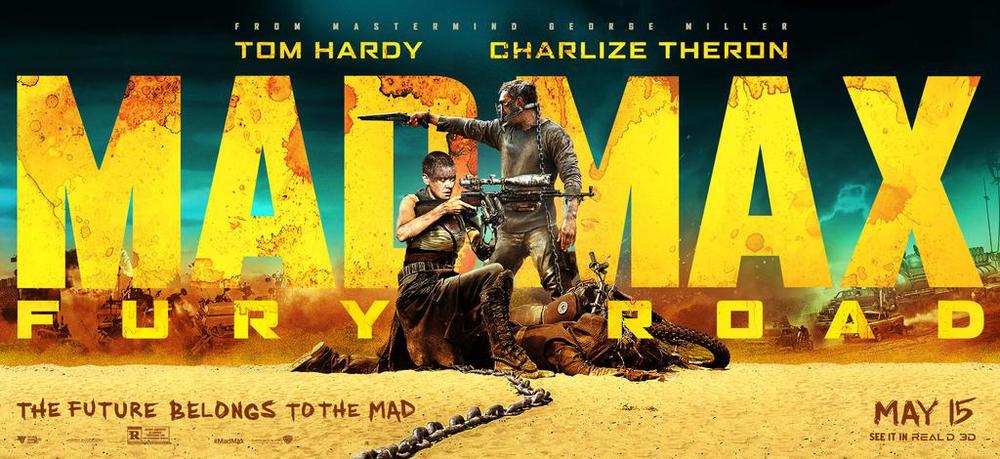
If you are looking to have your mind blown away by astounding visuals and amazing stunt work, blinding sandstorm apocalypses and psychotic banshees, mind-searing explosions and grotesque examples of human depravity, then you should really see Mad Max: Fury Road.
If you’re more interested in carefully constructed characters trying to make sense of a world gone mad, learning to cooperate even with their most hated enemies if only to survive and in the process, learning more about themselves as humans, then go watch Lord of the Flies (YouTube), because Mad Max: Fury Road has none of that.
I liked the movie. I liked it a lot. But I never engaged in the movie.
Throughout my time watching it, it remained a movie that stimulated my retinas and ear drums, but never reached my brain or my heart or my gut.
(NOTE: Some spoilers may follow.)
To summarize the plot:
Tanker truck driver Imperator Furiosa (Charlize Theron) is sent on a mission to go from the Citadel, a collection of humans controlled by the self-described demi-god Immortan Joe (Hugh Keays-Byrne), to deliver fuel and mother’s milk (you have to see it to believe it) to Gastown, presumably another citadel situated across the desert.
As she heads off with her armed escort—this is post-apocalyptic, gang-ravaged Australia, after all—Furiosa veers off the road, taking everyone into the desert. Unbeknownst to everyone else, she has stowaways aboard; Joe’s five prized breeder women whom he is using to build his master race (think Sister Wives meets TLC’s 19 Kids and Counting). Furiosa is taking the women to security in the mystical Green Place.
Learning that this has happened and that his fertility harem is gone, Joe calls out his troops and signals Gastown to do same, and a two-pronged pursuit across the desert is on.
Further complicating matters for Furiosa is her need to fight off the marauding gangs that litter the desert-scape between the towns and who want to steal her precious fuel.
Chase into sandstorm best part of movie
That gets you started on the story. Much more and we’re in spoiler territory…although, there are few revelations in this film that could get spoiled.
The one thing you may have noticed about my plot summary is the absence of Max (Tom Hardy), the title character of this film and the three originals of the series. That’s because, for about half of the movie, Max is just along for the ride (in some cases, quite literally).
Universal blood donor Max (Tom Hardy) is mostly along for the ride
Without question, after an initial misunderstanding, Max helps Furiosa in her journey—that is what Max does in these movies—but this is Furiosa’s journey and thus, her movie.
One of the challenges I have with the story and in retrospect, possibly one of the reasons the film never engaged my heart or gut, is I don’t ever recall learning why Furiosa is helping the women escape. From the outset, she seems to have a position of prestige within the Citadel, even if it is Hell incarnate. And while we do later get a sense of her long-term desire to leave, I still don’t recall the reason why she would jeopardize her escape by taking the women.
Imperator Furiosa (Charlize Theron) just wanted a peaceful drive in the desert
Although Joe is obviously angry at the betrayal, the fuel for his pursuit is the reclamation of his harem. Furiosa made her life more difficult by taking them, which would be fine if I understood why. People make outwardly rash decisions all the time in film—else there would be no film industry—but they always have an internal rationale for the decision that the audience can appreciate. That did not exist here.
Likewise, I didn’t understand why these women were so important to Joe. Yes, they were the most attractive of the fetid bunch that we see onscreen, but I am confident that they could have been replaced more easily than the fuel that was used in their reclamation. Even if it was just ego, show me that.
Immortan Joe (Hugh Keays-Byrne) is Leader of the Pack and universal sperm donor
I’m not expecting nuance in these characters—that would probably get you killed in this environment—but I would like to understand more about the rationales inside their heads.
The other thing that kept me from engaging was—to borrow a metaphor from This is Spinal Tap—that writer/director George Miller turned the dial to 11 the moment the chase started and largely left it there throughout the movie.
There is no denying that this provided a rush, much like being strapped to the nose of a bullet train, but after a handful of minutes like that, it just becomes normal. Rather than slowly escalate through the film and let me see that the next threat was more gruesome than the last, it was just one long chase scene with the same ever-present threat.
Sure, there were moments of quiet and introspection—if nothing else to provide exposition for where we are and what we’re doing—but the transitions there were like cranking the dial from 11 to 1 and then cranking it back up to 11.
This is largely why I say there is nothing to really spoil in discussing this story…there was nothing that really shocked the audience or caught them off guard. The cinematic experience was beautifully choreographed, but someone forgot to pull up the footmarks from the floor, so the audience was always aware if the next scene was going to be a tango, a waltz or the cha-cha.
But hey, this is an action film, and if it provided one thing, it was ACTION (all caps because that’s how much action it provided).
Like the man in the old Maxell Tapes advertising, you will be blown away by this experience. But when the lights go up, you will straighten your clothes, brush your hair and find yourself completely unaffected by this movie. Just a couple of hours at an amusement park.
Oh, and as for Max, all you really need to know is: yeah, he’s still messed up about his family (see Mad Max Movie #1), but he’s largely a good guy.
So, you plunk down your $20 for the new IMAX 3-D Star Wars film. You saw the two previous trilogies, so you think: “This is going to be so cool.”
But then you get a glimpse of Captain Jean Luc Picard and think: “What the feck?”
And then a few minutes later, there is a reference to the smoke monster, and you scratch your head: “How did Lost get in here?”
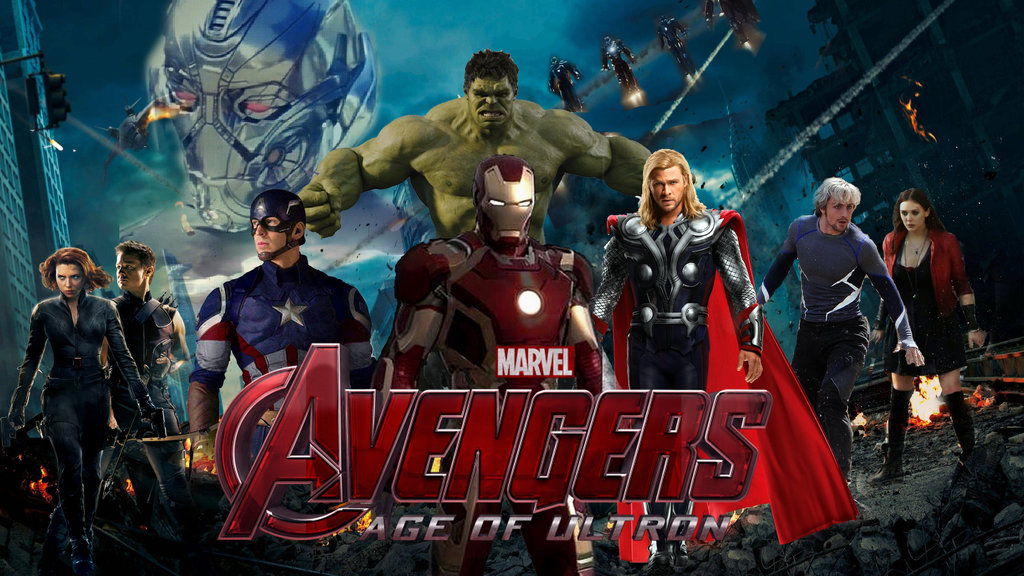
That’s the way I felt after watching The Avengers: Age of Ultron…or perhaps, more accurately, after sitting in a bar for 4 hours after seeing Ultron with friends who are completely immersed in the Marvel universe.
In fairness, I went into this movie with the attitude that it was a comic book movie and therefore, I had low expectations other than visual stimulation. And for the most part, I was pleased with the result.
The CGI was stunning. The characters were witty in their banter. And nothing in the movie was very surprising…if you didn’t know how this movie was going to end, you really shouldn’t be watching comic book movies.
My challenge with the film—and the subject of beer-laden discussion afterward—was the sheer volume of references to and characters from previous films and television series of the Marvel pantheon.
Marvel universe study aids.
For the record, I saw the first Captain America movie, all of the Iron Man franchise, two Thor movies, the first Avengers movie, all of the Spiderman movies (keep asking myself why, however), and just started watching the Daredevil television series.
And yet for all of that leg work, when the movie started, I had no idea why the Avengers were fighting who they were fighting and who the enemy were. Apparently, if you missed Captain America: The Winter Soldier and the Agents of Shield television series, you missed a lot that sets up this movie.
Now, having that background doesn’t necessarily keep you from understanding the main plot of this movie—can James Spader actually outsmarm Robert Downey Jr. (no spoilers)—but I’m the kind of person who likes to understand why things are happening.
They didn’t invent smarm, but they’ve taken it to new heights!
And to writer/director Josh Whedon’s credit (or condemnation), the dialogue throughout the film was one long stream of exposition—I wasn’t expecting character arcs in a comic book film.
Unfortunately, with the exception of a couple of short sequences, all of this exposition comes as things are exploding and/or in the midst of battle scenes, so your eyes and ears are being bombarded at the same time as your brain is trying to puzzle things together.
Thus, I spent a lot of time shrugging my shoulders when things happened without relatable context to me.
A guy with wings shows up…hunh, there’s a guy with wings. Thor slides into a pond in a cave…I guess this is something important.
[A couple of friends in my group were seeing the movie for the second time…apparently, this helps a lot. Nice move, Marvel marketing department!]
Now, I am not the demographic for this film series. I don’t still read the comic books and have not rushed to see ALL of the Marvel films or television series. And more importantly, I don’t want to do the Internet-searching homework necessary to fill in any blanks that arise (which was another activity in that 4-hour bar discussion).
And that’s why I have described this post as a comment rather than a review.
I cannot review this film because I don’t really know enough about the Marvel universe, other than to say “boom”, “ooooh”, “wow” and “okay, sure, whatever”.
You’ll be hard-pressed to be bored by The Avengers: Age of Ultron, but you may not be any further ahead at the end of the movie than you were at the beginning.
And when all is said and done (or blown up), that may ultimately be the reason I step away from the whole damned thing and leave the adulation to my friends.
Ex machina tells the story of Caleb (Domhnall Gleeson), a young computer programmer slaving for a large unnamed corporation that we eventually learn is somewhere between Facebook and Google. As the movie starts, Caleb’s computer flashes that he has won a company contest to visit the mountain-retreat home of recluse company founder Nathan (Oscar Isaac).
Upon confused arrival, he is welcomed warmly by Nathan and escorted through a labyrinthine maze of non-descript hallways where Caleb learns he has access to some rooms and not others based on his ID card. As Nathan explains, the austere design reflects the space’s use not as a home but rather as a research facility.
Nathan explains his AI breakthrough to Caleb
Nathan eventually divulges that he has been working on building an AI or artificial intelligence, and that Caleb’s role during his week at the retreat is to apply the Turing Test to the AI; that is, through a series of questions to elucidate whether the interviewer is speaking with a human or a computer.
Which brings us to Ava—played by Alicia Vikander—the ingénue AI that Caleb is to test. As she sits before her inquisitor, Ava is mostly metal and wires, but that hasn’t kept Nathan from endowing her with sexuality in her form, a soft approachable voice, and a human-like face.
Caleb becomes Ava’s inquisitor through plexiglas
Through a series of conversations—between Nathan and Caleb, and Caleb and Ava—the film explores questions of identity, freedom, inalienable rights and love. But therein lies my primary problem with the movie: It is a stage play performed as a film.
Without giving too much away [doing my best to avoid spoilers], the interactions between the characters are almost as sterile as the environment in which they occur. Simply put, damned little happens aside from a series of conversations.
A labyrinthine maze of halls and locked doors
I am confident that this was done on purpose by writer/director Alex Garland—best known for the films 28 Days Laterand 28 Weeks Later. I have no doubt that the minimalism of film is in itself a metaphor for the lifeless character of the AI.
But whereas minimalism is expected in a live theatre, it feels off-putting in a cinema. Ex machina engages the conscious mind but not the eye, unless your eye is drawn to beige. In fact, given the lack of action in this film, it would even work–possibly better–as a radio drama.
Domhnall Gleeson, Alicia Vikander and Oscar Isaacs (L to R)
The performances were good, but I didn’t feel like the actors were given a lot to work with.
As I found so ironic with the movie Prometheus, the character of the android Ava was the most deeply developed (compare Ava to Michael Fassbender’s David). You could actually see her character evolve as the movie progressed at its leisurely pace. And full marks to Vikander for being able to imbue so much internal communication through subtle verbal intonations.
Subtle intonations and expressions bring Ava to life.
The character of Nathan showed the most potential, however, as you could see a brooding darkness within him that vacillated between wilting depression and disturbing malevolence. But as with so many aspects of this film, the potential was never really explored and we were left with a subtextual emptiness.
And Caleb proved to be the type of antagonist that I find least appealing—the victim—mostly bobbing like a cork on the eddies and currents outside of its control. He is neither hero nor anti-hero and so leaves me cold and uncaring, and if I don’t care, I am not engaged.
Ex machina is a very cerebral movie, dealing with deeply philosophical questions about humanity and self-awareness, and to a lesser extent about emotional connection. And in many ways, it is only because of Ava that the film does not devolve into an Open University lecture.
There is little doubt that the robotics and artificial intelligence enthusiasts will get a hard-on from Ex machina, a biological function that forms a humorous sidebar in the story.
But for those who like these subjects and want to be entertained by a gripping story, I suggest you take another look at Ridley Scott’s Blade Runner, where identical questions are discussed in a backdrop of a film noir story line.
Ex machina is not completely without mystery, and I did find myself asking questions about the characters, including wondering if the audience wasn’t part of some Turing Test. But if I ever opened my mouth in anything approximating a “wow”, it was merely to yawn at the film’s glacial pacing.
There are small moments of tension, but they dissipate quickly and rarely result in any shocking revelations. There are moments that are squirm-inducing to start but do not really linger or pay off.
But for all my complaining, the ending of the story was satisfying. Although, for my money, that’s when the story finally got interesting.
Like Transcendence before it, Ex machina had a lot of potential, but failed to deliver.
We all remember the dire warnings from health class or worried parents: If you have unprotected sex, you run the risk of coming down with an STD.
Well, for the kids in the movie It Follows, the itch of crabs or the need for antibiotics would be a welcomed distraction from the STW they risk by having sex with the wrong partner.
Choose your partners wisely
STW? Sexually transmitted wraith.
It Follows tells the story of Jay, a sexually active late-teen who finally succumbs to the charms of her newest beau Hugh, only to learn that not only did she accept his penis, but she also accepted a curse that involves a plodding ghost trying to kill her.
As long as Jay stays alive, the ghost leaves Hugh alone. The best advice, he suggests, is for Jay to pass the curse onto someone else as soon as possible, hooking up like he did with her. If the wraith gets Jay, it then comes after Hugh and then continues up the line of transmission.
Complicating life is the fact that only the cursed can see the wraith, which can transform from a urinating half-naked mutilated woman to a senior citizen to someone you know. Thus, even when Jay enlists her sister and friends to help her, they are largely useless other than as a source of comfort and uncontrolled screaming and running.
Crazy kids hatch a plan
Now, I don’t like horror movies. I am a jumpy person by nature, and so sudden surprises bother me. Thus, when my horror-loving friends suggested we see It Follows, I was reluctant. But I am trying to expand my genre repertoire and so joined in.
As it worked out, there was no reason to worry.
(HEREAFTER THERE WILL BE SPOILERS.)
Throughout the entire 100 minutes of the movie, I jumped only once, and as it turned out, at nothing that had anything to do with the story.
None of the appearances of the wraith (okay, maybe one) were particularly startling or unexpected. And aside from the musical cues to the audience to become anxious—music that would not have been out of place in any classic 80s horror—the movie offered little suspense. And after more than a few musical feints, even that ceased to make me uneasy.
Aggravating the lack of tension was an excruciatingly plodding pace to the story, which triggered more yawns in me than shudders. The only thing slower than the pace was the plodding approach of the wraith.
My friends—the horror aficionados—suggested that this gave the demon (and the movie) a relentless feel…the wraith was often shown slowly approaching from a distance in wide-angle shots. But to me, the movie was relentless in the way a train travelling at one mile per hour is unrelenting.
It will crush you…eventually…once it reaches you…assuming you don’t simply step off the tracks.
What I will admit was relentless was that truthfully the story could only end one way. (I am trying not to tell you how the movie ends.)
Because the wraith will always move up the chain of transmission, Jay is fated to die. Even if she passes the curse onto another. She will die. It is simply a matter of when.
Not taking the news well
The writer and/or director essentially painted themselves into a corner from the outset.
This is not to say that the kids only run away, but they also had no information to help stop the wraith…if possible. And no one seemed interested in determining what is was or why it was.
This is yet another reason why I could not engage in the movie. It gave me nothing to do but wait, and watch the kids attempt roughly the same actions time and again.
Maika Monroe as Jay
Given the nature of the beast—horror movies, that is—the performances were solid. The acting was quite good—Maika Monroe as Jay was quite effective—and the relationships between the characters felt real. Aside from a few subtextual set-ups that had no payoff, most of the character interactions satisfied.
Sadly, the actors were completely let down by the writer and/or director.
With the wraith largely incapable of harming her sister or friends (it only wants the cursed), all of Jay’s (our hero’s) actions were self-serving. Simply put, Jay did everything not to die.
And while this is understandable and even compelling early on—again, Maika Monroe is very likeable—it eventually lacks nobility. There were no other stakes, and how do you raise the stakes from gonna die? After a very short period, I was ready for Jay to die simply so my friends and I could get to the pub.
I appreciate that I am in the minority here (and at the pub).
It Follows will inexorably spawn a sequel—no doubt entitled It Still Follows—and possibly a third (Yep, Still Following) and fourth (Hunh, Where’d It Go? Oh, Jesus, There It Is) chapter.
For me, however, I’ll just go back and watch Poltergeist (the original, thank you) and have nightmares about clown dolls.
Now THAT is scary
Now, if you want a good (and shorter) counterpoint to my antipathy for It Follows, check out a post written by another friend Danny F Santos, which can be found here.
Writer. Director. Lead performer. Possibly the most critical functions in defining how well a movie will do, and often one individual will play more than one role with varying degrees of success. But when a single person plays all three, look out.
For some reason, the movie that results from the triple play rarely seems to work in my experience. And 2013’s Fading Gigolo falls right into that category. (Citizen Kane is one of the few successes I can think of.)
The triple play of Hollywood stalwart John Turturro, Fading Gigolo tells the story of two friends, second-hand bookstore owner Murray (Woody Allen) and florist Fioravante (Turturro), who are both going through some financially tight times. So when Murray’s dermatologist (Sharon Stone) suggests she and her girlfriend (Sofia Vergara) are considering a ménage á trois, Murray immediately thinks about his good looking buddy and suddenly it is American Gigolo for the middle-aged.
Boobs and bums but no climax (Stone, Vergara)
Oh, and all of this happens in the first two minutes of the movie.
One after another, Murray lines up customers for Fioravante, whose kicked-puppy facial expressions and old-world charm sweep the women off their feet and money out of their wallet. To his credit, Fioravante feels some guilt over taking advantage of the lonely women, but he gets past that with the help of Murray’s nebbish logic.
Life becomes more complicated, however, when he meets the widowed Hassidic Jew Avigal (Vanessa Paradis) and in helping her come out of her shell, finds himself developing feelings for the woman.
Fioravante helps draw Avigal out of herself (Turturro, Paradis)
When I first saw the trailer for this movie, I thought it would be a beautifully sweet film about human relationships with the comedic backdrop of Woody Allen as a pimp. And to be sure, there are moments of beauty in the film. But only moments.
Unfortunately, there are no moments of conflict in the film. Nothing against which the characters can really push and grow, with the exception of Avigal, and so the movie feels like the emptiest of emotional calories. You feel good while it is in front of you, but the minute a scene is over, you don’t remember a single moment of it.
Woody Allen still has it, although somewhat sparingly, and there were moments in the story reminiscent of his characters in Bananas or Sleeper, but in some respects, he has just become an older caricature of those characters. Sharon Stone has one or two moments where you can see some vulnerability in her character, but those dissolve pretty quickly. And Sofia Vergara is simply boobs with an accent, as with every role I have ever seen her perform.
A little Hassidic slapstick (Allen, Liev Schrieber)
As mentioned earlier, Vanessa Paradis’ Avigal is the only character with an arc in this story, the only character who is transformed, and the actress does a pretty good job with a relatively straightforward character. Unfortunately, against a backdrop of nothing characters, I can’t tell if she did a good job or just a less bad job.
But again, all of my irritation is focused on Turturro and his failings. Fioravante is a sweet man but has all the internal conflict of Michael Landon’s angel character Highway to Heaven, i.e., too good to be true.
As a writer, Turturro missed every opportunity to enrich a flat screenplay. In the writing vernacular, there was no inciting incident (the reason to become a prostitute is weak), no turning points, no crisis and no climax except in the sexual sense.
And because the writer Turturro seemed satisfied with the screenplay, the director Turturro had nothing to offer to improve a moribund story comprised of high-fructose corn syrup.
So much talent. Such a beautiful concept. Such potential for humour and pathos.
I don’t know if it is that I have become numb to the harshness of world events shown on the news or that the movies I watch have inured me to violence, but I must say that I found the movie Rosewater didn’t hit me as hard as I expected.
For those of you who haven’t heard, Rosewater is Jon Stewart’s film adaptation of the book Then They Came For Me by Maziar Bahari, a journalist who was imprisoned and tortured in Iran for 4 months largely for filming the protests that arose after the re-election of Mahmoud Ahmadinejad in 2009. The protests were the result of an election that was almost certainly rigged to re-elect the incumbent and Supreme Leader favourite over more moderate candidate Mir-Hossein Mousavi.
Aside from the scenes that set up who Bahari is and how he came to be covering the Iranian election for Newsweek, leaving his pregnant wife behind, the film largely examines the relationship that develops between Bahari and his lead interrogator, a man who treats himself with a cologne of rosewater (thus the movie title) and is dealing with his own issues within the infrastructure of Evin Prison and the actual job itself.
This is where the movie excels. It rather even-handedly portrays a man who has little interest in being a martyr for a cause, as his father and sister had effectively become before him, and balances this against a delusional system that sees itself as protecting Iran’s Islamic State from the evils of outsiders and yet, at an individual level, struggles with the fact that it will inevitably lose. The interrogator is not a monster, but ultimately is a man who wants something better and yet feels incapable of achieving it. Thus, he plays the role he is assigned.
The relationship and struggles between these two men—Gael Garcia Bernal as Bahari and Kim Bodnia as the interrogator—is worth the price of admission alone, and in my opinion, Bodnia magnificently plays the more interesting of the two characters. As the movie itself alludes, Bahari was tortured of body while the interrogator was tortured of soul.
The horrified journalist (Gael Garcia Bernal)
The tortured interrogator (Kim Bodnia)
But that’s where I ultimately found the film wanting.
Although the movie gave us snippets of what a traditional interrogation looked like with harsh beatings and the resulting bruises on other prisoners, with the exception of one scene, we never truly saw how Bahari was tortured aside from solitary confinement (of which I by no means wish to underplay the significance). Thus, I never really felt like I was emotionally drawn into the peril Bahari was legitimately facing—potentially, his death. It remained all too abstract and cerebral.
To look at this issue from the other side, I am truly pleased that Stewart didn’t go down the road of over-dramatizing the violence, as this could easily have become a horror film. I just think there was room in the middle to bring me a little further into the peril.
Another complicating factor for my viewing was that I was watching this film next to my good friend and writing partner Agah Bahari, who is nephew to the man being assaulted onscreen. For his sake, I am grateful the portrayal of violence was not more heavy handed as I cannot imagine the impact such scenes would have.
Rosewater tells a very important story on many levels and despite being based on events from five years ago, remains significant today given the continued efforts at reform within Iran and its outward resistance to Western influences, as well as its horrible record of imprisoned and tortured political dissidents and journalists.
For such a dramatic story, the acting was incredibly even and bordered on inspiring, never becoming melodramatic. It had some amazingly beautiful moments of introspection mediated by the ghosts of the past, and again, the crisis of the interrogator was palpable and poignant. There is even a segment of outright laughter, incredible as that may be to believe given the subject matter.
Stewart did an amazing job with his directorial debut, providing us with a beautifully balanced presentation of completely polar events. I just wish it had stimulated my gut as much as it stimulated my mind.
I look forward to reading the book, simply to see what was altered and to learn more about Bahari’s thoughts and feelings in retrospect.
Mother, Nehiyaw, Metis, & Itisahwâkan - career communicator. This is my collection of opinions, stories, and the occasional rise to, or fall from, challenge. In other words, it's my party, I can fun if I want to. Artwork by aaronpaquette.net






























 createdbyrcw