Many levels of review – Part One

puzzle

Every time I read something, I find something I never found before. Thus, when someone has built up the nerve to ask me to read something he or she has written, I try to read it in several waves, each one moving deeper and deeper into the details of the subject or story.

30000_foot_view

The view at 30,000 feet: Particularly if it is a complex narrative, such as a novel or screenplay, I try to make my first read an uncritical one. This may sound counterintuitive to the requested task, but until I’ve read something from front to back, I don’t feel as if I have sufficient information to be critical.

A thought or comment made at first read may be rendered moot or significantly larger one, ten, fifty or a hundred pages later. I need context to see what the writer is trying to accomplish before I know what is working or what isn’t.

If possible, I will remove all writing implements from my pockets and move somewhere completely isolated so that I can give the piece my full attention. If I become immersed in the work, absorbed by the story and characters, then I know less work is needed, and I can drill to the deepest, most detailed level of comment quickly.

If, however, I find myself drifting from the story, or worse, struggling to move from page to page or scene to scene, then I know there are larger structural or thematic issues at play. Things that potentially make detailed feedback moot upon rewrite.

If you can’t resist using a pen at this stage, try just adding an asterisk next to the line of interest for a quick reminder later. Attention to details breeds attention to details, and you’re apt to miss the bigger picture.

5000_foot_view

The view from 5,000 feet: In the second read, I try to focus my attentions on the larger structural and thematic questions that arose in the first read. By being familiar with the story and knowing who is whom, I am less likely to need to flip backward through the pages to remind myself how I got here.

More importantly, I know where the writer is trying to go with the plot and characters, which should make it easier to identify bumps or inconsistencies along the way.

These moments typically take the form of a quick shuffling of pages to see if I’ve missed something or if two pages have stuck together. In my head, if not aloud, I find myself using phrases like “Wait. What…?” and “Hold it. I thought…”

If I did my first read well, I may remember struggling at this point in the story, and if it’s big enough, having to force myself to move on. Alternatively, I didn’t bump the first time through but now that I know the full story, this scene or moment has become a problem. What made perfect sense an hour or two ago has now become confusing. Regardless, it is a moment that has to be recognized, understood and adjusted.

Most writers in my experience have the greatest problem with notes at this stage because it often cuts to the core of their story and changes her can have a significant impact on the direction of the story. In some cases, this is where the writer might find out the story doesn’t work and needs a complete overhaul.

New writers, in particular, may either completely refute the notes to avoid being so fundamentally “off base” or simply give up the piece because they feel incapable of sacrificing all that hard work, ironically enough, and trying to rescue what was working.

At this stage, I’m asking pretty broad questions. Do I understand why this story is happening (why today)? Do I clearly see who is playing what role in the narrative (e.g., protagonist, antagonist, etc) and how they interrelate?

Can I recognize the plot and subplots, and do they make sense? How do they relate and am I seeing a coherent theme? Is there any conflict in the story and does it rise in scale or intensity as the story moves forward?

Part Two: In the next section, we will continue our journey into the depths of how I review stories with complex narratives, rapidly approaching ground level.

(The images are the property of their respective owners and are used here without permission because they’re beneath me.)

The Great Chicken Wing Hunt?

An odd movie about odd people eating an odd food

An odd movie about odd people eating an odd food

So, my friend Mike now has one more movie credit to his name than I do…largely because Mike now has one movie credit. And I would be fine with that except he has no interest in being involved in the movies. He’s a bioinformatics nerd, not a writer, director, actor, camera operator, craft services staff or any of the millions of other possible titles affiliated with movie making. It was his facility with number crunching that got him the credit.

On Sunday, I traveled with Mike to Buffalo, NY—about 2 hours southwest of Toronto—to eat amazingly greezy pizza (yes, I know I spelled “greasy” with two e’s and a z…that’s how greezy it was) at La Nova and to go watch a documentary a college buddy of his made.

Generally, I am not a fan of first-person documentaries, where the director and his or her obsession is the focus of the story. I typically find them boring as I often do not share the mania, and quickly become inured to the constant refrain of “look at me”. I am happy to report, however, that this movie was actually quite pleasant (if not perfect).

The Great Chicken Wing Hunt was the story of one man’s obsession (Matt Reynolds) to find the perfect Buffalo wing. Part history lesson, part personal pilgrimage, part gastronomic nightmare, the documentary had its humble start in the house parties of Matt (an American journalist) and his friends in Bratislava, Slovakia where Matt had introduced the chicken wing to all of his friends. Much to the chagrin of his saint of a girlfriend Lucie, Matt’s cooking hobby fermented into an obsession that led to his quitting his job to pursue the best Buffalo chicken in the world.

Now, I am personally okay with chicken wings and am a fan of the basic Buffalo sauce, which I understand to be a combination of butter, vinegar, Frank’s Red Hot Sauce, garlic, and cayenne pepper, but the idea of dragging a Slovakian film crew and a handful of chicken wing experts around New York State seems a tad ludicrous. And if the documentary is an accurate reflection of what happened on the trip, it was ludicrous. But they did it…gorging themselves on more than 4,000 wings over a 3- to 4-week span.

I won’t go into any further details of the story itself—you can find the trailer online—other than to say that it was pretty entertaining. The group approached the survey very scientifically (thus Mike’s ruddy film credit as statistician) and the debates within the group about what constituted a Buffalo wing occurred with the same earnestness one hears from people discussing Star Wars, Star Trek or which Dr. Who was best.

As one might expect from people eating chicken wings of various heats and flavours for breakfast, lunch and dinner, the search also became a social experiment that slowly grew reminiscent of Lord of the Flies, as Matt dealt with issue after issue, grumble after grumble from crew and wing-nuts alike, not the least of which was his increasingly uncertain girlfriend Lucie. Nicely, though, the film never descends into the reality gong-show it could have…the focus is always on the wings and the search.

If you get the chance—even if you have no idea where Buffalo is, what a chicken wing is (aside from the useless appendage on the bird) or why anyone cares—you should give yourself an opportunity to enjoy a gastronomic giggle at Matt’s expense.

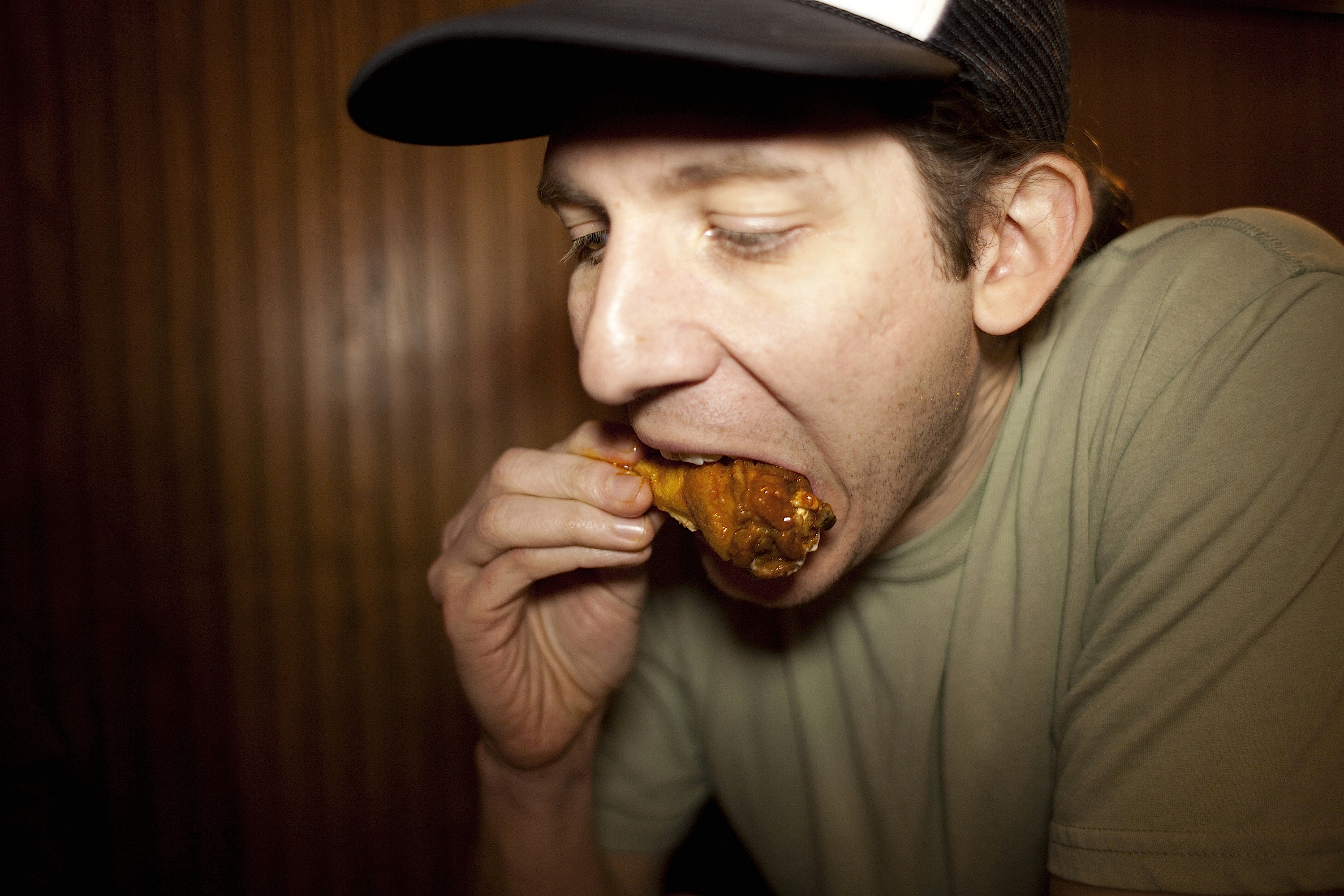
Director Matt Reynolds put his stomach where his mouth is

Director Matt Reynolds put his stomach where his mouth is

A Bug(gy) Life

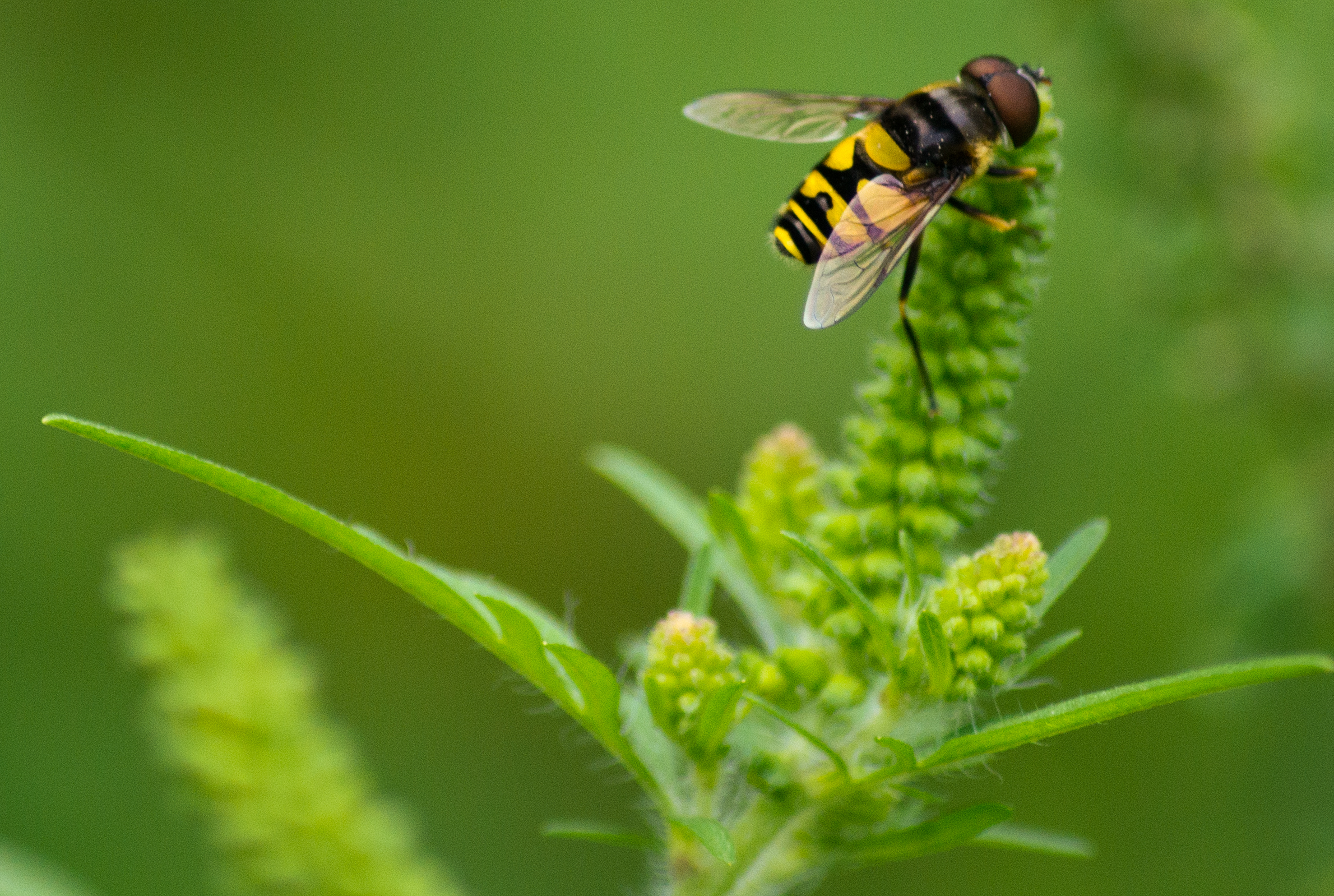
I run toward bees, not away...and they me, it seems

I run toward bees, not away…and they me, it seems

There is a scene early in the film Ace Ventura: Pet Detective where Ace calls out to all of the animals living in his apartment and they swarm from every crevice to give him the world’s biggest group hug (scene was totally ripped off in Evan Almighty). Well, every once in a while (aka daily), I feel the same way with insects.

Insects—and here I also include arachnids—love me. I don’t know why, they just do.

The best I can figure is that there is something in my personal chemistry—blood, sweat, breath, pheromones—that drives bugs wild.

When I go to the local beach to work—hard life, I know—I cannot sit on a bench for much more than an hour before I become a buffet for biting flies. And when I get home from the local park or ravine, I invariably find a couple small beetle hitchhikers somewhere on my clothing. That I have not yet contracted Lyme disease eludes me, although I am grateful, because that shit’s nasty.

When my grandmother’s seniors’ complex became host to a bed bug invasion, I became the canary in a coal mine. After her place had been sprayed, it was my duty to sit on her couch and see if the fumigation had worked. If there was a bed bug within 1 km of her apartment, it would find me within 10 minutes and leave its mark as a large red welt. I was bed bug fly paper.

As luck would have it, I also seem to attract spiders, which is fine as long as they focus their attentions on the various flies and other critters and not on me. So far, so good.

Perhaps this life-long attention from creepy crawlies has made me immune to the sociological ick-factor and has in fact turned into a fascination with them, as my many photographic blog posts would attest. In short, I like bugs. (I’m not quite ready for a love connection.)

On one of my recent walks through a local ravine, I ran into a young gentleman who also wandered the woods with a camera. As the conversation proceeded, we shared our interests—his was birds. When I told him mine was bugs, he was confused. It made no sense to him that anyone would be interested in insects. He wasn’t questioning my sanity, just my logic.

Other people who wander with me, however, do question my sanity as I approach a flower bed covered in bees rather than run the other way as they do. Or as I walk into a swarm of dragonflies rather than swat them away as a nuisance.

I wish I could explain my interest. As I believe with all other life forms, I believe there is an inherent beauty in the specialization of bugs to their environments—their shapes, decorations, behaviours. It probably doesn’t hurt that they will also stay still when I’m trying to examine them, rather than scatter as most other animals will.

Having recently moved into a basement apartment (as mentioned in the previous post), I will have the opportunity to test the limits of my fascination…and undoubtedly of my camera lenses. Should be fun!

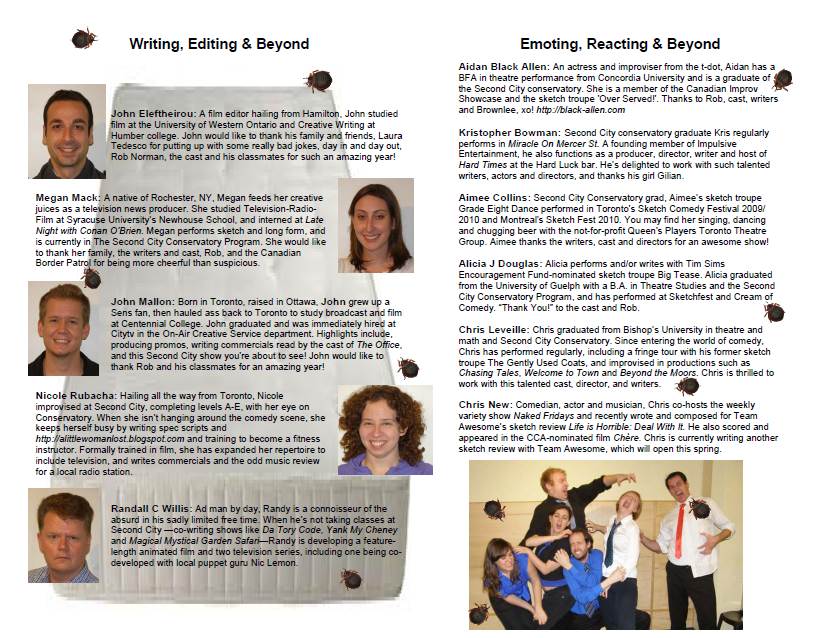
Ironically, I co-wrote a comedy show that became known as Bed Bugs & Beyond

Ironically, I co-wrote a comedy show that became known as Bed Bugs & Beyond