No parity in parody

Parody

Mel Brooks is a god! Carl Reiner is a god! Carol Burnett is a god! Mike Myers is a really funny Toronto boy, who flew pretty close to the sun. (He may yet be a god, but he has to get back on his feet.)

And among their many talents, these people share the amazingly delicate talent of creating parody…a talent I have yet to seriously attempt beyond the scale of sketch comedy.

Delicate talent? Seriously attempt? Isn’t parody just a matter of picking a genre and inserting dirty jokes and/or completely ham-fisting its various tropes in the mathematical assumption:

Absurd + Puns + Dirty = Funny

I increasingly understand why people think this as I watch more of the recent fare of parodic films that appear to have taken this equation to heart.

Last night, for example, I watched Paranormal Whacktivity, a sexed up romp through the found-footage haunted-home segment that includes films such as Paranormal Activity and Blair Witch. This film was horrific, but not in a good way…nor was it particularly funny or sexy. And it wasn’t very good as a parody because it didn’t even stick to its genre, mixing Paranormal Activity with Ghostbusters, which both involve spirits but are hardly cinematic siblings.

It was useful, however, to my understanding of parody.

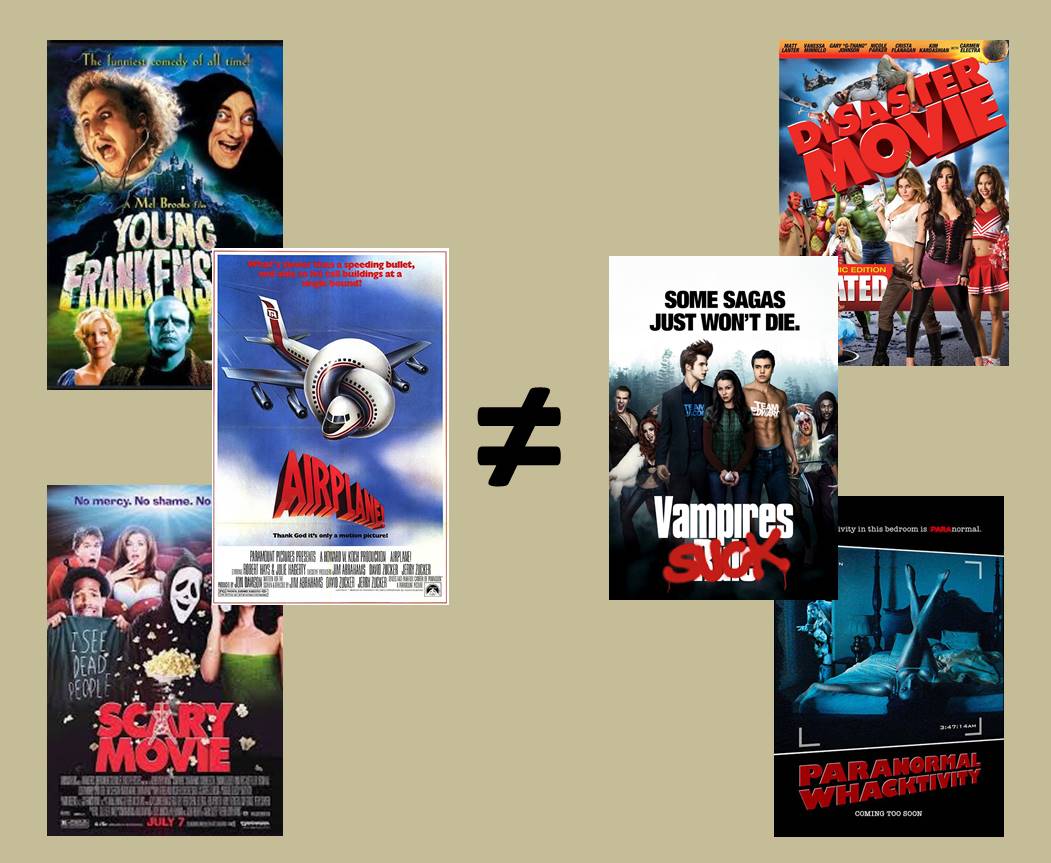
When I compare Blazing Saddles, Airplane, Dead Men Don’t Wear Plaid, and Austin Powers: International Man of Mystery to Disaster Movie, Not Another Teen Movie, and Breaking Wind, I realize that the truly classic parodies have something that the new ones don’t: a strong central story.

Somewhere in the evolution of parody films, the movies became less about story and more about ripping off as many genre clichés as possible, offering no firmer links between these scenes than bad jokes, fart noises or perky breasts.

Blazing Saddles wasn’t about taking a bunch of classic scenes from Westerns and simply linking them. It was more about taking iconic characters from the Westerns and creating a classic, if twisted, story. The sheriff abandoned by the town folk, the washed up gunslinger, the evil cattle rustler, the crooked politician.

Similarly with Shrek; although this film has such a strong central story that I’m not sure whether I should even include it in a list of parodies. Yes, it played up almost every fairy tale gimmick, but the story really didn’t model itself on any given style or pre-existing story.

Dead Men Don’t Wear Plaid is another odd case. With a strong through story led by Steve Martin and Rachel Ward (directed by Carl Reiner), it takes parody to a whole new level by incorporating actual scenes from noir films within the scenes with live actors. Thus, Martin’s character may find himself playing across from Barbara Stanwyck or Edward G. Robinson. Now, that is great film writing and editing.

http://www.youtube.com/watch?v=jAzV-BM3h5Q

Interestingly, the Wayans’ brothers first entry into this genre—Scary Movie—offers another lesson about parodies: the challenge of dipping into the same well too often.

Although horror/slasher movies are not to my personal tastes, I thought the first one or two films of this series were particularly well done. But as the series continued, picking on more films from within the horror/slasher genre, it started to become a parody of itself. The jokes were no longer fresh. All the best tropes had been used up in the first two movies and so the later films just seemed to be running in place.

Six Star Wars films, one Spaceballs. That works. (NOTE: Spaceballs is one of my least favourite Mel Brooks movies, much to the chagrin of many friends.)

Even the much stronger series of Austin Powers and Police Squad films showed this sense of comedic fatigue.

The original film is a surprise. The first sequel may be enjoyable. Anything after that is milking a dead cow.

I have no doubt that bad parodies will continue to be made…if nothing else, they seem to require little writing and typically have poor production values, and are therefore inexpensive.

My hope, however, is that another Mel Brooks, Keenan Ivory Wayans or Mike Myers comes along to raise us from these creative and comedic doldrums. (NOTE: At present, my money is on Keegan-Michael Key and Jordan Peele, who have the comedic talent and the Hollywood clout to do it right.)


A few personal favourites (hyperlinked to trailer or favourite scene, where available):

Dead Men Don’t Wear Plaid

Airplane

The Cheap Detective

Austin Powers: International Man of Mystery

Hot Shots (not so much the sequel)

Rustler’s Rhapsody

Shrek

Scary Movie

Blazing Saddles

Silent Movie (I may be only person who likes this one)

Young Frankenstein (all time favourite)
 

Too many voices (spoil the screenplay)

Superfluous

Congratulations! You have just outlined your next screenplay. Or maybe you’ve written “Fade Out”. That’s quite an accomplishment and you should be proud of yourself.

Go ahead. Take a moment to luxuriate. I can wait.

Okay, now I need you to kill one of your characters…or two…or maybe even three.

What? Oh, I know you’re not writing a thriller, but murder will be good for you. And even if you are writing a thriller, you’ll feel better after you pull the plug on certain characters.

Having written a few screenplays and having read 50X more, one common thread I find is that writers (me included) create too many characters, some of which are completely unnecessary.

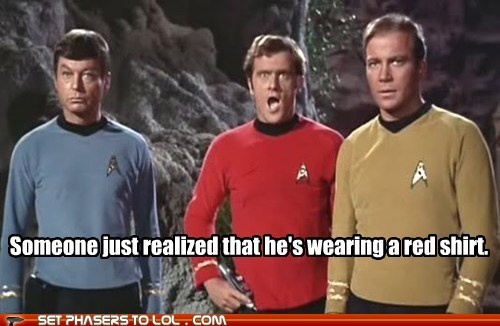
Now, I’m not talking about the red-shirted cannon-fodder that fills the background…the cab driver, the concierge, waiter, ex-boyfriend, whatever. No, I’m talking about those characters just below the protagonist, antagonist, side kick/mentor/love-interest who help move your characters through a plot point (or several) and then disappear completely.

red shirts

Let me give you an example from a murder thriller collecting dust on my hard drive…The Children of San Miani.

In my story, a journalist provides a young detective with just enough information to introduce her to the lead suspect, a victim’s rights advocate with a major reason to want the first murder victim dead.

In reviewing my first draft, I realized that the moment the journalist connected the detective and the advocate, he completely disappeared from the story. He became superfluous to (story) need, so I simply stopped talking about him.

This begged the question: Did I need the journalist character at all?

With very little thought, I quickly realized I could accomplish all of the journalist’s plot points without the journalist, either by ascribing his actions to other main characters or to the story itself. And poof, he was gone.

The result was a story that was that much tighter. A story that was a bit less confusing and yet still maintained the mystery I needed for the thriller.

Look at your story. Focus on those second-tier characters.

Are there some that don’t make it to the end of your story; that simply trigger or drive a scene or two forward?

Can those triggers or drives be handled by another character in your story, maybe a main character? Or perhaps those actions can extend the life of another secondary character who just plops into your story from the ether?

In some cases, the answer may be no; that in the grand scheme of things, this character is vital if temporary.

Fine. Keep the character. You are the best judge of what is needed for your story. But I’ll bet at least one character can go.

1248-left4dead-no-mercy-wallpaper-wallchan-1280x960

Show no mercy. Cut the strings. Release the Kraken. (Oops, sorry. Wrong movie.)

Don’t smother your screenplay. By eliminating the unnecessary, people will better understand and appreciate your story more quickly.

And when you may only get one read (if that), the easier you make it on your audience, the better.

(Images are property of owners and are used here without permission, and may be completely superfluous.)

charACTer

Anyone writing stories NEEDS to read the blog post by Chuck Wendig listed below!

http://terribleminds.com/ramble/2014/06/03/just-what-the-humping-heck-is-character-agency-anyway/

Wendig blog

Seriously. Please read this!

His pivotal point: “The story exists because of the character. The character does not exist because of the story.”

Too often, I read screenplays where the protagonist is merely swept along like a bobbing cork on a sea of conflict. They merely REACT to the injustice around them rather than ACT to change it. They are the victim of the story.

To my mind, a much more interesting character is one who takes action when presented with conflict and then deals with the repercussions of that action. In some stories (the best ones to my mind), the protagonist is his or her own worst enemy, bringing conflict upon him or herself.

It is not enough to chase your hero up a tree and then throw rocks at him. He can also catch some of the rocks and throw them back, perhaps hitting innocent bystanders who then turn on him as well.

As a reader and viewer, it is through the actions of your characters that we learn their perspectives, their world views, and thus, their flaws. And if your story has a redemptive angle, it is through the complete failure of this world view and the character’s re-evaluation of it that he or she is reborn.

Just like giving the same premise to 12 writers results in 12 different stories, placing any of 12 different characters into the identical situation with identical opponents will result in 12 different outcomes if the characters are real.

Honour that in your writing and honour your characters.

They are called char-ACT-ers, after all, not char-REACT-ers.


Wendig is on Twitter: 

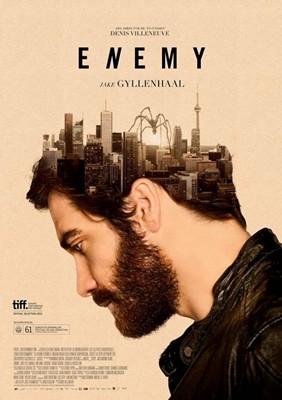
Enemy—The movie with the meta title

Enemy

So, it was $5-Tuesday yesterday at the Carlton Cinema in Toronto and a friend invited me to see a movie called Enemy, starring Jake Gyllenhaal. Like any weary movie-goer, I immediately jumped online to look at the trailer and thought, “Hmmm, weird, but interesting”.

I was half right. The movie was weird.

At this point, I should probably say “SPOILER ALERT”, but truth be told, I am not sure that if I laid out every event that occurred in this movie, you would know what was happening. I sat through it and I don’t know what happened.

As the trailer indicates, the movie is about a man who is dissatisfied with his life—never explains why, he just is—and is merely going through the motions of living until one day when he realizes that his exact doppelganger lives in town.

Terrified at this revelation—never explains why, he just is—he is nonetheless drawn to his twin and after jumping through a series of over-complicated hoops, he meets the twin. At which point, he second-guesses his decision and it is his twin’s turn to go neurotic—never explains why, he just does.

As you may have guessed from my above repetition of “never explains why”, my greatest issue with this movie is unclear character motivation. Perhaps it says more about me and my life history, but I have no idea why any of these characters acts as extremely as they do.

I am confident that it is part of the artistic conceit of the piece that at numerous moment are you fully sure which Jake Gyllenhaal character you are watching onscreen. The challenge with this is that the emotional rollercoaster of each of the characters is such that from cut-to-cut within the same scene, I am never sure which Jake Gyllenhaal character I am watching. I ended up watching the characters’ clothing rather than the actor’s face to try to follow the story.

And the motivations of the secondary characters are just as muddy for me, although at least here, we have different actors and so don’t have the Gyllenhaal rabbit hole with which to contend. Like a faucet tap, the emotions of these characters change with a flick—questioning in one moment, horny in the next, and angry in the third, and all in the span of 30-45 seconds.

A definite statement of who I am, I spent much of the movie trying to predict the reveal of the story based on the clues or purely on conjecture.

Twins separated at birth? Time travel with a glitch? Parallel universes collide? Psychotic episode of one man leading two lives?

No SPOILER ALERT to say none of these came to fruition, but that still doesn’t mean that any of them may not be true. Hell, all of them might be true. I don’t know.

And any hope of a conclusion is muddied by a massive metaphor that scurries through this movie—I won’t tell you what it is—and yet offers no satisfying explanation.

Enemy is described everywhere as a thriller. I’d be more inclined to call it a puzzler…and even that may be too lofty. Head-scratcher and headache-giver might be more accurate.

As I read up on the movie to write this, I learned the film won Canadian Screen Awards (our Oscar) for Best Director and Best Supporting Actress, and was nominated for Best Film. I find that disturbing.

The film was based on the 2002 novel The Double (O Homem Duplicado), by Portuguese author José Saramango. Part of me wants to find the novel to see if it is any clearer than the movie, but as of this moment, a bigger part of me just wants to walk away from this entire episode in my life.


Previous posts about characters in writing and film:

Just Tell The Story – Austin Film Festival

The Dignity of Characters

A Matter of Character

Can You Relate?

I Am Always Right (Motivation)

Dara Marks at Toronto Screenwriting Conference 2013

Unpacking Baggage (Part One)

Unpacking Baggage (Part Two)

Re: Rewrites (Part Two)—Toronto Screenwriting Conference 2014

Chitlik_2

In Part One of this post, we examined Paul Chitlik’s approach to reviewing the structural elements of a story, including the idea that a screenplay is actually comprised of four stories: The plot-based Main Story, the relationship-led Emotional Story, the protagonist’s internal Personal Growth Story, and the humanizing Antagonist’s Story.


Dissecting character

To truly understand your main characters, Chitlik recommends building something of a character profile that you can use as a steady reference while examining how the character acts and speaks within the screenplay. This is critical, Chitlik says, because often when you start writing a screenplay, you really don’t know your main characters and as you write, they will become more defined.

For assistance and more insights, Chitlik highly recommends Lajos Egri’s book The Art of Dramatic Writing.


Protagonist

Physiology – develop a sense of what your character looks like even if you don’t incorporate it into your story (something beyond “tall man in his mid-20s”)

Sociology – imbue the character with a social history: family life, school, jobs, etc.

Psychology – how does your character think and respond to his or her environment? Here is where the personal flaw comes to the fore

How is the character reflected in his/her dialogue? – in how he sounds, the word and grammar he uses, and how he acts

What is your character’s defining line? – Think Dirty Harry, a battle-weary cop with a strong moral center who is begging the criminal to make him shoot “Go ahead, make my day.”


Antagonist

Physiology

Sociology

Psychology

Human quality – what makes your antagonist more than a 2-D character? Why should we empathize with him or her?

How is the character reflected in his or her dialogue?

What is the antagonist’s defining line? – Think Terminator and “I’ll be back.”


Dissecting the screenplay itself

Chitlik then lifts his view slightly higher from the page, offering ways to dissect the screenplay in a more technical manner from its content to the paper itself.


Seeing the Scene

Each scene has all 7 of the structural elements of your story, so be sure you can identify them, although be aware that some elements may not occur within the lines of the scene but rather are implied or referenced within the lines.

Does the scene have any/enough/appropriate conflict? Chitlik finds conflict to be the #1 problem of new writers, which leads us to a discussion of goals

He is adamant that every character within a scene must have his or her own goal, however prominent or minimal to the plot. The conflict, he suggests, comes from the points at which these goals thwart or oppose each other.

Also, look at the emotions of the characters within the scene. Do you maintain them throughout the scene or when they change, do they change when something acts to cause the change?

And for emphasis, re-examine the conflict of the scene.


Looking for Cuts

Chitlik suggests he has never read a screenplay that couldn’t benefit from cutting about 10%.

He suggests you start by looking for scenes that lack conflict, don’t move the story forward (treading water) or fail to illuminate one or more characters in some manner.

Either eliminate these scenes or find some way to incorporate the missing ingredient.

Then look to cut off the heads and tails of scenes, starting later or ending earlier. An example he gives for the tails is leaving the scene when the final challenge arises or is issued, and he points at the work of David E. Kelley in this regard. The resolution of the challenge, he argues, can easily be worked out by the audience through the start or context of a subsequent scene. You don’t have to always spell things out.


Presently Presentable

This is the challenge of first impressions. Chitlik gives the example of a former student who sent him a screenplay she wrote and on the title page, she misspelled her own name. This, he says, did not bode well for what was to be found inside.

Chitlik describes this as the Mercedes Benz theory of script presentation. If you are going to spend $100K on a new Benz and you are presented with two cars—one that is absolutely beautiful and immaculate and one that is dinged up and dirty—which one would you choose to spend your money on?

Look at the pages of your screenplay and ask yourself how much of the page is black and how much white. Before looking at a single word, readers will be repelled by heavy screenplays with long descriptive sections or heavy dialogue. Find ways to break this up to leave more white space on the page.

Chitlik’s other cautions are: Spelling, Punctuation and Grammar.


The Rewrite Plan

Chitlik’s plan is straightforward and iterative:

  1. Write a biography of the protagonist in his/her own words/language
  2. Write a biography of the antagonist in his/her own words/language
  3. Reread the screenplay, making notes on the above topics
  4. Create a new beat sheet of the screenplay, adding new scenes that help your story play out and cutting old ones that don’t work or aren’t necessary
  5. Write new pages and rewrite old ones from the beginning
  6. Go back to Step 3

If it sounds like a lot of work, it is, but Chitlik promises that with each iterative run, the work gets easier and the outcome improves.

tsc-logo

Many levels of review – Part One

puzzle

Every time I read something, I find something I never found before. Thus, when someone has built up the nerve to ask me to read something he or she has written, I try to read it in several waves, each one moving deeper and deeper into the details of the subject or story.

30000_foot_view

The view at 30,000 feet: Particularly if it is a complex narrative, such as a novel or screenplay, I try to make my first read an uncritical one. This may sound counterintuitive to the requested task, but until I’ve read something from front to back, I don’t feel as if I have sufficient information to be critical.

A thought or comment made at first read may be rendered moot or significantly larger one, ten, fifty or a hundred pages later. I need context to see what the writer is trying to accomplish before I know what is working or what isn’t.

If possible, I will remove all writing implements from my pockets and move somewhere completely isolated so that I can give the piece my full attention. If I become immersed in the work, absorbed by the story and characters, then I know less work is needed, and I can drill to the deepest, most detailed level of comment quickly.

If, however, I find myself drifting from the story, or worse, struggling to move from page to page or scene to scene, then I know there are larger structural or thematic issues at play. Things that potentially make detailed feedback moot upon rewrite.

If you can’t resist using a pen at this stage, try just adding an asterisk next to the line of interest for a quick reminder later. Attention to details breeds attention to details, and you’re apt to miss the bigger picture.

5000_foot_view

The view from 5,000 feet: In the second read, I try to focus my attentions on the larger structural and thematic questions that arose in the first read. By being familiar with the story and knowing who is whom, I am less likely to need to flip backward through the pages to remind myself how I got here.

More importantly, I know where the writer is trying to go with the plot and characters, which should make it easier to identify bumps or inconsistencies along the way.

These moments typically take the form of a quick shuffling of pages to see if I’ve missed something or if two pages have stuck together. In my head, if not aloud, I find myself using phrases like “Wait. What…?” and “Hold it. I thought…”

If I did my first read well, I may remember struggling at this point in the story, and if it’s big enough, having to force myself to move on. Alternatively, I didn’t bump the first time through but now that I know the full story, this scene or moment has become a problem. What made perfect sense an hour or two ago has now become confusing. Regardless, it is a moment that has to be recognized, understood and adjusted.

Most writers in my experience have the greatest problem with notes at this stage because it often cuts to the core of their story and changes her can have a significant impact on the direction of the story. In some cases, this is where the writer might find out the story doesn’t work and needs a complete overhaul.

New writers, in particular, may either completely refute the notes to avoid being so fundamentally “off base” or simply give up the piece because they feel incapable of sacrificing all that hard work, ironically enough, and trying to rescue what was working.

At this stage, I’m asking pretty broad questions. Do I understand why this story is happening (why today)? Do I clearly see who is playing what role in the narrative (e.g., protagonist, antagonist, etc) and how they interrelate?

Can I recognize the plot and subplots, and do they make sense? How do they relate and am I seeing a coherent theme? Is there any conflict in the story and does it rise in scale or intensity as the story moves forward?

Part Two: In the next section, we will continue our journey into the depths of how I review stories with complex narratives, rapidly approaching ground level.

(The images are the property of their respective owners and are used here without permission because they’re beneath me.)

Book larnin’

Last week, one of my fellow bloggers expressed interest in screenwriting and wondered if I could recommend any good books to help him navigate this format of storytelling, and I promised to do it in a future blog post…well, guess what?

To be honest, my first piece of advice to anyone interested in getting into screenwriting would be to simply tell your story in whatever format comes easiest to you. Because, as I’ve said in a previous post, the most important thing is story. No matter how well formatted your screenplay, if your story doesn’t work, it doesn’t work.

Okay, that soap box being out of the way, my next advice is to take a class in screenwriting, because no matter how much you think you’ll write, there is nothing like the pressure of a deadline for 10 more pages to keep you motivated. And ultimately, until you’ve heard your pages read out loud, you have no idea if you’re getting your thoughts across or using the right words.

So now, on to books. There are few really good books to tell you what a script should look like, so I recommend you simply try to get your hands on several different scripts, whether film or television (although pick your preferred medium, because there are differences in presentation). There are several places on the Internet where you can get free scripts (and when I remember what they are, I will tell you), but for those with a couple of bucks to spare, I highly recommend Planet MegaMall for their breadth of scripts that you can purchase rather cheaply.

No one book will give you everything you need, so I recommend sitting in a bookstore and perusing as many books as possible to see which one fulfills some unconscious need today. Then, repeat the process several weeks later, because your unconscious needs will have changed.

For the best understanding of story as a whole, you can’t go wrong with Chris Vogler’s The Writer’s Journey. Using mythic structure, Vogler breaks down story into its key components and then contextualizes those concepts using popular movies. Knowing almost nothing about screenwriting, I wrote my first screenplay using these elements as a template.

To get more into the structure and execution of screenplays and plots, then Linda Cowgill’s The Art of Plotting is very good. Written very approachably, Cowgill goes through the fundamentals of a good plot (e.g., conflict, character, action) and helps you understand where your story may be faltering or be improved.

A little more into character and how character changes through the screenplay, Dara Marks’ Inside Story helps you understand the concept of theme, which will lead you to better understand the motivations of your characters. In a similar vein is Stanley Williams’ The Moral Premise, which examines how opposing forces within and between your characters will move them forward in your story and more importantly, make them much richer.

Somewhere between individual scenes and broader acts of a screenplay are sequences, which one of my instructors described as being equivalent to book chapters where a single idea is explored before moving to the next one. Paul Joseph Gulino’s Screenwriting: The Sequence Approach is your guide here, helping you pull your scenes together into the right order.

And the chief poobah of screenwriting books is Robert McKee’s Story. I was actually afraid of getting this book for quite some time as people warned me that reading it too early would make me too intimidated to keep writing. I can see where they were going, but it’s not that McKee’s writing is difficult to follow, it’s more that he talks about a huge variety of topics. Suddenly, you realize how many balls you’re juggling when you’re writing a screenplay.

Ellen Sandler’s The TV Writer’s Handbook is a great step-by-step, but you have to do the exercises to make it worth it. Pamela Douglas’s Writing The TV Drama Series is a little dated but still gives a fantastic overview of hour-long programs, spending the bulk of its time on how to break down and analyze a program, before it gets into actually writing an episode.

Scott Sedita’s The Eight Characters of Comedy is an interesting analysis of comedic archetypes in sitcoms. Written more from an actor’s perspective, it still offers valuable insights to the writer trying to understand or create characters. And finally, Peter Desberg and Jeffrey Davis’s Show Me The Funny offers amazing insights into how the minds of comedy writers work, but even more importantly, shows you that no two people will develop the same story from the same premise…so don’t sweat starting with cliché ideas.

That’s a lot for a first kick…I hope you find something in here to get you started.