
Tag Archives: review
Fresh eyes – writing tip

Fading Gigolo faded too slowly (a review)

Writer. Director. Lead performer. Possibly the most critical functions in defining how well a movie will do, and often one individual will play more than one role with varying degrees of success. But when a single person plays all three, look out.
For some reason, the movie that results from the triple play rarely seems to work in my experience. And 2013’s Fading Gigolo falls right into that category. (Citizen Kane is one of the few successes I can think of.)
The triple play of Hollywood stalwart John Turturro, Fading Gigolo tells the story of two friends, second-hand bookstore owner Murray (Woody Allen) and florist Fioravante (Turturro), who are both going through some financially tight times. So when Murray’s dermatologist (Sharon Stone) suggests she and her girlfriend (Sofia Vergara) are considering a ménage á trois, Murray immediately thinks about his good looking buddy and suddenly it is American Gigolo for the middle-aged.

Boobs and bums but no climax (Stone, Vergara)
Oh, and all of this happens in the first two minutes of the movie.
One after another, Murray lines up customers for Fioravante, whose kicked-puppy facial expressions and old-world charm sweep the women off their feet and money out of their wallet. To his credit, Fioravante feels some guilt over taking advantage of the lonely women, but he gets past that with the help of Murray’s nebbish logic.
Life becomes more complicated, however, when he meets the widowed Hassidic Jew Avigal (Vanessa Paradis) and in helping her come out of her shell, finds himself developing feelings for the woman.

Fioravante helps draw Avigal out of herself (Turturro, Paradis)
When I first saw the trailer for this movie, I thought it would be a beautifully sweet film about human relationships with the comedic backdrop of Woody Allen as a pimp. And to be sure, there are moments of beauty in the film. But only moments.
Unfortunately, there are no moments of conflict in the film. Nothing against which the characters can really push and grow, with the exception of Avigal, and so the movie feels like the emptiest of emotional calories. You feel good while it is in front of you, but the minute a scene is over, you don’t remember a single moment of it.
Woody Allen still has it, although somewhat sparingly, and there were moments in the story reminiscent of his characters in Bananas or Sleeper, but in some respects, he has just become an older caricature of those characters. Sharon Stone has one or two moments where you can see some vulnerability in her character, but those dissolve pretty quickly. And Sofia Vergara is simply boobs with an accent, as with every role I have ever seen her perform.
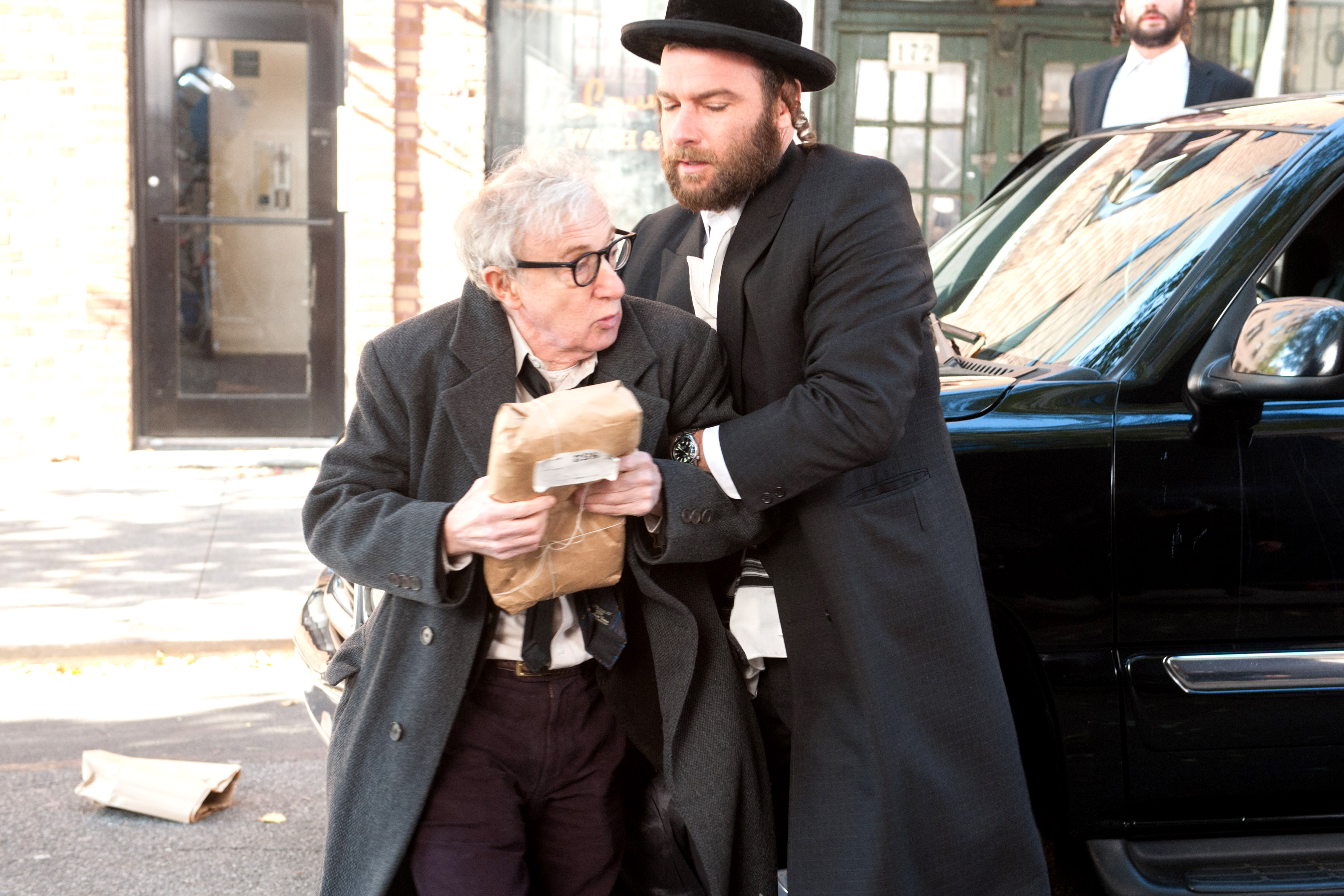
A little Hassidic slapstick (Allen, Liev Schrieber)
As mentioned earlier, Vanessa Paradis’ Avigal is the only character with an arc in this story, the only character who is transformed, and the actress does a pretty good job with a relatively straightforward character. Unfortunately, against a backdrop of nothing characters, I can’t tell if she did a good job or just a less bad job.
But again, all of my irritation is focused on Turturro and his failings. Fioravante is a sweet man but has all the internal conflict of Michael Landon’s angel character Highway to Heaven, i.e., too good to be true.
As a writer, Turturro missed every opportunity to enrich a flat screenplay. In the writing vernacular, there was no inciting incident (the reason to become a prostitute is weak), no turning points, no crisis and no climax except in the sexual sense.
And because the writer Turturro seemed satisfied with the screenplay, the director Turturro had nothing to offer to improve a moribund story comprised of high-fructose corn syrup.
So much talent. Such a beautiful concept. Such potential for humour and pathos.
Such a let down.

Movie should have worked just on this line alone
Rosewater too nicely scented (a review)

I don’t know if it is that I have become numb to the harshness of world events shown on the news or that the movies I watch have inured me to violence, but I must say that I found the movie Rosewater didn’t hit me as hard as I expected.
For those of you who haven’t heard, Rosewater is Jon Stewart’s film adaptation of the book Then They Came For Me by Maziar Bahari, a journalist who was imprisoned and tortured in Iran for 4 months largely for filming the protests that arose after the re-election of Mahmoud Ahmadinejad in 2009. The protests were the result of an election that was almost certainly rigged to re-elect the incumbent and Supreme Leader favourite over more moderate candidate Mir-Hossein Mousavi.
Aside from the scenes that set up who Bahari is and how he came to be covering the Iranian election for Newsweek, leaving his pregnant wife behind, the film largely examines the relationship that develops between Bahari and his lead interrogator, a man who treats himself with a cologne of rosewater (thus the movie title) and is dealing with his own issues within the infrastructure of Evin Prison and the actual job itself.
This is where the movie excels. It rather even-handedly portrays a man who has little interest in being a martyr for a cause, as his father and sister had effectively become before him, and balances this against a delusional system that sees itself as protecting Iran’s Islamic State from the evils of outsiders and yet, at an individual level, struggles with the fact that it will inevitably lose. The interrogator is not a monster, but ultimately is a man who wants something better and yet feels incapable of achieving it. Thus, he plays the role he is assigned.
The relationship and struggles between these two men—Gael Garcia Bernal as Bahari and Kim Bodnia as the interrogator—is worth the price of admission alone, and in my opinion, Bodnia magnificently plays the more interesting of the two characters. As the movie itself alludes, Bahari was tortured of body while the interrogator was tortured of soul.
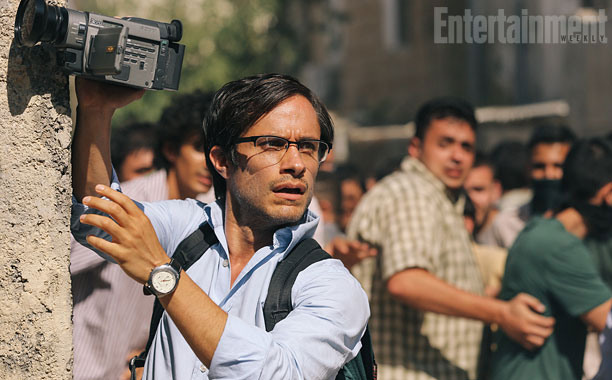
The horrified journalist (Gael Garcia Bernal)
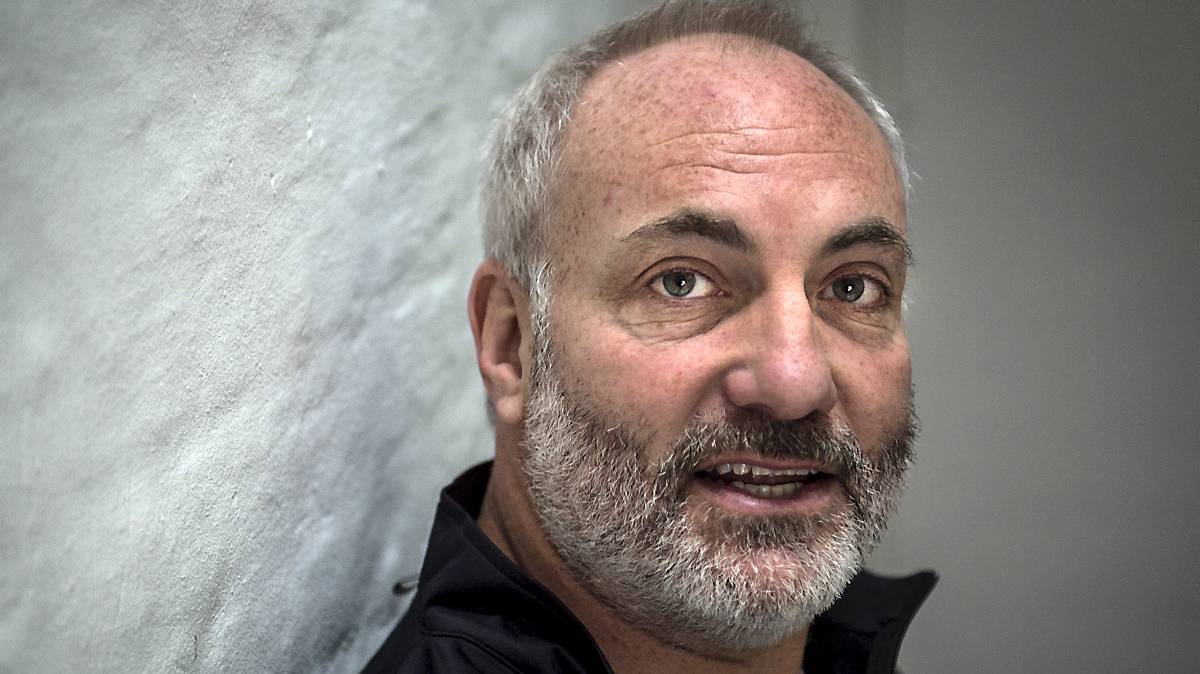
The tortured interrogator (Kim Bodnia)
But that’s where I ultimately found the film wanting.
Although the movie gave us snippets of what a traditional interrogation looked like with harsh beatings and the resulting bruises on other prisoners, with the exception of one scene, we never truly saw how Bahari was tortured aside from solitary confinement (of which I by no means wish to underplay the significance). Thus, I never really felt like I was emotionally drawn into the peril Bahari was legitimately facing—potentially, his death. It remained all too abstract and cerebral.
To look at this issue from the other side, I am truly pleased that Stewart didn’t go down the road of over-dramatizing the violence, as this could easily have become a horror film. I just think there was room in the middle to bring me a little further into the peril.
Another complicating factor for my viewing was that I was watching this film next to my good friend and writing partner Agah Bahari, who is nephew to the man being assaulted onscreen. For his sake, I am grateful the portrayal of violence was not more heavy handed as I cannot imagine the impact such scenes would have.
Rosewater tells a very important story on many levels and despite being based on events from five years ago, remains significant today given the continued efforts at reform within Iran and its outward resistance to Western influences, as well as its horrible record of imprisoned and tortured political dissidents and journalists.
For such a dramatic story, the acting was incredibly even and bordered on inspiring, never becoming melodramatic. It had some amazingly beautiful moments of introspection mediated by the ghosts of the past, and again, the crisis of the interrogator was palpable and poignant. There is even a segment of outright laughter, incredible as that may be to believe given the subject matter.
Stewart did an amazing job with his directorial debut, providing us with a beautifully balanced presentation of completely polar events. I just wish it had stimulated my gut as much as it stimulated my mind.
I look forward to reading the book, simply to see what was altered and to learn more about Bahari’s thoughts and feelings in retrospect.


Journalist and author Maziar Bahari
InterOkay – review of Interstellar

I can forgive writer-director-producer Chris Nolan for naming his movie Interstellar as few would be inclined to go see a movie entitled InterOkay and yet, that is what I thought of the movie. It was okay.
Not brilliant. Not amazing. Not a cinema-changing moment. Just okay.
Set in the near future, the Earth has suffered through a variety of crop blights and other unnamed disasters that has humanity at the brink of extinction. As one school principal puts it, the human race has become a caretaker generation, simply trying to manage the status quo in the hopes that something better might show up later.
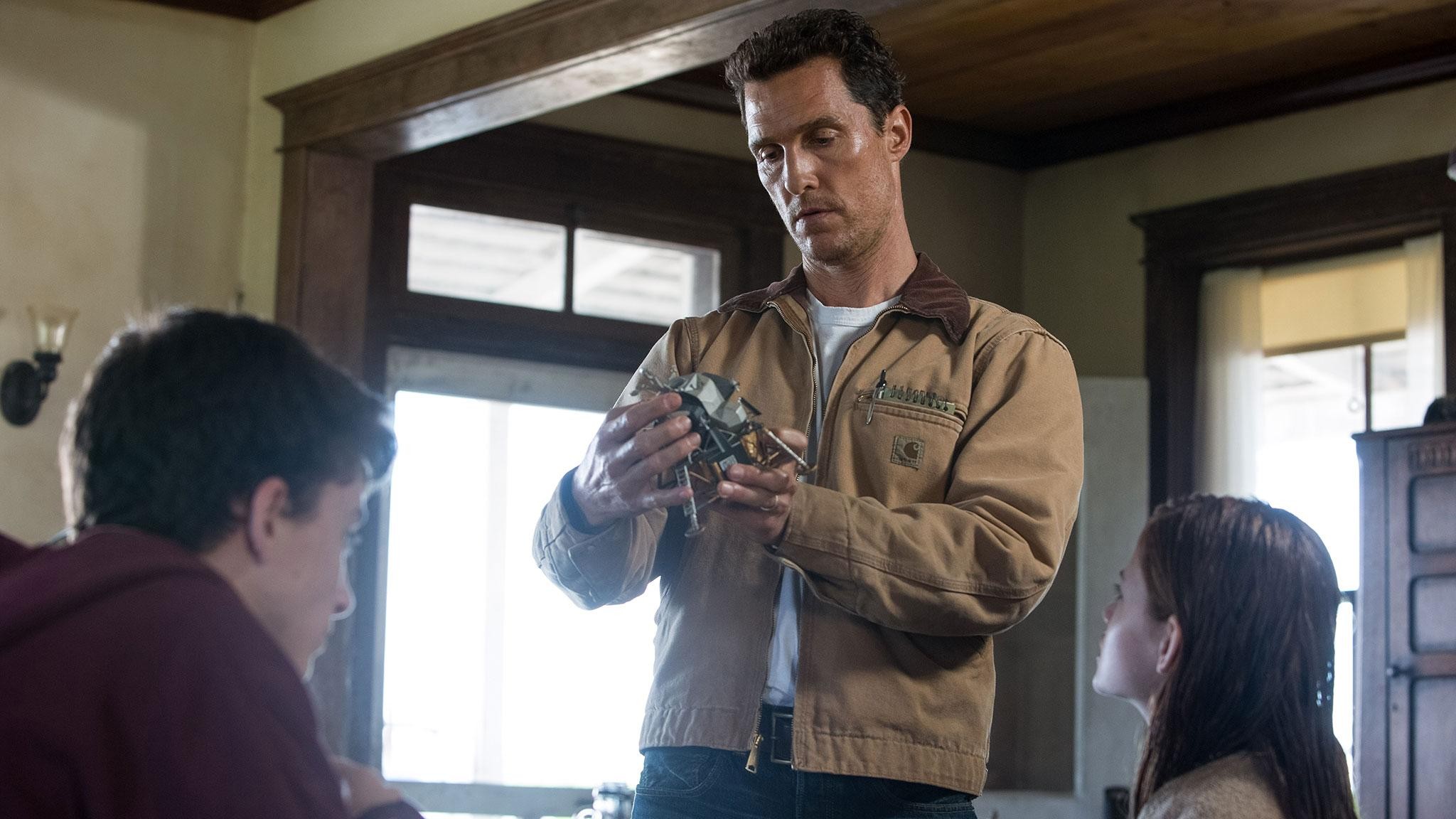
Failed astronaut Cooper struggles to keep his family whole
Drop into this failed world the character of failed-astronaut now failing farmer Cooper (Matthew McConaughey) who struggles to protect his family—dutiful son, frustrated pre-scientist daughter, sage father-in-law—from the ravages of dust storms and drought. Through a series of odd events, driven by daughter Murphy, Cooper learns of a mission to explore planets in other galaxies in hopes of finding a new home for humanity. They will get there via a wormhole that suddenly appears near Saturn, sent by a mysterious ‘They’.
To get deeper into the plot of the movie here would be to trip all over spoilers and I don’t want to do that. It would also require that I better understand the various plot points, which would likely take a second or third viewing…call me when Interstellar makes it to Netflix.
In an acknowledged homage to every movie that has come before it—Grapes of Wrath meets Top Gun meets 2001: A Space Odyssey meets Close Encounters of the Third Kind meets The Right Stuff meets Waterworld meets Prometheus meets The Black Hole meets…you get the idea—Nolan and his cowriter brother Jonathan Nolan have woven together a vision of human spirit that is broad in scope, deep in meaning and soul-defining in spirit. Or at least that seemed to be their intention.

The ones left behind search for a way out (Jessica Chastain)
On paper, the most meaningful speeches seem to come across as cliché, trite or in the most offensive cases, Pablum. And it is only because the Nolan boys have put these speeches into the mouths of some great actors—e.g., John Lithgow, Michael Caine, Jessica Chastain—that the movie is not laughed off the screen. Only actors of this quality could breathe life into these leaden lines and hoary speeches.
For me, possibly the worst example of this is scientist-cum-astronaut Amelia Brand’s (Anne Hathaway) attempt to explain love as a higher dimension of existence, as something that transcends space and time and should thus be counted as at least an equal in making logistical decisions. I’m not saying that her argument is wrong (or right) but rather that the material comes across as angst-riddled teen melodrama, made all the worse because it’s coming out of the mouth of an adult.

Ferris Bueller with lipstick? (Anne Hathaway)
Where I have to give the movie massive credit, however, is in the visual treatments. (Thank you, Director of Photography Hoyte van Hoytema and Production Designer Nathan Crowley.)
This is a visually stunning film where each image is inspired. You feel parched while witnessing the death of the American heartland and your eyes itch with the approaching dust storm. The other worlds are crafted with such realism that you sense the dampness or the cold. And for all its darkness, a black hole seems anything but black.
Without getting into spoilers, I found the story line challenging in some respects because it felt like the Nolans wrote a relatively short screenplay and then every time they asked someone to read it, they were asked “Yeah, but what about…?”
At least three times during the film, I caught myself thinking that this must be the end, only to have Nolan scream “plot twist” and have the movie spiral in another direction to tie up a loose end. Even as the credits rolled, I had the sneaking suspicion they would get half-way done and we’d have more scenes.
And the very last scene before the credits was either “Oh shit, we forgot about…” or was a ham-fisted attempt to set up the sequel (of which I have heard nothing).

As friend and fellow blogger Danny F. Santos suggested to me recently, he thought the movie might have been better served by converting it to a mini-series and I can definitely see his point. Some aspects of the film seemed rushed, despite its lengthy running time of 169 minutes. (Danny’s blog)
Given the importance of the replacement Earths to the conceit of the story, however, amazingly little time was spent on these worlds. I appreciate that the Nolans may not have wanted to make it longer, but that just lends credibility to Danny’s idea (or they could have done a Peter Jackson-Hobbit impersonation).
To their credit, the Nolan boys have woven an incredible tapestry of plots and subplots, tapping into several deep questions about humanity, the explorer’s heart, interpersonal commitment, abandonment, the purpose of science and complicity in our own demise.
Unfortunately, they used so many strings that they seem to have suddenly found themselves with a lot of loose ends that they either tied off with a bow or tied to another string. For the latter of those methods, I am confident that they wanted me to experience a revelatory “Oooooh!” but too often I was left with a confused “Eh?”
For all my issues with plot points and dialogue, however, I do have to admit that the movie passed my butt test. At no point did I find myself squirming uncomfortably. As the credits rolled, I found myself comfortably rested and satisfyingly entertained.
Unfortunately, for a movie of the scale and scope of Interstellar, “rested” and “entertained” are an indictment, not praise.
On shaky Groundlings (a review)
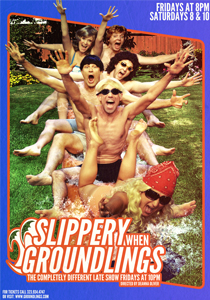
Just got back from seeing a preview of The Groundlings latest improv show entitled Slippery When Groundlings and really have only one response: Watch for the names Jill Sachoff-Matson and Alex Staggs. I don’t know when these two artists will hit it big, but I guarantee you they will.
Unlike the standard Second City shows I am used to watching, this one didn’t seem to have much of a theme beyond irritating people…but then, all sketch and improv comedy seems to be reduced to irritating people. And given the reputation of The Groundlings, I was surprised at how many sketches seemed to be one joke spread over 3 or 4 minutes. I expect that from student shows, but I expect more from main stage casts.
The first third of the show was evenly bad with the exception of a piece called “Carl’s Jr.”, where Sachoff-Matson first caught my attention as a dweeby woman who has been run down and then backed over by life.
The second third picked up somewhat, starting with “Church Camping Trip”, but a solid premise was completely let down by a lack of where to go with it. It’s a good sketch, it just needs more brainstorming. This was followed by Sachoff-Matson’s “Kindergarten”, which actually caused me to laugh out loud. Sachoff-Matson is mesmerizing both physically and in how her mind works, particularly as she portrayed yet another train-wreck character.
But just when I thought I had seen the best part of the show, Alex Staggs shows up with “Giving Up”, a lounge act in which he gets the audience involved with hilarious results. I would be willing to see where Staggs goes with this every night because he exudes comedic range with this.
Alex StaggsFollowing the short intermission, Ariane Price gave us her send up of sad-sack informercials with “Emulsion”, another audience participation bit that was incredibly tight because of the character Price portrayed. You felt so sorry for her Eastern European refugee glam-girl wannabe that your heart melted and you wanted to give her a hug.
Ariane PriceThe problem was, the crew then wasted all that good will with “Sub”, a throwaway bit about an aged substitute teacher who has trouble reading fine print on an attendance sheet. That’s it. That’s the bit.
But the show was rescued by the big musical dance finale “Brittany” where again Sachoff-Matson showed what she can do with a woman completely at odds with her world and her own body.
If I have one complaint about Sachoff-Matson’s overall performance, it is that her three best pieces all largely portrayed the same character. But where this would normally kill it for me, she managed to do so in such unique ways that it wasn’t the mortal sin it might have been.
I don’t know what other sketches they have in the hopper, but there is a definite need to replace several from tonight before this show will be solid from front to back. And while good, the other cast members are going to be challenged to shine as brightly as Sachoff-Matson and Staggs.
From Equalizer to minimizer (a review)

Eighties are the new teens…as in everything you loved about the 1980s is coming to a theatre near you. As the latest example, we have Denzel Washington in the role of Robert McCall in a revisit (can’t really call it a reboot) of the television series The Equalizer.
The central conceit of both the film and television series is that McCall is a retired special forces agent (think CIA) who tries to help people out when they get run over by criminals, corporations or malevolent government forces.
Whereas in the TV show, we see his mission fully formed, the movie is a bit more of a prequel, showing us the transformation of McCall from quiet man to vigilante.
The movie opens with McCall being the happy guy working at a Home Depot, jovially chatting with co-workers and providing something of a father figure to his younger compatriots. But away from the job, we see that he is a loner, a man with a heavy psychological burden that keeps him from sleeping.
And it is this insomnia that links him to young prostitute Teri (aka Alina, played by Chloe Grace Moretz) who is fascinated by this man who sits in a diner at 3 am, drinking tea (he brings his own bag) and reading classic literature (we open with The Old Man and the Sea…the books are a metaphor for the character). Again, the father figure comes into play as McCall is one of the few men who treat her as a human being and challenge her to be the woman she wants to be, not the victim she is.

And it is this bond that causes McCall to act when Teri is hospitalized by her Russian mobster pimp. A noble man, McCall offers to literally buy Teri’s freedom, but when the mobsters simply laugh him off, a life of brutality surfaces in the scarred knight and the world dissolves into chaos.
To give you any plot details beyond this would be to potentially spoil the movie.
Denzel Washington is an amazing actor and is wonderful in the role of Robert McCall. Offering a very different take on the character than his television predecessor Edward Woodward, the two actors share the ability to display a man who is outwardly in control of all situations but at the expense of always holding onto an inner torment that they are afraid to acknowledge, let alone unleash.
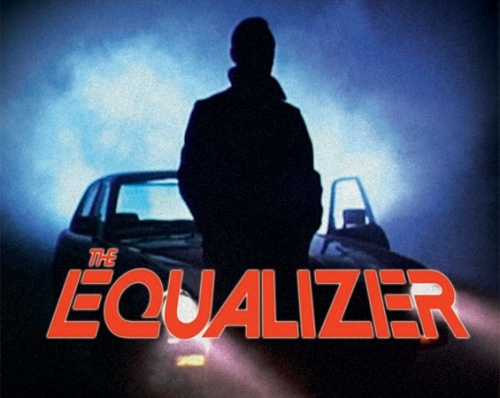
But whereas the TV equalizer rarely got his hands or his clothes dirty (compare TV poster below with film poster above), the film equalizer is willing to release a storm of martial arts and weaponry on the bad guys. Thus, the film is much more action packed than the TV show.
To the credit of director Antoine Fuqua—who also directed Washington in Training Day—despite at least a dozen scenes of intense violence and blood-letting, he does an amazing job of minimizing the amount of actual blood that reaches the screen. In part, he accomplishes this by shooting the most violent scenes in darkness such that you only really see light reflecting off dark puddles. Likewise, when McCall does resort to using make-shift weapons (remember, he works in a Home Depot), the camera often switches to McCall’s face as he uses the weapon rather than to weapon and victim.
Unfortunately, McCall is such a cool and controlled customer that I never really worry about him. I cheer his victories when he vanquishes the dragon, but I find it difficult to really attach myself emotionally to the man. I like the quiet man, but I find the killing machine to be just that, a machine; an automaton that does not touch my heart. And with the exception of a handful of moments, we never really get a chance to appreciate the toll these actions take on him.
The other place I feel the story falls down is in the use of the Russian mobster sent to clean up the mess that McCall started, a man simply known as Teddy. Played by Marton Csokas, Teddy and McCall are equals. The same side of the same coin. Equally smart. Equally charming. Equally viscious. And as such, the only real threat in the entire film to McCall.

(As a side note, if this role is any indication, we want to keep our eye on Marton Csokas. He will do amazing things.)
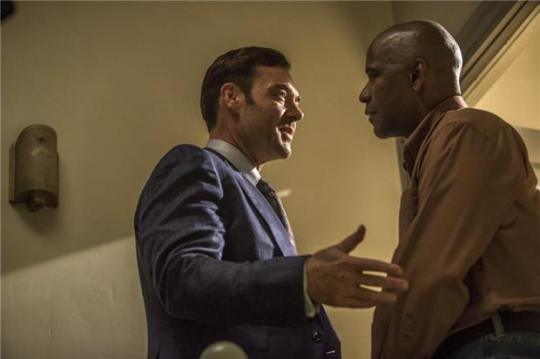
There are a couple of scenes where the two men literally face each other and calmly discuss the situation. One scene in particular is the best thing in this movie from my perspective. While on one level being the calmest moment in the movie, it is also the most chilling because of that calm. You really don’t know what’s going to happen.
And that’s where my problem lies.
Having set up the perfect opponent for McCall, the writer Richard Wenk (who also penned The Expendables 2) doesn’t really deliver. The audience was promised an epic show down between these two characters, but while they do clash, it is anything but epic (photo below is not from clash).
The Equalizer is entertaining. It is a wonderful diversion that requires little thought of its audience. It is Jason Bourne for the middle-aged set (but with enough carnage to keep the young’uns interested). It should, however, have been better.
But when it comes right down to it, the studios don’t really care if you like it, because they are already working on the sequel.
Nebraska: Bumpy lives, flat land (a review)

Much like the Big Sky prairies that serve as its backdrop, Alexander Payne’s 2013 film Nebraska takes a little bit to get going, but when it hits its stride, there is no stopping it.
An irascible old drunkard Woody (Bruce Dern) thinks he’s won a $1,000,000 lottery and is determined to collect his prize in person, walking if he must from his home in Billings, Montana to the prize centre in Lincoln, Nebraska. When his youngest son David (Will Forte) realizes there is no stopping the senile old coot, he takes a few days off work and offers to drive.
Along the way, they stop for a few days in his father’s home town of Hawthorne, Nebraska, where they are joined by his mother Kate (June Squibb) and older brother Ross (Bob Odenkirk). But almost as quickly as the townsfolk and extended family realize the old man has struck it rich, the hands reach out for their cut, led by Woody’s former business partner Ed (Stacy Keach).
As I said, the movie starts out slow. Woody has nothing to say to any of his family, at times appearing to have dementia. David meanwhile faces an empty life and just wants to communicate on some level with his family, never having felt like he could talk to them. Thus, when the two men with nothing in common aside from chromosomes take to the road, it feels very much like the start of an opposites-connect buddy film.

The dialogue is excruciatingly simple in the early going, rarely more than one or two syllable conversations. Despite occupying the passenger seat of the car, Dern’s Woody is never really there, only being forced into human contact by having everything repeated louder. Forte’s David, meanwhile, has a perpetual pout of a puppy begging to be patted on the head.
Eventually, though, if only out of frustration, David begins to take control of the situation and his life. Through his own explorations and by observing his father interact with the home townfolk, he begins to see that there is so much more to his father, and this is where I really started to take note of Forte as an actor, as something more than his MacGruber caricature.
I would say that Dern turns in a solid performance, but his dialogue is so short and his stare so vacant that only once in a while do we get a real glimpse of the tormented soul within the husk of a man. June Squibb’s Kate is something to behold, however (her voice and attitude remind me of Shelley Winters). Starting more as a screeching shrew, she really comes into her own in the latter half of the film with some of the funniest lines and the staunchest defense of her messed up husband. Odenkirk is solid, but isn’t really given much to do here…this is Forte’s movie.
My strongest reaction, however, is reserved for Stacy Keach, who yet again, plays the charming, smarmy bully asshole for which he is famous (think Papa Titus on the sitcom Titus). I can’t remember a role for which Keach didn’t deliver. The man eats up the screen. You can’t not watch him.
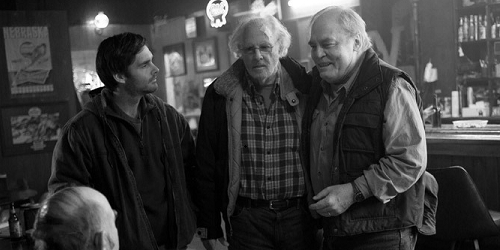
In terms of cinematography, Payne chose to film the entire movie in black and white, giving the whole story a sense of being trapped in another time, and adding to the sense of desolation exhibited by both the geography of the region and the simplicity of the town of Hawthorne, with its barren sidewalks and seemingly abandoned businesses. The whole thing feels like an emotional dead zone and the lack of human spark in all but a few citizens reflects that.
Bob Nelson’s screenplay is a simple one, devoid of plot twists or anxious moments. There are no great moments of revelation, but rather subtle hints at who Woody was when he was a young man. As such, the characters can come across as superficial and on-the-nose. But again, I think this was on purpose rather than a failing. I think he wanted to show us shallow people in a shallow land.
Toward the end, the movie started to take on a bit of a Hollywood ending feel, but although Nelson did start us down that road, he thankfully stopped himself before the point of schmaltzy no return.
All-in-all, I liked Nebraska, although I didn’t think it deserved the accolades it received at Cannes (Palme d’Or nomination, best actor for Dern), the Golden Globes (5 nominations) or the Oscars (6 nominations). It’s just not that deep a film, in my eyes.
You can find a PDF of the screenplay for Nebraska here.
Snow White more an off-grey (a review)
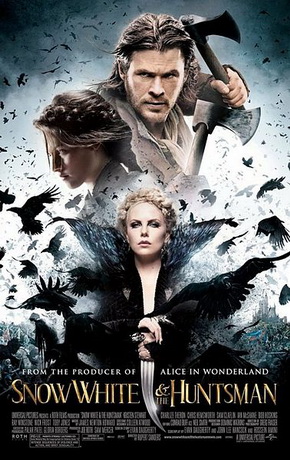
I find it difficult to appreciate a movie in isolation (its, not mine). At the same time that I strive to enjoy the movie, I also try to break down its various elements, ideally without immediate comparison to everything else I have seen.
Some movies make this easier by being truly unique stories (The Voices, for example), whereas others are either so familiar or so derivative that I find it virtually impossible to see it in isolation. The latter situation was the case for Snow White and the Huntsman, the 2012 take of the very familiar Grimm Brothers fairy tale by director Rupert Sanders.
This is not the Disney version, by a mile, but rather a much darker, more sinister take on the story of a young beauty (Kristen Stewart) condemned to death by her vainglorious step mother (Charlize Theron) who fights for her freedom in the dark woods where she meets all kinds of people and mystical creatures, including dwarves. Together, they reach a castle of renegades and Snow leads them into battle against her step mother.
So, we have the check list covered: evil step mother, check; mirror-mirror, check; bring me her heart, check; dwarves, check; poison apple, check; Prince Charming, sorta check.
Doing my best to isolate this movie from everything else, I give it a moderately passing grade. It is a fairy tale, so the dialogue hits the extremes of leaden cliché to screaming cliché.
There is no subtext to this movie…none, zero, nada, zilch. So don’t go looking for any. It is on-the-nose storytelling, which again, makes sense within the context of a fairy tale, but given that the film targets young adults to adults (much too dark for small children), I would have hoped for more.
The screenwriters offered a brief moment, where the huntsman (Chris Hemsworth) begins to let us into why he is so tortured over the death of his wife. But as soon as the moment starts, it slams shut and we are excluded from understanding the character beyond his alcoholic ramblings and Thor-like simplicity. (PS If I hadn’t seen the movie Rush, I might just think this is who Hemsworth is.)
So, where the dialogue wanes, the visuals have to take over and here, the director earns his keep. Special effects do not overwhelm the story, but instead are woven nicely into live action sequences to augment the reality. There was only one scene where I felt the director fell asleep at the SFX wheel and allowed his art director to run amok.
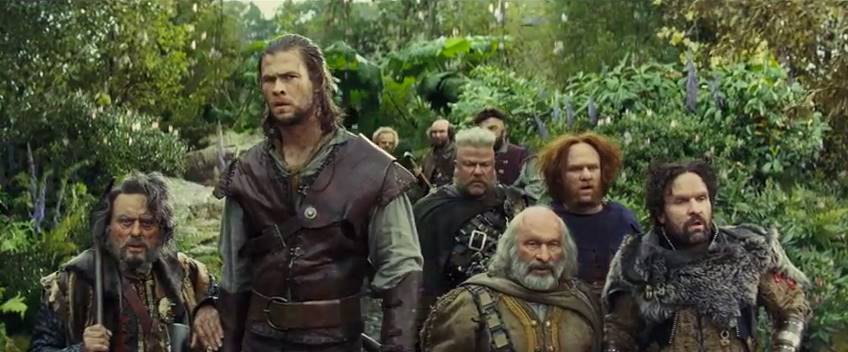
And perhaps my favourite part of the visual effects was how they took normal sized British actors and turned them into dwarves. Masterfully done. Imagine Ian McShane, Bob Hoskins, Ray Winstone, Nick Frost, Toby Jones, Eddie Marsan all about a meter tall yet perfectly proportioned, standing next to or fighting alongside Hemsworth. Don’t know how they did it…don’t want to know.
Where I found the movie particularly weak, however, was in the development of Snow White. Rather than be the protagonist of the story, I felt she was the victim of the story, literally being dragged across the countryside to avoid capture. While she clearly wasn’t the “Oh my. Dear me” victim of the Disney version, she was also not the “Girl Power” version that I think the movie promised.

When she wasn’t being rescued by one or more men, she was being rescued by a mystical inner force of which she was initially unaware and over which she had no control.
I was willing to let her be the victim over the first part of the story, but I needed her to turn around at the midpoint and attempt to kick some ass.
Now, to open the comparative flood gates, this movie has Tolkein written all over it. You’ll see dwarves walking across hill tops. Floating towns will burn. Dark forests will haunt you. Guys with swords and axes will be moody.
Now I appreciate that this is bound to happen, as there are certain pastiches that run rampant throughout fairy tales and epic sagas. I am speaking here more in terms of cinematography, however. In several parts of the journey sequence and the battle scenes, it looked like the director decided to save a few bucks by splicing in rejected footage left behind by Peter Jackson.
For what is it, Snow White and the Huntsman is not the worst 90 minutes I have ever spent watching a movie. It’s just a damned shame that the running time is 127 minutes.
Wolf of Wall Street a never-ending bore (review)

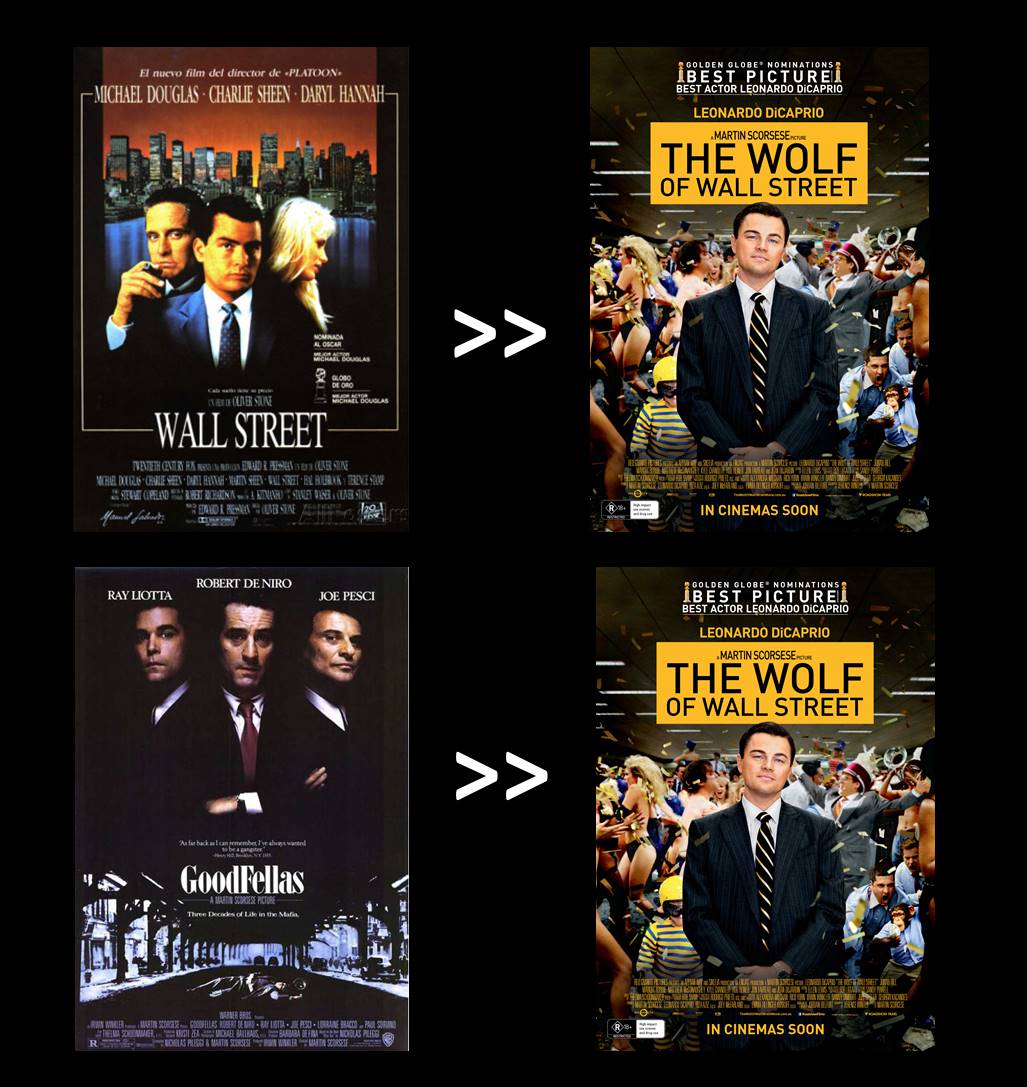
Layer the stylings of Martin Scorsese’s GoodFellas over Oliver Stone’s Wall Street and you have Scorsese’s 2013 treatise about greed in America, The Wolf of Wall Street. Unfortunately, where this should have been a wonderful blending of two great films, it was instead the mutated step-child.
Briefly, the movie follows the adventures of real-life stockbroker Jordan Belfort as he rises from the ashes of Wall Street to lie and cheat his way to fame and fortune from the then despised penny stocks market. Through a haze of booze, drugs and female flesh and relying on balls the size of the tri-state area, he pulls a fleet of nobodies into the middle of the financial maelstrom, becoming everything for which Wall Street is despised. Throw in a little money laundering and he, of course, becomes the target of an FBI and SEC investigation that ultimately brings him down.

If, from the synopsis, you don’t immediately see the influences of Wall Street and GoodFellas, you’re not really trying or you need to go back and watch them again.
I wish I could say it was just the 3-hour running time that interfered with my enjoyment of the film, but GoodFellas was 148 minutes and Wall Street was 126 minutes. Rather, I think the problem was that it felt like the movie was 6 hours long. Time seemed to drag out as though I was getting a contact high from all the Quaaludes the characters were consuming, but without the peaceful overtones.
I appreciate it was based on the life of Jordan Belfort, so perhaps the screenwriter Terrence Winter felt he had to be careful tiptoeing around the contents of Belfort’s book of the same title. But for the love of God, there was no place that Winter felt he could simply skip ahead?
When Leo DiCaprio would narrate the scenes, in some cases turning directly to the camera to do so, my mind immediately jumped to Ray Liotta in GoodFellas. Never more so than when he would try to explain how Wall Street functioned, almost mimicking Liotta’s explanation of the mob, down to the vocal cadence. The two examples below show both men introducing the troops.
And when DiCaprio would try to rally the troops, he became a bombastic Gordon Gecko (Michael Douglas), enthusiastically letting people know that greed was good…or in his case, that there was no nobility in poverty. Hell, in his narrative voice-over, he even mentions Gordon Gecko in an obvious homage that simply highlights how pale an imitator this movie is.
So I am left asking what exactly does The Wolf of Wall Street offer that the other two films didn’t.
Wealth, opulence, greed, excess? Been there, done that.
Booze, sex, drugs, violence? Watched that, saw it.
Illicit business, FBI investigations, wire taps? Old hat, nothing new.
Hubris, hedonism, idolatry? Biblical, but done and doner.
It made almost $400 million worldwide and was nominated for five Academy Awards (winning none), so people liked it.
For comparison, Wall Street earned $44 million globally in 1987 and won Douglas the Best Actor Oscar, while GoodFellas managed $47 million in the US in 1990 and won Joe Pesci the Best Supporting Actor Oscar (of six nominations).
DiCaprio has charm…and so did Liotta and Douglas.
Interestingly, I didn’t feel this one had the cinematographic snap of Scorsese’s earlier works…it didn’t feel like the camera was dancing with the actors as it did in GoodFellas.
Maybe it was simply a matter of timing. Wolf showed up just as the United States was truly starting to recover economically from the banking scandals and burst real estate bubbles, and in an almost self-abusive way, Wolf reminds Americans (and the rest of the world) of a time when money was cheap and easy. It’s definitely not a morality play, for no one is seen to suffer for their excesses.
It is the American dream seen through a tumbler of Scotch. The manifest destiny of anyone willing to gamble with the weaknesses of others. A sign that nothing has changed. That nothing ever changes.
Wall Street was a warning. GoodFellas was the rise and fall of Man. The Wolf of Wall Street is a love letter to unbridled greed.
 createdbyrcw