The Voices gets a hearing (a review)

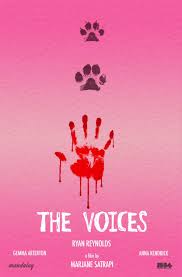
poster

Not one to generally participate in the Toronto International Film Festival, it was a rare evening in which I found myself standing in a rush line to see a movie, but a friend of mine wanted to see the latest Ryan Reynolds film called The Voices. This is not your typical Ryan Reynolds film.

Reynolds is Jerry Hickfang, a good-natured if skittish guy who works in the shipping department of a bathroom fixtures company in Milton, the derelict remains of a town in Nowhere, USA. Jerry is a nice guy, who lives above a derelict bowling alley with his dog Bosco and cat Mr. Whiskers. And of course, Jerry has the hots for office cupcake Fiona, a misplaced Brit with a craving for bigger things, played by Gemma Arterton. For her part, Fiona finds Jerry a little creepy, but is not above using his puppy lust to get a lift during a rain storm.
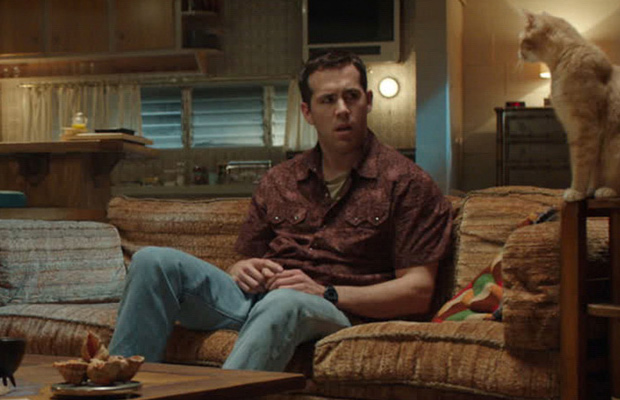
Jerry Hickfang (Ryan Reynolds) struggles to understand Mr. Whiskers' advice

Jerry Hickfang (Ryan Reynolds) struggles to understand Mr. Whiskers’ advice

Oh, and the other thing you probably need to know about Jerry is that he is in court-appointed psychiatric treatment, isn’t really good about taking his meds, and has a family history of hearing voices, but that’s not something he likes to talk about.

So far, so harmless. But after a literal run-in with a deer who begs Jerry to finish him off, the blood-letting never really stops and the rest of the movie becomes a giant slip-and-slide of mostly implied blood and offal.

So, The Voices is a thriller…and a drama…and a comedy…and a farce. You squirm in revulsion (never really reaches horror) as often as you LOL.

Director Marjane Satrapi (who brought us Persepolis) attended the screening and describes the story as completely fucked up. She said she was mesmerized by the screenplay and desperately wanted to meet the man who penned it to see what messed up human could conceptualize such a story. So she was surprised when she met Michael R Perry, a tall normal-looking fellow.

Marjane Satrapi

Marjane Satrapi

As Perry explained, he wanted to look at the life of someone of multiple personality disorder from their perspective rather than society’s. And in that, he succeeded.

With Satrapi’s help, the two clearly crafted the oddly idyllic yet troubled world within Jerry’s mind, giving the audience only the briefest glimpse of how the rest of the world saw things. With Jerry, it was all perfect love and butterflies. To the rest of us, it was squalor and pain.

Where the story fell down for me was in explaining why everything went wrong so suddenly. In writing circles, we talk about “Why today?” Why does your story begin today, at this moment, and not 6 weeks ago or 5 months from now? In this case, what was the event that caused Jerry to go from lovable schmuck to… Some might suggest it was the deer accident, but even Mr. Whiskers called that bullshit

The other place I felt let down was that the conflict never escalated, it merely accumulated. Rather than find interesting ways for Jerry’s mania to manifest itself, the writer simply repeated the same event over and over, as though each of the characters voluntarily walked into a wood chipper.

And I don’t know if the ending was presented as written or was something that blossomed out of Satrapi’s mind, but it was lazy and bordered on the ludicrous. It was a bad after-taste on a film that had merits.

Ryan Reynolds, Gemma Arterton, Anna Kendrick

Ryan Reynolds, Gemma Arterton, Anna Kendrick

On the plus side, Ryan Reynolds was amazing to watch…this was not the charming goofball romantic comedy, although Jerry was sadly charming when he wasn’t obviously tortured by his snarky brogue-spewing cat. (NOTE: Bosco and Mr. Whiskers easily have the funniest lines in this film.)

Gemma Arterton’s Fiona was a delight. She was delicious to watch as the voluptuous vixen whose biggest fear in life is being bored. Problem solved!

Anna Kendrick (Up in the Air), as tier-two love interest Lisa (see, the writer even repeated this beat), was largely wasted. Her character was pretty two-dimensional. As nice girl looking for a nice guy, her function was to have Jerry explain his condition to the audience (exposition disguised as opening up).

The Voices is definitely worth seeing, if only for what it attempts to do. I can’t help feeling, however, that if they had rewritten the screenplay a few more times, they would have achieved their goals much better than this.

My recommend (and that of my friend) is that this is a Cheapie Tuesday movie (or whatever your local half-price day is).


PS I was unable to find a trailer for this movie, so I offer the following interview with Satrapi at Sundance London…I will warn you, however, that it does include a lot more info about the plot than I gave above.

BoJack-sh!t (a review)

bojack-horseman-bar-640

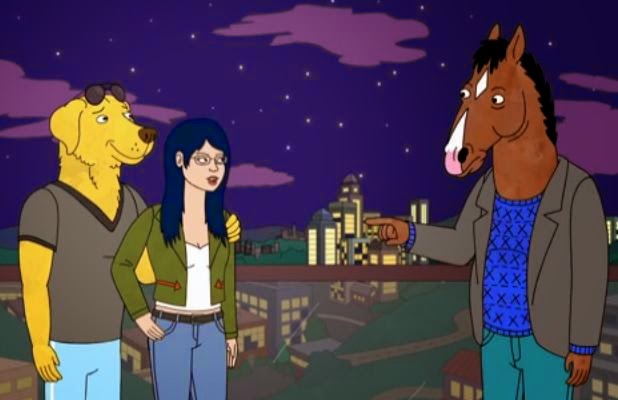
Unless this is a satire about satires, I don’t get the new Netflix Original Series BoJack Horseman.

Ostensibly, the zany life of a washed up sitcom star from the 90s, who also happens to be a horse, who is trying to find meaning in a life of idle emptiness, the show is instead an endless string of really bad puns and lame jokes about anthropomorphic animals and Hollywood, punctuated with long speeches to highlight the irony of a scene or episode.

I am surprised the character giving the speech doesn’t hold up a sign reading “Ironic part” or “Satirical condemnation of status quo” just in case the audience was too stoned to realize that’s what the speech was about.

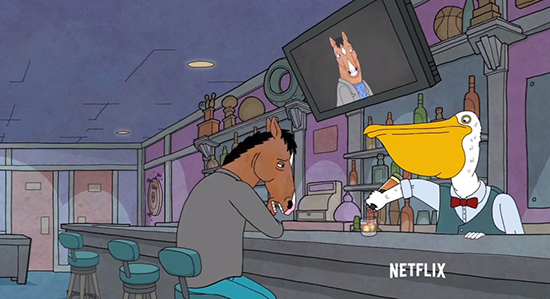
Episode 3 starts with an establishing shot of a bar called The Pelican. We then cut to BoJack sitting at the bar which is being tended by a…wait for it…pelican. Or in Episode 2, BoJack has a run-in with a Navy Seal who is a…here it comes…actual seal. Oh, and at the apex of humour, whenever BoJack’s girlfriend/agent puts him on hold, he listens to music from Cats…oh, did I mention his girlfriend/agent is a cat? Them’s the animal jokes, my friends.

pelican

There are attempts at social commentary, of course. In Episode 3, BoJack’s memoir ghost writer tries to make him feel better about a friend by claiming she was a victim of her circumstances and the pressures of society. But silly BoJack…he misunderstands this to mean that no one is responsible for their actions and that the fault universally lies with society, so he can act like a jerk and it’s not his fault. Silly BoJack.

HORSE

The voice talent is, well, talented. Alison Brie (Madmen, Community), Aaron Paul (Breaking Bad), Amy Sedaris (Strangers with Candy), Paul F. Thompkins (No You Shut Up!) and Will Arnett (everything else)…these people can act.

Show creator Raphael Bob-Waksberg is a mystery to me. An actor and writer, all I can really find out about him is he a member of a sketch comedy group called Olde English.

And the more I read about him, the more I wonder if my original comment wasn’t dead on…this may just be an amazing meta joke perpetrated by a very funny man. Or it’s just not very good.

person_11613

Because I only lose 25 minutes of my life at a go, I will continue to watch to see if it gets better…dear God, let it get better…or let me in on the divine joke of this comedy.

Unlucky Lucy – a review

lucy_ver21_xlg

What if every time…

Number Line #1

someone tried to tell you something…

Whispering+in+ear_jpg

they inserted a photo or video…

student

that showed the same thing they said?

mirror

Pretty irritating, eh?

Welcome to the first 30 minutes of Luc Besson’s Lucy, released to theatres this weekend.

(I’ve done my best to avoid spoilers, below.)

What could have been—should have been—an amazing sci-fi thriller about the possible repercussions of a young drug mule who becomes exposed to the drug and slowly finds her brain building to 100% functional capacity, was instead a massive disappointment weighted down by a ton of metaphoric sledgehammers and drowning in a sea of over-exposition.

To be sure, there is a really interesting movie somewhere in the middle of the morass that ironically becomes its own metaphor by the end of the movie. But it’s as though Besson the Director didn’t trust the story written by Besson the Screenwriter to simply let the story explore itself.

As the drug takes hold of Lucy, she goes from being an interesting female character (if a little cliché) to an automaton who simply narrates…literally narrates…what is happening inside her.

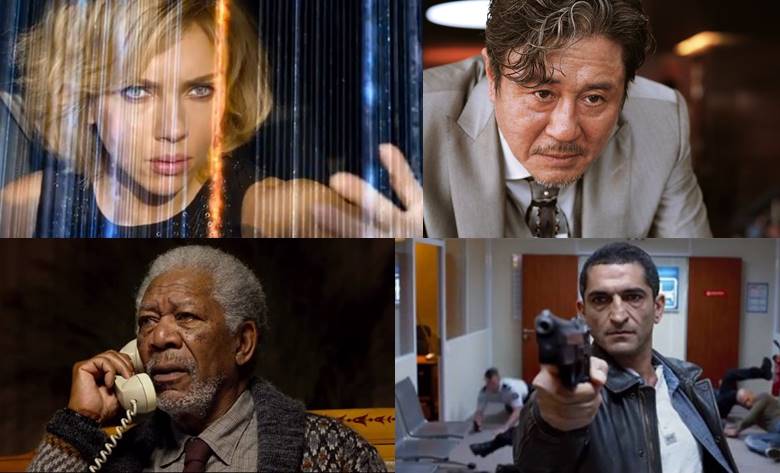
The drug lord Mr. Jang has the emotional range of complete indifference to mild irritation, which no doubt also expresses the feelings of acclaimed actor Min-Sik Choi, who portrayed him.

Even the calming voice and reason of Morgan Freeman’s Prof. Norman quickly gives way to befuddled camera-mugging and WTF?

The only truly interesting character was French police detective Pierre Del Rio, played beautifully by Amr Waked, who clearly functions as the eyes of the audience. As a friend of mine pointed out, even he at one point turns to Lucy and asks “What do you need me for?” What, indeed.

Lucy cast

To be certain, the visual effects in several parts of the movie were stunning, but as with so many movies I’ve seen in the past few years (e.g., Prometheus, Transcendence), the visual effects have become sleight-of-hand to keep you (or try) from seeing the weaknesses of plot and character.

The action sequences highlighted in the trailers take about as much time in the full movie as they did in the trailer, and so little is ever in doubt with the plot that the movie truly cannot be described a thriller.

But perhaps where the movie was most disappointing was in its promise to explore the nature of what it is to be human when faced with super-human capabilities. THIS is what the movie should have been about!

But Besson largely discards the question as quickly as he raises it in two short scenes involving a call home to mom and a simple kiss. And in both cases, Lucy coldly explains her conundrum, her human fears represented by the odd tear drop down an otherwise lifeless cheek. Rather than see Lucy struggle with her transformation, we watch her turn into a robot bent on a mission…a mission that she basically accomplishes without struggle.

But just to be sure we get the great metaphysical concepts behind the story, Besson then reverts to his earlier legerdemain, smacking the audience around with a brutally metaphoric journey through time and space. I give you intergalactic sperm meteors…you’ll know then when you see them.

And all this rancour without even touching on the biochemical, biomedical, anthropological and astronomical issues that run rampant in this mere 90 minutes.

This could have been an amazing movie. It wasn’t.

(Images are property of owners and are used here without permission.)

Dom Hemingway – A Review

CN_DomHemingway

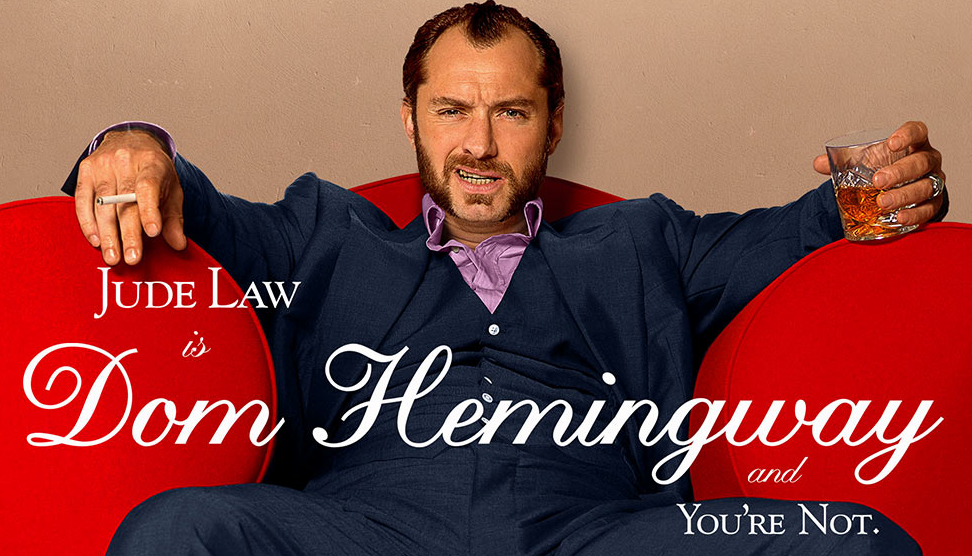
A redemption story of a career criminal who has played the game by an unwritten code, who has done his best to do right by people within the criminal world and been screwed at every turn. The only people he hasn’t done right by, in fact, are his ex-wife and daughter, whom he completely screwed over. (Trailer)

Written and directed by Richard Shepard, who brought us The Matador, Dom Hemingway works on so many levels—from its amazing opening soliloquy (no better way to describe it), through astounding montages of decadence that can only be described as balletic, to tender moments of friendship punctuated with foul language.

But sadly, because it works on so many levels, the places where it doesn’t are glaring. And there is perhaps no bigger failure than the actual story.

There is no doubt that Shepard can write. His use of words to express universal ideas and human frailty are musical. Unfortunately, those skills only serve to create islands of poetry in a story that slowly drowns in conflicting tides. The movie bogs down into little more than a series of fortunately/unfortunately vignettes that ultimately don’t go anywhere.

Likewise, the moment we leave the criminal aspects of the story and Dom has to face the wreck that is his life and relationships, the dialogue becomes wooden and cliché.

Even the redemption angle is eventually undercut by additional scenes that suggest Dom has learned little. Not sure what Shepard’s thought was here—that people don’t really change, perhaps—but it might simply be an unverbalized acknowledgement of Shepard’s own limitations.

The performances of Jude Law and Richard E. Grant cover for many of the story flaws. Law’s Dom is a man who can’t get out of his own self-destructive behaviours long enough to actually succeed and let his skills prove himself. Grant, meanwhile, plays the long-suffering conscience who just wants his friend to be happy, but doesn’t have the energy to watch Dom implode in his own fear yet again. Unfortunately, the minute these amazing men leave the screen, the movie flat lines.

(Side note: Just before the movie started, the theatre screened an ad for Filth (trailer). It was amazing how similar the lead characters of the two movies appear, as Law seemed to be channelling his inner James McAvoy at times.)

Perhaps the best way to describe Dom Hemingway is to say you will feel energized watching it, but a little empty of dissatisfied as you leave the theatre.

I wanted this movie to be better. I wanted it to be the best movie I’d seen all year, the most complete movie. Alas, it wasn’t.

Many levels of review – Part Two

Whenever someone asks me to review their writing, I try to be thorough and look at it from many levels. Yesterday, we looked at how I approach writing from the 30,000- and 5,000-foot levels. Below, we dig deeper.

1000_foot_view

The view from 1,000 feet: Now that I’ve identified the major structural and thematic issues and determined there is a reason to keep reading, I go back to the beginning and really start to peel things apart.

If I have a thing for character—and I do—I might follow an individual character through the story to see if I can reverse engineer the writer’s profile of that character. I am making this sound much more formal than it really is. Basically, what do I know about the character and are his or her actions and reactions consistent with that knowledge given: (a) where that character is now in the story; and (b) where he or she is trying to get or accomplish?

From the plot perspective, I begin to look at individual scenes and ask if the interplay between characters makes sense for their relationship and respective goals within the scene. For that matter, does each character in a scene have a clear goal?

How have the characters within the scene changed from one end of it to the other? Did one start with the upper hand and that power shift somewhere through the scene to the other character? This last point is not a necessity, but is merely one way a scene can experience reversal.

Likewise, is the scene clear with one predominant purpose or has the writer tried to accomplish too much too quickly, muddying the scene and leaving the reader uncertain as to what refers to what?

At a slightly broader level, how do the scenes play against each other? Are there smooth or logical segues from one scene to another, and if not, does the hard plot swing work? Does the scene in question set up a future one or pay off a previous one, and has it done this job effectively?

200_foot_view

The view from 200 feet: Now I really start to get into the weeds, looking at paragraphs and individual lines. From the narrative perspective, does the reader have all the information he or she needs to make sense of the story? Does the scenery or environment serve almost as another character at this point, representing a source of conflict or support for your characters? Again, this last point isn’t necessary, but can be quite effective such as in movies like The Perfect Storm.

Alternatively, has the writer massively over-written the narrative, demonstrating his or her superhuman vocabulary and/or visual imagination at the expense of the story and poor befuddled reader? As a personal aside, this is my greatest sin as a writer…but then you probably already knew that. Can I recommend any broad strokes edits (not copy edits) to help reduce the clutter and maintain the flow for the reader?

If it’s a screenplay, does the writer interrupt the reader too often with small directorial nods to the actors? For example, during a particularly heated scene of dialogue between the protagonist and antagonist, is the writer constantly reminding the actors to furrow their brows or shrug? I try to determine whether these narrative directions are absolutely necessary to get the idea of the scene across.

The problem here is that the regular intrusion of direction takes the reader out of the moment, disrupting the story and the emotional power of the characters. The senses, if only at the mental level, are forced to trip back and forth between things like subtle movements and emotive energy. Thus, in even the most action- or tension-packed scenes, too much narrative can sap the energy of the scene such that the read becomes plodding. By removing these superfluous lines, the reading speeds up and the energy of the scene is renewed.

This brings us to dialogue, which is easily my greatest challenge in screenwriting. I think novel writing gives you a bit more leeway with dialogue but I am less familiar with the medium from a writing perspective.

When I review dialogue, I try to sense how natural the dialogue feels…perhaps even reading it aloud, if I am not certain. Are these sentences that real characters would say and are the lines apt for the character who is saying them? From what I have surmised about the character, would he or she use those particular words in that way or to that purpose? Is the character saying exactly what he or she is thinking (on-the-nose) or is there some sense of subtext, whether known to the character or not?

Similarly, is the dialogue as tight as it could be, saying only what needs to be said and in the best way? Now, please note, I did not say or mean to imply in the shortest way, with the fewest words. People rarely keep their sentences to a minimum, but rather when caught up in the heat of the moment, tend to spew a bit more than necessary. There is a cadence to an individual’s speech patterns, so each of the characters should have their own cadences.

In a conversation between two or more characters, is the subject and banter clear or am I left with some uncertainty about what line corresponds as a response to what previous line or thought. To map it out somewhat mathematically, it might read something like A then A’, B then B’, C then C’, etc., rather than ABC then A’, D then B’C’, etc., where each of the letters and its prime counterpart represent a thought and its response or reaction. By the same token, however, I have to be alert and sensitive to cases where it is perfectly natural for that character to blurt out a series of thoughts and the resulting confusion may be consistent with the plot.

splashdown

Splashdown: Only once all of that has been settled, do I get to the cosmetic aspects of story review. This is where I might recommend copy edits and what have you to ensure the screenplay or novel is clean. This can include looking for stylistic inconsistencies (e.g., capitalization) or spelling errors. Personally, this part bores the hell out of me and I know that for every error or inconsistency I find, I have missed two or three others. As a courtesy, however, I will point out those that I do find and hope someone else catches the rest.

I find that by the time we reach splashdown, writers either love me or hate me…and I am okay with that. Although I prefer the former, I understand the latter and don’t take it personally. Putting your work out there for critique and possible criticism is difficult and not just a little nerve wracking. I applaud anyone who does that almost as hard as I applaud them for having written in the first place.

I just hope that, at the end of the day, I have helped the writer improve his or her work.

(Images are the property of their owners and are used here without permission because it’s more impactful.)

Many levels of review – Part One

puzzle

Every time I read something, I find something I never found before. Thus, when someone has built up the nerve to ask me to read something he or she has written, I try to read it in several waves, each one moving deeper and deeper into the details of the subject or story.

30000_foot_view

The view at 30,000 feet: Particularly if it is a complex narrative, such as a novel or screenplay, I try to make my first read an uncritical one. This may sound counterintuitive to the requested task, but until I’ve read something from front to back, I don’t feel as if I have sufficient information to be critical.

A thought or comment made at first read may be rendered moot or significantly larger one, ten, fifty or a hundred pages later. I need context to see what the writer is trying to accomplish before I know what is working or what isn’t.

If possible, I will remove all writing implements from my pockets and move somewhere completely isolated so that I can give the piece my full attention. If I become immersed in the work, absorbed by the story and characters, then I know less work is needed, and I can drill to the deepest, most detailed level of comment quickly.

If, however, I find myself drifting from the story, or worse, struggling to move from page to page or scene to scene, then I know there are larger structural or thematic issues at play. Things that potentially make detailed feedback moot upon rewrite.

If you can’t resist using a pen at this stage, try just adding an asterisk next to the line of interest for a quick reminder later. Attention to details breeds attention to details, and you’re apt to miss the bigger picture.

5000_foot_view

The view from 5,000 feet: In the second read, I try to focus my attentions on the larger structural and thematic questions that arose in the first read. By being familiar with the story and knowing who is whom, I am less likely to need to flip backward through the pages to remind myself how I got here.

More importantly, I know where the writer is trying to go with the plot and characters, which should make it easier to identify bumps or inconsistencies along the way.

These moments typically take the form of a quick shuffling of pages to see if I’ve missed something or if two pages have stuck together. In my head, if not aloud, I find myself using phrases like “Wait. What…?” and “Hold it. I thought…”

If I did my first read well, I may remember struggling at this point in the story, and if it’s big enough, having to force myself to move on. Alternatively, I didn’t bump the first time through but now that I know the full story, this scene or moment has become a problem. What made perfect sense an hour or two ago has now become confusing. Regardless, it is a moment that has to be recognized, understood and adjusted.

Most writers in my experience have the greatest problem with notes at this stage because it often cuts to the core of their story and changes her can have a significant impact on the direction of the story. In some cases, this is where the writer might find out the story doesn’t work and needs a complete overhaul.

New writers, in particular, may either completely refute the notes to avoid being so fundamentally “off base” or simply give up the piece because they feel incapable of sacrificing all that hard work, ironically enough, and trying to rescue what was working.

At this stage, I’m asking pretty broad questions. Do I understand why this story is happening (why today)? Do I clearly see who is playing what role in the narrative (e.g., protagonist, antagonist, etc) and how they interrelate?

Can I recognize the plot and subplots, and do they make sense? How do they relate and am I seeing a coherent theme? Is there any conflict in the story and does it rise in scale or intensity as the story moves forward?

Part Two: In the next section, we will continue our journey into the depths of how I review stories with complex narratives, rapidly approaching ground level.

(The images are the property of their respective owners and are used here without permission because they’re beneath me.)