The Throw – Austin Film Festival (part one)

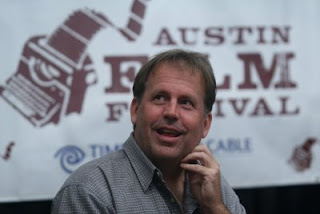
Terry Rossio on AFF panel

One of the sessions I was determined to attend this year was The Throw given by screenwriter Terry Rossio, the man who brought us Aladdin, Shrek, the Pirates of the Caribbean series and The Lone Ranger (okay, so nobody’s perfect).

Rossio is a legend at the Austin Film Festival; his The Rewrite session being one of the many highlights. But last year, he went one step further with The Throw, which this year, the folks at AFF decided to put in a hotel ballroom rather than a side meeting room.

For the uninitiated, Rossio explains, the throw is that thing designed into the end of the scene that sets up (or throws to) the next scene. It is a connective element that suggests the two scenes belong side-by-side at a level beyond plot or story.

It can be a visual to visual cue, such as the famous scene in 2001: A Space Odyssey where the victorious ape throws the bone club into the air and as it spins end-over-end, it turns into a space station.

Alternatively, the throw can be verbal to visual, such as in the scene in Raiders of the Lost Ark where Indiana Jones has made his way into the Nazi camp and learns that the Ark of the Covenant is being shipped out on a truck. Indy’s response is “Truck! What truck?” and the very next second, we watch a truck move through the Nazi camp, onto which Indy has somehow hidden himself.

According to Rossio, there are two ways to organize the narrative structure of a movie or screenplay: using storyline cuts or storyteller cuts.

Storyline cuts emerge from the events of the story, seeming natural and seamless. For example, the storming of the beach scene in Saving Private Ryan, where we see the soldiers move from one section of the beach to another.

Storyline cuts, Rossio explains, maintain the tension and keep the audience immersed in the story. It is a way to maintain and build story momentum while asking for minimal effort from the audience. It is much like a series of dominoes.

Another example Rossio offers is the end of the tornado scene from The Wizard of Oz, when the house finally stops spinning and Dorothy moves from the sepia tones of Kansas into the Technicolor world of Oz. She even states, famously, “I don’t think we’re in Kansas anymore.”

Storyteller cuts, in contrast, imply there is a grand design to the story or an author, who is choosing what you see and when rather than simply presenting events as they happen. This is common in ensemble films such as Love, Actually and American Graffiti.

This sense of a grand design can be comforting and reassuring to an audience, says Rossio. It creates a distance between the audience and the story, with the less immersive story being seen as a creation.

These types of cuts often support a narrator or guide who practically sits alongside an audience and takes them through the story. The guide can appear on-screen or perhaps as a voiceover. Think Morgan Freeman’s character in The Shawshank Redemption.

According to Rossio, storyteller cuts are also very good at renewing a story’s momentum, jumping to new locations or situations before a prior scene’s energy drops and thereby re-engaging the audience.

But how do you establish these cuts? With the throw, which Rossio divides into two categories (a fixation, it seems): the strong throw and the soft throw.

(See the next post for Part Two, which actually goes into the different throws and how you would use them.)

(Images is property of owner and is used here without permission, because I don’t give a toss.)

The First 10 Pages – Austin Film Festival

Lindsay Doran

For a new screenwriter trying to break his or her way into the film or television industries, one of the toughest tasks is getting someone to read your script. But even if you can get someone to crack that front page, the job isn’t done. You have to catch the reader’s attention and you may only have 30 or 10 or maybe a single page in which to do so.

At the 2013 Austin Film Festival in October, producer Lindsay Doran presided over a session called The First Ten Pages, which examined the opening pages of five scripts from people who had submitted to the screenplay competition. Below are some of her general thoughts on telltale trouble spots.

1. Boring title: From the cover itself, the title should grab the reader’s attention. Ideally, it will trigger a question in the reader’s mind or play with the reader’s imagination. Can you imply action or hint at something interesting inside. Don’t be vague or boring.

2. Story doesn’t begin: So often, the writer spends the first ten pages simply setting up the real world and its cast of characters that he or she forgets to actually start the action of the story. Without starting the story, you risk boring the reader.

3. Not actually a comedy: Presumably, she is talking here about comedy scripts that aren’t comedic. Funny is subjective, but is the movie actually a comedy or light drama, which Doran described as a bad place to be. If the writer is heading in that direction, perhaps it is better to write a drama that incorporates humour as a form of relief or due to specific characters.

4. Unlikeable main character: Not to say that the protagonist has to be a good person, but that the reader has no reason to root for him or her. Show us the human side of the protagonist that helps to explain why he or she is redeemable or needs the reader’s support.

5. Too many characters: One script Doran reviewed introduced 7 characters on the first page alone, which aside from being a lot to take in, left the readers with little sense of who the protagonist in the story was. As well, it was difficult to determine how these multiple characters related. Even with an ensemble piece, it is possible to introduce the characters more slowly, perhaps only introducing one subplot at a time.

6. Obstacles without stakes: While it is important to present the protagonist with challenges, the rising conflict, for the reader to engage in the story, those challenges must have important implications to the future of the protagonist. Delaying the protagonist from making it to the office is one thing, but make sure the reader understands why it is so important for the protagonist to make it to the office and what happens if the character doesn’t.

7. Confusing: Doran suggests there is a fine line between intriguing and confusing. If the reader finds him or herself lost while coursing through the opening 10 pages, he or she is unlikely to press further into the story.

8. Transparent exposition: On the flip side, make sure that any important bit of information is woven within the fabric of the narrative and/or dialogue and not simply plopped on the page. Clumsy, transparent exposition lifts the reader out of the story simply because it doesn’t flow and almost seems like a side thought.

9. Comedy based on a superficial world: Again, assuming a comedy, does the writer really understand the world she describes or is she simply aiming for cheap, cliché laughs at a well known environment and archetype? The Devil Wears Prada is a good example of a movie that went deep inside the fashion industry and avoided the superficial jokes about models, designers and photographers.

10. The three most terrifying words in the history of the American screenplay: Here Doran was being a bit playful, but wanted to make the point that it is difficult to get people to read a screenplay about a mature woman from outside the United States. Any one of those protagonist features is hard enough to promote, but to have all three is screenplay suicide, according to Doran.

Finding the Critical Sweet Spot – Part Two

Available now stamp

In the last post, we talked about the challenge of finding someone to critique your work in a way that was actionable; someone who was neither too hard nor too soft on you. Below, we continue the conversation by address the need for that person to be available for ongoing discussion and the limitations of options like coverage services.

Availability: A lot of screenwriters rely on coverage services to get feedback on their screenplays and there are a number of reputable organizations and readers out there.

The challenge, I find, with these services is that they tend to be unidirectional and/or very brief. You send your work, you receive a written report, you may receive an oral report—which allows you to ask questions—but ultimately, it’s “here you go”.

You can get more, you can have follow-up, but it’ll cost more.

As well, I think you really miss out on improving your own skills, knowledge and understanding of story through the critiquing of the work of others.

I also worry that the use of a professional service when your work and skill sets are at a nascent level is largely a waste of their time and your money. The feedback you receive will likely be so broad, so sweeping that it could easily overwhelm you. As well, any minor change you make at one stage is liable to make any of the remaining feedback moot.

Better, I think, that you find someone who is also trying to grow their skills, who understands and shares your needs and fragility. They want and need your help as much as you want and need theirs, and so you’ll be more apt to make time for each other.

Again, it is about building a relationship of trust.

Transient state: Unfortunately, no two people develop at the same rate, and even if you find yourself in a trusting artistic relationship, you will likely find that one of you is ready to move forward faster than the other. It happens in all facets of life.

As your Art develops, you will find that your needs change, and that the partner that got you to one stage of development cannot get you to the next one. It is time to bow to your partner and move on to the next one.

If you’re lucky, both of you recognize this and move on without acrimony. Not everyone is lucky. But for your Art to flourish, the move is necessary.

I wish I could tell you that there is an easy way to make the transition, but in my experience, it is like the end of a marriage and the need to start dating again. The footwork is shaky and the verbiage is awkward, but you won’t die of embarrassment.

The key is to remember why you’re doing this, why it is important to you, and then to simply move forward.

You’ll be okay.


Coverage services I have used or have had recommended to me:

Marsha Mason at Why The Face

Terry Zinner at A Film Writer

Scriptapalooza Coverage

(Image is property of owner and is used here without permission because it was available now)

Picture this

A new way to write?

A new way to write?

So, it would appear that somewhen in the recent past, I made a transition in my writing. As I was working with a friend and colleague the other day on a novel we’re writing, I realized that something significant had changed.

I no longer write in words. I now write in pictures.

This is not to say that I have become an animator or that my writing implement of choice is a paint brush or crayon (nothing wrong with those choices) but rather that when I imagine a scene in my head, I no longer think to describe it in words but literally as visuals.

This may not sound like much to you, but for me—who has long held myself to be a wordsmith, first and foremost—it is huge.

For quite some time, I have been taking screenwriting classes, and the one comment that has been made consistently throughout that time is that I write like a novelist. I have mentioned before my affinity for narrative and my need to describe a scene to within a literal inch of its setting. Well, it would appear that in trying to break myself of the verbosity, I have swung all the way into pictures, leaving words in my dust.

For the case in point, I was trying to describe to my colleague how we might open the novel at the end of our story and then transition from one event at the end to a metaphorically similar point at the beginning of the story, which all sounded great until I tried to put that down on paper.

I managed to cobble together some verbiage that roughly describes what I saw, but I know it will take some time to effectively capture the visual in words…time I am more than happy to put in. But it rocked me to realize that I no longer saw things the same way.

Oh, my God. You don’t think… Nah, couldn’t be. I’m still working on being a writer.

Dear God, please don’t tell me, I’m thinking about become a… ugh, I can’t say it… a… a… director!

Anyone have a beret and megaphone I could borrow?

directors-chair

(Images are property of owners and used here without permission because that is Legal’s problem.)

White space

blank-paper

Earlier today, I read a blog post by my dear friend Marsha Mason, the latest in a series for Why The Face. In today’s post, she touched on the subject of use of white space in writing, whether a screenplay, query letter, whatever.

“The goal of white space,” she explains, “is to never be at the detriment of your story…but to force you to condense, to economize, to pack as much punch as you can into less.”

I agree with her conclusion, but question if the goal of white space isn’t so much bigger.

For the uninitiated, white space is literally the empty space between lines of text and/or images, the complete absence of content which appears white on the printed page or computer screen.

As I suggested in my response to Marsha’s post, I have worked for several years in careers such as magazine publishing, web design, advertising and now screenwriting, and in all that time, I have found that white space is easily the least understood and most underutilized aspect of creativity.

For whatever reason, people seem to believe that an absence of something is an absence of work. Marsha’s comment about the need to be concise and economical in your word choice partly puts the lie to this conjecture, but it doesn’t go far enough.

We live our lives like we fill our pages, with mostly useless things designed to ground us but which, in fact, anchor us and restrict our movement. It is a restriction that we accept voluntarily and without which many of us could not function, or at least fear we couldn’t.

At this moment, I have five browser windows open and yet am ignoring all but one, and only because that one is playing music. And at the same time that I write this post, my mind is on several other posts and some projects I am neglecting.

Nature abhors a vacuum. True. But think of the greater image.

More than 99.99999% of the known universe is actually NOTHING! Only the absence of ubiquitous light keeps it from being literally white space.

In screenwriting, white space is there to let your reader run free with his or her own interpretation of your work. Restrict their thoughts with clutter, and they resist. Prevent their thoughts with too much specificity, and they disengage.

Let your story breathe, as you yourself should. Your readers will be happier for it. And so will you be.

(Image is property of owner; I stole it.)

Another year, another AFF Second Rounder

20th AFF poster

So, it would seem that rewrites work.

Last year, I entered my screenplay Tank’s into the Austin Film Festival screenplay competition and other than some amazing notes, it went nowhere in the competition. (My spec teleplay of The Big Bang Theory, however, reached the second round before bowing out.)

Fast-forward a year and four rounds of revisions, I just learned that the same screenplay made it to the second round of the competition before bowing out…Tank’s made it to the top 10% of its category, which feels pretty good considering the AFF received more than 8,600 screen- and teleplays this year, its highest submission rate ever.

Aside from the $200+ refund on my registration fee, what makes this really awesome is the esteem in which Second Rounders and higher are held at the screenwriting conference portion of the film festival. You see, the Austin Film Festival is more than just a whack of movie screens and Hollywood A-listers (like my own Toronto International Film Festival; on now). The AFF is also a 4-day screenwriters’ conference and love-fest, as 400+ introverts try to get just drunk enough to come out of their shells and commune with Hollywood screenwriters and film-makers.

If you are a screenwriter and have never been to the AFF, GO! It is worth the money.

Sure, some of the sessions amount to little more than hero-worship where you’ll hear questions like: “Remember that scene in X-Files when Mulder gave Scully that look? Did you write that, because that was awesome?” But most of the sessions are actually helpful discussions and learning opportunities with the film and television world’s elite writers…and best of all, these Gods not only stick around, but they’ll actually talk to you at the BBQ or in the bars. It’s like they give a shit about your shit.

Last year was my first AFF, and I was the introvert amongst introverts looking for the closest corner in which to nurse my beer or G&T. This year will be different. This year, I will move out of the corner and occupy the middle of the room…who knows, I may even talk to someone. (God, I need a drink!)

Oh, the Austin Film Festival runs October 24-31 from the Driskill Hotel.

PS If you think I’m bragging, my prowess is kept in check by a friend I met at AFF who had two Second Rounders and one Semifinalist screenplay in last year’s competition alone.

Not for nothing – REQUEST FOR HELP

ssnolan3

How do you write about nothing?

I know how to not write. In fact, I was very good at that in the past, but gratefully not writing is no longer much of an option for me.

I’m not talking about not writing, however. Instead, I am talking about writing scenes where superficially nothing happens, where a character walks through the mundane actions of life. What they are doing is unimportant to them, a robotic response to an overwhelming thought or scenario. There is an astronomic exchange of information and yet no words are spoken.

In a novel or short story, you can have an inner dialogue, revealing the character’s thoughts, but in a film, you have only silence. Sure, there’s always the trusty voiceover, but I personally think that unless the character is recalling a past statement, voiceovers are a crutch. And a voiceover weakens a scene when you compare it with silence.

Think of the last time you were faced with silence in response to something you said or did. Think of the dis-ease (yes, that’s where “disease” comes from) you experienced as you tried to figure out what the other party was thinking. In many of those situations, I bet that shouting would have been preferable to silence.

In an improv class I took—I am sorry that this is my version of “This one time, in band camp…”—we were doing a status exercise wherein one character would try to take status away from the other one, proving themselves superior through statement or action. While many student pairs would do their best to out-pompous, out-preen or out-bravado each other, I took a different tack. I went completely silent.

No matter what my partner said or did, I faced him stoically or indifferently, deigning to give him the merest glance on occasion while going about my activities. And the louder or larger he got, the less I minded or acknowledged him. The more he talked, the weaker he appeared.

Silence is powerful. And even if the silence is due to idiocy, it comes across as thoughtfulness.

Think of scenes in movies where a character has chosen to deal with a problem by thinking about it. With a good actor, you can see all the thoughts as they play out in his or her mind. The body, the face, the eyes tell you all you need to know about the emotional swells washing through the actor. A single word breaks that tension and weakens the moment. As a storyteller, why would you ever give that up?

Which brings me back to my original question: How do you write nothing?

Perhaps I am delving too far into the domains of the director and actor, but there has to be a way to ensure both those artists know what you, the writer, intend. But I’ll be damned if I know how.

So, I open the question to you, my fellow artists.

What do you do, what have you learned, what have you seen that tells you how to write nothing and yet convey a world of thought and feeling?

Please share your thoughts here as I can’t be the only one who wants to know.

Many levels of review – Part Two

Whenever someone asks me to review their writing, I try to be thorough and look at it from many levels. Yesterday, we looked at how I approach writing from the 30,000- and 5,000-foot levels. Below, we dig deeper.

1000_foot_view

The view from 1,000 feet: Now that I’ve identified the major structural and thematic issues and determined there is a reason to keep reading, I go back to the beginning and really start to peel things apart.

If I have a thing for character—and I do—I might follow an individual character through the story to see if I can reverse engineer the writer’s profile of that character. I am making this sound much more formal than it really is. Basically, what do I know about the character and are his or her actions and reactions consistent with that knowledge given: (a) where that character is now in the story; and (b) where he or she is trying to get or accomplish?

From the plot perspective, I begin to look at individual scenes and ask if the interplay between characters makes sense for their relationship and respective goals within the scene. For that matter, does each character in a scene have a clear goal?

How have the characters within the scene changed from one end of it to the other? Did one start with the upper hand and that power shift somewhere through the scene to the other character? This last point is not a necessity, but is merely one way a scene can experience reversal.

Likewise, is the scene clear with one predominant purpose or has the writer tried to accomplish too much too quickly, muddying the scene and leaving the reader uncertain as to what refers to what?

At a slightly broader level, how do the scenes play against each other? Are there smooth or logical segues from one scene to another, and if not, does the hard plot swing work? Does the scene in question set up a future one or pay off a previous one, and has it done this job effectively?

200_foot_view

The view from 200 feet: Now I really start to get into the weeds, looking at paragraphs and individual lines. From the narrative perspective, does the reader have all the information he or she needs to make sense of the story? Does the scenery or environment serve almost as another character at this point, representing a source of conflict or support for your characters? Again, this last point isn’t necessary, but can be quite effective such as in movies like The Perfect Storm.

Alternatively, has the writer massively over-written the narrative, demonstrating his or her superhuman vocabulary and/or visual imagination at the expense of the story and poor befuddled reader? As a personal aside, this is my greatest sin as a writer…but then you probably already knew that. Can I recommend any broad strokes edits (not copy edits) to help reduce the clutter and maintain the flow for the reader?

If it’s a screenplay, does the writer interrupt the reader too often with small directorial nods to the actors? For example, during a particularly heated scene of dialogue between the protagonist and antagonist, is the writer constantly reminding the actors to furrow their brows or shrug? I try to determine whether these narrative directions are absolutely necessary to get the idea of the scene across.

The problem here is that the regular intrusion of direction takes the reader out of the moment, disrupting the story and the emotional power of the characters. The senses, if only at the mental level, are forced to trip back and forth between things like subtle movements and emotive energy. Thus, in even the most action- or tension-packed scenes, too much narrative can sap the energy of the scene such that the read becomes plodding. By removing these superfluous lines, the reading speeds up and the energy of the scene is renewed.

This brings us to dialogue, which is easily my greatest challenge in screenwriting. I think novel writing gives you a bit more leeway with dialogue but I am less familiar with the medium from a writing perspective.

When I review dialogue, I try to sense how natural the dialogue feels…perhaps even reading it aloud, if I am not certain. Are these sentences that real characters would say and are the lines apt for the character who is saying them? From what I have surmised about the character, would he or she use those particular words in that way or to that purpose? Is the character saying exactly what he or she is thinking (on-the-nose) or is there some sense of subtext, whether known to the character or not?

Similarly, is the dialogue as tight as it could be, saying only what needs to be said and in the best way? Now, please note, I did not say or mean to imply in the shortest way, with the fewest words. People rarely keep their sentences to a minimum, but rather when caught up in the heat of the moment, tend to spew a bit more than necessary. There is a cadence to an individual’s speech patterns, so each of the characters should have their own cadences.

In a conversation between two or more characters, is the subject and banter clear or am I left with some uncertainty about what line corresponds as a response to what previous line or thought. To map it out somewhat mathematically, it might read something like A then A’, B then B’, C then C’, etc., rather than ABC then A’, D then B’C’, etc., where each of the letters and its prime counterpart represent a thought and its response or reaction. By the same token, however, I have to be alert and sensitive to cases where it is perfectly natural for that character to blurt out a series of thoughts and the resulting confusion may be consistent with the plot.

splashdown

Splashdown: Only once all of that has been settled, do I get to the cosmetic aspects of story review. This is where I might recommend copy edits and what have you to ensure the screenplay or novel is clean. This can include looking for stylistic inconsistencies (e.g., capitalization) or spelling errors. Personally, this part bores the hell out of me and I know that for every error or inconsistency I find, I have missed two or three others. As a courtesy, however, I will point out those that I do find and hope someone else catches the rest.

I find that by the time we reach splashdown, writers either love me or hate me…and I am okay with that. Although I prefer the former, I understand the latter and don’t take it personally. Putting your work out there for critique and possible criticism is difficult and not just a little nerve wracking. I applaud anyone who does that almost as hard as I applaud them for having written in the first place.

I just hope that, at the end of the day, I have helped the writer improve his or her work.

(Images are the property of their owners and are used here without permission because it’s more impactful.)

A matter of character

Method improv taken a tad too far

Method improv taken a tad too far

When we create stories, we try to come up with truly amazing characters; characters that will resonate in our audience’s memory, long after they’ve finished with our story. Unfortunately, what usually happens is we end up with characters that flatten on the page, becoming two-dimensional versions of our goal. The character may flare momentarily when their plot becomes particularly exciting, but for the most part, they are lifeless and have no depth.

Like subtext in our dialogue, so much that makes a character real has nothing to do with what they are saying or doing. It’s the intangibles, the subtleties that inform their speech and actions.

Would Darth Vader, for example, have been nearly as imposing without the emphysema? What would you think of Forrest Gump without his omnipresent blankness?

Years ago, in an improv class, we did an exercise in character when the instructor told us to endow our character with some physical attribute, but not to share that attribute with others, whether verbally or by incorporating it into the scene. Let the attribute impact your character and see what happens was the request.

I decided that my character’s left foot caused him excruciating pain every time he took a step. As the scene unfolded and my character found it necessary to move, I found that my sentences grew shorter, more clipped, and my patience with people wore thin. Requests to come look at this or hand me that were met with general reluctance and irritation. Everything about my character screamed leave me alone.

I did not wince when I walked. I did not massage my foot while seated. I did my level best to give no outward sense of what was wrong.

When the instructor surveyed the other students, both within the scene and watching, about what our various attributes were, none of us really knew. All they could say was that my character was very angry and a bit of an asshole.

When told I had an extremely painful foot, it was obvious. And please realize, I am NOT an actor. This was not about my Oscar-worthy performance.

But it does show that by making a very small choice about a character, a choice that has nothing to do with plot, you can significantly inform that character and how he or she interacts with others and his or her environment.

When I worked on my first screenplay, I looked for something that affirmed how cool a customer my antagonist was. I wanted something subtle that would indicate he had the ultimate confidence in himself and his manifest destiny. Something that said I have all the time in the world because the world will wait for me.

It was my last point that settled it for me. My character would never use contractions in his speech. From his perspective, every word he uttered was important, was specifically chosen for maximum impact and so why would he remove any of the letters. And because his destiny was your destiny, you would sit patiently and absorb everything he had to say, no matter how long it took.

Now the average reader or movie goer may never consciously notice this, but for many, they’ll experience the malevolent calm of the character.

And perhaps more importantly, as with the sore foot in the previous example, the contraction-free speech informed how I wrote the character. It forced me to slow down as I wrote his dialogue, to consider each and every word he spoke, to ensure they fit the creature I had created. Ironically, that I the writer served him the way he would expect to be served.

Based on the reader feedback to date, it is working.

Look at the characters you’ve created and ask yourself what physical tic, affectation or neurosis informs their lives. If you can’t identify one, can you introduce one to increase the depth of the character or heighten his or her reactions?

Even if it only helps you to better understand and write your character, the exercise will have been worth it.

(Images are property of owners and are used here without permission, because I didn’t eel like asking.)

Too cool for fish school

Too cool for fish school