I sight

I cannot see you

As you might wish,

But only as my eye allows.

Retinal engrams

Of old beliefs—

Blind spots

Emotional and real—

Shade the greys,

Colour the colours,

Frame light with dark,

Dark with light,

Until all I see

Is what I choose

To acknowledge,

To believe,

To understand.

I cannot see you

As you might wish;

Be glad I see

Any of you at all.

A slug eyes me eyeing him as it crosses a shrub near Tofino, BC

A slug eyes me eyeing him as it crosses a shrub near Tofino, BC

Costume storage

Last week, I walked through my neighbourhood and passed a theatrical costume store called Malabar, a place through which I love to rummage for the sheer joy of the pageantry. And that brief moment would have been forgotten had not fellow blogger Madelin Adena Smith posted a hyper-caffeinated blog and vlog early this morning.

In it, she challenged her readers/listeners to consider the roles they play in their day-to-day lives and asked us to consider the real us that lay hidden beneath those performances, which made me think of my psychosocial closet and all of the costumes I have worn throughout my life.

(Before proceeding, this is not a complaint against family or friends. These costumes were of my own choosing and it is only now in later life that I am realizing what I did to myself.)

Here is the schoolboy outfit…god, I was so small back then…the dutiful student who wanted to explore storytelling, but knew that this was not the accepted route to success. Oh, I was supported in my storytelling, but only as a hobby. My real future lay in science and medicine.

And the eldest son/man-of-the-house costume…almost looks like a football uniform with its broad shoulders and firm back…heady responsibilities for a young boy growing up and not having a clue as to who he is supposed to be, let alone actually is.

The clown costume…my go-to in times of stress…a protective device against a world in which I didn’t feel I belonged or related. Make ‘em laugh, make ‘em laugh, make ‘em laugh. Then run away.

The Creative Director costume…the true song-and-dance man of my repertoire. This was perhaps my biggest role in life and is a costume I still wear on occasion, if only because it is expected by clients.

My psychosocial closet is filled with these things and all of them served to block my art because they stifled the real me.

You see the problem with the bars of a cage is that they work in two directions. Yes, they keep the world from getting at you, but at the same time, they keep you from reaching your true self and that is where your art lives.

During my eldest son phase, my art would express itself in the wee hours of the morning, long after everyone had gone to bed, until my mother would finally yell downstairs for me to cease the deafening machine-gun fire of my electronic typewriter.

The clown phase almost cost me the love of my life but when the silly girl challenged that I was simply a clown, my hackles rose and I gave her reams of painfully personal poetry I had written. Her preconceptions shattered, we were married within a year and were so for 13 years.

Interestingly, it was the new costumes we donned during our marriage that led to our separation last year. Luckily, in shedding those costumes, we remain very close friends and confidantes.

Ironically, even my Creative Director guise stifled my art. Sure, I was creative, but for others, not me. This is the main reason why I chose to quit my job last year and pursue my art as a career unto itself. I had to sacrifice something, and it was the job.

With rare exceptions, my psychosocial closet is now just a relic of my past; a yearbook at which I can reflect on lives lived and mistakes made. It is not, thank goodness, something into which I feel the need to dip.

The only real costume I wear now is my Randall C Willis (please, call me Randy); the only costume that was ever truly mine. The artist has no clothes, if you will.

And because I have finally divestmented myself, my art can flow freely and keeps me warm at nights.

I am, therefore I create. It’s a great feeling.

And in the meantime, I wonder if Goodwill accepts old costumes.

So, now that I stand here naked (don’t think about it), I feel free to ask: What costumes you have worn in your life or do so now that have blocked your art?

The only costume I am apt to wear these days is on my hand

The only costume I am apt to wear these days is on my hand

Dara Marks at Toronto Screenwriting Conference 2013

Engaging the Feminine Heroic

Dara Marks

In a follow-up to her very popular Transformational Arc talk of previous years, Dara Marks took us through another aspect of character development, something she calls the feminine heroic. A counterpart to the well known hero’s journey, the feminine heroic completes the hero’s character and thus is not necessarily tied simply to female heroes. Rather, it encapsulates the feminine side of everyone’s natures.
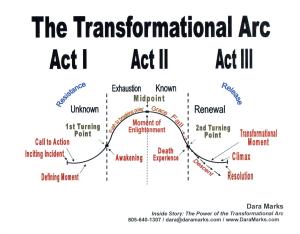
Transformational Arc

She explains, as writers, we are constantly trying to understand the narrative in which we are living, but we experience that narrative from a very personal perspective. Thus, in her canonical transformational arc, there is both an outer realm, where external forces act upon the hero, and an inner realm, the more personal influences. We grow, she says, only in relationship to demands on us to grow, and the external realm stimulates the internal reckoning.

The union of the feminine and masculine brings about wholeness in the character. It is a combination of the masculine spirit, which represents all that we can be, and the feminine soul, the deepness of our authentic self. Marks offers the example of a tree, which may reach toward the sky, but is only as strong as the root system that provides it nutrients.

Everything we are in life is what comes from deep within ourselves.

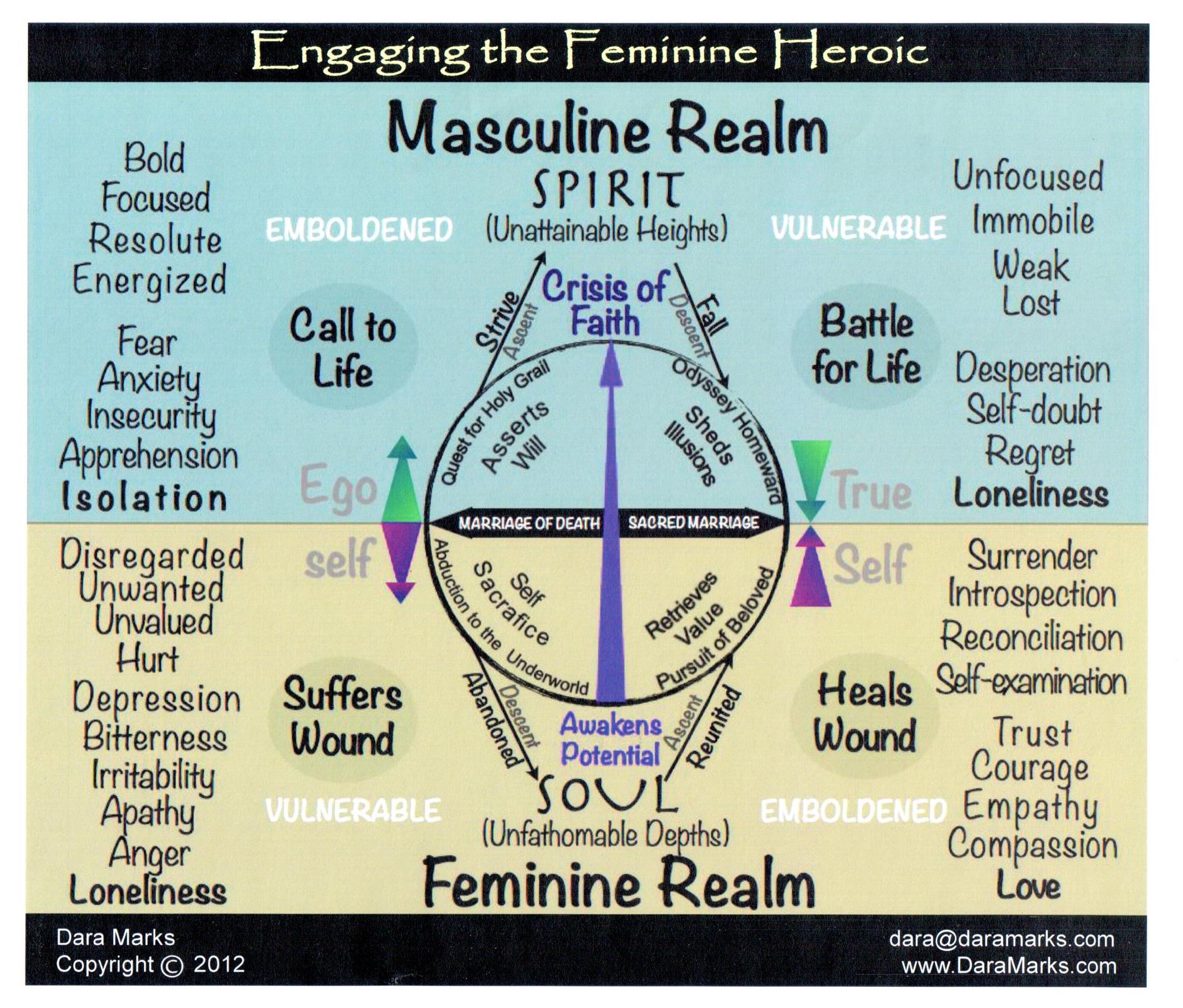
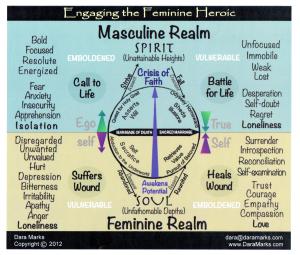
Marks presented this relatively complicated diagram that illustrated the hero’s external and internal journey (and in many ways, reflects our own journey through counseling or life itself). To the left, we find the Ego Self, where the onus is on my aspirations and beliefs of me. To the right is the True Self, which is understood after reflection and denotes my understanding of myself in the universe.
The union of the masculine and feminine sides of a character creates a wholeness

The union of the masculine and feminine sides of a character creates a wholeness

Ego Self: All early development, even that of a child, relies very heavily on the development of the Ego, a sense of will and determination. We believe that we’re in charge, despite all evidence to the contrary.

So if we start the journey in the Ego Self realm, we can look at the External or Masculine side and the Internal or Feminine side of ourselves.

Masculine Ego: In the top left quadrant, we have the Call to Life, the external mission that demands we strive or ascend to a greater level. We assert the force of our will on the universe. This area therefore is associated with a youthful and energetic quality. We have to move forward. We cannot let fear hold us back. To do this, we must sacrifice our feminine side, pushing those feelings down, or we cannot move forward.

Marks suggests that the tragedy of Hamlet was that he couldn’t get beyond his feminine side when he needed to move forward. She also gives the very literal example of Agamemnon, who was forced to sacrifice his daughter Iphigenia before the Greek ships would be allowed to voyage to Troy.

Feminine Ego: In the lower left quadrant of the diagram, we see the influence the masculine decision has on the feminine ego. We suffer a wound because part of us is no longer valued. We are literally abandoning a key part of our self and this will have a lingering effect. While we appear invincible externally, we are very vulnerable internally.

Thus, the feminine side needs to be rescued by the proverbial knight on a white charger. Marks is quick to point out that this is no time for political correctness as at this stage in our development, we just don’t have the internal skills to rescue ourselves.

She goes back to Greek myth to show how this works, focusing on the story of Demeter and her daughter Persephone, the latter of whom was abducted to the underworld by Hades to become his wife. Demeter was distraught at the loss of her daughter and journeyed to the underworld to bring her back to the surface.

The underworld experience may be difficult, but it is educational and we need to journey through it to come out more whole in the next stage.

Marriage of Death: The combination of the masculine and feminine ego is what Marks calls the Marriage of Death. Anytime we strive to become something new, it means the death to other aspects of our being. We just can’t strive at all things at the same time. But this marriage is not designed to last.

As Marks points out, the problem with striving is that it is doomed to failure. We can’t be rich enough, strong enough, famous enough, whatever enough. And it is at the moment of realization that our dreams are doomed that we have a Crisis of Faith (masculine side), which leads to an Awakening of Potential (feminine side). We move closer to the discovery of our true self, the right hand side of the diagram.

Masculine True Self: As the masculine ego passes through its crisis of faith, it suffers a fall from the unattainable heights, which converts the Call to Life into a Battle for Life. For self-renewal, it is essential that our delusions and illusions are shed during this descent, such as the belief that we are in control of our lives. And thus, at this stage, it is the masculine self that needs rescuing.

Marks offers the example of Odysseus (a popular subject at TSC this year) and the knowledge that his journey home was his great undoing as he loses more and more of his ego self (including his ships, crew, etc). The second half of his journey is literally the journey homeward toward his true self.

Feminine True Self: And who rescues the masculine true self? As the masculine side becomes more vulnerable, the feminine side becomes emboldened. We heal our wounds and reunite, turning pain and suffering into love and creativity.

The way out of our self-imposed purgatory is through compassion. We have to hear the story and then feel and acknowledge the pain. And it is only when the pain is given voice that it can move back from the underworld into life.

Marks exemplifies this aspect with the myth of Inanna and Erishkegal (which I do not know as well and so simply provide a link).

Sacred Marriage/True Self: It is at this point, through the sacred marriage of the masculine and feminine that we finally achieve the true self.

NOTE: All images and illustrations are property and copyright of Dara Marks and are used here without permission.

Glen Mazzara at Toronto Screenwriting Conference 2013

The Odyssey of Writing

Image

In his opening presentation to the TSC, Mazzara recounted the story of The Odyssey and used it as a metaphor for his own journey as a writer, comparing the setbacks and challenges experienced by Odysseus to his own.

As Mazzara explains, the story of Odysseus’s return home after the Trojan War is a story of changing winds. Such is the case with writers. When we decide to become writers, we have a lot of anxiety blowing in our heads. They can drive you insane. And bad news; those winds don’t go away, no matter how successful you become as a writer.

That anxiety permeates every scene you write. And once you start working with others, those people add to the confusion in your head.

Writers constantly look for validation, he says, they look for love. In this way, actors and writers have much in common as both groups are looking to receive love and adoration. The big difference is that writers know they’ll never get it, whereas actors maintain the delusion.

The chaos in writers’ heads also sets them at odds with the rest of the film and television industry, which is designed to run under more control. Thus a snarky relationship develops, with people in the industry constantly putting down or belittling writers and diminishing their works. The example he cites is the discussion of whether Shakespeare wrote his plays or it was a British lord with absolutely no record of having written a single literary word.

Mazzara says you simply have to get into a space where you are purely working on the work for the sake of the work. You have to learn to live with the anxiety.


He then looked at the concept of hubris and ego. In recounting the story of Odysseus blinding the Cyclops, he noted that as long as Odysseus remained “Nobody”, he was safe and managed to escape the island. It wasn’t until he stood on the prow of his escaping ship and proclaimed that it was Odysseus who blinded the Cyclops that things really went to hell.

When we write, Mazzara says, we have to remove our ego. We are only the steward of the story. The story wants to be told and we are merely the instrument by which this happens. And when working in groups, we have to be generous with each other and avoid taking credit.

He suggests that there is a tendency to try to manage our anxiety by taking the credit for work we have done or to which we have contributed, but we have to avoid this at all costs.


Mazzara then gets to the part of The Odyssey where Odysseus reaches Ithaca but finds his home invaded by suitors for his wife. Disguised as a beggar, he sets up a challenge that whomever can string Odysseus’s bow and fire an arrow through a series of axe heads will win the hand of Penelope. After all others have failed, the ridiculed beggar is given the opportunity and despite not being known for his strength, Odysseus strings the bow, makes the shot and then slaughters his disrespectful competitors.

All this to say that writing is about sticking to your strengths and doing it your own way. Mazzara showed loose sheets of foolscap on which he hand wrote his presentation because that’s the way he writes, by hand, on paper. When he tries to write on the computer, he finds himself editing his material and reworking lines as he writes them. On paper though, he can let the writing flow and works his way through the material in his head. However it works for you, he says, be sure you stay in the moment, stay in the story.

We all feel anxiety about conforming to how others do things. He is adamant that we have to fight this urge. As he describes it, it was a lonely journey for him to see that his method of writing works despite being antithetical to the way Hollywood works. Writing, he says, needs to be effortless.

As far as writing as part of a group in a writers’ room, he makes the comparison to a musical group heading into a recording studio, where everyone makes a contribution to the final product. Change one of the players or eliminate one component and the final product is different.


And finally, he says, there is a moment when you get your shit together and you know you can make it work. That is the moment you’ve come home.


In the Q&A, when asked about the bloody slaughter and carnage phase of The Odyssey, Mazzara said that was the editing phase of screenwriting, when the sheets are covered with red ink and look like they’ve been dipped in blood. In fact, he said, to lighten the blow on other writers, he refuses to use a red pen.

Now I’m her-o

It may sound incredibly self-centred, but I am the hero of my personal journey through life, and by that, I don’t mean a literal Hercules or Aeneas so much as the protagonist. Everything in my life is interpreted through my eyes in how it impacts me.

Sure, if I try, I can step outside of my ego and try to consider life and specific events through others’ eyes, but even here, if I am to be completely honest, I am still tempering those reflections through my own life experiences and biases.

And now to the controversial aspect of this vignette.

When creating characters for a story—a novel, screenplay, poem, excuse for lateness—each character in that story is the hero of the story, if only in their own eyes. The events you record as a writer are witnessed by the characters in your story from their own perspectives and their responses and reactions to events and other characters will be based on their individual experiences and biases.

Sure, the story you are trying to tell may only have a main protagonist, perhaps a secondary protagonist and an antagonist. Everyone else is just there for colour or to help your main characters rationalize their worlds and world views. But you have to be honest to those other characters if we, as readers, listeners and viewers, are to believe them.

When I read screenplays, I often get quite attached to the main characters, whether positively or negatively. More often, unfortunately, I end up watching minor characters for whom I have no opinion if for no other reason than I cannot believe they exist.

They are placeholders to keep me from watching 95 minutes of nothing other than antagonist and protagonist in earnest conflict. To call them two-dimensional would be a slight to some finely crafted animated characters I’ve watched in well written cartoons.

Even if a character has one line or is silent, I want to know in my gut, if not my head, that the character has a reason to exist, not for the sake of your plot, but for the sake of his or her universe.

I’m not asking for 37 stories for 37 characters. I’m asking for one story for 37 characters that matter.

A lot of people tell me that this over-complicates things—you may be thinking this right now. I obviously disagree, believing that a Who is a Who, no matter how small.

That character’s reality doesn’t have to be on the page, but it better be in your head, because the reader will know if it’s not. The character won’t pop, if it isn’t.

If it helps, think of this as another way of telling a story that’s been told a thousand times before. Rather than tell the story from the perspective of the protagonist everyone knows, tell it from the perspective of the character few people ever remember. The 100 bajillion Christmas stories are perfect examples of this.

The Little Drummer Boy was the story of the birth of Christ and yet it wasn’t.

What if you retold the story from Pretty Woman but from the perspective of the hotel manager?

Make every character in your story believe he or she is the hero of his or her universe, and they will live on beyond their few lines of dialogue.