Much Review About Nothing

http://prettycleverfilms.com/movie-reviews/modern-times/review-much-ado-about-nothing-2013

There is a certain degree of irony in this review of Joss Whedon’s Much Ado About Nothing which is just that; the reviewer complains at length about the bare-bones nature of the production and the lack of interpretation over mere presentation (i.e., modern dress without modern sensibilities).

I seriously doubt the reviewer would have had quite the same issues with the setting simplicity if this had been a staged production rather than a filmed production, and it is important to remember that Shakespeare’s plays were written for the stage, not the screen.

As to modern interpretation and sensibilities, I largely think this is impossible without a complete rewrite of the play into another project all-together and most particularly in the case of the comedies. Take, for example, the movie 10 Things I Hate About You as a modern interpretation of The Taming of the Shrew.

The tragedies so better lend themselves to simple modern reinvention by simply changing the uniforms of the many and varied soldiery or political figures. As an example, I give you House of Cards, which to me is a retelling of Richard III with a soupcon of Othello for flavour.

And let’s face it, Much Ado About Nothing is one of the more frivolous and playful of Shakespeare’s comedies…it is play for the sake of play. It offers no deep meaning but instead centres on the silliness of love; a topic that will remain universal for all time.

Which brings me to the biggest challenge I have with this review.

The reviewer seems to assume that Whedon meant for this to be anything more than a lark…but Whedon being Whedon, a lark that he filmed with very good friends who happen to be very good actors.

I know as little as the reviewer, but I have every reason to believe the choice of modern dress was simply the reality of not having racks of Renaissance costumes lying around the house. The choice of black & white cinematography was perhaps an homage to the screwball comedies of yesteryear, of which this play is truly one and possibly the most yester of yesteryears.

As you can probably tell, I liked the movie…I had few expectations other than laughter and those were met. I also liked Kenneth Branagh’s version, which really only differed in multiple sets, colour film and period costume.


Adapt or die

Image

Recently, I’ve read a couple of screenplays based on novels, and with this albeit low number of examples, let me start by saying thank goodness I have yet to find a book I wish to adapt for screen. The process, it would seem, is tedious and fraught with perils.

Odds are, especially if you are just starting out as a writer, you’ve chosen to adapt a specific book because you love it.

You love the way it is written. You love the story it tells. You love the characters. You may even love the paper on which it’s printed or its cover art.

Congratulations. You’re doomed.

I say this not to be mean but to point out that the book was written as a book for very specific reasons. The format and structure of a novel is incredibly different from that of a film.

At its simplest, you have the space in a novel to indulge yourself in narrative and character introspection. More simply put, you can describe a setting or reaction in such detail that if linearly translated to a screenplay, it would result in ten minutes of film focused exclusively on waves rolling across a beach or on the angle of an eyebrow raised over the left eye of your heroine.

Even simpler, novels are verbal, ironically, while films are visual.

And unless you’re planning on running a voice over throughout your movie—please say no—I have no idea what your characters are thinking. I can try to guess from their facial expressions, but it is a guess and will have as much to do with how easy it was to find a parking place in the megaplex as it does with the actor’s talent.

The novel could afford to be 500 or 1000 pages. Your screenplay can’t.

I love Kenneth Branagh. I love Shakespeare. Branagh did a very linear interpretation of Hamlet for film. I was bored. Mel Gibson’s Hamlet? Held my attention and was entertaining. [Compare the two “alas, poor Yorick” scenes linked here.]

The difference? A very sharp editorial knife.

So, I am going to ask you to take the thing you love and hack it. Cut it with broad strokes and wild abandon. This is no place for finesse.

This isn’t about trimming paragraphs. It is about slashing subplots or entire chapters. It is about burning away all of the decorative niceties until you reach the essence that turns your crank.

Be cruel. Be ruthless. Be honest.

Take that Sistine Chapel and reduce it to the handful of bricks that make you sweaty; that keep you coming back time after time.

It will feel like murder. In some ways, it is. But it’s murder for the greater good, because once you’ve hit that core, you can begin to rebuild. You can start to rescue some of the elements you set aside earlier or add new ones that are truly unique to your vision.

What is that core? I don’t know. That’s for you to decide.

Maybe it was the setting. Perhaps it was the relationship between two characters.

Whatever it is, find it and make that your story. That is what you love. That is why you keep coming back for more.

Honour that and you’ll have a screenplay worth turning into a movie.

(Image is property of owner and is used here without permission. I’m adaptable that way.)

Onward creative spirits

Image

Once more unto the breach, dear friends, once more.Henry V III, i, 1

In his thrilling speech to his troops (see excerpt below), who stood exhausted before the walls of Harfleur, Henry V challenges them to try yet again to take the city, that now is not the time to back off. Keep moving forward.

As it was expressed dramatically about war, so it is with Art and with life itself. It is vital that once you gain some momentum, you should do everything in your power to maintain that momentum.

Several years ago, I took up running. I hated it. I hated every living moment of it. But I was trying to improve my health and I knew that it was important. And so every couple days, when I would head out for my run, I had but one thought in my mind: keep moving forward. I knew that if I stopped, I might never run again.

As it was with running, so it is with writing. I write because I desire to, but also because I fear that if I stop, there is every chance that other aspects of life will creep in and keep me from it. My fear of losing writing is bigger than my fear of writing crap.

If I’m working on a screenplay and hit a creative sticking point, I try to move around it rather than dwell on it and lose the forward momentum. Sometimes, moving around it means writing another scene elsewhere in the same screenplay, but more often, it means jumping to another screenwriting project, developing another blog post or riffing wildly on Twitter or Facebook. My poor keyboard owes me nothing.

Even when I am simply writing some notes for a scene yet to be written, I do not allow the “correct” word choice to block me from writing…I simply add a placeholder where the right word should be and keep the thoughts flowing onto the page. The placeholder can be a blank underline (fill it in later) or a close enough word so I will know what I meant later, or it can be the word “shit”. It doesn’t matter.

It’s the artistic version of Newton’s First Law of Motion: An object at rest remains at rest unless acted upon by a force. An object in motion remains in motion, and at a constant velocity, unless acted upon by a force.

In this case, the object in question is me and/or my creative spirit.

In fact, forward movement doesn’t even have to be the same art form. I often use photography to keep me going. But you can also read a book, see a movie, sit in a park. Do whatever it takes to keep the creative parts of your brain and soul moving forward.

But how will I ever get anything done if I keep flitting back and forth from distraction to distraction?

Unless you’re specifically working to a deadline for your creative project—and there will be times when this is true—creativity is about the process, not the product.

Most artists (and we are all artists) live and act to create, not to have created.

And even if you are working to deadline, forcing your way through a challenge will likely result in a work that requires significantly more reworking than if you had simply let the creative spirit take you where it would. Thus, I don’t know that you’ve really gained much by pushing on something that isn’t coming naturally.

The natural direction of the universe is forward. You have it in you to continually move forward. Why would you give that up?


In peace there’s nothing so becomes a man
As modest stillness and humility:
But when the blast of war blows in our ears,
Then imitate the action of the tiger;
Stiffen the sinews, summon up the blood,
Disguise fair nature with hard-favour’d rage;
Then lend the eye a terrible aspect;
Let pry through the portage of the head
Like the brass cannon; let the brow o’erwhelm it
As fearfully as doth a galled rock
O’erhang and jutty his confounded base,
Swill’d with the wild and wasteful ocean.
Now set the teeth and stretch the nostril wide,
Hold hard the breath and bend up every spirit
To his full height.
– Henry V III, i, 3-17

(Image used without permission.)

Stupid is pretty smart

Image

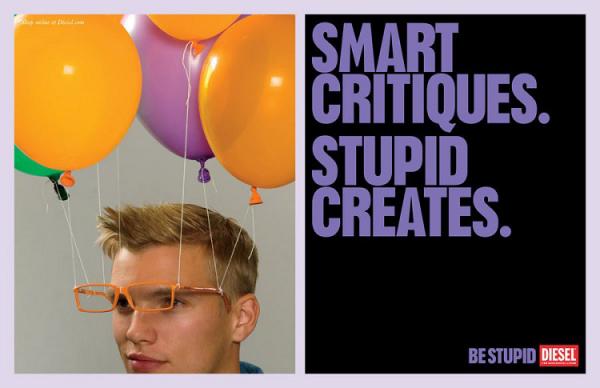
I find it interesting that most people seem to be less afraid of being stupid than they are of looking stupid.

I say this because of the inordinate amount of stupid material I find every day—the people posting this stuff obviously don’t think it’s stupid—and yet many of the brightest people I know (and not just those with whom I agree) are paralytically afraid of saying anything lest people think they’re stupid.

Now, I appreciate that stupid is subjective, but this is not a condemnation of stupid, it is a call to embrace our personal stupid and use it to move forward to brilliance.

If you watch a group of children as they age—not literally moment-by-moment; that would be stupid—you will see that they start out unfiltered and unhindered by subconscious voices that make them edit themselves. They are free to create amazing things and proudly display those things on refrigerators around the world.

As they get older, though, those subconscious voices creep in and you find the children become less enthusiastic about their art. They become more self-conscious about being seen as stupid, and so the refrigerators of the world become increasingly barren.

That is incredibly sad, and not just because the typical refrigerator is a featureless, oddly coloured box with little inherent fashion sense. It is sad because it creates a population of adults who are incredibly repressed and overwhelmingly self-conscious.

Image

As I have mentioned before, I have numerable friends who want to write, but they are routinely stopped from taking any action by an infernal firewall of what to write. They can’t just write anything. Writing just anything would be stupid.

No! No! No! Writing just anything would be freaking brilliant!

Writing just anything would make you a writer, rather than the non-writer you are now.

Write the word “stupid”. Write “stoopid”. Write “styupid”. Write “stewed pet”. And bloody screw AutoCorrect.

Let stupid be your creative scissors and run around the room not caring into whom you run or stab. Stupid begets intelligent, no matter how stupid that sounds.

Image

Besides, no matter how clever, intelligent or prosaic you are, someone is going to find your writing stupid. Stab them with your stupid scissors and move on.

I absolutely abhor the novel Crime and Punishment, routinely espousing that the crime was the writing of the book and the punishment is the reading, and yet many people find it a marvelous work of art. How stupid is that? (You can read that as I’m stupid or they’re stupid…I don’t really care.)

In King Lear (III, ii), Shakespeare wrote: “The art of our necessities is strange that can make vile things precious.”

As used in the play, this line has absolutely nothing to do with the point I’m making, and depending on how you read it, the line actually blows my thesis apart or completely justifies it. Now that is freaking stupid.

As Liam Neeson should have said in the movie: Release the Stupid!

You may just find that your stupid is pretty amazing…and even if it’s not, you’re one step closer to your brilliant.

Image

(Images used without permission. Pretty stupid, eh?)

Death by a Thousand Meetings

Committee (n): 1) a group of individuals specializing in irreversible creativity vivisection; 2) last known location of a good idea. See also: elephant’s graveyard.

Perhaps the greatest challenge facing anyone creating art is less the generation of new ideas and more the knowledge that at some point, you will have to release your art to an awaiting world; aka, relinquish control.

Now, we can (and have) discuss the illusion of control at any phase of the creative process, but there is no denying that if you want your art to be appreciated by others, you will have to pass your newborn into someone else’s hands…or worse, someseveral else’s hands.

For writing—my predominant area of interest—that moment can come quite early in the creative process, whereas for other art forms, such as sculpture or painting, it may appear quite a bit later (please correct me, if I under- or misstate things).

You must respect your art. You must protect your art. But you must also realize that if you intend to share your art, and perhaps even make money from it, you must be somewhat flexible with your art. When you bring it to the world, it ceases to be all about you.

A teacher once suggested that upon completing a play, Shakespeare merely became another critic of the work. His opinions on meaning and significance within the play were simply one more voice and held no more sway than those of any other critic. I don’t know that I agree—what self-respecting writer would?—but I see the point.

When I write a screenplay, I need dissenting and diverging voices to ensure that I am not leaving things out or glossing over important plot or character points that are clear in my head. At the same time, I must be sure that my vision is protected, lest I start writing someone else’s screenplay.

I understand, however, that if I want to turn this screenplay into a movie or television episode, I will have to relinquish some of the control to the hands of studio executives, producers, directors, actors, directors of photography, sound teams, and in all likelihood, the third cousin of the guy who runs the craft services table. I have to be comfortable with the idea that each of these people wants to (actually, must) contribute in some way to the final product to give them a sense of ownership. They too are artists.

I am struggling at this stage with several television projects I have been developing. I have a computer filled with TV series concepts and/or pilot scripts, and I am trying to decide with what production companies to share my babies. Like Smeagol, I stroke my precious and have a rampant distrust of everyone.

How do I know the company I choose shares my vision, will protect my baby, isn’t just a group of ravenous Orcs? I don’t. I can’t, ahead of time.

What helps is watching fellow writers who rabidly protect their newborns at a much earlier stage in development. Who in a reading group, spew buckets of foamy spittle while savagely defending the use of the word “vivisection”, or primal scream that their protagonist’s motivations are obvious to anyone with half a brain.

I am doing the same thing with my projects, only at a later stage and mostly in my head (and possibly with just half a brain). Just as they have to learn to let go or at least lighten up, so do I.

In writing this post, I am coming to realize that my art is in the writing of the screenplay, not in the making of movies or television. Thus, when the screenplay is ready to move on, I must let it go and hope it flourishes…even if I am not ready to let it go. The art must grow and breathe, regardless of my personal reluctance and fears.

Committees are still evil…you will never get me to say otherwise…but unless I am willing to do everything on my own, which would not do justice to my babies, committees are a necessary evil and less dangerous to my babies’ successes than on overbearing, overprotective parent.


For a humourous take on the evils of meetings, please also see the recent blog post by Ben’s Bitter Blog: Meeting Bitterness.

Another Liebster Award?

Image

I can’t believe how lucky I feel and how honoured I am to have been nominated for a second Liebster Award in just two months of running my blog. My nominator was new friend Julian Froment—book lover and reading fanatic—who blogs at http://julianfroment.wordpress.com/.

According to Julian, and as I recall from earlier, the rules for the Liebster Blog Award are:

  • List 11 random facts about yourself.
  • Answer a series of questions that were asked of you.
  • Nominate another 11 bloggers for the Liebster Award and link to their blogs.
  • Notify those bloggers of their nominations.
  • Ask those bloggers 11 questions they must answer in accepting their award.

Eleven (different) random facts:

  1. I missed actually being at the Pentagon (specifically, the metro station) on 9/11 by about an hour.
  2. I have an almost paralytic fear of heights and am getting sweaty as I type this because I am thinking of heights of which I have been afraid
  3. I adore sleep and positively purr in those moments just before sleep arrives and just as I awake
  4. I am a nature/science documentary junkie, but not the ones with overt agendas that border on zealotry (even if I agree with the agenda)
  5. To celebrate my 50th birthday this year, I am trying to plan an evening comedy cabaret in support of some charity, just so I can hang out with funny people
  6. I would eat cold cereal for all 3 main meals if I could
  7. I typically create my written works long-hand in a notebook and then transfer to the computer
  8. I struggle with weight and have been an emotional eater my entire life
  9. I am a dog person, but real dogs, not those rats with a glandular condition (no offense to rats)
  10. I have a tattoo that reads Julius Caesar V. v. 73
  11. When it comes to housework, I am tidy but not clean…I’ll organize, but it’s gotta be pretty dirty for me to mop it

Julian’s questions of me:

  1. What is your favourite book? I would pick something by Shakespeare, but as you specified book, I would have to go with Dune, which for all its brevity, provides an amazingly intricate story that also serves as something of an ecological allegory.
  2. Do you play an instrument? If so, which one? No, but have often wished I did, as I am envious of the joy others experience while playing.
  3. What is your ideal holiday? Sunshine, warmth, water, a breeze, a notebook and my camera.
  4. Which author would you most like to meet (they do not need to be currently alive)? As I behaved earlier, I will cheat here and push for Shakespeare, although I must admit to some trepidation that the man could not possibly match the art.
  5. What is your favourite genre to write in? I am a natural comedy writer—sketch, sitcom, movie—but don’t like to be hemmed in by specific genre…not wanting to sound pretentious but certain I will, my genre is story.
  6. What is your least favourite book? There have been many books I have found lacking, but if forced to focus my animosity on just one, it would have to be Ken Dryden’s The Moved and the Shaken, which if nothing else answered my question why don’t people write novels about normal people leading normal lives (answer: they are boring).
  7. Do you have siblings, if so which? Yes, I have two brothers, whom I am happy to say I have finally learned to appreciate as great men—the lack was on my part, not theirs.
  8. PC or Mac? PC
  9. Do you eat meat? Aggressively so!
  10. What is your favourite sport? Hockey (and specifically, my beloved Toronto Marlies)
  11. Do you have a day job? No…it got in the way of my storytelling efforts.

Eleven nominees for the Liebster Award:

I believe the idea behind the Liebster is to promote relatively new bloggers who have fewer than some threshold of followers (I’ve seen anywhere from 200 to 500).

Last time, I begged off on this part, because I really didn’t know anyone who fit that category, but I feel it would be a cop out to do the same this time, so I am simply going to nominate people who jazz me in some manner.

  1. Ben’s Bitter Blog – for his sardonic wit and the sheer pleasure he takes in bitterness
  2. A Day in the Life of Shareen A – she makes me smile
  3. BadsPhotoBlog – because I thought he was nuts for considering these bad photos (misread the name)
  4. Salty Palette – for the sheer delicacy of these amazing photographs
  5. Ryan Hermann – for making me want to try harder with my camera
  6. Pressed Words – their sheer elan and joy of food
  7. Bite Size Canada – for the tireless efforts to celebrate Canada’s history and culture
  8. Life According to Madelin – because her interests are completely unrelated to mine but her joy is not
  9. Write, Read, Repeat – for her sheer determination to do just that

Questions for the nominees:

  1. What is your primary art, whether desired or actively pursued?
  2. Artichokes, brussel sprouts, beets, bok choy, durian. Which, if any, of these do you enjoy eating?
  3. What teacher meant the most to you in your life (school or otherwise)?
  4. Do you actively or would you consider mentoring someone?
  5. Are you funny and can you give an example (either way)?
  6. If you could be any other species, which would you choose?
  7. Pick a number between 1 and 3.
  8. Do you live urban, suburban or rural?
  9. What is the most exotic place you have ever visited (define exotic as you wish)?
  10. What actor or performer turns you on? Turns your stomach?
  11. When was the last time you cried (for whatever reason, positive or negative)?

I look forward to learning more about each of you.

Who is this guy?

Without putting too fine a point on it, I have been trying to discover the answer to this question for almost 50 years and I don’t feel that I’m any closer to an answer.Image

I’m a writer. I’m a photographer. I’m a creator. I’m a distiller.

I write comedy. I write tragedy. I write technical. I write lyrical.

I photograph nature. I photograph society. I photograph the concrete. I photograph the abstract.

I think. I feel. I fulfill. I surprise.

And tomorrow, I will do it all over again.