The Throw – Austin Film Festival (part one)

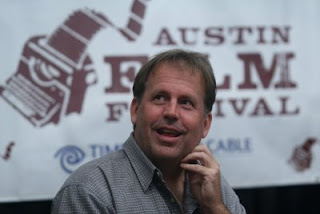
Terry Rossio on AFF panel

One of the sessions I was determined to attend this year was The Throw given by screenwriter Terry Rossio, the man who brought us Aladdin, Shrek, the Pirates of the Caribbean series and The Lone Ranger (okay, so nobody’s perfect).

Rossio is a legend at the Austin Film Festival; his The Rewrite session being one of the many highlights. But last year, he went one step further with The Throw, which this year, the folks at AFF decided to put in a hotel ballroom rather than a side meeting room.

For the uninitiated, Rossio explains, the throw is that thing designed into the end of the scene that sets up (or throws to) the next scene. It is a connective element that suggests the two scenes belong side-by-side at a level beyond plot or story.

It can be a visual to visual cue, such as the famous scene in 2001: A Space Odyssey where the victorious ape throws the bone club into the air and as it spins end-over-end, it turns into a space station.

Alternatively, the throw can be verbal to visual, such as in the scene in Raiders of the Lost Ark where Indiana Jones has made his way into the Nazi camp and learns that the Ark of the Covenant is being shipped out on a truck. Indy’s response is “Truck! What truck?” and the very next second, we watch a truck move through the Nazi camp, onto which Indy has somehow hidden himself.

According to Rossio, there are two ways to organize the narrative structure of a movie or screenplay: using storyline cuts or storyteller cuts.

Storyline cuts emerge from the events of the story, seeming natural and seamless. For example, the storming of the beach scene in Saving Private Ryan, where we see the soldiers move from one section of the beach to another.

Storyline cuts, Rossio explains, maintain the tension and keep the audience immersed in the story. It is a way to maintain and build story momentum while asking for minimal effort from the audience. It is much like a series of dominoes.

Another example Rossio offers is the end of the tornado scene from The Wizard of Oz, when the house finally stops spinning and Dorothy moves from the sepia tones of Kansas into the Technicolor world of Oz. She even states, famously, “I don’t think we’re in Kansas anymore.”

Storyteller cuts, in contrast, imply there is a grand design to the story or an author, who is choosing what you see and when rather than simply presenting events as they happen. This is common in ensemble films such as Love, Actually and American Graffiti.

This sense of a grand design can be comforting and reassuring to an audience, says Rossio. It creates a distance between the audience and the story, with the less immersive story being seen as a creation.

These types of cuts often support a narrator or guide who practically sits alongside an audience and takes them through the story. The guide can appear on-screen or perhaps as a voiceover. Think Morgan Freeman’s character in The Shawshank Redemption.

According to Rossio, storyteller cuts are also very good at renewing a story’s momentum, jumping to new locations or situations before a prior scene’s energy drops and thereby re-engaging the audience.

But how do you establish these cuts? With the throw, which Rossio divides into two categories (a fixation, it seems): the strong throw and the soft throw.

(See the next post for Part Two, which actually goes into the different throws and how you would use them.)

(Images is property of owner and is used here without permission, because I don’t give a toss.)

Many levels of review – Part Two

Whenever someone asks me to review their writing, I try to be thorough and look at it from many levels. Yesterday, we looked at how I approach writing from the 30,000- and 5,000-foot levels. Below, we dig deeper.

1000_foot_view

The view from 1,000 feet: Now that I’ve identified the major structural and thematic issues and determined there is a reason to keep reading, I go back to the beginning and really start to peel things apart.

If I have a thing for character—and I do—I might follow an individual character through the story to see if I can reverse engineer the writer’s profile of that character. I am making this sound much more formal than it really is. Basically, what do I know about the character and are his or her actions and reactions consistent with that knowledge given: (a) where that character is now in the story; and (b) where he or she is trying to get or accomplish?

From the plot perspective, I begin to look at individual scenes and ask if the interplay between characters makes sense for their relationship and respective goals within the scene. For that matter, does each character in a scene have a clear goal?

How have the characters within the scene changed from one end of it to the other? Did one start with the upper hand and that power shift somewhere through the scene to the other character? This last point is not a necessity, but is merely one way a scene can experience reversal.

Likewise, is the scene clear with one predominant purpose or has the writer tried to accomplish too much too quickly, muddying the scene and leaving the reader uncertain as to what refers to what?

At a slightly broader level, how do the scenes play against each other? Are there smooth or logical segues from one scene to another, and if not, does the hard plot swing work? Does the scene in question set up a future one or pay off a previous one, and has it done this job effectively?

200_foot_view

The view from 200 feet: Now I really start to get into the weeds, looking at paragraphs and individual lines. From the narrative perspective, does the reader have all the information he or she needs to make sense of the story? Does the scenery or environment serve almost as another character at this point, representing a source of conflict or support for your characters? Again, this last point isn’t necessary, but can be quite effective such as in movies like The Perfect Storm.

Alternatively, has the writer massively over-written the narrative, demonstrating his or her superhuman vocabulary and/or visual imagination at the expense of the story and poor befuddled reader? As a personal aside, this is my greatest sin as a writer…but then you probably already knew that. Can I recommend any broad strokes edits (not copy edits) to help reduce the clutter and maintain the flow for the reader?

If it’s a screenplay, does the writer interrupt the reader too often with small directorial nods to the actors? For example, during a particularly heated scene of dialogue between the protagonist and antagonist, is the writer constantly reminding the actors to furrow their brows or shrug? I try to determine whether these narrative directions are absolutely necessary to get the idea of the scene across.

The problem here is that the regular intrusion of direction takes the reader out of the moment, disrupting the story and the emotional power of the characters. The senses, if only at the mental level, are forced to trip back and forth between things like subtle movements and emotive energy. Thus, in even the most action- or tension-packed scenes, too much narrative can sap the energy of the scene such that the read becomes plodding. By removing these superfluous lines, the reading speeds up and the energy of the scene is renewed.

This brings us to dialogue, which is easily my greatest challenge in screenwriting. I think novel writing gives you a bit more leeway with dialogue but I am less familiar with the medium from a writing perspective.

When I review dialogue, I try to sense how natural the dialogue feels…perhaps even reading it aloud, if I am not certain. Are these sentences that real characters would say and are the lines apt for the character who is saying them? From what I have surmised about the character, would he or she use those particular words in that way or to that purpose? Is the character saying exactly what he or she is thinking (on-the-nose) or is there some sense of subtext, whether known to the character or not?

Similarly, is the dialogue as tight as it could be, saying only what needs to be said and in the best way? Now, please note, I did not say or mean to imply in the shortest way, with the fewest words. People rarely keep their sentences to a minimum, but rather when caught up in the heat of the moment, tend to spew a bit more than necessary. There is a cadence to an individual’s speech patterns, so each of the characters should have their own cadences.

In a conversation between two or more characters, is the subject and banter clear or am I left with some uncertainty about what line corresponds as a response to what previous line or thought. To map it out somewhat mathematically, it might read something like A then A’, B then B’, C then C’, etc., rather than ABC then A’, D then B’C’, etc., where each of the letters and its prime counterpart represent a thought and its response or reaction. By the same token, however, I have to be alert and sensitive to cases where it is perfectly natural for that character to blurt out a series of thoughts and the resulting confusion may be consistent with the plot.

splashdown

Splashdown: Only once all of that has been settled, do I get to the cosmetic aspects of story review. This is where I might recommend copy edits and what have you to ensure the screenplay or novel is clean. This can include looking for stylistic inconsistencies (e.g., capitalization) or spelling errors. Personally, this part bores the hell out of me and I know that for every error or inconsistency I find, I have missed two or three others. As a courtesy, however, I will point out those that I do find and hope someone else catches the rest.

I find that by the time we reach splashdown, writers either love me or hate me…and I am okay with that. Although I prefer the former, I understand the latter and don’t take it personally. Putting your work out there for critique and possible criticism is difficult and not just a little nerve wracking. I applaud anyone who does that almost as hard as I applaud them for having written in the first place.

I just hope that, at the end of the day, I have helped the writer improve his or her work.

(Images are the property of their owners and are used here without permission because it’s more impactful.)

Many levels of review – Part One

puzzle

Every time I read something, I find something I never found before. Thus, when someone has built up the nerve to ask me to read something he or she has written, I try to read it in several waves, each one moving deeper and deeper into the details of the subject or story.

30000_foot_view

The view at 30,000 feet: Particularly if it is a complex narrative, such as a novel or screenplay, I try to make my first read an uncritical one. This may sound counterintuitive to the requested task, but until I’ve read something from front to back, I don’t feel as if I have sufficient information to be critical.

A thought or comment made at first read may be rendered moot or significantly larger one, ten, fifty or a hundred pages later. I need context to see what the writer is trying to accomplish before I know what is working or what isn’t.

If possible, I will remove all writing implements from my pockets and move somewhere completely isolated so that I can give the piece my full attention. If I become immersed in the work, absorbed by the story and characters, then I know less work is needed, and I can drill to the deepest, most detailed level of comment quickly.

If, however, I find myself drifting from the story, or worse, struggling to move from page to page or scene to scene, then I know there are larger structural or thematic issues at play. Things that potentially make detailed feedback moot upon rewrite.

If you can’t resist using a pen at this stage, try just adding an asterisk next to the line of interest for a quick reminder later. Attention to details breeds attention to details, and you’re apt to miss the bigger picture.

5000_foot_view

The view from 5,000 feet: In the second read, I try to focus my attentions on the larger structural and thematic questions that arose in the first read. By being familiar with the story and knowing who is whom, I am less likely to need to flip backward through the pages to remind myself how I got here.

More importantly, I know where the writer is trying to go with the plot and characters, which should make it easier to identify bumps or inconsistencies along the way.

These moments typically take the form of a quick shuffling of pages to see if I’ve missed something or if two pages have stuck together. In my head, if not aloud, I find myself using phrases like “Wait. What…?” and “Hold it. I thought…”

If I did my first read well, I may remember struggling at this point in the story, and if it’s big enough, having to force myself to move on. Alternatively, I didn’t bump the first time through but now that I know the full story, this scene or moment has become a problem. What made perfect sense an hour or two ago has now become confusing. Regardless, it is a moment that has to be recognized, understood and adjusted.

Most writers in my experience have the greatest problem with notes at this stage because it often cuts to the core of their story and changes her can have a significant impact on the direction of the story. In some cases, this is where the writer might find out the story doesn’t work and needs a complete overhaul.

New writers, in particular, may either completely refute the notes to avoid being so fundamentally “off base” or simply give up the piece because they feel incapable of sacrificing all that hard work, ironically enough, and trying to rescue what was working.

At this stage, I’m asking pretty broad questions. Do I understand why this story is happening (why today)? Do I clearly see who is playing what role in the narrative (e.g., protagonist, antagonist, etc) and how they interrelate?

Can I recognize the plot and subplots, and do they make sense? How do they relate and am I seeing a coherent theme? Is there any conflict in the story and does it rise in scale or intensity as the story moves forward?

Part Two: In the next section, we will continue our journey into the depths of how I review stories with complex narratives, rapidly approaching ground level.

(The images are the property of their respective owners and are used here without permission because they’re beneath me.)

A matter of character

Method improv taken a tad too far

Method improv taken a tad too far

When we create stories, we try to come up with truly amazing characters; characters that will resonate in our audience’s memory, long after they’ve finished with our story. Unfortunately, what usually happens is we end up with characters that flatten on the page, becoming two-dimensional versions of our goal. The character may flare momentarily when their plot becomes particularly exciting, but for the most part, they are lifeless and have no depth.

Like subtext in our dialogue, so much that makes a character real has nothing to do with what they are saying or doing. It’s the intangibles, the subtleties that inform their speech and actions.

Would Darth Vader, for example, have been nearly as imposing without the emphysema? What would you think of Forrest Gump without his omnipresent blankness?

Years ago, in an improv class, we did an exercise in character when the instructor told us to endow our character with some physical attribute, but not to share that attribute with others, whether verbally or by incorporating it into the scene. Let the attribute impact your character and see what happens was the request.

I decided that my character’s left foot caused him excruciating pain every time he took a step. As the scene unfolded and my character found it necessary to move, I found that my sentences grew shorter, more clipped, and my patience with people wore thin. Requests to come look at this or hand me that were met with general reluctance and irritation. Everything about my character screamed leave me alone.

I did not wince when I walked. I did not massage my foot while seated. I did my level best to give no outward sense of what was wrong.

When the instructor surveyed the other students, both within the scene and watching, about what our various attributes were, none of us really knew. All they could say was that my character was very angry and a bit of an asshole.

When told I had an extremely painful foot, it was obvious. And please realize, I am NOT an actor. This was not about my Oscar-worthy performance.

But it does show that by making a very small choice about a character, a choice that has nothing to do with plot, you can significantly inform that character and how he or she interacts with others and his or her environment.

When I worked on my first screenplay, I looked for something that affirmed how cool a customer my antagonist was. I wanted something subtle that would indicate he had the ultimate confidence in himself and his manifest destiny. Something that said I have all the time in the world because the world will wait for me.

It was my last point that settled it for me. My character would never use contractions in his speech. From his perspective, every word he uttered was important, was specifically chosen for maximum impact and so why would he remove any of the letters. And because his destiny was your destiny, you would sit patiently and absorb everything he had to say, no matter how long it took.

Now the average reader or movie goer may never consciously notice this, but for many, they’ll experience the malevolent calm of the character.

And perhaps more importantly, as with the sore foot in the previous example, the contraction-free speech informed how I wrote the character. It forced me to slow down as I wrote his dialogue, to consider each and every word he spoke, to ensure they fit the creature I had created. Ironically, that I the writer served him the way he would expect to be served.

Based on the reader feedback to date, it is working.

Look at the characters you’ve created and ask yourself what physical tic, affectation or neurosis informs their lives. If you can’t identify one, can you introduce one to increase the depth of the character or heighten his or her reactions?

Even if it only helps you to better understand and write your character, the exercise will have been worth it.

(Images are property of owners and are used here without permission, because I didn’t eel like asking.)

Too cool for fish school

Too cool for fish school

Anybody home?

The house was dark, which made Helen worry all the more. As long as she could remember, her neighbours kept at least one light on in the house.

“You never know when someone will show up for a visit,” Jackie would explain. “Would hate for them to think they’re not welcome.”

The funny thing was, Helen never saw any visitors at the Jarrols. Maybe that’s why the house always seemed to drip in melancholy.

Helen took the first step on to the porch, making sure not to lean on the railing that more than once abandoned poor Ned to the garden below. Jackie finally planted decorative cabbage just to cushion the blow.

Each step felt spongier than the next as Helen ascended. She wasn’t sure if it was the wood or her trepidation, the silence of the house growing more oppressive the closer she got.

Helen didn’t bother with the doorbell, it never worked, but instead rapped heavily on the door before turning the handle.

“It’s just Helen,” she called into the darkness, the weak light of blinded windows helping her make out the living room. “Jackie? Ned?”

Her words hung in the air, the warmth of her breath buoyant in a house unnaturally cold.

Helen hesitated at the door, afraid to proceed but worried about her neighbours. She really wished Sarah was with her right now, but she wouldn’t be home until tomorrow. Helen was on her own.

“Hello,” Jackie’s voice called from the kitchen.

“Jackie, it’s—“

“We’re not home right now, but if you leave a message, Neddy and I will get right back to you.”

Ned had long ago turned off the phone ringer because it always startled Jackie, who had a weak heart. Helen actually thought it was because Ned hated talking on the phone.

Helen searched the main floor, but the Jarrols were nowhere to be found. Upstairs it was.

As though pulling off a bandage, Helen vaulted the stairs to the second floor, but her hand froze as it came to rest on the bedroom door handle.

Knocking would have been respectful, but Helen just turned the knob and pushed. The door showed no resistance.

Jackie and Ned lay next to each other on the bed, eyes closed. Jackie was under the covers, hair bound in that all-too-familiar brown kerchief, while Ned was atop the covers.

Helen didn’t call out. She didn’t even check them. It was just like Ned to turn the heat off first. He wouldn’t do anything to hurt the potential resale value of the house.

I had no idea

Ideas are everywhere, but they don't always look like ideas

Ideas are everywhere, but they don’t always look like ideas

“How the heck did you come up with that?”

It’s a common question I get when talking about my latest ideas, and for years, my answer was a resounding “I dunno…just came to me.”

To a limited extent, the response is correct, but it suggests the process of ideation is much more passive or deus ex machina than it really is.

Ideas surround me, as they do you. They are in the nouns, verbs, adjectives and adverbs that make up our moment-by-moment reality. They are in the streetcar in which I presently ride, the streets down which I presently travel.

In the dark-haired beauty two rows before me who is fixated on adjusting her hair rather than close the window through which the hair-mussing breeze blows. And in the armada of free-range humans who occupy the parkette we just passed, proving themselves houseless rather than homeless.

The challenge for many would-be writers is that these are starting points for ideas rather than fully fledged stories or subjects. These are the writers who wish to be reporters or chroniclers rather than explorers.

Think instead of these idea kernels as pieces of clay, as something that can be moulded into any of a thousand other shapes. Take the kernel and play with it for a while. Give yourself a chance to see what it feels like, smells like, sounds like, tastes like.

Twist it. Turn parts of it over. Reverse its halves.

What is something were feasting on Toronto’s homeless? Imagine a mobile service that will do your hair and makeup while you commute to work. What if a terrorist planted a bomb on a streetcar and it had to travel no slower than 50 mph? Or an aesthetician to the deceased in From Hair to Eternity.

All of these are probably bad ideas, but the ideas have evolved.

Twist it again. Mould it again. Press it onto something else, like so much Silly Putty, and see what sticks.

Keep the good. Set aside the bad. But keep working it until something you really like begins to show itself.

You have no idea the wonders you will discover.

The word was cat – an exercise

Image

“Cat killer,” Anthony thought to himself, ruefully. He was now going to be forever known as the cat killer of Borden Street.

To be fair, it was an accident. At worst, negligent manslaughter. Catslaughter?

Yes, if Anthony had gotten his car tuned up as he’d been promising himself for weeks, he might have noticed the strange sound emanating from his motor. But a “rowr” sounds an awful lot like a “rawr”, so it was hardly his fault.

Why would a cat crawl on the engine block in the first place? And it’s not like Anthony held its tail against the fan belt.

No. It was a mercy killing. Clearly, living in a house with 17 other cats had taken its toll on Snowball. She had lost the will to live and decided to end her days.

It was Old Lady MacGillvary’s fault. Nobody needs 18…17 cats. A sign of mental defectiveness on a grand scale.

Hell, Anthony was lucky it wasn’t the old woman herself who flung around his engine like a piñata on heroin.

Anthony liked cats. Well, he tolerated them. He’d never killed a cat before. Two dogs, a ferret and a budgerigar, sure, but never a cat.

It was a bad year for pets in his neighbourhood.

As he recalled, the Great Dane was an automotive accident, his hood still bearing the scars, and the chow was proof that you shouldn’t buy electric garden lamps from a guy in a van on the highway.

The ferret shouldn’t have been loose while he mowed the lawn, and why the bird was anywhere near his barbecue while he was using his leaf blower is anyone’s guess.

It had gotten so bad that Anthony had to beg off a trip to the petting zoo with his nephew for fear of dropping a horse on the kid.

You’d think Anthony’s job as a taxidermist would come in handy here, but apparently a stuffed pet is considered poor compensation for a loss.

The point was moot where Snowball was concerned. All the King’s horse and all the King’s men, you know?

Oh well, Anthony shrugged, no use crying over eviscerated Persian. If he took the highway to work, most of the fur would probably fall out and cooked flesh is so much easier to extract from metal.

Anthony turned the motor over, listening for the familiar “rawr”, and then put the car in reverse.

Thump.

Adapt or die

Image

Recently, I’ve read a couple of screenplays based on novels, and with this albeit low number of examples, let me start by saying thank goodness I have yet to find a book I wish to adapt for screen. The process, it would seem, is tedious and fraught with perils.

Odds are, especially if you are just starting out as a writer, you’ve chosen to adapt a specific book because you love it.

You love the way it is written. You love the story it tells. You love the characters. You may even love the paper on which it’s printed or its cover art.

Congratulations. You’re doomed.

I say this not to be mean but to point out that the book was written as a book for very specific reasons. The format and structure of a novel is incredibly different from that of a film.

At its simplest, you have the space in a novel to indulge yourself in narrative and character introspection. More simply put, you can describe a setting or reaction in such detail that if linearly translated to a screenplay, it would result in ten minutes of film focused exclusively on waves rolling across a beach or on the angle of an eyebrow raised over the left eye of your heroine.

Even simpler, novels are verbal, ironically, while films are visual.

And unless you’re planning on running a voice over throughout your movie—please say no—I have no idea what your characters are thinking. I can try to guess from their facial expressions, but it is a guess and will have as much to do with how easy it was to find a parking place in the megaplex as it does with the actor’s talent.

The novel could afford to be 500 or 1000 pages. Your screenplay can’t.

I love Kenneth Branagh. I love Shakespeare. Branagh did a very linear interpretation of Hamlet for film. I was bored. Mel Gibson’s Hamlet? Held my attention and was entertaining. [Compare the two “alas, poor Yorick” scenes linked here.]

The difference? A very sharp editorial knife.

So, I am going to ask you to take the thing you love and hack it. Cut it with broad strokes and wild abandon. This is no place for finesse.

This isn’t about trimming paragraphs. It is about slashing subplots or entire chapters. It is about burning away all of the decorative niceties until you reach the essence that turns your crank.

Be cruel. Be ruthless. Be honest.

Take that Sistine Chapel and reduce it to the handful of bricks that make you sweaty; that keep you coming back time after time.

It will feel like murder. In some ways, it is. But it’s murder for the greater good, because once you’ve hit that core, you can begin to rebuild. You can start to rescue some of the elements you set aside earlier or add new ones that are truly unique to your vision.

What is that core? I don’t know. That’s for you to decide.

Maybe it was the setting. Perhaps it was the relationship between two characters.

Whatever it is, find it and make that your story. That is what you love. That is why you keep coming back for more.

Honour that and you’ll have a screenplay worth turning into a movie.

(Image is property of owner and is used here without permission. I’m adaptable that way.)

Microcosms

Image

A thousand years ago (give or take), I listened to a radio theatre program called X Minus One, which told a story about a society that makes its first attempts to leave its planet only to slowly realize it lives within a bubble of water in our universe.

I have not been able to look at a dew droplet in quite the same way ever since.

Based on my true story

Image

As I wrote yesterday in “Write what you…No!”, I wanted to talk about a variant of writing on a topic in which you have expertise: the true story.

Now let me start off by saying that I have never written anything directly lifted from a true story—at least never attempted to fictionalize one—but I have spent the better part of two years listening to people try to do same, and it seems to me the effort is fraught with pitfalls.

(Ironically, however, I am about to start a project with someone that will be based on his true story, so let’s see if my attitudes change once I’m on the inside.)

The biggest challenge I have seen is that many novice writers forget that they need to tell a story. On the surface, that may sound ridiculous. It is a story. I know. I was there. The problem it seems is that a lot of writers try to chronicle the actual events that occurred rather than try to tell a story. That is a history, not a story.

It’s like sharing a joke with someone and having a third party enter asking what’s so funny. When you think about it, you realize the joke itself is not the funny part and you respond “You had to be there.”

The same holds true for the true story. With rare exceptions, while experiencing the actual events, you experienced emotions and actions that are just too difficult to translate into a narrative. And without your context, the audience loses something.

Likewise, you may be leaving out critical facts that are obvious or second-nature to you but elude us. When this happens, characters do not feel fully developed or plot points don’t seem connected, because we don’t instinctively see the link.

And ironically, despite what I just said, novice writers working on such stories tend to want to stick to the facts as they know it to the detriment of any sense of story…they refuse to fictionalize their story beyond changing names, settings and the odd plot point because to do more would be to remove the truth of their experiences.

Let me give an example.

A friend of mine was trying to develop a screenplay about a family coping with young adult son with a psychological disability, and the young man’s attempts to find his personal space. It was very well written, but at least in its initial stages, it felt like there were plot and motivational holes throughout the manuscript. As we discussed it in class, we learned that this was effectively a fictionalization of the writer’s family.

In her manuscript, the protagonist—the young man—was largely shut down from his family and even they largely repressed their feelings with each other as a coping mechanism. As an audience member, this made it difficult to get into the characters and rather than feel empathy or any form of connection with the protagonist, he just pissed many of us off. We hadn’t lived the experience the writer had, so we couldn’t see her story the way she did.

Try as we would to get the writer to see our dilemma, she was equally adamant that to make the protagonist any other way would make him unrealistic given his condition; a defensible position within limits. She couldn’t let go of enough of the truth to develop a story.

The story must come first if you ever hope to engage an audience. Even fact-laden documentaries and news items focus on a story or narrative. Without that, you are reading a dictionary or encyclopedia entry.

The truth or reality of your personal experiences are vitally important, but only in so much as they are used to bolster or support the story you are trying to tell. It is almost impossible to successfully do it the other way around.

(Image used without permission, and that’s my true story.)