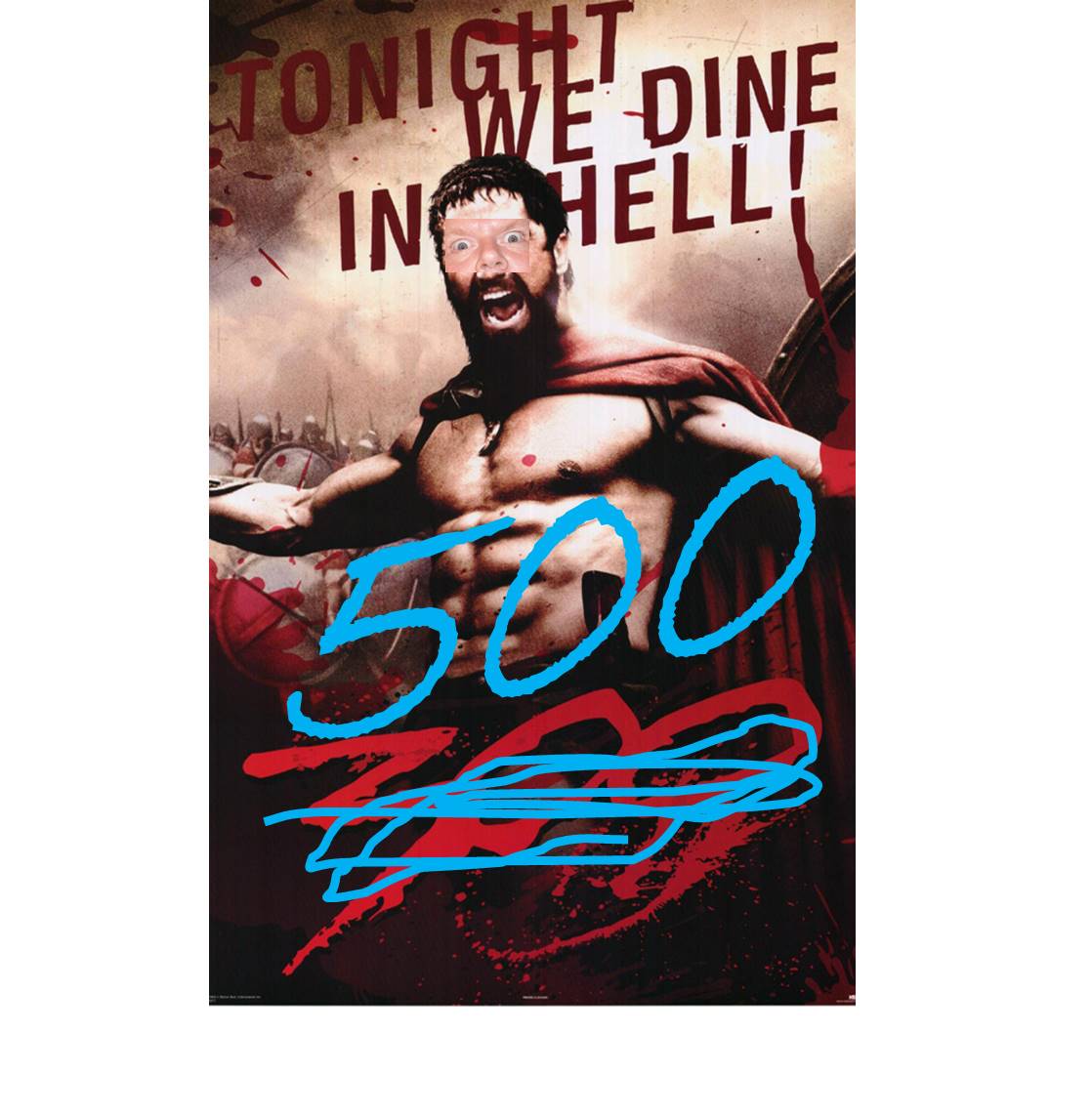
500

500b

So I have hit the milestone blog post: 500.

For some of you, who have followed me from the earliest days, you are no doubt thinking: “500? Really? Seems like 5,000.” For those of you relatively new to the wonder that is my blog, please note closely the previous statement.

I dithered over what to write for my 500th post, and have decided I’m going to talk about you…well, some of you.

I “follow” quite a few blogs…I read many fewer…and I seek out even fewer. I’m sorry for those I don’t visit more regularly…hours in a day and all that. It’s some of that last group, I want to highlight here…those glorious few who make me stop whenever I see they’ve posted something new.

crows

Filippa Levemarks Blog

The paintings that this woman creates and the themes she explores by mixing media and mixing subject-matter blow me away. Rare is the image that doesn’t elicit some emotion in me. Hers is a style I have seen nowhere else and is worth exploring.


Jack Flacco

To read Jack’s blog is to have no clear idea as to who Jack is, and I mean that as a compliment. Jack takes on any subject it seems, but always in a thought-provoking and welcoming way that makes you want to contribute with a comment. His latest topics have been: monotasking, Veronica Mars, infectious pandemic readiness and phone addiction.
 

bareknuckle

Bare Knuckle Writer

As the title suggests, Steph Snow is a no-holds-barred writer who likes to talk (or rant) about writing. With generous dollops of humour, she discusses the creative fortunes and practices that torture her soul on a seemingly daily basis. Misery truly does like company.

 

ionia julian

Readful Things Blog/Julian Froment’s Blog

I list these two blogs together because they are both discussions of the written word—e.g., reviews of books and authors, discussions of book marketing—and because the bloggers (Ionia Martin & Julian Froment) are beautifully connected at the soul (I don’t ask questions about any other forms of connections). Amazing people whose love for words is only surmounted by their love for each other.


Schelley Cassidy Photography

As a photo-hobbiest, I deeply appreciate the craft and skills that other photographers bring to the world. In this case, however, Schelley and I seem to share a greater fascination for the minute rather than the panoramic, as suggested by her regular feature “What is it?” where you only see an aspect of an object and are left guessing as to what that object is.


Ron Scubadiver’s Wild Life

If I couldn’t have my life, I would want Ron’s. A world traveller and freelance journalist, Ron is an amazing photographer, capturing incredible aspects of life in the many places he has visited. I particular enjoy his collections of people photos, often taken at a festival or gathering, which are incredibly natural and inviting.


ned

Ned’s Blog

Ned Hickson is not right in the head. And that’s what I love about him. A journalist in the Pacific Northwest and volunteer firefighter (or latex-coat fetishist…can’t really tell), Ned brings an irreverent sense of humour to everything he writes, earning him several accolades including his own NSA file. Ned also has a book to his credit, which I believe he has to return to the library next Tuesday.


Curnblog

More a collective than a personal blog, Curnblog offers amazing insights into all things film, whether examining an individual film or genre from angles such as sociology, creativity or cinematography. Predominantly the work of James Curnow, the blog is like having your own little film school where you can access new and unusual topics on a weekly basis without the pressure of essays, theses or exams.


There are so many other blogs to which I would like to direct you, but I am happy that you made it this far down the page. Perhaps for my 1000th blog post!

My gratitude for your patience and enduring interest.

post-milestone-500-1x

We shall overcome if it kills us (and it will)

That way

Friends and family hate walking up hills with me. I have no idea how they feel about the flat regions, but definitely the hills they hate. And it’s not that they are out of shape. To the contrary, I am the excessively shaped one…and I’m lazy.

Thus, when I reach the bottom of a hill, I want to get the climb over with as quickly as possible…I power my way up the hill, leaving them to trot along or simply do their own thing and catch up with me.

But the biggest challenge, once they catch up, is that they then have to wait for me to recover from my exertion. In my zeal to get to the top, I completely ignore the fact that the trip is not over once I reach the top…I leave nothing in my tank for the rest of the trip.

I’ve done the same whenever I’ve decided to change my shape with exercise or diet. I start out incredibly aggressively…not holds barred. And for a week or two, my goals are not only met, they are surpassed. I am incredible. I am a GOD! I am also exhausted and sore…and I slowly stop my program.

And as if this behaviour wasn’t already annoying enough, I find I also have a tendency to take the same attitude in my writing.

Prepare my work area. Cogitate on what I want to do. Research. Procrastinate. And then, WRITE LIKE THERE IS NO TOMORROW BECAUSE I REALLY WANT TO GET THIS DONE THIS WEEK OR AT LEAST GET AS FAR AS I CAN GET BECAUSE NEXT WEEK…

At the end of the process, whether it is a hundred pages of a novel, another feature article for a magazine, an outline and beat sheet for a new screenplay, I am exhausted and my brain hurts. The creative wheels come off (or wobble severely), and I lay up for a couple of days accomplishing nothing, except possibly another thousand games of Solitaire.

My ultimate goal is still way over there. Whether it is within sight or not, I can’t do anything about it because I am doubled over with my hands resting on my knees wondering why my (creative) lungs have shrivelled to the size of grapes.

I can drive a car by flooring the accelerator for 30 seconds and then releasing it until the car crawls to a stop, only to repeat the cycle again and again. I can. But the car will like it about as much as the other drivers and police. And whether due to a destroyed transmission or arrest, I will lose the car.

As I reminded myself on Twitter this past week, I am not writing a novel today. Rather, I am writing a scene, a paragraph, a sentence. But I am writing.

The top of the hill is not my destination, but rather is a way-station along the journey, a landmark I will pass. And for all I know—because despite my best efforts, omniscience has not yet occurred—the hill may be the most interesting and/or important part of the journey. The upward grade itself may hold the answer to the whole damned project

So here’s to my best efforts to ease into the next hill and enjoy the scenery along the way. I’ll reach my destination eventually and who knows, I might actually enjoy the trip (or at least, not drop of a coronary).

Destination

(Images are property of owners and used here with no destination in sight.)

Why models fail us in childhood, on TV and in drug discovery

I know you’re used to me babbling in these pages, but I am sure two of you have wondered, so how does he pay his bills? I know my landlord wonders that.
Below, I have reprinted my latest commentary from DDNews, a magazine for which I write regularly and for which, to my great surprise, the Publishers pay me. Thought it might make a nice change of pace for those tired of the current pace.
DDnews
For those of you who read the article, there is a bonus at the bottom (worst fruit-in-yogurt tagline, EVAR!) 
For a brief period of my childhood, I dabbled in model airplanes and model ships. And by “dabbled,” I mean I spent an inordinate amount of time with my fingers glued together. But aside from the medical agonies of modern chemistry, what struck me most about the exercise was how pale an approximation these models were of the real thing—about the only thing my miniature Spitfire had in common with the WWII fighter was the sheer carnage of the plane as it went from airborne to groundborne in its flight across the room.
More recently, my fascinations have turned to models of a more human variety, such as those found on the catwalks of America’s Top Model. (Let’s face it, after DDNews, I am all about the latest issue of Vogue.) And like the plastic variety described above, these models seem to be at best a glittery approximation of the actual thing.
It’s often hard to believe that I share about 100 percent DNA sequence identity with these mystical creatures. Now, 98 percent coherence with bonobo chimps, I have no problem believing.
All this to say that we are constantly surrounded with models that are poor facsimiles of the real deal upon closer inspection. So, it should probably should come as no surprise that the same is true in medicine and drug discovery.
Last week, I read a story in the newspaper that touted the life-prolonging properties of the diabetes drug metformin; a regular fountain of youth, the headlines implied. And yet, after coursing through the article, I eventually discovered that the rejuvenation experiments were performed on the worm C. elegans, which was shocking for two reasons.
One, I did not realize that there were largely untapped market opportunities in annelid diabetes. And two, the life-extending implications were being made based on a species that wasn’t even a chordate, let alone a mammal.
Now, I appreciate that this is an extreme example, probably overhyped by an eager press officer, but the literature is rife with examples of models that completely failed to live up to expectations when researchers tried to match success in model systems with success in actual humans.
As oncology god Judah Folkman once mused, we have become really good at curing cancer in mice.
Part of the challenge, I think, is that because we cannot experiment directly on humans, or at least not within the editorial reach of DDNews, researchers are often forced to study new compounds or therapeutic modalities on approximations of approximations of approximations of human disease.
We don’t study the impact of irinotecan on human colorectal cancer but rather extrapolate from its effects on an induced form (approximation 1) of murine colon cancer (approximation 2) in mice (approximation 3). Or we study new biologics against a chemically induced inflammation in dogs that bears a passing resemblance to rheumatoid arthritis in humans.
Within the realm of in-vitro models, the advent of technologies like 3D cell culture and microtissues is adding some biological context back into the completely artificial realm of 2D cultures of immortalized cell lines. (For more on this, see the special report “Life moves on” in this issue, on page 21). But in the absence of factors such as tissue vascularization and the like, even these advances result in weak approximations.
The goal of a better, more representative model may be getting a step or two closer, however, with the help of stem cells.
As we’ve reported previously in these pages, and as I am presently hearing at the ISSCR conference in Vancouver, stem cells are giving us enhanced opportunities to study human disease generated from the source material—human cells—potentially down to the scale of the individual patient.
The standard technical limitations of in-vitro analysis hold for stem cells—a lump of microtissue in a microwell dish does not a micro-human make—but we do have the opportunity to limit one or two approximations.
At ISSCR, for example, Daniela Cornacchia and colleagues at Sloan-Kettering and Weill Cornell Medical College describe their efforts to understand the inadvertent de-aging of cells transformed into iPSCs. Even when taken from older patients, the reversion process makes it difficult to use the cells to study late-onset diseases. The group is trying to identify factors that will allow them to induce natural aging into these cultures to improve models of such diseases as dementia.
Similarly, Rohan Nadkarni and Carlos Pilquil of McMaster University are endeavoring to produce 3D lung tissue from iPSCs that contain both conducting and gas-exchange zones mimicking normal lung function. If the model bears out, it may provide an even more realistic platform to study respiratory diseases in vitro.
Until we are in a position where we can do high-throughput human screening—in a 96-well cube farm, perhaps—the search for better model systems must be a priority. And given the challenges of translating preclinical success into clinical success, perhaps it should be a higher priority than the development of new therapeutics.

Look for more on this topic in a special feature on disease modeling in the November issue of DDNews.

Added bonus for blog readers:
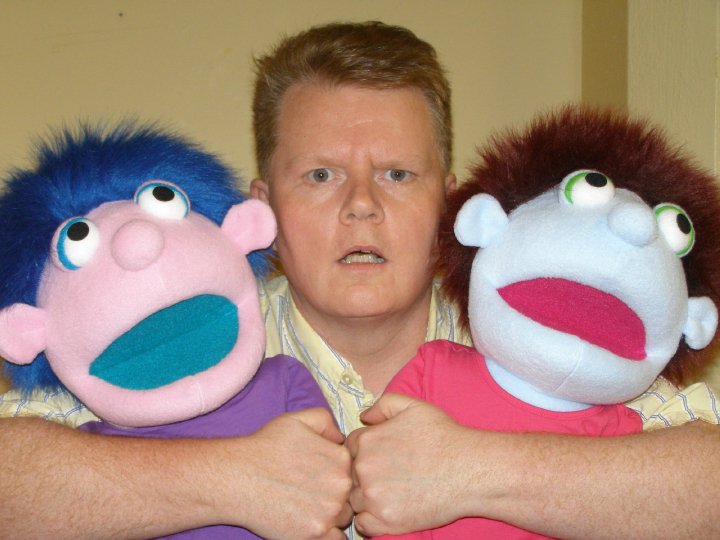
#1 on the left photo and #2 on the right photo

#1 on the left photo and #2 on the right photo

How I Met Your Series Finale

tv-set-with-a-broken-screen-81240769

Earlier today, my friend Marsha Mason posted her weekly blog on Why The Face. This week, Marsha chose to focus on series finales of television programs, picking up on the How I Met Your Mother phenomenon now that the teeth-gnashing and hair-pulling have died down.

Marsha considered this outpouring from the perspective of the magnanimous response of the show’s creators. An excerpt of her blog post:

And while they did what they felt they needed to do to bring their story to its completion, there was no way they were going to tell their audience that any of their feelings were wrong.

A beautiful way to look at the uproar.

But of course, Marsha’s post also made me think about the challenges of writing a series finale (damn you, Marsha, you made me think again).

I truly feel for showrunners who are faced with this task. It is a daunting task made that much more difficult by a dedicated audience, who for the most part can only be disappointed.

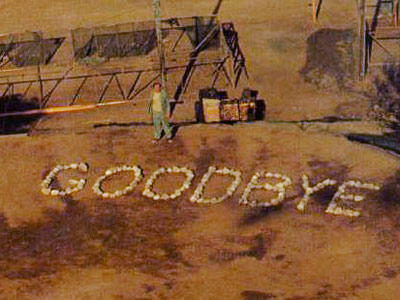
For me, the best series finales were done by shows like The Fugitive and M*A*S*H, where luckily, the writers had a hard end point in their story, i.e., the capture of the real killer and the end of the Korean conflict, respectively. In these cases, the resolutions between characters was more obvious (not to give the sense that the episodes would have been easy to write or weren’t written well). Similarly, The West Wing had the end of Bartlett’s 8-yr term and the inauguration of the new POTUS.

Mash-Goodbye_l

For other shows, the challenge is that the lives of the characters typically continue beyond the finale, if only in their fantasy worlds. From their perspectives, this isn’t the end of their lives; it’s Tuesday.

Thus, writers are forced to pencil in a flurry of seemingly arbitrary events to explain why the characters are parting ways or moving on, and typically, this means leaving a lot of unresolved questions for the audience. Closure is impossible when nothing is truly closing.

Take, for example, the end of The Sopranos…the family sits down to dinner in a restaurant…fade to black. After years of a series filled with violence that would make Titus Andronicus blush, the pure normality of this ending was almost a let down, and yet, rang as a true moment in human lives.

sopranos_final_scene_1

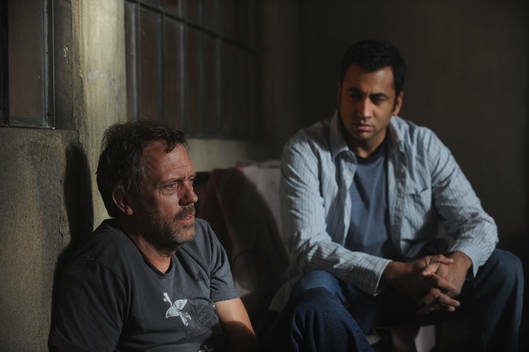
The alternative is to go big, such as the ludicrous ending of my beloved series House. The final 20 minutes or so looks like it was written by a group of pubescent boys hopped up on 24 consecutive hours of Grand Theft Auto. For god’s sake, it’s Gregory House…you couldn’t have him die of something he and his team couldn’t diagnose in time, only to have a letter arrive a week later from House showing he knew the diagnosis months ago?

houseandkutnerburning

Of course, the biggest complication is likely that most series have run out of steam well before they are given the opportunity for a series finale. All of the really great opportunities to end the series have long passed, the characters have little left to say to each other and it is only the blood-from-a-stone networks and die-hard fans who keep applying the paddles to the moribund concept. I give you the finale of Seinfeld. For this reason, I really do not look forward to the series finale of The Big Bang Theory.

TelevisionSeinfeldFinale

(I feel an admonition from Lee Aronsohn coming on.)

In these cases, better the mercy killing of cancellation than the sad wheeze of life-support equipment.

(Images are property of owners and are used here without permission…finale!)

You never “no”

Because my mother refuses to throw anything away, but prefers to store it in a drawer or cupboard until I come for a visit, I was reminded this past trip to BC about a phase in my writing career that kind of occurred sideways.

Several years ago, I was in desperate need of a job (wow, some things never change). So desperate, in fact, that I decided to take a flyer on and leverage my background in science writing and magazine editing for a job as editor of a manufacturing automation industry trade magazine published by CLB Media.

It should be noted, I knew and to this day know nothing about manufacturing. But I can write and I can edit and I have a good idea for design. I also have a fondness for money.

It was obvious throughout the interview with the magazine’s Publisher and Director of Sales & Marketing that I could write and knew magazines well, but that if I got the job, I would have to scramble to understand the issues and lingo of a completely alien industry. They were kind, but it was obvious the job and I were not a match.

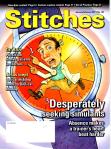
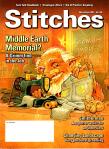
When I finally got home, I was in the middle of discussing the interview with my wife when I received a phone call from the company VP, Publishing who said my interviewers had mentioned me and that the company had a medical humour magazine (Stitches) and companion consumer pub (Stitches for Patients) that were in need of a new editor. Would I be interested in talking to him and its Publisher the next day.

Uh, yeah!

The job didn’t last very long–the magazines had been in a steady decline for years before they found me and never recovered sufficiently to keep operating–but it was a great experience, and not only allowed me to write nerdy medical comedy but also allowed me to eventually add the title Associate Publisher to my resume.

And all because I was desperate enough to apply for a job for which I had few qualifications but showed general competence and a willingness to listen and learn.

I offer the covers of my first three issues of each magazine below (thanks mom).  The insane covers are the work of the amazing illustrator Max Licht under the direction of the equally amazing Art Director Graham Jeffrey.

charACTer

Anyone writing stories NEEDS to read the blog post by Chuck Wendig listed below!

http://terribleminds.com/ramble/2014/06/03/just-what-the-humping-heck-is-character-agency-anyway/

Wendig blog

Seriously. Please read this!

His pivotal point: “The story exists because of the character. The character does not exist because of the story.”

Too often, I read screenplays where the protagonist is merely swept along like a bobbing cork on a sea of conflict. They merely REACT to the injustice around them rather than ACT to change it. They are the victim of the story.

To my mind, a much more interesting character is one who takes action when presented with conflict and then deals with the repercussions of that action. In some stories (the best ones to my mind), the protagonist is his or her own worst enemy, bringing conflict upon him or herself.

It is not enough to chase your hero up a tree and then throw rocks at him. He can also catch some of the rocks and throw them back, perhaps hitting innocent bystanders who then turn on him as well.

As a reader and viewer, it is through the actions of your characters that we learn their perspectives, their world views, and thus, their flaws. And if your story has a redemptive angle, it is through the complete failure of this world view and the character’s re-evaluation of it that he or she is reborn.

Just like giving the same premise to 12 writers results in 12 different stories, placing any of 12 different characters into the identical situation with identical opponents will result in 12 different outcomes if the characters are real.

Honour that in your writing and honour your characters.

They are called char-ACT-ers, after all, not char-REACT-ers.


Wendig is on Twitter: 

Our story so far…

Bradbury

It’s been roughly two years since I stepped off the ledge of the normal world and into the free fall of who I am…and perhaps it is not surprising that I am still discovering who that is.


For the uninitiated, a brief recap:

After spending the better part of my adult life as a scientist, magazine writer, communications manager and ad copywriter/creative director, I realized I wasn’t happy. Adding fuel to that fire was the death of my beloved grandmother and of my marriage (thankfully not an acrimonious separation). But where I might have let these events take me to darker depths, I realized that I had never been freer in my life…and the freedom felt good.

Thus, with nothing to hold onto and therefore nothing to lose, I stepped into the abyss of uncertainty and am pursuing my life as a storyteller. And nicely, two years in, I am starting to see dividends.


After taking screenwriting classes for a while, I now feel confident that I know what I am doing and have no problem trusting my instincts when it comes to storytelling. I’m good at this.

My latest and possibly most commercial screenplay to date, The Naughty List, awaits external validation in 4 different screenplay competitions. (I may be good at this, but my name is hardly renown at this point.)

My first screenplay Tank’s has slowly climbed its way up the “charts” of screenplay competitions over the past year, and after being a Second Rounder at the Austin Film Festival, it took top prize in the Nashville Film Festival as Best Animated Feature Screenplay.

SomeTV!, the sketch comedy show that I co-wrote, is in front of cameras, and I am told by our Producer/God-head that the initial cuts look amazing. You’ll see the footage as soon as I can send you to it.

Eye of the Beholder, the novel I am co-writing with Agah Bahari—based on the real events of his life in Iran—is starting to write itself (a wonderful moment for a writer) and already has anticipatory buzz in New York entertainment circles.

Eye of the Beholder

I wrote a short children’s book, Butch Goes To Work, that teaches children about working dogs and the abilities of people with disabilities. It is currently seeking a publisher.

Really, really slowly (sorry Kevin Scott), I am co-writing a comedy album in the understanding that what doesn’t lend itself to YouTube is perfect fodder for iTunes!

I almost signed an agreement to develop a screenplay treatment of a mystery novel, and even though this project didn’t come to fruition, I will continue to work with the novelist on future projects.

And I am in the process of taking my new life to the next level by moving to Los Angeles. When the move will take place is still a question.

I am grateful to the folks involved in the magazine and advertising work that continues to pay my bills. And I am over-the-top grateful to all of my friends, family and other supporters who applaud my journey at every turn.

I am a storyteller. I tell stories. And I have never been happier.

PS I don’t know if Bradbury actually said the quote at the front of this piece, but he or whomever was right.

And that’s the (mostly) truth – my new bio

Okay, so my producer for SomeTV!, the sketch comedy insanity currently in production in Toronto, asked me to provide him a short bio for the group’s web site.

Keeping in mind the sheer brilliance/stupidity of what we are attempting, I sent him this:

A born story-teller and punster, Randall told his first knock-knock joke in the Obstetrics Department of a Toronto hospital at the ripe old age of today. His early comedic repertoire consisted of poop jokes, fart jokes and snot jokes, but on learning that Vaudeville was dead, he learned how to write. After several failed attempts at living other people’s lives (scientist, journalist, press agent, ad man), he has more recently focused his energy on sketch comedy and screenwriting. In 2014, Randall won the Nashville Film Festival award for Best Animated Feature for his screenplay Tank’s. His influences are caffeine, Mel Brooks, sleep deprivation and human frailty.

Would love to hear your thoughts!

Randy (the one in the middle)

Image

Writing the prose angelic

If nothing else, using interviews in my magazine writing has given me a new respect for choir leaders.

The art is to harmoniously fuse voices that are roughly singing the same song and make it sound like the synchronized beat of angels’ wings.

A multitude of the heavenly host, praising God and saying "Glory to God in the Highest" Luke 2:13-14

A multitude of the heavenly host, praising God and saying “Glory to God in the Highest” Luke 2:13-14

Is writing Art?

Questions you are unlikely to ever hear:

  • How close to the edge of the canvas can I apply acrylic paint?
  • If I’m sculpting the bust of Zeus, at what moment should I work on his nose?
  • Is it okay to drum the body of an acoustic guitar with my fingers rather than pluck the strings?

Painting. Sculpture. Music. Three of the myriad art forms where practitioners typically acquire some degree of training, and then step away from that training to develop  their own style.

Art comes where the rules end

Art comes where the rules end

Questions you can fully expect to hear:

  • In a 90-page screenplay, on what page should the inciting incident occur?
  • In a poem, should I complete a thought within a line or break it up into two or more lines?
  • Can I describe more than one character’s point-of-view within a scene in my novel?

Writing.

Every day, billions of people across the planet write. Post-It notes. Shopping lists. Emails. Love letters. And perhaps because of this ubiquity—perhaps because writing is rivaled only by speech as a form of expression—the world tends to view writing in a different category from all of the other arts, assuming people see it as an art form at all.

Everybody writes, so how special can it be

Everybody writes, so how special can it be

Obviously, there are better writers and worse writers, but more often than not, that reality is viewed as difference in skill, not art or craftsmanship. It is as though the world believes that if we all applied ourselves a little more, we could all write a great novel or play.

If asked, I am confident few would think that the only difference between them and Mozart, Yo-Yo Ma or the guy playing bassoon in the subway (my friend Jeff Burke) was time in.

Certainly, most acknowledge the greatness of Shakespeare, Dickens, Moliere, Hemingway (forgive my Western bias), but those are seen as rare exceptions to the norm.

Art comes where the rules end

Art comes where the rules end

People will buy paintings on the roadside. You will sometimes stop and listen to a musician in the park. But how many of us will stop and buy a novel or collection of poems anywhere other than the bookstore or online?

And sadly, this sense that pretty much anyone can be a writer pervades the writing community itself in insidious ways, and is particularly debilitating to new writer artists timidly trying to develop their craft.

Unlike almost any other art form, to my eye, writers get hung up in the right way to do things, as suggested by the questions above. As an example, this post was prompted by similar questions raised by a novelist blogger I follow.

It is okay to emulate aspects of others’ writings, to follow certain conventions of grammar and syntax. But at the end of the day, you have to ask yourself why you write; because it is a passion within you or to please the universe?

“Write the way you want to write,” was my advice to her questions on acceptable style (my italics). “As your colleagues suggested, this is just your style and will either be liked or not liked by your readers.”

“Never be afraid to be yourself…your readers will respect that in you,” I concluded, “and anyone who doesn’t is frankly not your reader.”

No one questions the difference between the skill of painting a house and the art of painting a landscape. Why should the same not be true for writing a Tweet and writing a poem?

Writing is an Art Form, to answer the title question, and you—the writer—are an Artist.

Learn from those who have come before and who practice now, but be brave and divine your own path.