Puppet Up! visits Toronto (UPDATED)

PuppetUp! logo

As some of you know who’ve watched this space, I am fixated on puppets and improv and so, several months back, I started a social media campaign to bring Puppet Up! uncensored to Toronto.

For the uninitiated, I recommend you click the link to see what this show is all about. Briefly, however, it is the Jim Henson Company taking their puppetry genius and applying it to a largely improvised comedy show designed for adults.

Well, shortly after starting my campaign, the Henson Company announced the show was coming to Toronto. While I realistically have to believe the wheels were in motion long before I started whining on Facebook and Twitter, I will happily claim responsibly for them coming.

In the weeks leading up to the show, like a 15-year-old girl at a Bieber concert, I followed everything PuppetUp! on TV and online. I tweeted with the show organizers on an almost daily basis, and then when one of the puppeteers (Grant Baciocco) made the mistake of letting the world know he was in rehearsals, the stalking began.

PuppetUp! shines into the night

PuppetUp! shines into the night

My first show was opening night (October 22) and within seconds of the lights going down, my mind was completely blown! This was everything I imagined and then some. It was everything I had in me not to run down from the balcony, up the aisle and onto the stage, grabbing a puppet as I passed the wall of hollow bodies. As one, the audience laughed, cringed, oohed and ahhed at the antics that both sent up and paid noble tribute to the late Jim Henson.

But then, dear god, I found out that you could have your picture taken with some of the puppets after the show…I am proud to say I did not swoon (on the outside).

(L-to-R) Brian Clark, Grant Baciocco and Peggy Etra surround me with puppet love

(L-to-R) Brian Clark, Grant Baciocco and Peggy Etra surround me with puppet love

Opening night was going to have to hold me for another week as 7 hours after the lights came up, I was in a cab, heading to the airport and a week-long date with the Austin Film Festival. The conference was great but I positively bounced at the idea that when I got home, I had two more shows to see…the final weekend matinees.

Sitting at the feet of the master

Sitting at the feet of the master

On Saturday (Nov 2), there I was, second row, stage left…effectively at the feet of show co-creator and host Patrick Bristow. Rather than have to squint at the puppeteers and watch the big screens, I now had close up access to the puppeteers, who became more fascinating than what was happening onscreen, to me. The show was great, although a few of the bits in the first act failed…which made them even funnier. It was in that show that I truly fell in love with the talent of puppeteer Colleen Smith. WOW!

And it was after that show that I finally got to meet Grant Baciocco, who was as charming and affable while wielding a camera as he was on Twitter.

Brian Clark and Peggy Etra welcome me back (Grant Baciocco on camera)

Brian Clark and Peggy Etra welcome me back (Grant Baciocco on camera)

My love and enthusiasm for this show was so big that I decided there and then that I had to buy tickets for the final show and I had to bring two friends along for me even though it would mean going out of pocket. I was so tickled, I had to share this with people. Texting madly to check my friends’ availability and enthusiasm, I then popped open my laptop and purchased the best available tickets for the Sunday, 8 pm show for all three of us.
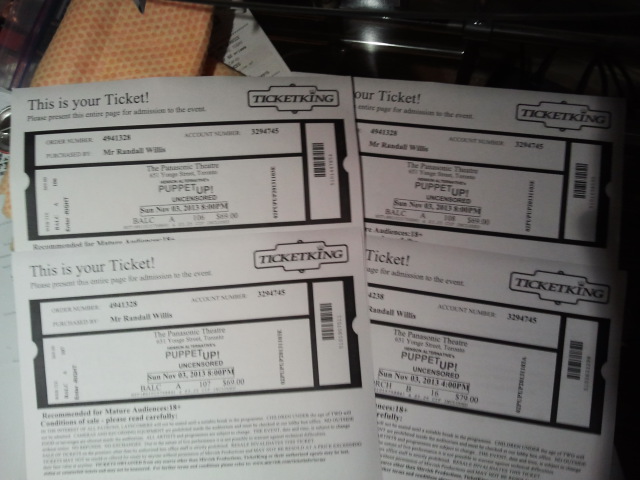
Matinee ticket and 3 tix for the final performance

Matinee ticket and 3 tix for the final performance

Then came the show on Sunday (Nov 3). Again, sitting at Patrick Bristow’s feet. Shouting suggestions left, right and centre. Feeling like we were developing a bond, even though I knew he probably couldn’t see more than two feet into the audience.

Nary a flaw in this show. The musical numbers popped. The classics practically brought tears. Colleen and Grant were amazing. Brian Clark, Peggy Etra, Michael Oosterom and Ted Michaels were on fire. And I got to add Michael to my photographic portfolio of puppeteers.
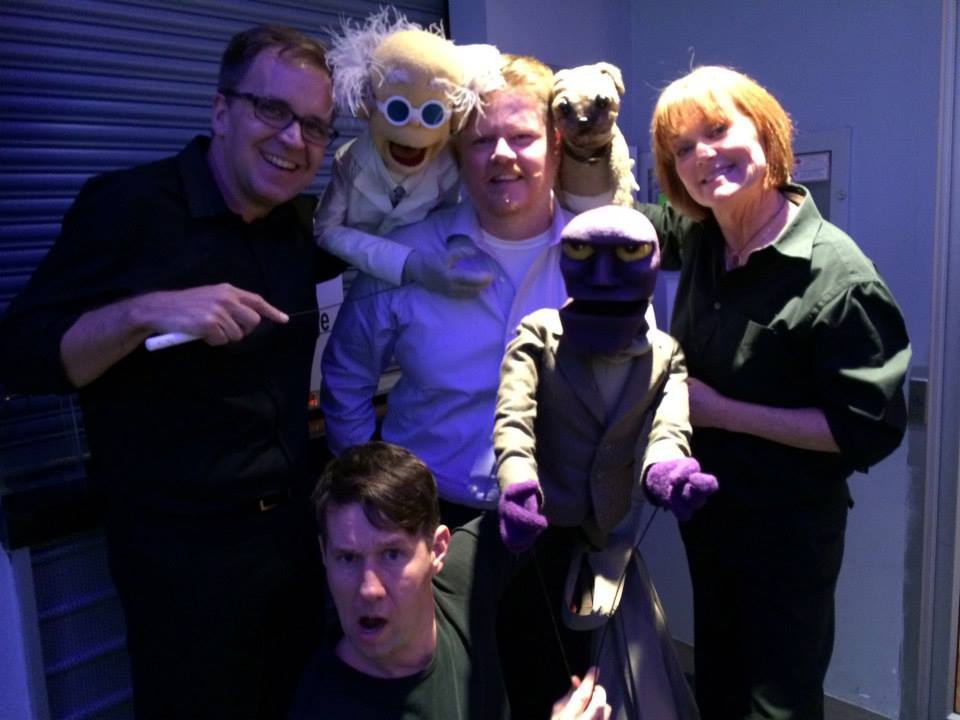
(L-to-R) Was able to add Michael Oosterom to the list of puppeteers with Brian Clark and Peggy Etra (Grant Baciocco on camera)

(L-to-R) Was able to add Michael Oosterom to the list of puppeteers with Brian Clark and Peggy Etra (Grant Baciocco on camera)

To make the afternoon even more special, as I waited in line at a nearby restaurant to grab dinner between the 4pm and 8pm shows, who should walk in behind me other than Patrick Bristow. Still needing a picture with two of the puppeteers, I couldn’t die quite yet, but I was getting close. Patrick was wonderful and charming and was nice enough to pose for a photo.

Patrick Bristow and I await dinner near the theatre (no earthquake, just shaky camera)

Patrick Bristow and I await dinner near the theatre (no earthquake, just shaky camera)

So here we are. Eight pm on Sunday night. I met Leela in the foyer of the theatre and left the ticket at Will Call for my friend, Michael. If I vibrated any faster, I might have been able to pass through walls. I was going to get to share this with two really important people in my life. This was my birthday gift to me…sharing PuppetUp!

There were a couple bumpy bits in the first part of the show, but it was still amazing. And the closing half was A-FIRKIN-MAZING! Every bit went perfectly. Even from the balcony, Patrick would take my suggestions (I was in the balcony, not Patrick). Leela, who is a tough comedic audience, laughed raucously throughout the show (high praise if any of the PuppetUp! people are reading this).

Leela and Michael were both great to hang back with me…I wanted to be one of the last people to get my photo done tonight so I could let everyone know how much I appreciated their performances and talents. And beauty of beauty, the entire cast was out for photos on the last night. I was going to complete the set of puppeteers for the photo.

Finale photo with (L to R) Brian D Clark, Michael Oosterom, Ted Michaels, Colleen Smith. Buried is Peggy Etra, and Grant Baciocco is on camera duty.

Finale photo with (L to R) Brian D Clark, Michael Oosterom, Ted Michaels, Colleen Smith. Buried is Peggy Etra, and Grant Baciocco is on camera duty.

As I was waiting for my turn, Patrick passed through the lobby and asked me to hang back. Interesting.

After having my picture done and convincing my friend Michael to get his done, Patrick came out from a back room and handed me a puppet from the concession stand as thanks for all the support and enthusiasm I offered them while they were in Toronto. Nice! She (the puppet is a girl) is sitting on my desk as I type this.

The new lady in my life thanks to Patrick Bristow and the folks at PuppetUp!

The new lady in my life thanks to Patrick Bristow and the folks at PuppetUp!

I was able to shake everyone’s hand and let them know how much I enjoyed knowing them. I am currently hooking up with many of the puppeteers on Twitter and Facebook. And have promised them all that I will initiate the next social media campaign to get them to come back to Toronto.

Based on their experiences in Toronto, both in the theatre and on the town, I think they’d be open to the idea.

And now, sadly, PuppetUp! has left Toronto, but not without leaving an incredibly big mark on my heart. Thanks, folks. It was a special couple of weeks.

The Throw – Austin Film Festival (part two)

Terry Rossio, Pirates franchise

In Part One of this post, we talked about Terry Rossio‘s comments at the Austin Film Festival regarding the different kinds of cuts in films: storyline cuts and storyteller cuts. But how do you establish these cuts?

With the throw, which Rossio divides into two categories (a fixation, it seems): the strong throw and the soft throw.

[Added note: Rossio provided a film clip to demonstrate each of these throws but I was only able to record so many in my notebook…hopefully, you’ll be able to figure them out for yourself.]

Strong throws can be very obvious and are used for a variety of reasons. He offered the example of the movie Slumdog Millionaire, where a strong throw is used to set up a flashback. Alternatively, a throw can be used to convey story information so that the audience can discern the link between two scenes. Rossio quotes someone from Pixar who once suggested: “Give the audience 2+2 and they will love you forever.” Throws can also be used to move us through a montage, where each snippet is linked in some way.

Rossio described the discovery throw, where one scene is the answer to the question raised in the previous scene. As an example, he offered the scene in Aladdin where Jafar and Iago complain they will need a new victim to attain the lamp, “a diamond in the rough”, at which point, we move to Aladdin running across a roof with guards yelling “Stop thief!”

And he described the comic throw—also known as the Gilligan cut—where a character repeatedly comments on something (e.g., refusing to wear a dress), only to see the character immediately in that situation (e.g., Gilligan in a dress).

And finally, Rossio suggested strong throws can be used to set up reversals in a story, where we see characters moving a story in one direction, only to see the exact opposite in the next scene.

Soft throws, Rossio suggests, are much more common in film and are by nature more varied and artistic, providing a greater range of effects.

Such throws can provide a promise of things to come for an audience, such as in Raiders of the Lost Ark when Indy remind his partner what a cautious fellow he is, only to then grab a gun from his desk and head into the fray. Alternatively, such throws can also imply that the next events will be really boring in this scene and that something is more interesting elsewhere. The example he gave was from The Empire Strikes Back, when Luke is leaving Hoth for Dagoba, a long boring journey, and so he tells R2D2 “I’d like to leave it on manual control for a while.” A signal that we’ll kill time here, so let’s go watch Han and Leia run the blockade.

Such throws can also be used to cut off a scene before key information is revealed, creating a sense of mystery and a promise of an answer to come. Rossio warns, however, that this type of throw can feel very manipulative to an audience. The example he gives is again from The Empire Strikes Back, when Luke is in a hurry to leave Dagoba to rescue Han and Leia but Yoda and Obi-Wan’s apparition try to hold him back. As Luke leaves, Obi-wan says “That boy is our last hope.” only to have Yoda correct him, “No, there is another.” Is that Leia in Cloud City?

Rossio describes these throws as connective tissue in a film or screenplay, unifying disparate elements and speaking to the audience in a subliminal, symbolic or subtextual manner.

There is the intentional misdirect throw, to keep the audience from figuring out what’s going on too quickly, and the throw to set up a passage of time, often so characters can have sex, Rossio quips. The train entering the tunnel.

Soft throws can also help set up a change in the state or tone of the movie or to introduce a new character. Rossio gives the example of the movie Key Largo, when the suspicious guests of a Florida fishing resort reveal themselves to be mobsters who take the other guests hostage. A second later, we meet the mysterious boss (Edward G. Robinson) upstairs. The mood of the story has changed, for the worse for Humphrey Bogart and Lauren Bacall.

These cuts can also be used as an internal cut within a single scene to cue the passage of time in a scene that would take too long to play out and would bore the audience. The cigarette that is lit and rested in a clean ashtray, only to be followed seconds later by another cigarette being placed in a full ashtray—ah, the 70s.

As Rossio explains, whether strong or soft, the throw allows the audience to fill in the gaps within a movie. He offered a quote that suggested “Filmmaking is giving the audience the experience of completing the image.” And he added the idea that no scene should be complete except for the last one. There should always be something that prompts the audience to move willingly from this spot to the next one.

He then offered a self-deprecating moment by presenting a quote that suggested a very popular use of throws is to give a movie a sense of consistency or connectivity when in fact the story makes little or no logical sense at all. The quote was referencing a movie that Rossio wrote and acknowledge had a plot that was all over the place.

In the Q&A session afterward, someone asked Rossio if throws were something for which you should aim in the first draft of a screenplay and his answer was basically no, that it was something you added in later drafts. His thinking was that in a first draft, you don’t really know if your scenes are in the right places and if things will need to move around for the sake of the best story.

You only look to incorporate a throw once the story is pretty much set, he says, adding that not every scene abutment requires a throw and you should never simply add one for the sake of adding one, if it will look arbitrary or out of place. The throw, he says, should smooth the transition between scenes, not highlight them by standing out.


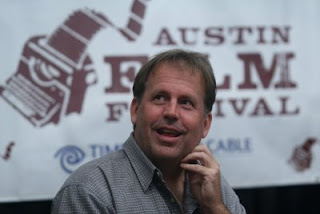
(Image is property of owner and is used here without permission for a sense of continuity.)

The Throw – Austin Film Festival (part one)

Terry Rossio on AFF panel

One of the sessions I was determined to attend this year was The Throw given by screenwriter Terry Rossio, the man who brought us Aladdin, Shrek, the Pirates of the Caribbean series and The Lone Ranger (okay, so nobody’s perfect).

Rossio is a legend at the Austin Film Festival; his The Rewrite session being one of the many highlights. But last year, he went one step further with The Throw, which this year, the folks at AFF decided to put in a hotel ballroom rather than a side meeting room.

For the uninitiated, Rossio explains, the throw is that thing designed into the end of the scene that sets up (or throws to) the next scene. It is a connective element that suggests the two scenes belong side-by-side at a level beyond plot or story.

It can be a visual to visual cue, such as the famous scene in 2001: A Space Odyssey where the victorious ape throws the bone club into the air and as it spins end-over-end, it turns into a space station.

Alternatively, the throw can be verbal to visual, such as in the scene in Raiders of the Lost Ark where Indiana Jones has made his way into the Nazi camp and learns that the Ark of the Covenant is being shipped out on a truck. Indy’s response is “Truck! What truck?” and the very next second, we watch a truck move through the Nazi camp, onto which Indy has somehow hidden himself.

According to Rossio, there are two ways to organize the narrative structure of a movie or screenplay: using storyline cuts or storyteller cuts.

Storyline cuts emerge from the events of the story, seeming natural and seamless. For example, the storming of the beach scene in Saving Private Ryan, where we see the soldiers move from one section of the beach to another.

Storyline cuts, Rossio explains, maintain the tension and keep the audience immersed in the story. It is a way to maintain and build story momentum while asking for minimal effort from the audience. It is much like a series of dominoes.

Another example Rossio offers is the end of the tornado scene from The Wizard of Oz, when the house finally stops spinning and Dorothy moves from the sepia tones of Kansas into the Technicolor world of Oz. She even states, famously, “I don’t think we’re in Kansas anymore.”

Storyteller cuts, in contrast, imply there is a grand design to the story or an author, who is choosing what you see and when rather than simply presenting events as they happen. This is common in ensemble films such as Love, Actually and American Graffiti.

This sense of a grand design can be comforting and reassuring to an audience, says Rossio. It creates a distance between the audience and the story, with the less immersive story being seen as a creation.

These types of cuts often support a narrator or guide who practically sits alongside an audience and takes them through the story. The guide can appear on-screen or perhaps as a voiceover. Think Morgan Freeman’s character in The Shawshank Redemption.

According to Rossio, storyteller cuts are also very good at renewing a story’s momentum, jumping to new locations or situations before a prior scene’s energy drops and thereby re-engaging the audience.

But how do you establish these cuts? With the throw, which Rossio divides into two categories (a fixation, it seems): the strong throw and the soft throw.

(See the next post for Part Two, which actually goes into the different throws and how you would use them.)

(Images is property of owner and is used here without permission, because I don’t give a toss.)

The Maples – A short story

Center Bar

“The maples?”

“Still there,” Lucy smiled. “They look like hell, but they’re there.”

“I thought the hurricane took everything out,” Jeremy replied.

“Actually, the ice storm in February did the most damage. About half the trees split at the trunk, so the whole copse leans to the left.”

Jeremy smiled at her, eyes alight.

“What?”

“The whole ‘copse’?” he teased.

She slapped his arm, causing his rye and coke to splatter. She mopped the mess with her napkin as he licked the alcohol from his fingers.

“Well, it’s hardly a forest. There are what? Twenty trees?”

“Sounds right, from what I remember.”

Lucy sipped at her straw, taking in the new Jeremy as she took in her iced tea. He had come a long way from the torn jeans and sleeveless sweatshirt she remembered from school.

Truth be told, she too was a long way from the matching couture of her younger days, knock-off Gucci and Prada long replaced by Mommy and Dadda.

“So, what kind of law?” she asked.

“Corporate mostly,” he said. “M&As, takeovers, trusts.”

“A real-life Gordon Gecko!”

He laughed.

“Nothing that sexy. No Darryl Hannahs in my life. Although, I am okay with greed…within reason.”

“Still. New York City.”

“Might as well be Albuquerque for all I get to see the city,” he replied. “Most days, I sit in boardrooms watching people talk to tape recorders and then reading transcripts of the same conversation to verify the transcriptionist isn’t an idiot or deaf.”

Lucy rolled her eyes.

“Seriously, if I wasn’t charging $750 an hour to play Tetris, I’d go back to bicycle repair.”

Lucy’s eyes widened.

“I’m sorry. I should have said anything about the money. Sounds like I’m bragging.”

“Bragging?” Lucy repeated. “Surprised you’re not standing on the bar, crowing.”

Jeremy’s smile faded, triggering a flicker of self-consciousness in Lucy. She put her hand on his.

“Tell you what, you can buy the drinks,” she said, trying to make light of it all.

He smiled, and they fell silent for a moment.

Jeremy swished the ice around in his glass, attracting the bartender’s attention. Jeremy shook his head at him.

“So, two kids,” Jeremy finally managed.

“Yes, boy and a girl,” Lucy said, jumping at the change in conversation. “As well as three dogs, a cat and a goldfish that just won’t die. Don’t believe them when they tell you goldfish have the lifespan of a toilet flush.”

“That’s quite the menagerie,” Jeremy responded. “You hear about a big rain storm I should know about?”

“No,” Lucy giggled. “Besides, Dave would look terrible in the long white beard.”

“Your husband?”

“Yeah,” she replied. “Has a John Deere dealership in town. He’s stable.”

“Stable?” Jeremy chuckled. “Not the most ringing endorsement I’ve ever heard.”

Now it was Lucy’s turn to go quiet, adjusting her jacket below the bar.

“I’m sorry,” Jeremy interjected. “That came out totally wrong.”

“No, it’s okay,” Lucy replied softly. “And you’re right.”

Lucy poked at her ice cubes, searching her thoughts for her next words, as Jeremy waited. Something told him, she was actually glad to talk about this.

“Dave’s a good man. A good father,” she explained, adding quickly, “And husband!”

Another moment of silence.

“The best man I could ask for…in Bedford”

Jeremy waited. Lucy would continue when she was ready.

“I don’t know. Maybe I expected too much after high school…” she faded off into her own world.

Finally looking up, Lucy realized Jeremy was watching her, eyes full of concern. She laughed at herself.

“I’m babbling,” she blurted. “Life is good. Great. Really.”

A wistful smile migrated across Jeremy’s face.

“We all have skeletons, eh?”

“And some of them come with mortgage payments.”

“Attention passengers of US Airways flight 7783 to New York. We are now boarding executive and elite status members at Gate 61.”

Jeremy removed his boarding pass from his pocket and threw a $20 bill on the bar.

“Sounds like that’s my cue,” he said, rising to his feet.

Lucy stood, giving him a quick hug, which he returned, not releasing her right away.

“Good seeing you, again.”

“You, too,” Jeremy replied. “Give my best to Bedford.”

Lucy remounted her bar stool as Jeremy grabbed his bag and headed toward the concourse.

“Hey Jeremy,” Lucy called across the bar.

Jeremy turned back, confused.

“I didn’t think you liked me.”

Jeremy smiled and winked.

“I didn’t,” he laughed. “I like this you much better.”

Lucy blushed as he dissolved into the crowd.


(Image is property of owner and is used here without permission because I had to fly.)

Just tell the story – Austin Film Festival

Ron Nyswaner

Perhaps the most interesting advice I heard while attending the 2013 Austin Film Festival came from the Just Tell the Story session by screenwriter Ron Nyswaner, who suggested that not all stories are movie-worthy. It’s not that such stories are unimportant or not worth telling, but rather that film is a very specific medium—as are novels, videos, television, etc.—and therefore requires specific criteria be met for appeal.

1. Do you have a worthy protagonist? It is important that the audience understands the protagonist’s struggle, that the character is constantly dealing with questions of life, loss, yearning. There should be clearly understood interior and exterior conflict.

2. Does you protagonist have face worthy obstacles or a worthy antagonist? The antagonist should represent the opposing view, but that doesn’t necessarily mean the antipode to your protagonist’s views. Overall and within individual scenes, there should always be a sense of ideas in conflict. Nyswaner stressed the importance of the hope-dread axis—What do you hope is going to happen and what do you dread is going to happen in a scene—suggesting that the stronger the axis, the more tension you build in your story.

3. How strong is the central relationship? Sydney Pollack suggested that every story is a love story, and Nyswaner followed on that, suggesting that the relationships between your characters, and particularly the protagonist and antagonist, is what drives the story forward. The stronger that relationship (positively or negatively), the stronger the story. He also discussed the idea of triangulation; the effect of adding a third party into a scene to increase the tension or stakes.

4. Where am I (the writer) in the story? Who am I? All good art is personal, Nyswaner said, so the writer should look for his or her emotional connection with the story. By making the story personal to you, you develop a deeper story.

5. Take your audience into a world that’s interesting. If the audience cannot connect with the environment that you’ve created, they will find it difficult to get into your story. This doesn’t mean that the environment has to be familiar so much as understandable and relatable.

6. Do you have enough turning points to carry through a feature? A good film story is constantly changing direction, keeping the audience engaged and intrigued. Without sufficient turning points, audience members disconnect from the story or worse, get bored. Attitudes and powerbases should shift throughout the story to keep the audience guessing.

7. Does the audience love the story and its characters? Nyswaner suggests writers must be ruthless, paraphrasing a quote (trying to remember by whom) that a writer is a person who will betray the people he loves to impress people he will never meet. The key for a writer is to give everything to the story he or she is trying to tell, even at the cost of real-world expectations and relationships. This is not to say that success comes from being the biggest asshole, but rather that it is important to keep the focus of a film on the story and its characters to the detriment of other external factors (as best as possible).


Ron Nyswaner is perhaps best known for having penned the movie Philadelphia, but has also worked on television (Ray Donovan) and in print, and teaches film at the Columbia University School of the Arts.