Alas, Mel Smith

Image

Today, I would like to commemorate the legendary comic genius that was Mel Smith, who passed away this past week.

And he was a legend…in the sense that his story offers a scintilla of fact ham-fisted into a pasty-white pasty shell of human dung perpetuated by self-immolating vivisectionists with personal hygiene problems and a fetish for peat moss.

For those of you who didn’t know him, Mel Smith was a kind, gentle, giving man who would go out of his way to help the less fortunate.

For those of us who did, however, know him, Mel Smith was a fucking asshole. Wouldn’t give a toss about anyone even if they offered to wank the bugger themselves. As nasty a piece of shit as Britain has ever produced, and remember, these include the Thatcher years.

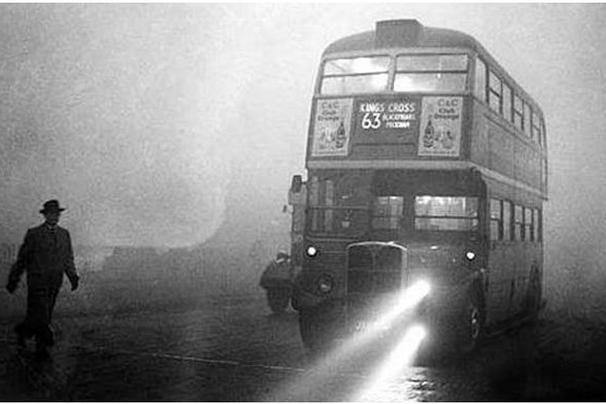
Mel Smith was born in West London on December 3, 1952, presumably from the uterus of a woman who had shagged a large black ram during some pagan ritual the previous March. No one is quite sure why he chose this day, but some have tried to link his birth to the great smog that swept over London the very next day, killing upward of 12,000 people.
Image

A right bloody bastard he was.

Over the next several years, Mel Smith attended a variety of schools where he was considered a bright pupil. Unfortunately, the ability to shoot light from your eyes is not one of the criteria to succeed in A-levels and Smith’s general lack of intellectual acuity—it is rumoured he had the IQ of retarded tapioca—meant he was only able to attend Oxford.*

It was while attending Oxford that Mel Smith learned he had a knack for convincing himself he was funny, and through sheer perseverance—and a gun—he caught the eye of director John Lloyd. Lloyd, who was fond of both of his eyes, immediately gave Smith a role on the hit comedy television series Not the Nine O’clock News.

Image

BBC audiences, however, quickly concluded that this was also Not the Funny Comedy Program.

Blaming everyone but himself for the demise of the careers of people like Rowan “Who” Atkinson, Smith beat up the little Welsh kid on the show—Griff Rhys Jones (talk about your Dumbledork)—and started a hard new series that took a satirical look at Islam called Allah’s Smith and Jones.

Two days into the fire bombings, a slight change was made to the title of the show, now Alas Smith & Jones. The ampersand saved the day.

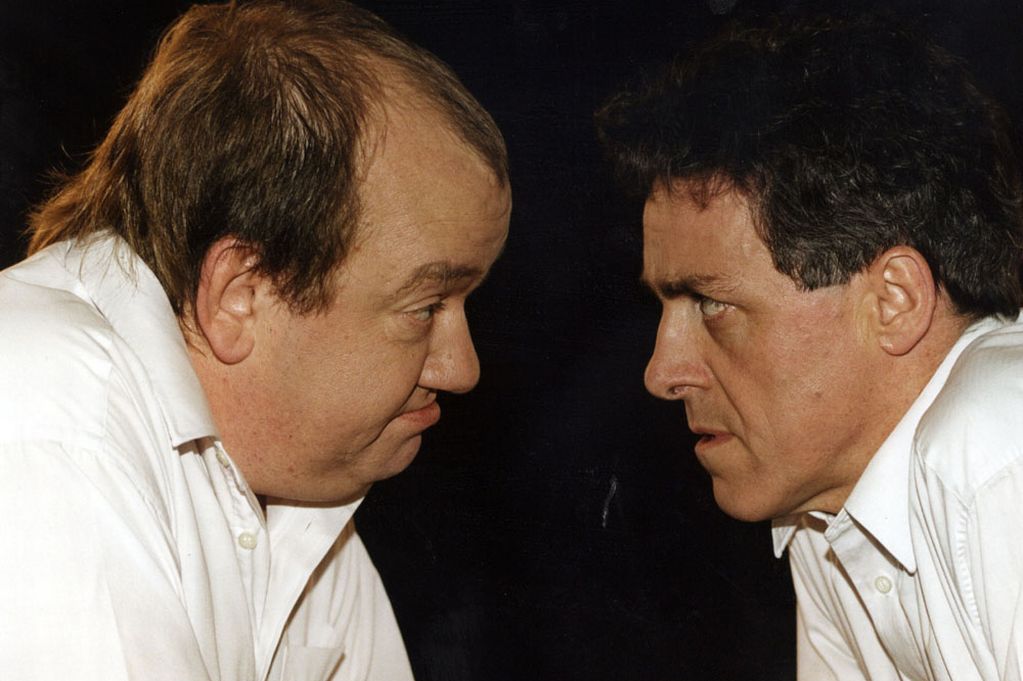
Out of the gate, critics were harsh. “Who are these two wankers who do nothing but mumble to each other from 3 inches?” “Kiss, already.”
Image

But the British public ate it up.

Since the fall of the Empire, they had pretty much been doing the same ruddy thing every night, smugly satisfied in their fetid shanties that they didn’t have to get bloody malaria just to find a decent curry.

When the show finally went off the air—nobody knows exactly when, because to be honest, nobody could stomach more than 20 minutes of that shite—Jones wandered off, never to be heard from again, except as that sad ugly bloke who would masturbate monkeys on Whose Line Is It Anyways?

Smith, however, dragged his bloated carcass to Hollywood, where he was met with rave reviews like “What is that prick doing to my dog?”, “Can human beings really sweat that much?”, and “Did Charles Laughton just take a shit on my lawn?”

On January 7, 2001, Mel Smith’s career was declared dead. His body, however, continued to function until July 19, 2013, when Mel himself passed away from a heart attack. The news sent shock waves through the British comedy community, both of whom expressed surprise that Smith even had a heart.

Smith leaves behind pretty much everybody who didn’t die on or before July 19, 2013.


*Ed.’s note: It has since been verified that even retarded tapioca can gain attendance at Cambridge. We thank Hugh Laurie for the correction and apologize for printing the aforementioned rumour.


Thanks Mel


[Images are property of owners and are used here without permission because that’s what Mel would have wanted…and frankly, I don’t give a toss.]

Do it

Image

Do it now!

Don’t think about it.

Go!

Don’t hesitate.

Aaaand now!

You’re stalling.

Now, Now, Now!

Suckage is encouraged.

Make it happen!

Don’t let fear stop you.

You are the [insert action]!

Do or do, there is no failure.

Dooooooo it!

It’s better than sex (unless you’re doing the sex, in which case, it is exactly like sex)

Go-go! Get’m-get’m! Ooh-aah!

Yay you!

(Image is property of owner and is used here without permission because I do’ed it!)

Indirect influences

Image

I naturally speak with one voice. If pressed, I can speak with a second, more professional voice; the one that presents concepts to advertising clients or interviews corporate executives for a magazine. But most of the time, I speak with one voice that uses a vocabulary and attitude established over my many decades of life.

I think this is largely the case for everyone, which is why it is not surprising that people tend to write stories with a series characters that can largely sound the same. The protagonist is typically quite distinct. The antagonist is often distinct. But after that, I don’t know that I could tell who was speaking if I didn’t read the names.

These secondary characters, by their very nature, are not our focus as writers, so they tend to have the least developed back stories even in our heads. Other than age or gender, what makes the paperboy different from the local sheriff from the school teacher?

The same thing that makes you different from me. Our experiences, past and present.

One of the tricks for informing a character that I learned in improv was to endow a character with a trait that only you as the performer knew, and ideally a trait that had absolutely nothing to do with the scene that was developing.

In one exercise, I decided that my character had a bad right ankle, so that every time I took a step, my ankle would cause me pain. I didn’t hobble or verbally express the pain with either an “Ow” or “Would you slow down, my ankle hurts”.

The pain was expressed, however, in how my character responded to his environment and the other characters in the scene. What might have been a middle-of-the-road character suddenly became a terse character, someone in a hurry to get things over with, quick to anger or frustrate, less apt to engage in activities.

The bonus aspect of the exercise, for me, was that my fellow improv performers quickly got and responded to my character, but when pressed, could not exactly say why I behaved as I did.

Now change that ankle pain to a foot orgasm (read about it this week online) and see where that character would go (probably jogging).

The sore ankle had no impact on what role the character played in the scene, but more in HOW that character performed that role. And this made the character stand out from all of the others.

I go back to this exercise often, when I find myself creating secondary or tertiary characters that aren’t differentiated from the background. A little something to make them stand out, however briefly, in their scene.

If you find yourself stuck, give it a shot. What could it hurt, other than possibly your ankle?

(Image is property of owners and is used here without permission, because it makes me happy/indifferent/snarky/hot.)

Ode to a Loan Shark

Ouch, sayeth I

As sinews disrupt

Their femured rest

To lie astride the knob.

Where once my leg

Did show spritely measure

Now it does lie askew

Rent for rent’s sake.

Principled currency have I

Yet usurious interest

Abandons my very soul

To restless piscine slumber,

To don wearied galoshes

Of most compressed clay.

Stir not thy ire

Brooklyn-ed Vincent

Thy due is nigh

As the night is dewed

I would not lie now

Lest I should lie forever,

A cornerstone of commerce,

Tenement to history.

Vis’t me but anon

And thy dower is done;

Do me in here

And you’ll none, I fear.

(Image is property of owner and is used here without permission, so please don’t hurt me.)

Take notes

Image

Dear Diary: I couldn’t believe that this type of thing would happen to a guy like me, but when that woman got out of the pool, she wasn’t wearing any…

Oops. Wrong diary.

We are all incredibly talented, witty, sophisticated, creative people. Unfortunately, for most of us, we are incredibly talented, witty, sophisticated, creative people who would have trouble remembering our names if they weren’t on our drivers licenses.

I personally have a brilliant memory. I remember that the most common form of cockroach in the United States and Canada is Periplaneta americana. I recall that the parasitic Paragonimus westermani is a lung fluke. And I am quite certain that Tycho Brahe had history’s first rhinoplasty, however involuntarily on his part.

I also remember that I had three really good ideas for blog posts yesterday…I just can’t remember today what they were.

We never know when the creative spark will light us up, but as often as not, it is likely to happen when we are least prepared to act on it. A mall parking lot. Dinner with the family. Police interrogation. And inevitably, because we’re in the middle of that distraction, we forget the idea.

Carry a note book and pen or pencil at all times. Capture that fleeting moment, no matter how (in)conspicuously. Whether you’re a writer, sculptor, painter, musician, whatever your art, the important thing is to give yourself some form of reminder that you can use for inspiration later.

As I believe I’ve mentioned in earlier posts, my first screenplay grew out of a four-word pun (a song parody) that I wrote in a note book several years earlier.

When the pun occurred to me, I had no idea what to do with it, but I wrote it down any way. Over the next two years, when I would struggle for inspiration, I would flip the pages of my notebooks, and one day, I read the pun and an idea began to ferment. 18 months later, I had the first draft of my first screenplay.

Too often, I fear, we let these moments of inspiration slip away, and while we may kick ourselves momentarily on realizing we’ve lost something, we shrug our shoulders and simply move on. Fine, move on, but don’t keep repeating the mistake.

We all know how hard to come by moments of creative insight can be. Those moments are precious gifts, even if we can’t see the application today. So, the last thing we need to be doing is simply letting them float by and be lost.

Write it down. Save it for later, when you have the time or creative inclination to turn the idea into something special.

In any event, I just had to get this off my chest before I forgot it too.

(Image is the property of Biodiversity Explorer and is used here without permission.)

My Creative Journey – Part Two

Picking up from my first realization that my passion might also be a gift, as explained in Part One.

Image

Over the years, I’ve had opportunities to display my creative demons before an audience. An effective little soap opera episode in Grade 12. Geeky science humour in my own magazine. Heart-wrenching poetry following the end of a close friendship that might have been much more.

I worked my way into the magazine world, writing interesting stories about interesting discoveries and advances, but it wasn’t the same. The words poured forth and the story-telling skills improved, but I was always a chronicler of someone else’s story.

Creativity expressed itself in my approach to the story. In seeing a story that no one else saw. In context that was invisible to everyone else. Creativity manifested itself in identifying authors and writers from all walks of life to fill gaps in the magazines. I may not have been the best project manager, but I was definitely the most creative.

As I matured in my jobs, I extended this creativity to everything I did. Looking for effective solutions to seemingly intractable problems. But it wasn’t enough. That voice within me cried out to be heard. And the more I worked—and overworked—to distract it, the louder it screamed. So loudly, that even my wife could hear it.

While sitting in an Orlando hotel bar one night, she finally challenged me and my workaholic tendencies, demanding that we come up with a hobby for me. When pressed, I admitted that I had always felt like I’d been born 30 years too late. That if I could have any miracle in my life, it would be to work on those old sketch comedy shows from the 1950s as a comedy writer. Sid Ceasar’s Show of Shows came to mind. Imagining myself in the writers’ room with Mel Brooks, Larry Gelbart, Woody Allen and Neil Simon.

Neither of us knew how to make that happen, but my wife challenged me to find something at home that would set me up in that direction. The next week, I signed up for my first improv class at Second City.

Although it still wasn’t where I wanted to be—more performance than writing—the improv classes were amazing; therapeutic on a variety of levels. Eventually, though, I stumbled onto their sketch comedy writing program and that’s when I hit my stride. A wonderful instructor, talented zany fellow students.

The words flowed incredibly quickly. Within weeks, I had dozens of sketches and felt like I was making serious headway in my education of what worked and why. If there was a problem with the class, it was that my production vastly outstripped the need. I tried new things. I broke out of my comfort zone. I pushed my limits. My only goal was funny.

As I honed my sketches, I prepared for the reality of rehearsals with actors, when all of this work would really come true; when my efforts became more than an academic exercise. Rehearsals went well. Out actors seemed genuinely grateful to be performing our work. I saw what worked and what didn’t, even in the work of others.

Interestingly, I wasn’t in control of the process and I was okay with that. There’s something to be said for being so far out of your element that you recognize the limitations of your control. I had complete faith in the director and our actors. I believed they too wanted this to work as badly as I did.

And then the day of the performance arrived. Nervous energy ran through my body and I couldn’t sit still. I could barely communicate. There was no fear. Only anticipation and potential validation. Was I funny?

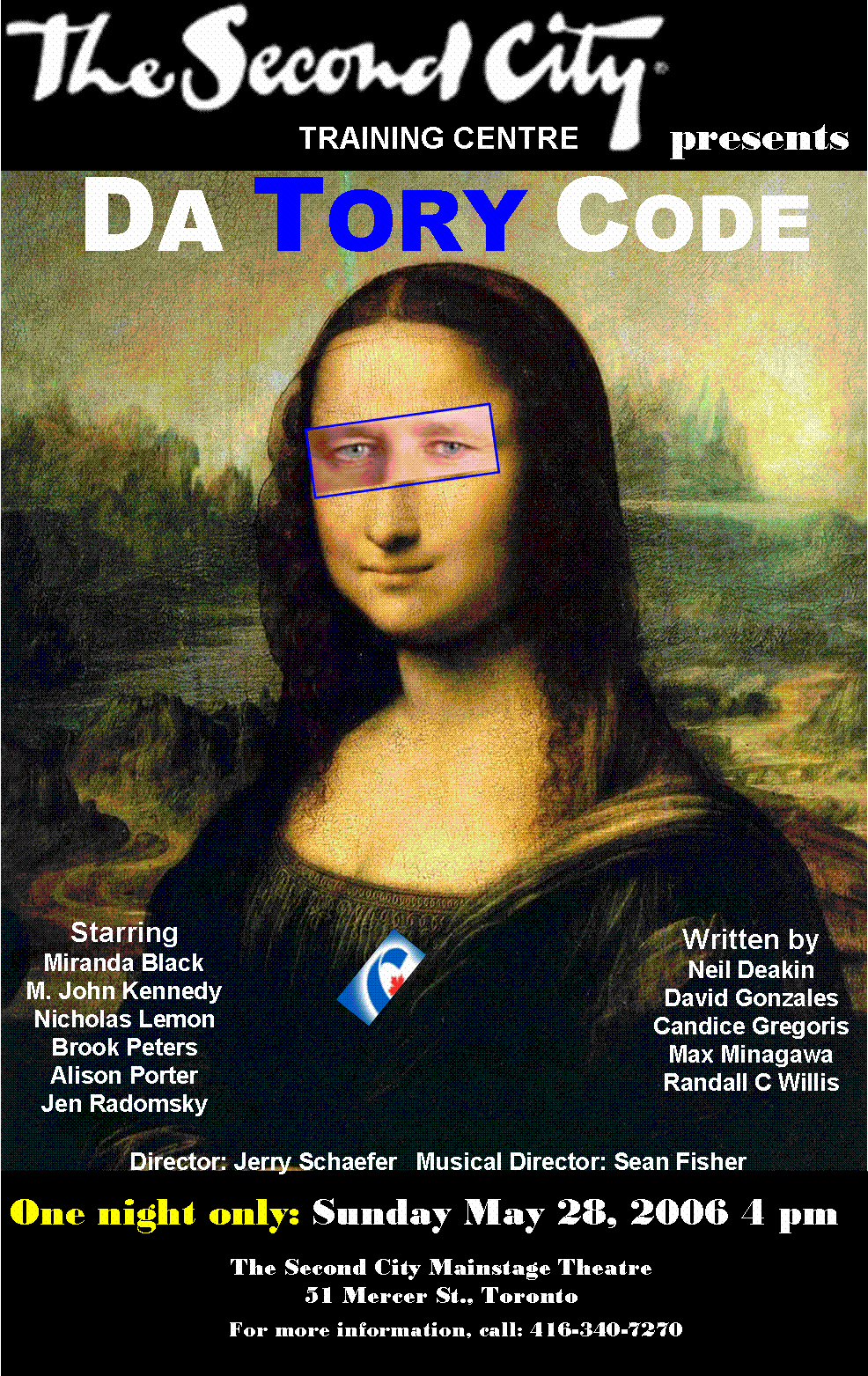
The day we premiered Da Tory Code was easily one of the best days in my life. The audience laughed. Not at everything, which was a valuable lesson, but they laughed at enough to validate my talent.

Image