10 Steps to Writing a Pilot That Sells

No, no! Not that kind of pilot. Although, cute photo. (Image used without permission)

No, no! Not that kind of pilot. Although, cute photo. (Image used without permission)

1) Watch a lot of television; especially stuff you don’t like or think is bad. This will establish the belief within you that you could write something at least that bad and still get it on the air.

2) Conceptualize a show that combines one of your siblings or cousins, the second job you ever had, and a famous moment in history. Every idea after this will sound entirely plausible; and hell, this might actually work as a sitcom.

3) Conceptualize an idea that is morally offensive to you and then see if it was one of the shows in Step 1. If not, then the market is ripe for the picking.

4) Describe the absolute worst day of your life, a day when everything went wrong. Then switch one of the disastrous elements. Then, switch another element. Do this 10 more times. Season One!

If you can’t create 13 variants, your day wasn’t that bad and your life is too good for you to be writing for television. Go write greeting cards.

5) Grab a copy of Bulfinch’s Mythology and reset all of the stories in modern-day Seattle or the smallest town you’ve ever visited. Warning: Brace for complaints that it’s a rehash of Dallas or Friday Night Lights.

6) Grab a copy of Bulfinch’s Mythology and do not reset the stories. Hell, if it worked for The Borgias and The Tudors, it might work here. Call it The Olympians.

7) Start with Episode Two, because pilots suck and you’ll never want to show it to anyone. You need to know/believe your idea works.

8) No matter what your current idea is, when you go to pitch it and you think you’re losing your audience, suddenly reveal “And the protagonist is a ghost!” Vampire, werewolf and zombie are equally acceptable.

9) Stop reading advice on writing a successful pilot and just write your story, already. There is no telling why someone in a suit will get excited by your story, but I can guarantee they won’t if you’re not.

10) If all else fails, generate a top-ten list of ways to write a pilot that will sell and use it as the basis of a book you will later turn into a sitcom.

Covering your ass-ets

So often, when I start a new series of classes or attend a conference on screenwriting, I hear the same refrain: How can I register my stuff so no one steals my ideas?

And, as logic would dictate, the question always comes from the most junior writers in the room, if they have yet to write at all.

There is no denying that the universe is a dangerous place. Global climate change necessitates we choose higher floors in a high-rise to ensure our laptops are not flooded by rising sea levels. I always write with my back to the wall so that people in the condos across the street can’t take telephoto shots of what I’m writing. And whenever I publicly speak the word “tadpole”, I actually mean screenplay…likewise, “garlic”, “symbiont” and “purse” for protagonist, antagonist and onomatopoeia. (Don’t bother memorizing those; I have already changed them.)

All in an effort to make sure that no one steals my ideas. They are mine. I created them. They are owned by me. (Much as with Miss Ann Elk’s theory about the brontosaurus.)

Ah, but wait a tic. Just a mo’. Hold your horses and tell them that you love them.

I forgot one teensy little thing.  A bit of a fly in the old ointment. You see: YOU CAN’T PROTECT IDEAS!

1) I defy you to actually show me a completely new idea, and not just something old that you’ve redecorated.

2) The idea is not the important bit…it’s what you do with the idea. Give 12 people the same idea and you will end up with 12 very different stories.

3) There is every reason to believe that your idea is shit. No offense intended. Most of my ideas are shit. That’s how you find the truly brilliant ones, by moving the shit out of the way so the good ones are more visible. (See also: Miss Ann Elk’s theory about the brontosaurus.)

I applaud you for having ideas, shit or otherwise, because it’s not easy to do and is a valuable first step in your art. But not until you’ve completed your story, however, do you have something to protect.

You have completed your story, haven’t you? If your idea was solid, then you should be anxious to tell the story. If your idea is good, I want to hear your story. Seriously. No kidding. We need more good stories.

The story—not the idea—is where you will shine as an artist. The story tells me everything about you. It puts multiple facets of your personality and belief system on display and says: Hey universe! Here I am!

That, my friends, is worth protecting. That is what you register somewhere so that no one can tell exactly your story without your permission.

Once you’ve reached that point, I then recommend:

Writers’ Guild of America – West (web site is easier to use than the East chapter)

Writers Guild of Canada

The organizations have a reciprocal agreement, so registry with one is sufficient for both the United States and Canada.

Unfortunately, I only know of these two organizations, so if anyone wants to contribute others in Europe, Asia or anywhere else, please do.

Yes, you want to protect your assets, but you’ll be a lot better off putting your energies into creating assets that are worth protecting.

Fort Knox isn’t meant to be a kitty litter box.

A strange jobs program in British Columbia. (Whistler)

A strange jobs program in British Columbia. (Whistler)

Write…as rain

I write.

I write because I love playing with words.

I write because my head will explode if I don’t.

I write to explore ideas.

I write because I’m interested in a lot of stuff.

I write because I’m a narcissist.

I write because the stories flow through me.

I write because I’m funny (some of the time).

I write because I have thoughts worth expressing.

I write because the blank page beckons.

I write to release my pain.

I write to share my joy.

I write to add beauty to the world.

I write to keep moving.

I write to share the magnificent visions I see.

I write to exorcise and exercise the voices.

I write to play.

I write because I am a writer.


Why do you?

Penny Penniston at Toronto Screenwriting Conference 2013

Not Just Talk: How Writers Think About Dialogue

Image

Many people come to screenwriting because they have a good instinct for dialogue, but it is important to look beyond the instinct and understand the theory behind dialogue. If nothing else, this understanding is useful in helping the writer communicate with other artists so that you can articulate why you wrote a specific line a certain way, rather than simply standing there scratching your head saying “I dunno”.

Dialogue vs. conversation: Most people think writing dialogue is easy, Penniston says, because they are under the delusion that dialogue and conversation are the same thing. They are not. In comparing words to the keys of a piano, she loudly showed that conversation is noisy and discordant, while dialogue is musical, it is precise and crafted, it presents voices and themes.

Dialogue gives clear direction to the artist interpreting it, but it also gives the artist a chance to interpret the words in his or her own way, to show off his or her talents.

Like music, you have to develop something of a muscle memory for dialogue through repetition; however, understanding the theory behind dialogue will allow you to step back and analyze your writing with a certain distance.

Using visual cues, Penniston suggested that your story is much like an aerial shot of the Grand Canyon, with long, sweeping turns and deeper and shallower canyons. Dialogue, however, is more like someone kayaking through white water, experiencing the eddies and whorls of the currents and avoiding the rocks where possible.

Forces: Characters, she says, are very lazy. If left to their own devices, they won’t do anything. We need to get them to move and we do that by applying a force on them, which in physics has both a direction and magnitude. You can use physical forces, evolutionary forces (e.g., against death or for sex), cultural or societal forces (e.g., need to conform), or psychological forces (e.g., need for love or respect).

And these forces should be defined in very specific ways, again offering a sense of direction and magnitude. The strongest of all the forces on a character will drive your scene, but she stresses, the other forces are still important. This landscape of forces, she says, is the character’s situation in a scene.

Text and subtext: You want to be sure you put your characters in interesting situations with a network of multiple forces pushing and pulling your characters in different directions. You should always feel that your dialogue is adjusting and moving as these forces shift in strength and direction. A good line of dialogue, she says, manifests the sum of all of the forces acting on the character at a particular moment (e.g., personal baggage, setting, other characters).

In text, only one force acts on your character. In subtext, however, more than one thing is happening at one time. Subtext, she warns, is not the result of something being left unsaid but rather that so many things are trying to be said, but aren’t. It can manifest itself as an odd word choice given the superficial context or self-interruption and rephrasing.

When the forces converge and cancel each other out, she suggests, the character remains silent, unable to communicate anything. The character will look static, but he or she is not. It is a moment of paralysis (in physics, potential energy). And the line after a lengthy silence can be very interesting, she argues, because it is the first sign of which of the forces won. At the same time, she warns that we should look for lengthy pauses within our screenplays that do nothing for the scene or the drama. Those pauses aren’t based on reactions to forces.

Story beats: For Penniston, a story beat transitions when the balance of forces in a scene shifts, and for as a writer, you want to be very clear about the point at which this shift occurs. You should be able to point to the specific line in a scene.

Memorable lines, she says, come when the tension of a beat breaks. She harkens back to the Rule of Threes, suggesting the scene beat should occur in three steps: establish the tension, heighten the tension, and break the tension.

And wonderfully, she suggests, with change, you get an opportunity for surprise, such as the punchline of a joke. These lines can’t come out of left field, however. They must fit the context of the scene, but they can still be unexpected.

Writer Tricks: Create interesting situations in which your scene plays out. Pick a discordant place, person or circumstance. And avoid beat repetition. A specific combination of forces should never occur twice or you’ve just gone back to a previous beat and eliminated the reasons for everything that occurred between them.

Find interesting things within your situation. Add and/or explore details within your scene. Assign random elements and figure out how to make those elements work within your scene. Get insights from others and look for opportune moments to create truly memorable lines that encapsulate your character or the situation.

Tell your story as clearly but as efficiently as possible to avoid distractions. Only add narrative if it is revelatory or adds something new, and don’t direct. Although, she says, if you’re writing for studio readers, you may want to err on the side of too much narrative to make sure your story gets across.

(Aside from being a professor at Northwestern University, Penniston is also a playwright and author of the book: Talk the Talk: A Dialogue Workshop for Scriptwriters)

Dara Marks at Toronto Screenwriting Conference 2013

Engaging the Feminine Heroic

Dara Marks

In a follow-up to her very popular Transformational Arc talk of previous years, Dara Marks took us through another aspect of character development, something she calls the feminine heroic. A counterpart to the well known hero’s journey, the feminine heroic completes the hero’s character and thus is not necessarily tied simply to female heroes. Rather, it encapsulates the feminine side of everyone’s natures.
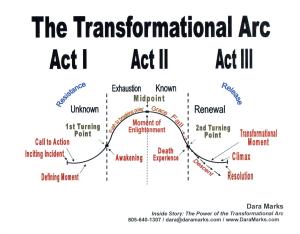
Transformational Arc

She explains, as writers, we are constantly trying to understand the narrative in which we are living, but we experience that narrative from a very personal perspective. Thus, in her canonical transformational arc, there is both an outer realm, where external forces act upon the hero, and an inner realm, the more personal influences. We grow, she says, only in relationship to demands on us to grow, and the external realm stimulates the internal reckoning.

The union of the feminine and masculine brings about wholeness in the character. It is a combination of the masculine spirit, which represents all that we can be, and the feminine soul, the deepness of our authentic self. Marks offers the example of a tree, which may reach toward the sky, but is only as strong as the root system that provides it nutrients.

Everything we are in life is what comes from deep within ourselves.

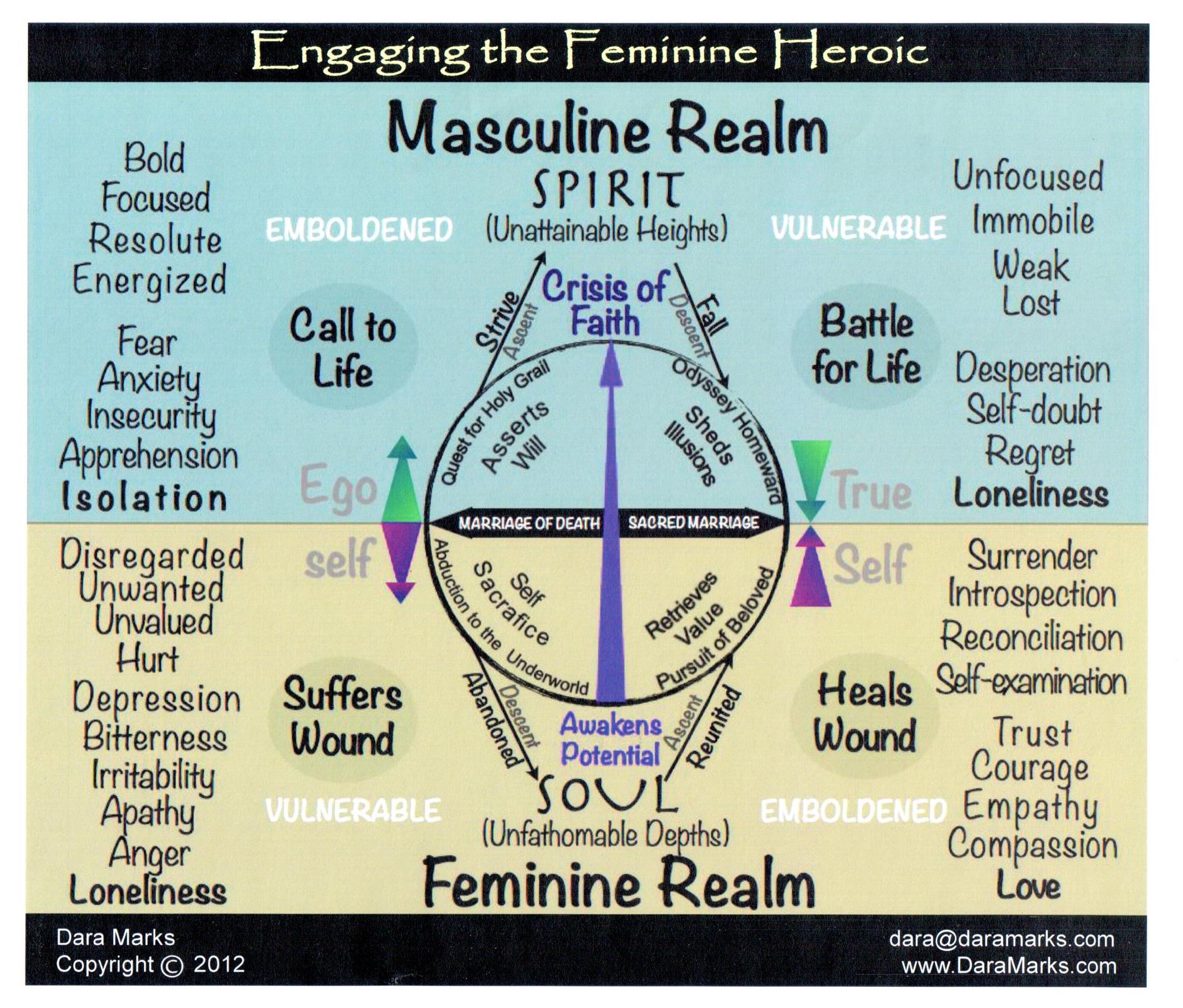
Marks presented this relatively complicated diagram that illustrated the hero’s external and internal journey (and in many ways, reflects our own journey through counseling or life itself). To the left, we find the Ego Self, where the onus is on my aspirations and beliefs of me. To the right is the True Self, which is understood after reflection and denotes my understanding of myself in the universe.
The union of the masculine and feminine sides of a character creates a wholeness

The union of the masculine and feminine sides of a character creates a wholeness

Ego Self: All early development, even that of a child, relies very heavily on the development of the Ego, a sense of will and determination. We believe that we’re in charge, despite all evidence to the contrary.

So if we start the journey in the Ego Self realm, we can look at the External or Masculine side and the Internal or Feminine side of ourselves.

Masculine Ego: In the top left quadrant, we have the Call to Life, the external mission that demands we strive or ascend to a greater level. We assert the force of our will on the universe. This area therefore is associated with a youthful and energetic quality. We have to move forward. We cannot let fear hold us back. To do this, we must sacrifice our feminine side, pushing those feelings down, or we cannot move forward.

Marks suggests that the tragedy of Hamlet was that he couldn’t get beyond his feminine side when he needed to move forward. She also gives the very literal example of Agamemnon, who was forced to sacrifice his daughter Iphigenia before the Greek ships would be allowed to voyage to Troy.

Feminine Ego: In the lower left quadrant of the diagram, we see the influence the masculine decision has on the feminine ego. We suffer a wound because part of us is no longer valued. We are literally abandoning a key part of our self and this will have a lingering effect. While we appear invincible externally, we are very vulnerable internally.

Thus, the feminine side needs to be rescued by the proverbial knight on a white charger. Marks is quick to point out that this is no time for political correctness as at this stage in our development, we just don’t have the internal skills to rescue ourselves.

She goes back to Greek myth to show how this works, focusing on the story of Demeter and her daughter Persephone, the latter of whom was abducted to the underworld by Hades to become his wife. Demeter was distraught at the loss of her daughter and journeyed to the underworld to bring her back to the surface.

The underworld experience may be difficult, but it is educational and we need to journey through it to come out more whole in the next stage.

Marriage of Death: The combination of the masculine and feminine ego is what Marks calls the Marriage of Death. Anytime we strive to become something new, it means the death to other aspects of our being. We just can’t strive at all things at the same time. But this marriage is not designed to last.

As Marks points out, the problem with striving is that it is doomed to failure. We can’t be rich enough, strong enough, famous enough, whatever enough. And it is at the moment of realization that our dreams are doomed that we have a Crisis of Faith (masculine side), which leads to an Awakening of Potential (feminine side). We move closer to the discovery of our true self, the right hand side of the diagram.

Masculine True Self: As the masculine ego passes through its crisis of faith, it suffers a fall from the unattainable heights, which converts the Call to Life into a Battle for Life. For self-renewal, it is essential that our delusions and illusions are shed during this descent, such as the belief that we are in control of our lives. And thus, at this stage, it is the masculine self that needs rescuing.

Marks offers the example of Odysseus (a popular subject at TSC this year) and the knowledge that his journey home was his great undoing as he loses more and more of his ego self (including his ships, crew, etc). The second half of his journey is literally the journey homeward toward his true self.

Feminine True Self: And who rescues the masculine true self? As the masculine side becomes more vulnerable, the feminine side becomes emboldened. We heal our wounds and reunite, turning pain and suffering into love and creativity.

The way out of our self-imposed purgatory is through compassion. We have to hear the story and then feel and acknowledge the pain. And it is only when the pain is given voice that it can move back from the underworld into life.

Marks exemplifies this aspect with the myth of Inanna and Erishkegal (which I do not know as well and so simply provide a link).

Sacred Marriage/True Self: It is at this point, through the sacred marriage of the masculine and feminine that we finally achieve the true self.

NOTE: All images and illustrations are property and copyright of Dara Marks and are used here without permission.

Know when it’s over

Writing a screenplay or novel is a lot like being in a long-term relationship as you largely go through the same steps.

At first, you’re unfailingly passionate about your partner, flush with love for an incredible idea. You dive into her with a zeal you have never felt before and are certain you will never experience again. You embrace every inch of her, her very essence and when finally forced to surface, you just want to show everyone how happy you are.

As time goes on, however, the initial zeal diminishes, if not in scale, at least in monomaniacal focus. You become more comfortable with her. You spend more time contemplating her rather than just diving in. You are caring, loving, nurturing. And even if not everything proceeds as smoothly as it once did, those are just the little maturities that slip into life.

Eventually, you grow into each other. There is love, there is care, but it’s mellower, more set in its ways. She isn’t as all-consuming as she once was, but you’re both okay with that. You might spend time with other couples, sharing common bonds and then making fun of them on your way home. Life is good, it’s right, it’s comfortable.

Now, if you’re fortunate, this goes on for the rest of your time together. You mature with each other. You fulfill her needs until that fateful day when she passes on to the other side. You’re wistful, but satisfied that you had a good life together.

Not every couple is so fortunate, however.

Sometimes little inconsistencies or minor difficulties can inflate in importance. What was once just a tiny tic, becomes this really aggravating feature that just drives you up the wall. Oh, you try to work through it. You try to convince yourself it’s nothing, that you’re just being paranoid, but after a certain point, she just seems to do it all the time and damn it, on purpose.

You soon find yourself coming up with excuses to go out for a little bit to clear your head, but the moment you leave the house, you find your mind wandering off to sexier screenplay ideas. You’re fantasizing and you can’t help it. And damned if, the minute you walk back into the house, there she is, staring right at you like she can read your mind.

“What do you expect?” you scream. “You knew I was an artist when we started.” And she just lay there, letting you stew in your self-incriminating guilt. It’s the silence, the inertness that just gets under your skin.

If you’re lucky enough to calm down, you may decide that you just need a little time apart. Both of you. A little time to remember why you came together in the first place. A month, six months, a year later, maybe those petty little problems won’t be so big. Hell, you might even have found a way around them. But right now, you just need some space.

Time goes by and maybe you do get back together to solve your differences. But maybe you don’t. It’s tough, but you realize it’s over. It’s time to move on.

It’s okay. You’ll live. You can’t beat yourself up over it. You tried and it just didn’t work out.

You may not think it right now, but there’ll be others. You’ll try again and maybe that one will work out differently.

You didn’t fail. You’re not a bad person. It just wasn’t meant to be.

You have to know when it’s over…but nothing says you have to know any sooner than is absolutely necessary.


PS If screenplays and novels are long-term relationships, I guess that makes sketch comedy a quickie in the alley. No wonder they’re so much fun, but rarely fulfilling.

Doubt

I have doubt.

Not in my skills, thank goodness, or the belief that with the right guidance, I can improve them steadily, but I have doubt.

I have doubt that I will find the right people to see the merits of those skills and help me to convert them into something meaningful. A video, a television program, a film, a novel, a photo exhibit. Something that I can share with all the world. Something that will touch the souls of others as the gestation and creation of the work has touched mine.

I have doubt that I can hold on to my new fantasy life and that reality, oh harsh reality, won’t poke its head into the mix and throw me back to where I was. That I will need to find resources to live, and that the need will draw me away from my art. Perhaps irreparably tearing me from it and setting me back upon the course I once journeyed of discontent and pain.

I have doubt that I won’t continue to find supporters and friends—my oh so wonderful friends—who will hold my hand on this journey. Who will provide a tether to keep me connected and yet free enough not to anchor me to the world.

I have doubt about what is around the next corner. About the shadows in the darkness. About the approaching ground in my free fall through life.

I have doubt.

But I will not let that change what I am doing. I cannot allow my doubt to prevent me from living the life I have finally discovered.

If around the corner is an oncoming train, in the shadows lay a vicious monster, and on the approaching ground shards of glass, I will not allow doubt to slow or still me.

I may not succeed in achieving my goals, but in overcoming my doubt, I will have succeeded in my journey. And for that, I will be eternally grateful and find peace.

Glen Mazzara at Toronto Screenwriting Conference 2013

The Odyssey of Writing

Image

In his opening presentation to the TSC, Mazzara recounted the story of The Odyssey and used it as a metaphor for his own journey as a writer, comparing the setbacks and challenges experienced by Odysseus to his own.

As Mazzara explains, the story of Odysseus’s return home after the Trojan War is a story of changing winds. Such is the case with writers. When we decide to become writers, we have a lot of anxiety blowing in our heads. They can drive you insane. And bad news; those winds don’t go away, no matter how successful you become as a writer.

That anxiety permeates every scene you write. And once you start working with others, those people add to the confusion in your head.

Writers constantly look for validation, he says, they look for love. In this way, actors and writers have much in common as both groups are looking to receive love and adoration. The big difference is that writers know they’ll never get it, whereas actors maintain the delusion.

The chaos in writers’ heads also sets them at odds with the rest of the film and television industry, which is designed to run under more control. Thus a snarky relationship develops, with people in the industry constantly putting down or belittling writers and diminishing their works. The example he cites is the discussion of whether Shakespeare wrote his plays or it was a British lord with absolutely no record of having written a single literary word.

Mazzara says you simply have to get into a space where you are purely working on the work for the sake of the work. You have to learn to live with the anxiety.


He then looked at the concept of hubris and ego. In recounting the story of Odysseus blinding the Cyclops, he noted that as long as Odysseus remained “Nobody”, he was safe and managed to escape the island. It wasn’t until he stood on the prow of his escaping ship and proclaimed that it was Odysseus who blinded the Cyclops that things really went to hell.

When we write, Mazzara says, we have to remove our ego. We are only the steward of the story. The story wants to be told and we are merely the instrument by which this happens. And when working in groups, we have to be generous with each other and avoid taking credit.

He suggests that there is a tendency to try to manage our anxiety by taking the credit for work we have done or to which we have contributed, but we have to avoid this at all costs.


Mazzara then gets to the part of The Odyssey where Odysseus reaches Ithaca but finds his home invaded by suitors for his wife. Disguised as a beggar, he sets up a challenge that whomever can string Odysseus’s bow and fire an arrow through a series of axe heads will win the hand of Penelope. After all others have failed, the ridiculed beggar is given the opportunity and despite not being known for his strength, Odysseus strings the bow, makes the shot and then slaughters his disrespectful competitors.

All this to say that writing is about sticking to your strengths and doing it your own way. Mazzara showed loose sheets of foolscap on which he hand wrote his presentation because that’s the way he writes, by hand, on paper. When he tries to write on the computer, he finds himself editing his material and reworking lines as he writes them. On paper though, he can let the writing flow and works his way through the material in his head. However it works for you, he says, be sure you stay in the moment, stay in the story.

We all feel anxiety about conforming to how others do things. He is adamant that we have to fight this urge. As he describes it, it was a lonely journey for him to see that his method of writing works despite being antithetical to the way Hollywood works. Writing, he says, needs to be effortless.

As far as writing as part of a group in a writers’ room, he makes the comparison to a musical group heading into a recording studio, where everyone makes a contribution to the final product. Change one of the players or eliminate one component and the final product is different.


And finally, he says, there is a moment when you get your shit together and you know you can make it work. That is the moment you’ve come home.


In the Q&A, when asked about the bloody slaughter and carnage phase of The Odyssey, Mazzara said that was the editing phase of screenwriting, when the sheets are covered with red ink and look like they’ve been dipped in blood. In fact, he said, to lighten the blow on other writers, he refuses to use a red pen.

Toronto Screenwriting Conference – Day Two Highlights

Personal highlights or take-aways from Day Two of the Toronto Screenwriting Conference:

tsc-logo

Darlene Hunt – Masterclass (creator, showrunner for Showtime’s The Big C)

Take your time responding to questions: When someone is asking you about a specific line or scene, whether in meeting on or set, give yourself time to think about it, because you may not remember exactly why you wrote that scene that way. At the same time, even if you can explain why you went that way, make sure you remain open to new interpretations or new ideas that may work better.

Bob Kushell—Anatomy of a Pilot (creator of BBC series Way to Go)

Pilots suck: All pilots suck to one extent or another and he explains why using the analogy of an approaching tornado. You’re living your life when suddenly you hear that a tornado is coming. Quickly, you run into the storm shelter with several other people and try to prepare for the coming storm. At the same time, as each of you goes about your tasks, you remind one of the people about that time she ran over your cat, which is why you don’t like her. But hey, you love the fact that another individual’s here despite those awkward feelings after that drunken fling at the cottage. Oh, but you still need to prepare for the coming tornado.

Within an ever-shortening time span (now around 21 minutes), you need to fill in useless backstory that everyone in the show should know (it’s their backstory) and still manage to tell a coherent plot that somehow illustrates the show’s premise.

Penny Penniston—Not Just Talk: How Writers Think About Dialogue (professor at Northwestern University)

Dialogue is not conversation: If words were keys on a piano keyboard, then the difference between conversation and dialogue is the difference between noise and music. Dialogue is precise and crafted, gives voice and describes themes. It gives clear direction to the artists interpreting it and a chance for them to show off. And like learning to play music, learning to craft dialogue takes practice to develop muscle memory, but at the same time, understanding the theory behind dialogue will allow you to step back from your work and find the good and bad things about it.

Aaron Korsh – Masterclass (creator and showrunner of USA Network’s Suits)

Understand your scene’s goal: Reading a scene out loud can be very helpful when it comes to determining if it’s working, as some scenes may read well, but something goes wrong when it becomes audible. And if the scene isn’t working, it’s often because you haven’t really established what the scene’s dynamic or purpose is.

Hero of a Thousand Voices

I hear dead people.

I also hear living people, imaginary people and people who aren’t even people.

I am a writer, and I am highly confused.

Since quitting my day job to commit full-time to writing, I have found the voices that run rampant through my head have amplified, in volume and seemingly in number.

Before I quit, the anxieties and activities of daily living dampened the voices, shoved them to the periphery, surely as a functioning if not coping mechanism.

Now, without those distractions, the voices push outward, stretching their muscles after years of confinement, exploring their new world with the glee of a four-year-old on a steady diet of Coco Puffs. And here I sit, trying to control or harness them, sticking my pinky in a fire hose opened to maximum flood.

I have so many stories to tell, to record, to witness. But as soon as I sit down to transcribe one, a dozen others poke their heads out of the ground; conceptual prairie dogs wondering if the coast is clear.

I’ve always believed that creativity breeds creativity. I am experiencing that in spades, these days.

I will admit that after so many years of holding it back, part of me wants to let the voices flow unchecked. I want to stand at the foot of the waterfall and let the deluge wash over me, cleansing the grime of repressed enthusiasm from my soul.

But at some point, in some way, I still have to function in this universe. I want to recount these stories to someone, and for them to be intelligible, I have to direct my journey through the eddies that buffet me.

I hear voices. And I struggle with how to deal with them all.

At times, the onslaught of voices is one more wave than I can handle. (Photo taken at Carilla Beach, Costa Rica)

At times, the onslaught of voices is one more wave than I can handle. (Photo taken at Carilla Beach, Costa Rica)