Consciously unconscious

When a writer is on her game, when she has found a creative groove, she writes at two levels.

At the conscious level, she weaves the stories of her various characters and environments into a literary carpet of amazing delicacy. She understands the work won’t be flawless when she’s done, but she knows and is comfortable in the belief that she can surgically pull the extraneous threads later.

This is a beautiful thing. But an even more dazzling spectacle is happening at the unconscious level.

This is the level at which the writer’s subconscious creates delicate near-invisible tendrils of connections between characters and themselves, their surroundings and other characters. It is at this level that amazing nuance and metaphor is added to a story. Without the harsh distractions of planning and plotting (both very important, mind you), the subconscious is free to perform magic that we may not recognize or appreciate until much later in the creative process.

One way you witness this is when you realize that conscious concerns you had before sitting down to write have been miraculously addressed, as though story-writing elves snuck onto our computers overnight.

Interestingly, this is one reason why it’s important to have other people read your stuff. They will see things you cannot. In some cases, it is because of what they bring to the table—their personal biases and experiences. But more importantly, it is because they aren’t encumbered by your blinders.

Other readers see your work more clearly because they are untainted with what comes before and after, whether on the page or in your head.

I witnessed and shared this personally in two reading group sessions where my fellow writers created incredible metaphors that deeply informed their lead characters. Yet, when pressed directly as to whether they were conscious of those decisions, both were the most shocked people in the room.

Both demurred that the incidences were quite accidental, but whereas I might agree that they were unintentional, I don’t believe they were in any way accidental.

We make choices for a reason (or several) even when we don’t know what those reasons are. The truth is our truth no matter how ignorant we may remain to what that truth is. We cannot help but splay that truth across our pages.

To some extent, I think creative harmony lay in not caring what those reasons are. For if we try to dissect them, I fear we run the risk of killing them. It is enough, I think, to let our subconscious guide us while we work consciously.

Let the magic within you happen. Your work will be the better for it.

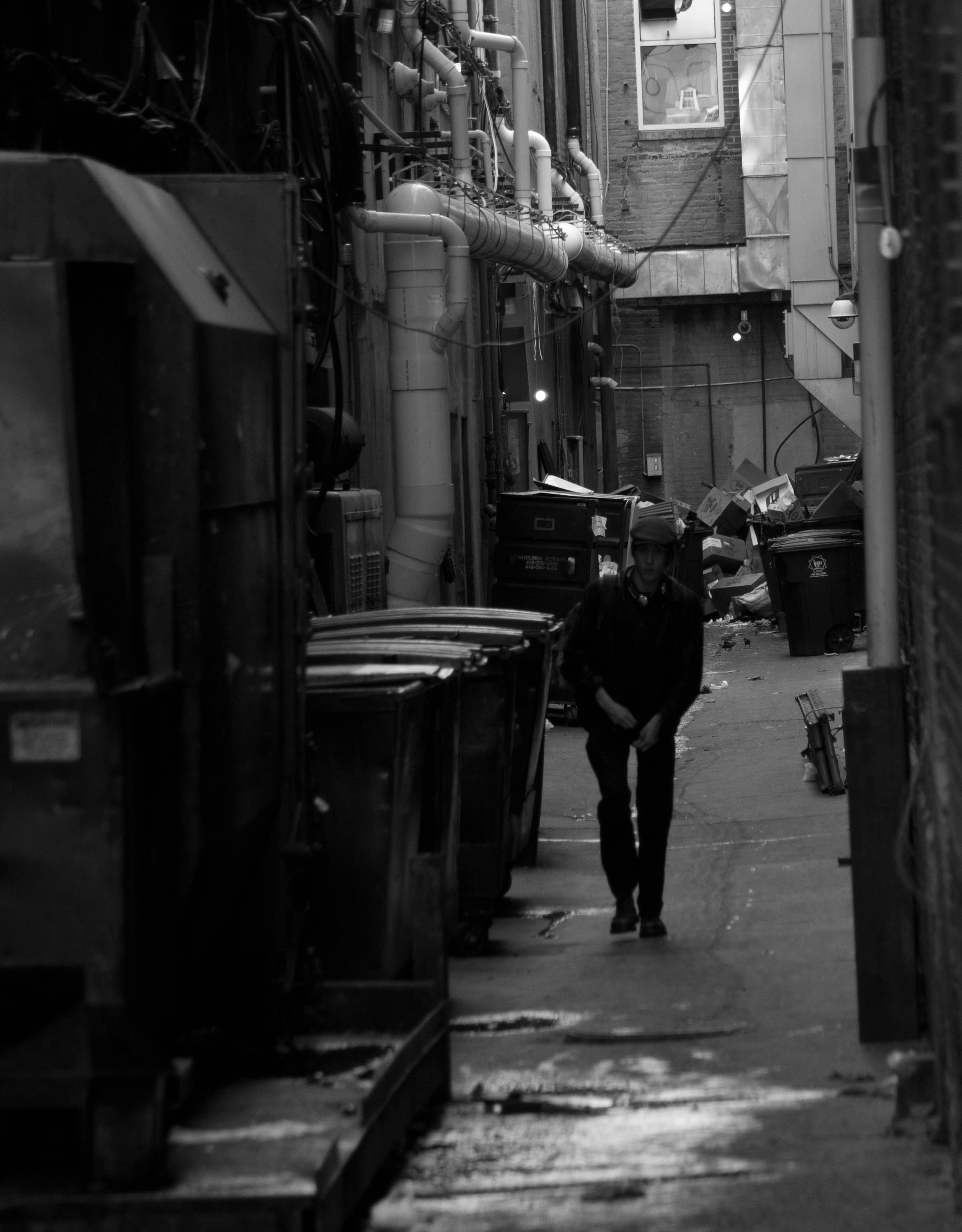
I never intended to take a photo of someone urinating in a Washington, DC alley way, but am tickled I did...especially as he realizes he's been caught

I never intended to take a photo of someone urinating in a Washington, DC alley way, but am tickled I did… especially as he realizes he’s been caught

Two’s company, three’s a story

As I read through a lot of early-stage screenplays and stage plays (including my own), I have noticed an interesting trend: Any scene that only involves two characters is boring.

No matter what the posturing, no matter how violent or loving, no matter whom the characters are, a scene with only two characters quickly loses steam for me. The dynamic peters out, and I find a lot of writers try to overcompensate for that by simply making the characters’ gestures larger. As though they believe talking louder to someone who does not speak your language will make you any more intelligible.

I speak for the trios: Turns out there may be some behavioural psychology behind this…at least, if you’re a rock hyrax—no, no, not “Lorax”.

Last week, a research paper was published in the journal Animal Behaviour that looked at the dynamics of triad relationships between these small creatures living in the hills of Israel, and the results were fascinating.

In a dyad relationship (two individuals), the authors say, you cannot make any predictions about the future other than friends will likely remain friends and enemies will likely remain enemies. With a triad (3 individuals), however, a social power dynamic is established that can morph in any number of directions, although some directions are inherently more likely and more stable than others.

The researchers found plenty of examples of the standby relationships, such as the friend of my enemy is my enemy (+ – -) or the friend of my friend is my friend (+ + +), and found that these relationships were highly stable in that they were likely to remain unchanged from year to year for any set of three individuals.

Enemy mine: What was fascinating, however, was that the seemingly unstable and counter-intuitive state of the enemy of my enemy is my enemy (- – -) occurred a lot more often than expected by chance and that it could be quite stable from year to year. This completely flies in the face of the standard that the enemy of my enemy is my friend (- – +).

From a story perspective, however, it can make complete sense. What if all 3 of you are vying for the same objective? As one of the enemies, you have to be constantly wary that any effort to thwart one enemy will provide an advantage to the other enemy.

Friend of a friend: What was also interesting was how gender played a role in the evolution of the unstable triad the friend of my friend is my enemy (+ + -). In females, this triad tended to morph toward (+ + +), while in males, it tended toward (+ – -), suggesting the need for female cooperation in raising young and male competitiveness in breeding. Typical men, eh?

From a story perspective, though, consider the power of (+ + -). What if the friend of your friend pushed them to do something contrary to your desires? This would make them your enemy—whether you’re being altruistic or selfish. A much more interesting dynamic as you may inadvertently push your friend into making a choice between the two opposing forces.

Dynamite dynamics: Regardless of the way your scenes play out, the triad dynamic gives you so much more room to play with emotionally and socially than a dyad. At any given moment, one of the trio can switch poles and the dynamic changes. With a dyad, the sudden switching of poles better have a good rationale in your story or it won’t be believable. That brings me to my next point.

Two characters: Now, before you go out and scrub all your two-person scenes from your screenplays, novels and stage plays (because yes, my hubris states I am that influential), let me remind you I said two characters, not two people.

Environment, situation and unseen third parties can also be characters in a scene between two individuals. It is those subtextual elements that convert a vomitously dull scene into one that sizzles. The challenge is in making sure the reader/viewer knows it’s there through carefully selected word choice and narrative (NOT exposition).

Two friends meet, but one hides a secret from a previous conversation that muddies their exchange in ways unexpected by the ill-informed (- + – or + + -) (e.g., plot to every spy movie ever made).

Two men with diametrically opposed viewpoints have to set aside their differences to deal with an external threat (- – -) (e.g., Hooper’s shark to his Quint is his enemy), which turns into (- + -)).

So, when you find yourself creating a scene with only two people, ask yourself who or what is influencing this scene aside from the two people and remember to incorporate them or it into the dialogue and narrative.

As Jed Barlett said to Sam Seaborn while playing chess in a scene from West Wing, “Look at the whole board.”

Didn't want to play your silly games, anyways

Didn’t want to play your silly games, anyways

(Re)Learning to Swim – Art vs Technique

I love to swim. It is one of my favourite activities and one of the only forms of exercise I don’t begrudge, perhaps because I can’t tell if I’m perspiring. I am by no means athletic or proficient with it, but I enjoy doing it and have decent stamina.

Several years ago, a friend of mine decided she wanted to learn to swim. As an adult, however, she was embarrassed that she didn’t already know how, so she asked if I could help her learn the basics. Being a good friend—and not just a little bit infatuated with her—I said sure, happy to help.

A few days later, we got to the pool and I tried to break things down for her. Unfortunately, unlike many other exercises, with swimming you are in water and therefore much of the mechanics are difficult to view directly. Thus, I had to show her the mechanics above water, as though swimming to the ceiling. And that’s when everything started to fall apart.

No sooner did I begin teasing out the various movements in swimming than I realized that I was rapidly losing the ability to swim. Eventually, I just had to thrash about for a bit to remind myself how to do it.

It was unnerving.

I had been swimming (swum? swam?) for so many years that it was just something I did. It was never something I analyzed. You get in the water. You swim. It was muscle memory.

In teaching my friend to swim, I had separated the technique from the art, and for a brief few minutes, lost the art in the process.

The same can happen with writing.

In the earliest phases of our development as writers, it is important to develop a basic understanding of the mechanics of writing and story, to have someone walk us through the process. But at some point, we have to step forward and simply practice our art.

If writing is purely a mechanical exercise, then it is very dry and boring. It lacks the spirit that it needs to live. It is the difference between an animatronic deer and a biological deer. They may look very similar, but one is alive and the other is inert.

As a more seasoned writer, I have found that there will be times where I try to focus on the more mechanical, structural aspects of the stories I am writing. I want to make sure all the right elements are in the right place. But when I read the material over later, it always sounds forced, wooden, bereft of life.

In my effort to teach someone how to write properly—in this case, teach me—I have, however briefly, lost the ability to write. I have sacrificed the art for the technique.

Technique and process are vital, but they are not art. Art comes as you build the spiritual, intellectual, psychological muscle memory to allow yourself to immerse yourself unthinking into your writing and simply allow the story to flow.

As I’ve said before, story before structure. Art over technique.

Do fish ever think about swimming? And if so, do they then sink to the bottom? (Manuel Antonio, Costa Rica)

Do fish ever think about swimming? And if so, do they then sink to the bottom? (Manuel Antonio, Costa Rica)

10 Steps to Writing a Pilot That Sells

No, no! Not that kind of pilot. Although, cute photo. (Image used without permission)

No, no! Not that kind of pilot. Although, cute photo. (Image used without permission)

1) Watch a lot of television; especially stuff you don’t like or think is bad. This will establish the belief within you that you could write something at least that bad and still get it on the air.

2) Conceptualize a show that combines one of your siblings or cousins, the second job you ever had, and a famous moment in history. Every idea after this will sound entirely plausible; and hell, this might actually work as a sitcom.

3) Conceptualize an idea that is morally offensive to you and then see if it was one of the shows in Step 1. If not, then the market is ripe for the picking.

4) Describe the absolute worst day of your life, a day when everything went wrong. Then switch one of the disastrous elements. Then, switch another element. Do this 10 more times. Season One!

If you can’t create 13 variants, your day wasn’t that bad and your life is too good for you to be writing for television. Go write greeting cards.

5) Grab a copy of Bulfinch’s Mythology and reset all of the stories in modern-day Seattle or the smallest town you’ve ever visited. Warning: Brace for complaints that it’s a rehash of Dallas or Friday Night Lights.

6) Grab a copy of Bulfinch’s Mythology and do not reset the stories. Hell, if it worked for The Borgias and The Tudors, it might work here. Call it The Olympians.

7) Start with Episode Two, because pilots suck and you’ll never want to show it to anyone. You need to know/believe your idea works.

8) No matter what your current idea is, when you go to pitch it and you think you’re losing your audience, suddenly reveal “And the protagonist is a ghost!” Vampire, werewolf and zombie are equally acceptable.

9) Stop reading advice on writing a successful pilot and just write your story, already. There is no telling why someone in a suit will get excited by your story, but I can guarantee they won’t if you’re not.

10) If all else fails, generate a top-ten list of ways to write a pilot that will sell and use it as the basis of a book you will later turn into a sitcom.

Covering your ass-ets

So often, when I start a new series of classes or attend a conference on screenwriting, I hear the same refrain: How can I register my stuff so no one steals my ideas?

And, as logic would dictate, the question always comes from the most junior writers in the room, if they have yet to write at all.

There is no denying that the universe is a dangerous place. Global climate change necessitates we choose higher floors in a high-rise to ensure our laptops are not flooded by rising sea levels. I always write with my back to the wall so that people in the condos across the street can’t take telephoto shots of what I’m writing. And whenever I publicly speak the word “tadpole”, I actually mean screenplay…likewise, “garlic”, “symbiont” and “purse” for protagonist, antagonist and onomatopoeia. (Don’t bother memorizing those; I have already changed them.)

All in an effort to make sure that no one steals my ideas. They are mine. I created them. They are owned by me. (Much as with Miss Ann Elk’s theory about the brontosaurus.)

Ah, but wait a tic. Just a mo’. Hold your horses and tell them that you love them.

I forgot one teensy little thing.  A bit of a fly in the old ointment. You see: YOU CAN’T PROTECT IDEAS!

1) I defy you to actually show me a completely new idea, and not just something old that you’ve redecorated.

2) The idea is not the important bit…it’s what you do with the idea. Give 12 people the same idea and you will end up with 12 very different stories.

3) There is every reason to believe that your idea is shit. No offense intended. Most of my ideas are shit. That’s how you find the truly brilliant ones, by moving the shit out of the way so the good ones are more visible. (See also: Miss Ann Elk’s theory about the brontosaurus.)

I applaud you for having ideas, shit or otherwise, because it’s not easy to do and is a valuable first step in your art. But not until you’ve completed your story, however, do you have something to protect.

You have completed your story, haven’t you? If your idea was solid, then you should be anxious to tell the story. If your idea is good, I want to hear your story. Seriously. No kidding. We need more good stories.

The story—not the idea—is where you will shine as an artist. The story tells me everything about you. It puts multiple facets of your personality and belief system on display and says: Hey universe! Here I am!

That, my friends, is worth protecting. That is what you register somewhere so that no one can tell exactly your story without your permission.

Once you’ve reached that point, I then recommend:

Writers’ Guild of America – West (web site is easier to use than the East chapter)

Writers Guild of Canada

The organizations have a reciprocal agreement, so registry with one is sufficient for both the United States and Canada.

Unfortunately, I only know of these two organizations, so if anyone wants to contribute others in Europe, Asia or anywhere else, please do.

Yes, you want to protect your assets, but you’ll be a lot better off putting your energies into creating assets that are worth protecting.

Fort Knox isn’t meant to be a kitty litter box.

A strange jobs program in British Columbia. (Whistler)

A strange jobs program in British Columbia. (Whistler)

Write…as rain

I write.

I write because I love playing with words.

I write because my head will explode if I don’t.

I write to explore ideas.

I write because I’m interested in a lot of stuff.

I write because I’m a narcissist.

I write because the stories flow through me.

I write because I’m funny (some of the time).

I write because I have thoughts worth expressing.

I write because the blank page beckons.

I write to release my pain.

I write to share my joy.

I write to add beauty to the world.

I write to keep moving.

I write to share the magnificent visions I see.

I write to exorcise and exercise the voices.

I write to play.

I write because I am a writer.


Why do you?

Penny Penniston at Toronto Screenwriting Conference 2013

Not Just Talk: How Writers Think About Dialogue

Image

Many people come to screenwriting because they have a good instinct for dialogue, but it is important to look beyond the instinct and understand the theory behind dialogue. If nothing else, this understanding is useful in helping the writer communicate with other artists so that you can articulate why you wrote a specific line a certain way, rather than simply standing there scratching your head saying “I dunno”.

Dialogue vs. conversation: Most people think writing dialogue is easy, Penniston says, because they are under the delusion that dialogue and conversation are the same thing. They are not. In comparing words to the keys of a piano, she loudly showed that conversation is noisy and discordant, while dialogue is musical, it is precise and crafted, it presents voices and themes.

Dialogue gives clear direction to the artist interpreting it, but it also gives the artist a chance to interpret the words in his or her own way, to show off his or her talents.

Like music, you have to develop something of a muscle memory for dialogue through repetition; however, understanding the theory behind dialogue will allow you to step back and analyze your writing with a certain distance.

Using visual cues, Penniston suggested that your story is much like an aerial shot of the Grand Canyon, with long, sweeping turns and deeper and shallower canyons. Dialogue, however, is more like someone kayaking through white water, experiencing the eddies and whorls of the currents and avoiding the rocks where possible.

Forces: Characters, she says, are very lazy. If left to their own devices, they won’t do anything. We need to get them to move and we do that by applying a force on them, which in physics has both a direction and magnitude. You can use physical forces, evolutionary forces (e.g., against death or for sex), cultural or societal forces (e.g., need to conform), or psychological forces (e.g., need for love or respect).

And these forces should be defined in very specific ways, again offering a sense of direction and magnitude. The strongest of all the forces on a character will drive your scene, but she stresses, the other forces are still important. This landscape of forces, she says, is the character’s situation in a scene.

Text and subtext: You want to be sure you put your characters in interesting situations with a network of multiple forces pushing and pulling your characters in different directions. You should always feel that your dialogue is adjusting and moving as these forces shift in strength and direction. A good line of dialogue, she says, manifests the sum of all of the forces acting on the character at a particular moment (e.g., personal baggage, setting, other characters).

In text, only one force acts on your character. In subtext, however, more than one thing is happening at one time. Subtext, she warns, is not the result of something being left unsaid but rather that so many things are trying to be said, but aren’t. It can manifest itself as an odd word choice given the superficial context or self-interruption and rephrasing.

When the forces converge and cancel each other out, she suggests, the character remains silent, unable to communicate anything. The character will look static, but he or she is not. It is a moment of paralysis (in physics, potential energy). And the line after a lengthy silence can be very interesting, she argues, because it is the first sign of which of the forces won. At the same time, she warns that we should look for lengthy pauses within our screenplays that do nothing for the scene or the drama. Those pauses aren’t based on reactions to forces.

Story beats: For Penniston, a story beat transitions when the balance of forces in a scene shifts, and for as a writer, you want to be very clear about the point at which this shift occurs. You should be able to point to the specific line in a scene.

Memorable lines, she says, come when the tension of a beat breaks. She harkens back to the Rule of Threes, suggesting the scene beat should occur in three steps: establish the tension, heighten the tension, and break the tension.

And wonderfully, she suggests, with change, you get an opportunity for surprise, such as the punchline of a joke. These lines can’t come out of left field, however. They must fit the context of the scene, but they can still be unexpected.

Writer Tricks: Create interesting situations in which your scene plays out. Pick a discordant place, person or circumstance. And avoid beat repetition. A specific combination of forces should never occur twice or you’ve just gone back to a previous beat and eliminated the reasons for everything that occurred between them.

Find interesting things within your situation. Add and/or explore details within your scene. Assign random elements and figure out how to make those elements work within your scene. Get insights from others and look for opportune moments to create truly memorable lines that encapsulate your character or the situation.

Tell your story as clearly but as efficiently as possible to avoid distractions. Only add narrative if it is revelatory or adds something new, and don’t direct. Although, she says, if you’re writing for studio readers, you may want to err on the side of too much narrative to make sure your story gets across.

(Aside from being a professor at Northwestern University, Penniston is also a playwright and author of the book: Talk the Talk: A Dialogue Workshop for Scriptwriters)

Dara Marks at Toronto Screenwriting Conference 2013

Engaging the Feminine Heroic

Dara Marks

In a follow-up to her very popular Transformational Arc talk of previous years, Dara Marks took us through another aspect of character development, something she calls the feminine heroic. A counterpart to the well known hero’s journey, the feminine heroic completes the hero’s character and thus is not necessarily tied simply to female heroes. Rather, it encapsulates the feminine side of everyone’s natures.
Transformational Arc

She explains, as writers, we are constantly trying to understand the narrative in which we are living, but we experience that narrative from a very personal perspective. Thus, in her canonical transformational arc, there is both an outer realm, where external forces act upon the hero, and an inner realm, the more personal influences. We grow, she says, only in relationship to demands on us to grow, and the external realm stimulates the internal reckoning.

The union of the feminine and masculine brings about wholeness in the character. It is a combination of the masculine spirit, which represents all that we can be, and the feminine soul, the deepness of our authentic self. Marks offers the example of a tree, which may reach toward the sky, but is only as strong as the root system that provides it nutrients.

Everything we are in life is what comes from deep within ourselves.

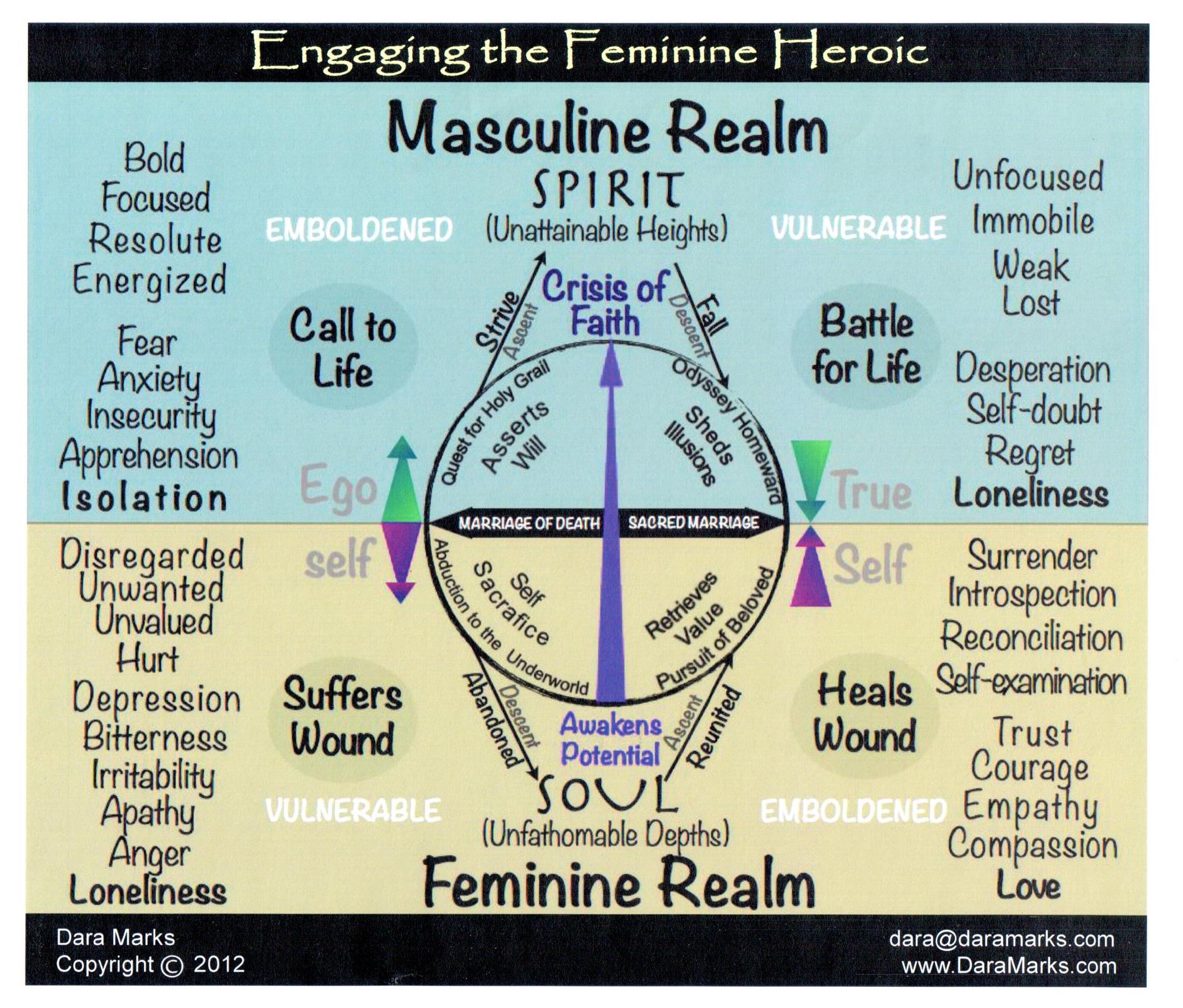
Marks presented this relatively complicated diagram that illustrated the hero’s external and internal journey (and in many ways, reflects our own journey through counseling or life itself). To the left, we find the Ego Self, where the onus is on my aspirations and beliefs of me. To the right is the True Self, which is understood after reflection and denotes my understanding of myself in the universe.
The union of the masculine and feminine sides of a character creates a wholeness

The union of the masculine and feminine sides of a character creates a wholeness

Ego Self: All early development, even that of a child, relies very heavily on the development of the Ego, a sense of will and determination. We believe that we’re in charge, despite all evidence to the contrary.

So if we start the journey in the Ego Self realm, we can look at the External or Masculine side and the Internal or Feminine side of ourselves.

Masculine Ego: In the top left quadrant, we have the Call to Life, the external mission that demands we strive or ascend to a greater level. We assert the force of our will on the universe. This area therefore is associated with a youthful and energetic quality. We have to move forward. We cannot let fear hold us back. To do this, we must sacrifice our feminine side, pushing those feelings down, or we cannot move forward.

Marks suggests that the tragedy of Hamlet was that he couldn’t get beyond his feminine side when he needed to move forward. She also gives the very literal example of Agamemnon, who was forced to sacrifice his daughter Iphigenia before the Greek ships would be allowed to voyage to Troy.

Feminine Ego: In the lower left quadrant of the diagram, we see the influence the masculine decision has on the feminine ego. We suffer a wound because part of us is no longer valued. We are literally abandoning a key part of our self and this will have a lingering effect. While we appear invincible externally, we are very vulnerable internally.

Thus, the feminine side needs to be rescued by the proverbial knight on a white charger. Marks is quick to point out that this is no time for political correctness as at this stage in our development, we just don’t have the internal skills to rescue ourselves.

She goes back to Greek myth to show how this works, focusing on the story of Demeter and her daughter Persephone, the latter of whom was abducted to the underworld by Hades to become his wife. Demeter was distraught at the loss of her daughter and journeyed to the underworld to bring her back to the surface.

The underworld experience may be difficult, but it is educational and we need to journey through it to come out more whole in the next stage.

Marriage of Death: The combination of the masculine and feminine ego is what Marks calls the Marriage of Death. Anytime we strive to become something new, it means the death to other aspects of our being. We just can’t strive at all things at the same time. But this marriage is not designed to last.

As Marks points out, the problem with striving is that it is doomed to failure. We can’t be rich enough, strong enough, famous enough, whatever enough. And it is at the moment of realization that our dreams are doomed that we have a Crisis of Faith (masculine side), which leads to an Awakening of Potential (feminine side). We move closer to the discovery of our true self, the right hand side of the diagram.

Masculine True Self: As the masculine ego passes through its crisis of faith, it suffers a fall from the unattainable heights, which converts the Call to Life into a Battle for Life. For self-renewal, it is essential that our delusions and illusions are shed during this descent, such as the belief that we are in control of our lives. And thus, at this stage, it is the masculine self that needs rescuing.

Marks offers the example of Odysseus (a popular subject at TSC this year) and the knowledge that his journey home was his great undoing as he loses more and more of his ego self (including his ships, crew, etc). The second half of his journey is literally the journey homeward toward his true self.

Feminine True Self: And who rescues the masculine true self? As the masculine side becomes more vulnerable, the feminine side becomes emboldened. We heal our wounds and reunite, turning pain and suffering into love and creativity.

The way out of our self-imposed purgatory is through compassion. We have to hear the story and then feel and acknowledge the pain. And it is only when the pain is given voice that it can move back from the underworld into life.

Marks exemplifies this aspect with the myth of Inanna and Erishkegal (which I do not know as well and so simply provide a link).

Sacred Marriage/True Self: It is at this point, through the sacred marriage of the masculine and feminine that we finally achieve the true self.

NOTE: All images and illustrations are property and copyright of Dara Marks and are used here without permission.
Know when it’s over

Writing a screenplay or novel is a lot like being in a long-term relationship as you largely go through the same steps.

At first, you’re unfailingly passionate about your partner, flush with love for an incredible idea. You dive into her with a zeal you have never felt before and are certain you will never experience again. You embrace every inch of her, her very essence and when finally forced to surface, you just want to show everyone how happy you are.

As time goes on, however, the initial zeal diminishes, if not in scale, at least in monomaniacal focus. You become more comfortable with her. You spend more time contemplating her rather than just diving in. You are caring, loving, nurturing. And even if not everything proceeds as smoothly as it once did, those are just the little maturities that slip into life.

Eventually, you grow into each other. There is love, there is care, but it’s mellower, more set in its ways. She isn’t as all-consuming as she once was, but you’re both okay with that. You might spend time with other couples, sharing common bonds and then making fun of them on your way home. Life is good, it’s right, it’s comfortable.

Now, if you’re fortunate, this goes on for the rest of your time together. You mature with each other. You fulfill her needs until that fateful day when she passes on to the other side. You’re wistful, but satisfied that you had a good life together.

Not every couple is so fortunate, however.

Sometimes little inconsistencies or minor difficulties can inflate in importance. What was once just a tiny tic, becomes this really aggravating feature that just drives you up the wall. Oh, you try to work through it. You try to convince yourself it’s nothing, that you’re just being paranoid, but after a certain point, she just seems to do it all the time and damn it, on purpose.

You soon find yourself coming up with excuses to go out for a little bit to clear your head, but the moment you leave the house, you find your mind wandering off to sexier screenplay ideas. You’re fantasizing and you can’t help it. And damned if, the minute you walk back into the house, there she is, staring right at you like she can read your mind.

“What do you expect?” you scream. “You knew I was an artist when we started.” And she just lay there, letting you stew in your self-incriminating guilt. It’s the silence, the inertness that just gets under your skin.

If you’re lucky enough to calm down, you may decide that you just need a little time apart. Both of you. A little time to remember why you came together in the first place. A month, six months, a year later, maybe those petty little problems won’t be so big. Hell, you might even have found a way around them. But right now, you just need some space.

Time goes by and maybe you do get back together to solve your differences. But maybe you don’t. It’s tough, but you realize it’s over. It’s time to move on.

It’s okay. You’ll live. You can’t beat yourself up over it. You tried and it just didn’t work out.

You may not think it right now, but there’ll be others. You’ll try again and maybe that one will work out differently.

You didn’t fail. You’re not a bad person. It just wasn’t meant to be.

You have to know when it’s over…but nothing says you have to know any sooner than is absolutely necessary.


PS If screenplays and novels are long-term relationships, I guess that makes sketch comedy a quickie in the alley. No wonder they’re so much fun, but rarely fulfilling.

Doubt

I have doubt.

Not in my skills, thank goodness, or the belief that with the right guidance, I can improve them steadily, but I have doubt.

I have doubt that I will find the right people to see the merits of those skills and help me to convert them into something meaningful. A video, a television program, a film, a novel, a photo exhibit. Something that I can share with all the world. Something that will touch the souls of others as the gestation and creation of the work has touched mine.

I have doubt that I can hold on to my new fantasy life and that reality, oh harsh reality, won’t poke its head into the mix and throw me back to where I was. That I will need to find resources to live, and that the need will draw me away from my art. Perhaps irreparably tearing me from it and setting me back upon the course I once journeyed of discontent and pain.

I have doubt that I won’t continue to find supporters and friends—my oh so wonderful friends—who will hold my hand on this journey. Who will provide a tether to keep me connected and yet free enough not to anchor me to the world.

I have doubt about what is around the next corner. About the shadows in the darkness. About the approaching ground in my free fall through life.

I have doubt.

But I will not let that change what I am doing. I cannot allow my doubt to prevent me from living the life I have finally discovered.

If around the corner is an oncoming train, in the shadows lay a vicious monster, and on the approaching ground shards of glass, I will not allow doubt to slow or still me.

I may not succeed in achieving my goals, but in overcoming my doubt, I will have succeeded in my journey. And for that, I will be eternally grateful and find peace.