Nudes and Nature

Debbie Boostrom

If ever there was a campaign for “Milk, it does the body good”

A thousand years ago, when I was a much younger man, I found myself in possession of an issue of Playboy, where I discovered a lovely young woman named Debbie Boostrom.

I was smitten (let’s agree to leave it at that).

I remember sharing my discovery of Ms. Boostrom with some school friends at a hockey rink (where all good Canadian things happen). And at some point, as we admired her physique, I found myself saying aloud:

“Man, can you imagine what she looks like in a bathing suit!”

That my friends chose to remain my friends is a testament to their patience…or possibly to their respective inabilities to make friends.

In any event, I too joined them in shock at the idea that it would be good to alter such loveliness…and especially cover it.

Well, a thousand years later, I find myself in similar shock, but less with nudes than with nature.

Recently, on the way to a hockey game (see what I mean), I took an amazing photograph of a sparrow in a thorn bush.

SONY DSC

Given my fascination with nature, my initial inclination is to focus in on the bird, but in this case, I decided to keep the image relatively wide, the bird blending in beautifully with its surroundings.

I was smitten (let’s agree to leave it at that).

As I was discussing the photo with a friend earlier today, I commented that the photo would make a great painting. If I put a wash over it, it might look like something wildlife artist Robert Bateman would paint.

Batemix

Just assumed Bateman was born on a foggy day

Hunh.

Yet again, I want to take something I smit (that’s a word, right?) for its natural beauty and alter it…even cover it. Such delicate detail and I want to blur the lines.

Maybe this is some deep-seated desire to mar the things I love to spare myself the pain of inevitable rejection…although Ms. Boostrom has reportedly passed on and there must be 439 other sparrows in that ruddy bush.

Perhaps I am a closeted Puritan who believes there is evil in anything that brings pleasure. Nah, my love of hockey and bacon, and my Jabba the Hutt-like lair (and body structure) suggest otherwise.

Or maybe I’ve stumbled onto a hybrid art form.

Yes, you too can Batemanize your family portraits!

I don’t know…maybe I’m just weird. I should go to the rink and think about this some more.

To wash or not to wash?

Auto(populate)bots Assemble!

robot-n-women

Reports suggest that within the next two decades, robots will take responsibility for upward of 50% of jobs currently handled by humans, who simply remain inefficient and cannot work 24 hours a day.

Already, we are seeing automation in manufacturing and order-entry kiosks in the services industry. It is assumed the next stage will involve a complete takeover of the social media industry, with timelines auto-filled by trivia and rumour bots.

This post brought to you by the Xorblat 3-11A

Photo stolen without permission from The Robot State blog.

For a legitimate discussion of such topics, check out The NeoHuman Blog.

Malnourished with malinformation

KnowledgeI’d argue that any amount of knowledge is a good thing. It is a little bit of information that is likely to trip you up.
As many of you know, I am a science and medicine writer in another life—the more lucrative one, but that’s not saying much—and so I spend many of my days immersed in the worlds of scientific and medical discoveries and blundering. I even spent several years working at a biochemistry bench as a scientist—you may genuflect, now—so I know the world of which I speak.

For this reason, I tend to view science and medicine as a work-in-progress, as so much noise with moments of signal. Rarely do I herald the hype and equally rarely do I despair the bumps.

To my friends who see every announcement as a breakthrough, I am a cynic. And likewise, to everyone who pounces on every setback as evidence of mass conspiracy, I am a complicit shill. Whatever.

The challenge comes when I engage in a discussion of the topic du jour, because more often than not, the person with whom I am talking is adamant that he or she knows the truth. They are empowered by something they have heard or read from a renown expert. They have information.

(Let me state here that I do not believe that I am the holder of all truths. I do feel, however, that I have a good handle on what I do not know, and just as importantly, what is not yet known for certain.)

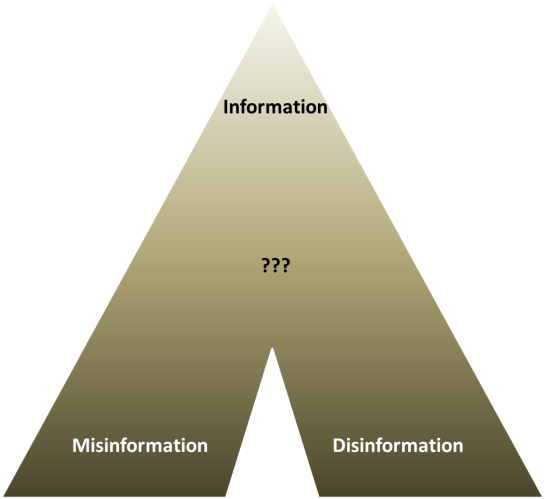
So, let’s start with some definitions (purely mine) of information types:

Information: A collection of facts about a subject upon which someone can formulate a testable theory or postulate a conjecture.

Misinformation: Incorrect declarations that potentially lead one to false conclusions.

Disinformation: Knowingly false declarations for the purposes of misleading another group (e.g., counter-espionage, propaganda).

information triangle

I suggest, however, that we need another category to address the shade of grey between the positives of information and the negatives of mis- and disinformation.

Following the model of nutrition versus starvation, I propose we call this new category malinformation, with the following definition:

Malinformation: A collection of facts that, while true, is insufficient to formulate a definitive conclusion without the support of further facts.

Just as a malnourished person is not starving, but rather suffers the effects of an insufficient blend and quantity of nutrients to experience balanced health, a malinformed individual is not wrong per se, but rather suffers the effects of an insufficient blend and quantity of facts to experience balanced knowledge and understanding.

For example, people who change their eating habits because they read about a single study that showed a specific food extract reduced tumour size in mice. Or a clinician who has created a behavioural modification program to reduce addiction based on a thought exercise using largely unrelated studies.

Any of these decisions are based on legitimate data from legitimate studies, but often ignore (or simply don’t look for) alternative and/or possibly conflicting data from equally legitimate studies. Rather than analyze all available data before generating a theory, they find the malinformation that supports their beliefs and then stop; a little bit of data being taken to conclusions that simply are not supported.

Boom-bust

Maybe they’re right. But more likely, it is much more complicated.

In conversation, I find the malinformed much more intractable than the ill-informed. With the latter, there is a chance you can correct the misinformation. With the former, however, the mere fact that the malinformation is correct seems to be sufficient cause for them to defend the castle they have built in the sky. When you “yes, but” them, all they tend to hear is the “yes”.

In fairness, all information is technically malinformation as we will never have access to the complete knowledge of the universe. We are always going to be forced to make decisions based on limited knowledge.

But where more knowledge is available, I think there is duty to examine and understand it before becoming intractable in our positions.

If there is a newspaper article about a new scientific discovery, efforts should be made to learn more about the limitations of the science that led to the discovery. How far can you realistically extrapolate from those few data points?

In biomedical research, that which occurs in a mouse is, at best, a clue to what might happen in a human. Nothing more.

It could lead to the next step in scientific inquiry—the actual purpose of science—or to a dead end.

Belief is nice, but unless that belief is well founded on broad and balanced information, it is limiting and might be dangerous.

(Or at least, as far as I know based on my understanding of the available information.)

Toronto Marlies crunch Syracuse

As the New Year arrived, my beloved Toronto Marlies played host to their cross-border rivals Syracuse Crunch.

The New York team is well named, with a history of pounding their opponents physically if not always on the scoreboard…and the local boys were ready to give as good as they got.

Saturday, January 2: Toronto 3 – Syracuse 2 (YouTube highlights)

Sunday, January 3: Toronto 3 – Syracuse 2 (OT) (YouTube highlights)

The hard-hitting series sets up an interesting three-quel when Syracuse visits Toronto’s Ricoh Coliseum yet again on Wednesday, January 20.

Substance over volume

ddnews

When you meet someone who does not speak your language, there is a cliché response of talking louder to make yourself understood. There is something within many of us that says if we simply pump up the volume, we can overcome the disconnect.

A couple of months ago, Tufts University released their latest estimates for the average cost of developing a new drug: $2.6 billion (I’ve seen estimates up to $5 billion). Eleven years ago, the same group calculated the costs at $0.8 billion.

Now, every time these estimates arise, the hand-wringing begins over how the costs were calculated, which factors make sense and which are over-reaching. What no one seems to argue, however, is that drugs are less expensive to develop today than they were a decade ago.

So what has this to do with speaking louder?

The same period has seen amazing technological achievements designed to facilitate and accelerate drug discovery and development.

Combinatorial chemistry was heralded as a way to expand compound libraries from hundreds to hundreds of thousands. High-throughput and high-content screening, as well as miniaturization and automation, were lauded as ways to screen all of these compounds faster under the paradigm of “fail early, fail often”. And given the masses of data these technologies would churn out, the informatics revolution was supposed to convert data into knowledge and knowledge into healthcare.

And yet, for all of these improvements in throughput, I question whether we have seen much improvement in the number or quality of drugs being produced. We certainly haven’t made them less expensive.

Please understand, I don’t place any fault in the technologies. These are truly marvels of engineering. Rather, I question the applications and expectations of the technologies.

Almost two years ago, GSK CEO Andrew Witty told a London healthcare conference: “It’s entirely achievable that we can improve the efficiency of the industry and pass that forward in terms of reduced prices.”

The pivotal question here, I believe, is how one defines efficiency.

I wonder how many people simply felt economies-of-scale would improve discovery, much as mass production made Henry Ford a rich man. But drugs are not cars, and where throughput and scale make sense when you have a fully characterized end product, they have their limitations during exploration.

When I was a protein biochemist in an NMR structural biology lab, I spent some time trying to wrap my head around two concepts: precision and accuracy. A 3-Å protein structure is very precise but if the structure isn’t truly reflective of what happens in nature, it is meaningless. A 30-Å protein structure is much less precise, but if it is more accurate, more in tune with nature, then it is likely more useful.

By comparison, I wonder if our zeal to equate efficiency with throughput hasn’t improved our precision at the cost of our accuracy. If you ask the wrong question, all of the throughput in the world won’t get you closer to the right answer.

In researching the DDNews Special Reports over the last couple of years, I have spoken at length to several pharma and biotech specialists about this topic, and many feel that the industrialization of drug discovery and development has underwhelmed if not outright failed. Several have suggested it is time to step back and learn to ask better questions of our technologies.

But getting back to the costs issue.

I know many will rightly point out that the largest expense comes from clinical trials. To address this challenge, new technologies and methodologies are being developed to get the most useful information out of the smallest patient populations.

Here again, however, no one segment of the drug development process stands in isolation, and I think back to the compounds reaching the clinic and question the expense of incremental improvements.

Oncolytics CEO Brad Thompson discussed the challenge in Cancer in the Clinic (June 2014 DDNews).

“If you could double [overall survival], you could show that in a couple of hundred patients. If you want to do a 10-percent improvement, you’re talking thousands of patients to do it to the statistical level that everybody would prefer to see. How do you run a study like that?”

That is a huge difference in financial expenditure that begs the question is an efficacy improvement of just 10 percent of value.

From an individual patient perspective, assuredly. From a pharmacoeconomic perspective, maybe not, and particularly with the growing prevalence of high-cost targeted biologics. Maybe we need to aim for bigger improvements before moving candidates forward, which happens long before the clinic.

Again, I’m not placing blame. The history of any industry is filled with experimentation in different methodologies and technologies. Everyone involved had the best of intentions.

But after a couple of decades of middling results, perhaps it is time to question how and when many of these advancements are applied. Simply yelling at a higher volume doesn’t seem to be enough.

[This piece was originally published in the January 2015 issue of DDNews. A lot has happened in the year since, including some amazing results in the field of immuno-oncology that might just address the demand for high-performance treatments even if only for a select patient population. For more on that, see my June 2015 Special Report “Body, heal thyself”.]

Movie memories for 2015

Posters_1

For a guy trying to make it as a screenwriter, it takes a lot for me to go out and pay to watch a movie. I think it’s, at least in part, because I don’t deal well with disappointment and particularly when I’ve had to pay for it.

Luckily, my friends had some luck dragging me out of the house this year, so below, I offer one-line critiques of the various films I saw in theatres (with hyperlinks to longer reviews I’ve written).

Taken 3: When the hell did I see this, and more importantly, why?

Paddington: Charming and a lot of fun.

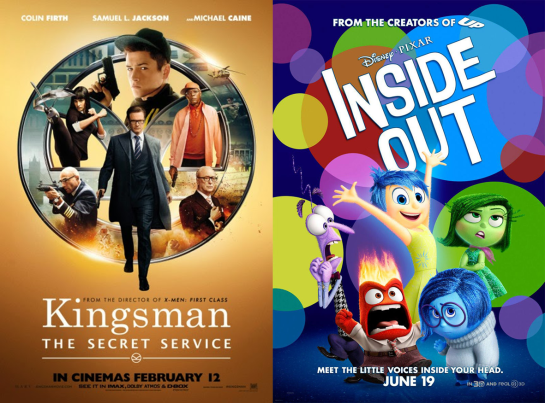
Kingsman: A rollicking good time.

It Follows: It bores me

Ex Machina: Oh My Deus, was this written by a robot devoid of emotions?

Age of Ultron: Miss a movie, lose a thread; think I am out of this series.

Mad Max Fury Road: You will believe a man can drive…that is all.

Inside Out: Underwhelmed, but appreciate I am only one.

Self/Less: Flawed but interesting

Posters_2

Trainwreck: Not one, but Schumer can do better

Ant-Man: Most fun I’d had all year…Rudd is perfect for this

Man from UNCLE: Stylish throwback that I liked more than most people did

The Martian: Surprise hit for me; kudos to all including author of book

Steve Jobs: A metaphor for dysfunction…and sadly, not in a good way

In the Heart of the Sea: More like in the heart of my sleep

Star Wars The Force Awakens: Visually stunning, overly sentimental, disappointingly regurgitated story

Spectre: Good movie with a stupid ending…am I outgrowing Bond?

Posters_3

The Force Awakens…to a Khan job (SPOILERS)

tfa_poster

J. J. Abrams is on my shit list.

That statement alone should tell you everything you need to know about my experience with Star Wars: The Force Awakens (Ep. VII).

As background: I am old enough to have seen Star Wars: A New Hope (Ep. IV) in theatres as a young teenager. And I was so impressed by the film that I immediately came home from the theatre and wrote a sequel…400 hand-written pages of a screenplay. My first screenplay, in fact, at the ripe maturity of 13 years.

Star Wars is my birthright. I will defend it tooth and nail.

Thus, J. J. Abrams is on my shit list.

After the underwhelming prequels (Ep. I-III), I looked forward to Abrams’ take on the saga. I was a big fan of his reboot of Star Trek, although I had a bit of a nagging doubt after the reboot sequel Into Darkness. But if anyone had a sense of the epic, almost operatic scale of the Star Wars universe, it should have been Abrams.

Star_Wars_Episode_VII_42318

And to some extent, he fulfilled his end of the bargain.

Shivers went down my spine when we scaled across the vast deserts of Tatooine…I mean Jakku.

I worried when R2…I mean BB-8, was captured by the Jawas…I mean scrap metal scavengers.

I bounced happily with the music of the Mos Eisley cantina…I mean the Takodana cantina.

I cheered when R2 successfully arrived at the Rebel base…I mean BB-8 arrived at the Resistance base with the vital information.

I sat back in awe as I saw the might of the Death Star…I mean Starkiller Base, for the first time.

J. J. Abrams is on my shit list.

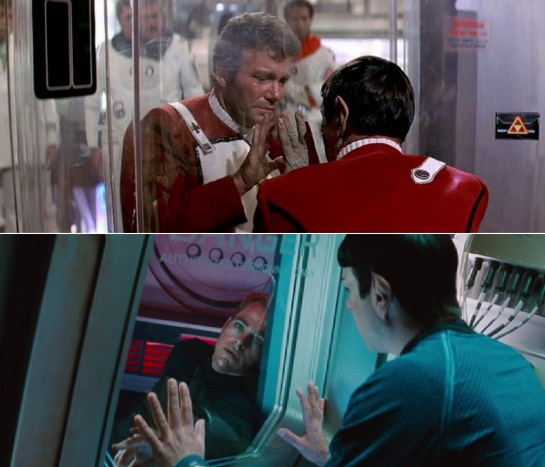
To get back to Star Trek: Into Darkness, briefly, we all knew that Abrams was rewriting the story of Kirk’s greatest nemesis Khan Noonien Singh. And the movie didn’t disappoint in its grand opening flourishes and early Starfleet intrigue.

But then, at some point, it was like Abrams had run out of ideas and so simply inserted the last 20 pages or so of the original Wrath of Khan screenplay, hoping we wouldn’t notice.

The least tweaked moment of overlap between the two movies was the scene between Spock and Kirk across the glass as one dies from radiation sickness. Abrams simply swapped the positions of the two characters.

twokstid

Some might consider this an homage to the original. A friend of mine, in discussing The Force Awakens, called it alt-universe mirroring. I call it bullshit, and lazy bullshit at that.

Now, Into Darkness was not intended to be a prequel to any of the older Star Trek movies, so I can buy into the alt-universe idea a bit. But The Force Awakens is Ep VII of a saga. It is not an alt-universe but the same freaking universe 30 years later.

An homage is the holographic chess set. An homage is NOT a beat-for-beat repetition of Ep IV, even if jumbled up a little bit and with a few scenes from Ep V and Ep VI thrown in.

The spell of childhood memories faded rapidly as The Force Awakens played out on the screen, and I spent much of movie sitting with an attitude of “Really?”

And as I walked home from the theatre…a 40-minute walk…I just got angrier and angrier as the volume and sheer audacity of the parallels continued to sink in.

J. J. Abrams is on my shit list.

Droid capture

“You’re pretty bang on, but it’s what I was expecting,” explained a friend whose ear I bent. “It’s the old ‘the same, but different’.”

“I saw it more as a mirroring of the previous six films; a device to draw in new fans and satiate old fans,” another friend said.

I call bullshit…not of my friends, you understand, but of the idea that The Force Awakens needed to remind us of the saga up to now or reinvigorate fans.

Please, how could anything from the Star Wars saga fail to draw box office records?

I know I’m in the minority here. Most fans won’t clue into any of the parallels but instead simply wrap themselves in the old familiar or marvel at the new spectacle. Cool, I am glad they enjoyed the film.

Even I will likely see it again as my first viewing was in regular 3D—strange to think of that as a thing—and not in IMAX or AVX.

And as much as I would buy Henry IV, Part Three if Shakespeare wrote a sequel to his first two Henry IVs, I will eventually add this movie to my Star Wars collections.

But J. J. Abrams is on my shit list, and I will approach any of his future movies with suspicion and cynicism.

And that, more than anything, I am saddest about.

Ep IV_VII

When numbers fail (DDNews commentary)

Dutee Chand

Athletics bodies have questioned whether sprinter Dutee Chand has an unfair advantage.

What is normal?

The question may sound absurdly philosophical, particularly for the pages of DDNews, and yet healthcare directly or indirectly deals with this question on a daily basis. And the clinical response can be as life-altering as the societal and political responses that we see on the news every night.

An entire industry has been created to test and monitor health using various diagnostic assays, to the most recent of which DDNews dedicates an entire section. In some cases, the results of these assays are binary—the classic example is being a little bit pregnant. But in most cases, healthy (or normal) falls within a range of values—think LDL/HDL, blood glucose or body temperature.

In part, this is a recognition that results can vary within an individual throughout the day, and on the larger scale, because individuals are products of their genetics and environments. What might be a healthy level for me in Toronto may actually be limiting in Johannesburg.

But even with the recognition of variability, we must always be vigilant in questioning how the normal range was defined. Was it based on the combined results of 200 male Manitoba bush pilots (I have read such a study), or a sampling of tens of thousands of individuals from around the world? If only for economic reasons, the former is more likely to be the case.

In 2011, Boston University’s Shalinder Bhasin and colleagues examined this challenge by identifying reference ranges for testosterone in healthy men. Suggesting that these ranges “have been derived previously mostly from small convenience samples or from hospital or clinic-based patients,” they examined a much larger cohort from the Framingham Heart Study (Gen 3), publishing their results in the Journal of Clinical Endocrinology & Metabolism.

Although most values were consistent with historic values, their lower limit of total testosterone was higher than that used historically but was “closer to the thresholds associated with sexual and physical symptoms in a recent investigation of older men.” Thus, when it comes to testosterone, it seems (sample) size matters.

But what about the outliers, the norms who don’t fit the norms and the unwell who do?

As a bit of a sidestep, just over a year ago, the International Association of Athletics Federations (IAAF) banned Indian sprinter Dutee Chand from competing in sanctioned competitions because her blood testosterone levels fell into the normal range of male athletes rather than that of her female competitors. Thus, the group decided, she would have an unfair advantage over her fellow runners.

What made this ruling particularly challenging, however, was that Chand’s testosterone levels were natural; they did not come about from doping. Her levels simply fell outside of the clinically accepted norm for women.

Closer to home for me are two friends who live with symptoms of hypothyroidism and have resorted to alternative medicine because they were dissatisfied with the medical establishment. In both cases, standard thyroid function tests suggest they fall within the normal range and therefore would not benefit from standard treatment. This may be true, but neither knows because it was never tried.

Admittedly, these are anecdotes. Three women struggle because they do not fit ascribed definitions, whether of health or pathology. And for every anecdote I can list, the healthcare establishment can rightly point to hundreds if not thousands of individuals who fit the defined ranges of normalcy.

It’s a conundrum I have discussed previously: healthcare is population-based while health is personal.

In our zeal to standardize healthcare and make medicine more scientific, we have to be careful not to ignore the natural variabilities of individuals within those populations. So-called normal ranges should suggest action, not dictate it.

Even as we pursue the precision medicine mandate, spending billions (and possibly trillions) of dollars on expanding our understanding of human biology and generating technologies to value every facet of it, we have to make sure that our knowledge doesn’t blind us to the patient’s truth. If that happens, if all we accomplish is a bigger monolith, then we have failed in the mission.

As to Chand’s racing career, the Court of Arbitration for Sport recently overturned the IAAF’s rule, giving them two years to prove that the higher testosterone levels truly give the runner an unfair advantage.

DDNews_0915
Originally published in DDNews in September 2015, this is one of a series of commentaries I write each year. If you’re interested in recent technological and business innovations in biotech, pharma and healthcare, you should check the publication out.