Sad hooded eyes
Look me over,
Stare into me,
Searching my soul
For empathy,
A kindred spark,
Recognition
That we are one.
Lives held sacred,
Spirits unchained
Despite coiled wire.
Acknowledgement,
We’re each encaged,
Trapped by limits,
Captive of views
Held by others;
Defining us,
Confining us,
Refining us
To imagery;
A dull shadow
Of former selves,
Bleeding vibrance
To worlds of grey.
But hope remains,
The spark still burns;
Words unspoken
Continue tales
Yet unwritten.
Share my story
Of wilds now gone
That glow in eyes
Hooded and sad.
Shhh…the Toronto Marlies made the playoffs
My beloved hometown Toronto is often described as “hockey-mad”, and as home to the Hockey Hall of Fame and one of the most legendary franchises in National Hockey League history—the Toronto Maple Leafs—you might think that makes sense. The epithet hockey-mad is, however, a lie.
Toronto is not hockey-mad, it is Maple Leafs-mad.
In fact, it is now Maple Leafs-livid because yet again, the big team has failed to make the Stanley Cup playoffs and so my fair city will go a 48th consecutive year without a championship.
Still legendary, but for entirely the wrong reasons.
But while the local news media are filled with stories about what the woeful Toronto hockey fans will do as the Leafs players take to the golf courses, they are completely overlooking one local professional hockey team that has made the playoffs—for the fourth consecutive season.
I speak of my beloved Toronto Marlies, the American Hockey League farm team of the Toronto Maple Leafs.
Nary a word. Nary a reporter. No pictures. Doesn’t exist.
The team is covered by bloggers whom I respect:
- Kyle Cicerella (Kyle the Reporter)
- Mark Rackham (who lives in the UK for god’s sake)
But otherwise, silence.

Mark (facing us) came all the way from the UK to watch the Marlies play. Toronto sports reporters, not so much.
To address this short-coming, I have started a campaign with other Marlies fans to bombard the local media with news and highlights of what is happening in Toronto playoff hockey. My first missive is below:
Playoff hockey in Toronto
Over the past week, I have read two stories in the Sports Section of the Toronto Star describing what playoff-starved Torontonians can do now that the Maple Leafs have hit the golf links. Woe is Toronto in the absence of playoff hockey.
And yet, Toronto will play host to professional playoff hockey, and by players proudly sporting blue and white maple leaves. I am, of course, speaking of the Toronto Marlies, the farm team of the moribund Toronto Maple Leafs.
You see, as the ACC has sat deathly quiet, the Ricoh Coliseum just a little way down Lakeshore Boulevard has been rocking night after night as the Marlies rescued a terrible season start and turned it into a rollicking run back into the Calder Cup playoff race.
Last night, with a loss by the Hamilton Bulldogs and a win by the Marlies, Toronto’s boys in blue clinched their fourth consecutive playoff spot, and over the next two days, could see themselves sit anywhere from 6th to 8th in the AHL Western Conference.
And how did the boys do in their previous runs at the Calder Cup? Three years ago, they reached the championship finals, only to fall to the juggernaut that was the Norfolk Admirals. Last year, they were within 22 minutes of advancing to yet another Calder Cup final, but fell to the ultimate champion Texas Stars.
Sure, everyone was disappointed that the boys didn’t bring home the Cup, but in a city that is used to switching allegiances in April, touting a hockey team as Conference Finalist and Cup Finalist is pretty heady stuff.
With the house-cleaning planned up the road at the ACC, the Marlies have never had a greater importance to the Maple Leafs. The boys I watch on a weekly basis are the future of the big squad. Rookie scoring champion Connor Brown. Future phenom William Nylander. Tomorrow’s goaltending duo Christopher Gibson and Antoine Bibeau. Former Defenceman of the Year TJ Brennan. I can keep going.
So as your readers bemoan being unable to spend hundreds or thousands of dollars taking in one Leafs playoff game, they should know that they can come down the road a bit (plenty of parking) and bring the whole family (for a fraction of the price) to cheer the Marlies as they march into Calder Cup competition.
I’ll be cheering the boys. My friends will be cheering the boys. Come on down. We’ll give you a warm welcome!
Go Marlies, Go!
Wish me (and the Marlies) luck.
Lake Ontario
While waiting for Windows to update my computer (ugh), I was left without my laptop and so decided to take advantage of the springtime weather (finally!!!) and nearby beach to do a bit of photography in east Toronto.
- The birds hung close to the trees today
- The light breeze made for amazing visual effects
- When colour fails you, go to b/w
- The light and water waves danced on the stones
- A terrible photo but my first fish for Lake Ontario
- Had to get the canonical v-winged gull image
- Couldn’t pass up on it…got a Rolex and a Timex
- It was like the lake bottom was alive
- These little guys were out in profusion today
Floater
Terry’s biggest fear was pain. He had a particularly low threshold for it, and so the thought of his limbs bashing against the rocks had brought a clammy sweat to his palms.
Turns out, he was worried about nothing.
After the initial crunch of what used to be his left knee cap, the free rotation of his leg really didn’t hurt. Rather, it was more of a surreal distraction.
What actually bothered Terry was the unquenchable cold, as wave after wave of grey water sponged the heat from his flailing limbs.
Winter had come early to the Scarborough bluffs, and despite being well into April, showed no signs of releasing its crystalline grip on the world. More than one chunk of ice from the nearby shore added insult to stony injury as Terry rolled with the currents, thrown tantalizingly close to the pebbled beach only to be unceremoniously tugged back to the depths.
To all outward appearance, Terry was as lifeless as the shredded plastic bags that clung to his limbs as their paths crossed. Even the gulls had stopped their surveillance, his constant mobility keeping them from determining his potential as food.
Terry didn’t thrash. Nor did he scream.
What his lost will to live couldn’t achieve, the water completed as his body involuntarily pulled muscle-activating blood from his extremities, its focus completely on preserving his heart and mind. Ironically, these were the two things that first failed Terry.
In the grey waters under a grey sky, tumbling mindlessly with wave and wind, Terry knew his death was just a matter of time.
And oddly, for the first time in his life, Terry had all the time in the world.
A touch of poetry
Left-handed (DNA) compliment
While attending the surprise birthday party for a friend in the sciences, I noticed he owned a coffee mug from a group called Life Sciences Career Development Society based at the University of Toronto. Actually, to be more accurate, what caught my eye was the DNA double-helix on the mug…and the fact that it was wrong.
BOOM! My head explodes.
As someone with biochemistry & genetics degrees who has written about the life sciences for ~15 years, this seemingly innocuous error drives me crazy. This must be how copy editors feel when they see a misused semi-colon (and I’m sorry about that).
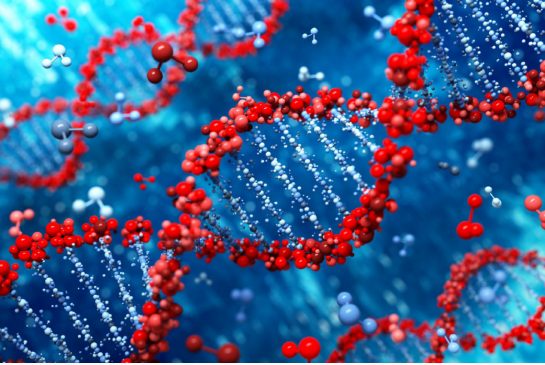
For the non-biochemists, through a characteristic known as chirality (look it up…too hard to explain here), the typical DNA double-helix in human cells—the famous Watson-Crick-Franklin structure or B-DNA—has a right-handed helix. This means that if you could see the double-helix (above) and let your fingers follow along the curve of one side as it wraps around the other, you could only do this comfortably with your right hand.
You can see that in an example of a single helix that curves either to the left (left) or the right (right).
Unfortunately, somewhere in the mists of science illustrations time, an artist drew the double-helix of DNA in the wrong direction and that double-helical abomination has perpetuated ad nauseum, including irritatingly enough, in science publications and scientific logos such as a recent health article in the Toronto Star (image below), the cover of a sci-fi novel and the LSCDS logo.
And if I only saw this in 50% of the images, I’d be irritated but probably not the raving loony I am now. But no, this freak of nature is everywhere. The correct right-handed DNA illustration is the anomaly.
So why does this matter? Maybe it doesn’t, and I am just a raving loony.
But for me, I struggle with what else might be wrong in a life science or healthcare story if they can’t get the DNA helix right. Do I trust the math of an investment planner who doesn’t know that four quarters equals one dollar?
Luckily, the fix is an easy one. Simply mirror the image you have (not turn it upside down) and the left-handed double-helix becomes a right-handed one. (In a mirror, your actual left hand looks like a right hand.)
So, medical illustrators everywhere, please fix your catalogues of scientific illustrations. My head can’t take too many more explosions.
[Also, from a design perspective, up and to the right is more palatable for North American audiences as it implies future success (e.g., rising value). Has nothing to do with handedness, here.]
For the more biochemically savvy:
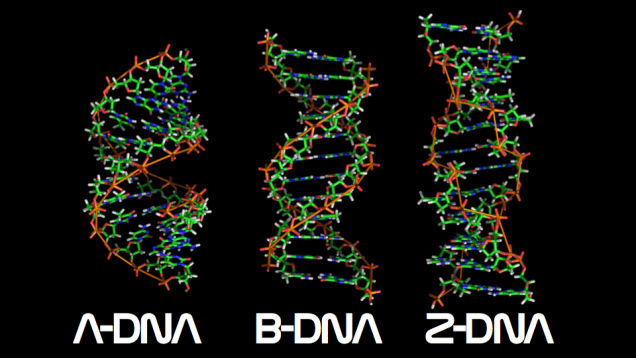
Yes, there is left-handed DNA, which is also known as Z-DNA. But as you can see from the illustration below, its structure is significantly different from the smooth-flowing curves of B-DNA (and the equally unusual A-DNA).
You are your own inspiration
Comedy versus Ridicule (2 rules)
Have been very passively watching the Trevor Noah controversy regarding some Tweets of questionable taste (to some) and felt I needed to weigh in…but only after calming down a bit.
I think the difference between comedy and ridicule comes down to intent, common decency and a realistic view of the world:
1) If you make a joke about an individual and he/she doesn’t like it, you should apologize sincerely and move on.
2) If you make a joke about a group, community or category and they don’t like it, fuck ‘em; that’s what comedy’s about.
* drops mike *
* picks mike back up *
* apologizes to mike for being a jerk *
* moves on *
A week of brain farts
As you may have guessed, I really don’t filter things that come into my head.
With that in mind (see what I mean), I present some of the stupidities that I have spent time on over the last week or so.
Off the pedestal, Western medicine
Western medicine can be a smug son-of-a-bitch. Seriously.
Now, it would be unfair to lump this attitude on all practitioners of Western medicine, but I haven’t the time to survey all of its adherents and gauge individual opinions so that I can name names of those who are the smug bastards and those who believe in thoughtful open-minded consideration.
To provide some context, I have a B.Sc. in molecular biology and a M.Sc. in medical genetics, and have written about the latest biotechnical and biomedical advances for about 15 years. I have also written about Western medicine for about 7 years.
Given this background, it may seem odd to some that I am writing a complaint about the attitudes of Western medicine, but what may not be as obvious about that background is the amount of hubris and self-satisfaction I have seen in questionable practices with limited benefits.
Recently, there was an article in New Scientist magazine that described the rediscovery of a possible treatment against superbugs (e.g., MRSA), a therapy chronicled in an Anglo-Saxon era manuscript. The roughly 1000-year-old remedy is being studied in a modern lab and early results suggest that it may prove effective against the bugs that threaten modern lives on a weekly basis.
(BTW, there is a thousand miles between early results and coming to a pharmacy near you.)
But what struck me most was the response to the findings in various media, which bordered on shock and awe that something relevant to today could come from such an ancient source. Even CBC’s The National (Canada’s national news broadcast) commented that the discovery came from an era when leaches were considered good medicine.
Which leads me to scream:
Science wasn’t invented in 20th century, people.
The grand assumption seems to be that anything that happened in medicine before the First World War was complete voodoo and not worthy of consideration in an era of rational thought.
Everyone involved in health remedies before the modern medical era was either a charlatan or a moron, and either way was dangerous to the people around them. The human capacity for sober scientific enquiry did not occur until shortly after the invention of the Erlenmeyer flask, the spectrometer and the harnessing of the X-ray.
I call bullshit.
Folkloric medicines are based on scientific inquiry by people without test tubes and spectrometers. The approach may have been less statistical in nature, but everyone from apothecaries to shamans (shamen?) ran clinical trials the old-fashioned way.
Take this. Do you feel better? Great. It’s a keeper. Did you die? Yes. Nuts, try something else on the next guy.
Having actually looked at modern clinical trials, the only differences between then and now are the test patient population size and the accounting of the results. And I don’t know that we can say definitively that these parameters have improved things.
I am not advocating that we discard modern medicine—it has merit—but rather than it must get off its high-horse and approach historical medicine with an open mind so that more rediscoveries like this latest one can happen and be tested.
China has about 20% of the planet’s population, so there might be something to Traditional Chinese Medicines (TCMs). The same goes for India and folkloric Indian medicines (FIMs). Or Anglo-Saxons or Sumerians or the indigenous peoples of the Americas. These people were not morons.
Our ignorance and outright hubris is a hangover of the Age of Reason as we dismiss everything that came before because it was often presented in raiments of spirits and ritual.
We should not let our fascination with the instrumentational bells and whistles of the modern scientific method blind us to the wonders of the not-so-modern scientific method, which lacked in instrumentation but not in knowledge and understanding.
Before you blithely dismiss something as troglodyte quackery, perhaps you should ask yourself:
What would Hippocrates do?
And as to the CBC’s comment about the era of leeches, both leeches and maggots have a long history up to this day of facilitating health in people (see Leeches and Maggots).