(Image used without permission)
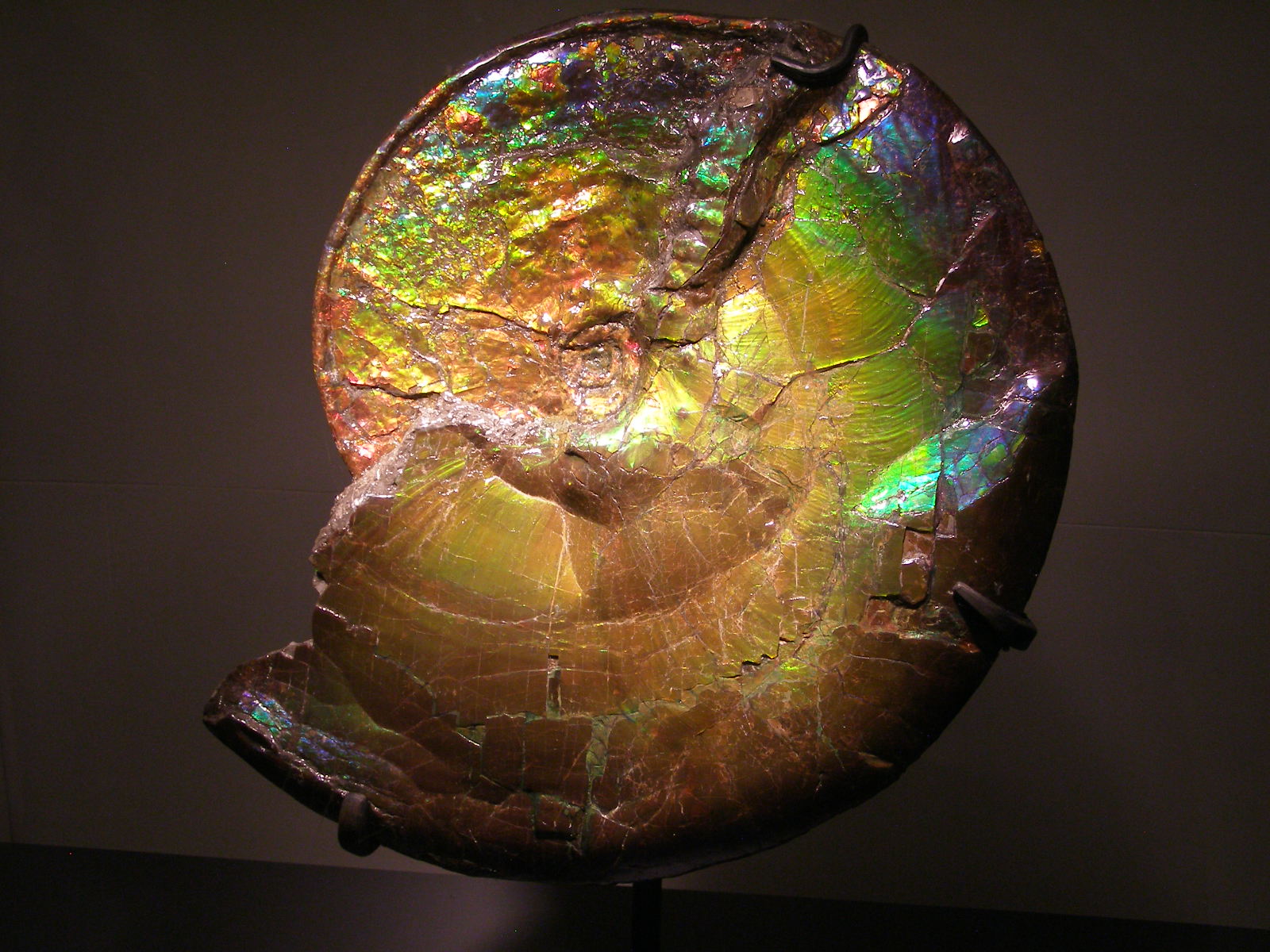
A few more shots of my 2011 trip to New York City, this time from the American Museum of Natural History, where I shot the photo of the ammonite fossil in my earlier post.
Earlier today, I read a blog post by my dear friend Marsha Mason, the latest in a series for Why The Face. In today’s post, she touched on the subject of use of white space in writing, whether a screenplay, query letter, whatever.
“The goal of white space,” she explains, “is to never be at the detriment of your story…but to force you to condense, to economize, to pack as much punch as you can into less.”
I agree with her conclusion, but question if the goal of white space isn’t so much bigger.
For the uninitiated, white space is literally the empty space between lines of text and/or images, the complete absence of content which appears white on the printed page or computer screen.
As I suggested in my response to Marsha’s post, I have worked for several years in careers such as magazine publishing, web design, advertising and now screenwriting, and in all that time, I have found that white space is easily the least understood and most underutilized aspect of creativity.
For whatever reason, people seem to believe that an absence of something is an absence of work. Marsha’s comment about the need to be concise and economical in your word choice partly puts the lie to this conjecture, but it doesn’t go far enough.
We live our lives like we fill our pages, with mostly useless things designed to ground us but which, in fact, anchor us and restrict our movement. It is a restriction that we accept voluntarily and without which many of us could not function, or at least fear we couldn’t.
At this moment, I have five browser windows open and yet am ignoring all but one, and only because that one is playing music. And at the same time that I write this post, my mind is on several other posts and some projects I am neglecting.
Nature abhors a vacuum. True. But think of the greater image.
More than 99.99999% of the known universe is actually NOTHING! Only the absence of ubiquitous light keeps it from being literally white space.
In screenwriting, white space is there to let your reader run free with his or her own interpretation of your work. Restrict their thoughts with clutter, and they resist. Prevent their thoughts with too much specificity, and they disengage.
Let your story breathe, as you yourself should. Your readers will be happier for it. And so will you be.
(Image is property of owner; I stole it.)
Iridescent jewel,
Multicoloured wheel,
What wonders did you see
In your aquatic home
A half billion years ago?
Vast schools of shelled minds,
Thousands of eyes
Scanning the waters for prey,
Thousands of arms
Reaching into the darkness
Seeking sustenance or mate.
Named for a sun god,
Did you play in the shoals
Or patrol the inky depths
Of the world yet young?
We remember you,
Museums commemorate you,
And yet you are
And ever shall be
A stranger to us.
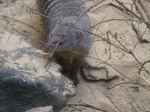
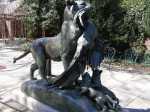
A few photos I took while traveling through the Central Park Zoo in Manhattan back in 2011…my previous camera and unedited, so not as good as more recent images, but I like them just the same.
I just finished a post by fellow blogger Bare Knuckle Writer, entitled: Mutants: You and Your Protagonist. In it, she describes how her protagonists eventually end up being some version of herself; her beliefs, her mannerisms, her idioms. Not a carbon copy, you understand, but a variation on the theme that is she. (If you don’t know what a carbon copy is, talk to your grandma.)
This got me thinking about my own writing habits and quickly crystallized into the realization that all of my characters, or at least the major ones, are some variant of me.
Although I would never—or at least rarely—expect me to perform any of the actions or give any of the speeches of my characters, to make the characters believable, for me to truly get inside their heads, I have to give them free range inside mine.
I have no expectation that I will ever chase a murder suspect down an alley or cut off my enemy’s oxygen supply to get him to submit to my will, but I can’t say the idea is impossible given who I am (and what I have muttered in traffic).
To bring out the best and the worst in my characters, I have to be willing to reveal the best and the worst in me. The process is a variation on what makes other writers’ characters relatable to me.
If we look at one of my favourite plays—Shakespeare’s Othello—I can quite easily visualize aspects of my personality and even past behaviours in all of the main characters.
I have spit venom and schemed like Iago, been as empassioned as Othello, been as blinded by lust as Roderigo, as fawning for favour as Cassio, and as blinded by love as Desdemona. All various aspects of one person’s personality.
In an ironic footnote of life imitating art, my wife finally took me aside one day to explain that asides only work in the theatre. Although it was true that no one could hear Iago’s asides in Othello, everyone in the real world could quite easily hear mine. This, of course, helped explain why all of my evil and cunning plans failed so miserably.
I am my characters and my characters are me.
It is less “you are what you eat”, for people like me, and more “you are who you write”. Thus, to thine own characters, be true.
Before I start, let me state unequivocally that if you are writing or thinking of writing, I congratulate you and hope it goes well.
Now, despite that enthusiasm, I have to express my dismay at the number of people who don’t seem to want to improve their writing.
Over the last two years, I have read thousands of pages—outlines, scenes, plays, chapters—and have been amazed to watch so many people get so much better at their craft. Unfortunately, I’ve also seen plenty for whom their only draft is their final draft.
Perhaps it is ego that suggests me and my fellow readers have nothing to contribute to their work. That all of our comments fall well short of their prodigious talents and would only weaken the work. But if that’s the case, why ask for our input in the first place? If the work is that good, why do you need our validation, our applause?
For most, if not all cases, I think it is more likely fear and laziness. The belief that if the piece isn’t perfect on the first pass, it never will be. What these people seem to fail to realize—or perhaps recognize all too well—is that a learning curve isn’t just some gentle bend in the road. Rather, it is a steep daunting hill, and to climb that hill, they must invest energy.
If you ask me for my input, my thoughts, my impressions, I will give them to you freely with the understanding that they are just my opinions. You don’t have to follow them. This is your work, to be executed your way. I am only offering alternative views.
At the same time, if you continually ask for my thoughts (or someone else’s) but make no effort to change—in any directions—then these efforts have been wasted.
Perhaps the writer was correct and the work was perfect out of the gate. Congratulations. It would be the first time I would ever have been witness to such an event.
I have no pretenses about my own work—or I don’t think I do. My work will never be perfect, but it can always be better than it was yesterday, and almost as good as it will be tomorrow. And the more and more varied input I get, the closer I get to the top of that learning curve.
At least until the next project begins.
(Image is property of owner and is used here without permission, because I never learn.)
Weep not, my love.
Release the sadness
That encumbers your heart,
Holding you earthbound
When you should soar.
Deny the anger
That blots your visage,
Shading your eyes
Where once smiles did dance.
You are beautiful
Of body and of spirit.
The world sings
Of your graces and charms.
Hear the song.
Feel the dance.
Rejoice in warmth
And weep no more,
For you are love.
More photos from my sandy walk along Toronto’s beaches.
Okay, that was either the most effective social media campaign EVAR! or the folks at Puppet Up! were already coming to Toronto.
Either way, I don’t care and am simply ecstatic that Puppet Up! Uncensored is coming to Toronto’s Panasonic Theatre October 22 to November 3.
Tickets are currently only open to Mirvish Theatre subscribers, but will likely open up soon.
Thanks to everyone who responded to, looked at or smiled bemusedly at my Bring Puppet Up! to Toronto campaign.
For more about Puppet Up!, visit their web site or FB page.
PIECES OF ME...
Mother, Nehiyaw, Metis, & Itisahwâkan - career communicator. This is my collection of opinions, stories, and the occasional rise to, or fall from, challenge. In other words, it's my party, I can fun if I want to. Artwork by aaronpaquette.net
Life at any age can be amazing! We only need to grab hold & experience it!
The internet web log of Michael Cedarwood. I used to be a stripper. Now I'm a writer.
Thoughts on creativity, Pharma and whatnot
Mindfulness, Philosophy, Spirituality, Meditation, Awareness, Religion, Nature Photography
Living for Happiness
A perspective from the other side of the hockey ocean
Romance Author
Author of Kritsotopoula, Girl of Kritsa and Rodanthe's Gift
Our opinions don't stink!
Rantings and Ravings on all things Screenwriting and Movies
My Elicits, an Inception... Learning to Live in Perfection