Not for nothing – REQUEST FOR HELP

ssnolan3

How do you write about nothing?

I know how to not write. In fact, I was very good at that in the past, but gratefully not writing is no longer much of an option for me.

I’m not talking about not writing, however. Instead, I am talking about writing scenes where superficially nothing happens, where a character walks through the mundane actions of life. What they are doing is unimportant to them, a robotic response to an overwhelming thought or scenario. There is an astronomic exchange of information and yet no words are spoken.

In a novel or short story, you can have an inner dialogue, revealing the character’s thoughts, but in a film, you have only silence. Sure, there’s always the trusty voiceover, but I personally think that unless the character is recalling a past statement, voiceovers are a crutch. And a voiceover weakens a scene when you compare it with silence.

Think of the last time you were faced with silence in response to something you said or did. Think of the dis-ease (yes, that’s where “disease” comes from) you experienced as you tried to figure out what the other party was thinking. In many of those situations, I bet that shouting would have been preferable to silence.

In an improv class I took—I am sorry that this is my version of “This one time, in band camp…”—we were doing a status exercise wherein one character would try to take status away from the other one, proving themselves superior through statement or action. While many student pairs would do their best to out-pompous, out-preen or out-bravado each other, I took a different tack. I went completely silent.

No matter what my partner said or did, I faced him stoically or indifferently, deigning to give him the merest glance on occasion while going about my activities. And the louder or larger he got, the less I minded or acknowledged him. The more he talked, the weaker he appeared.

Silence is powerful. And even if the silence is due to idiocy, it comes across as thoughtfulness.

Think of scenes in movies where a character has chosen to deal with a problem by thinking about it. With a good actor, you can see all the thoughts as they play out in his or her mind. The body, the face, the eyes tell you all you need to know about the emotional swells washing through the actor. A single word breaks that tension and weakens the moment. As a storyteller, why would you ever give that up?

Which brings me back to my original question: How do you write nothing?

Perhaps I am delving too far into the domains of the director and actor, but there has to be a way to ensure both those artists know what you, the writer, intend. But I’ll be damned if I know how.

So, I open the question to you, my fellow artists.

What do you do, what have you learned, what have you seen that tells you how to write nothing and yet convey a world of thought and feeling?

Please share your thoughts here as I can’t be the only one who wants to know.

A man of letters

untitled

The other day, while driving with a friend of mine, I came to the sudden realization that I no longer know the alphabet. Please understand, this is not an Alzheimer’s moment—not to make light of that debilitating condition—but rather a sign of the place I have reached as a writer.

You would think, if I am a writer, that the alphabet would be the most subconscious of things in my life. Everything I have just written has relied on the use of letters. But it’s not the letters I’m having problems with…it is the alphabet.

My first experiences with a typewriter were during typing class—how ironic—back in high school, where I was the only boy in a class of about 20 girls. So much for paying attention to the typewriter keys. As I became more comfortable with the idea that the girls and their developing curves would still be there for my next class, however, I slowly paid more attention to and became more comfortable with the keyboard.

Olivetti_Lettera_35

As a side note, I am old enough that my initiation to typing was on a manual typewriter, which meant pounding on the keys to make keystrokes. To this day, my various computer keyboards suffer mercilessly as I continue to pound the keys rather than simply depress them.

In the decades since high school, I moved to electronic typewriters and then to computers and smart phones…and in all cases, I worked the old standard QWERTY keyboard, on which the keys were supposedly arranged based on usage in the English language and finger ergonomics.

My understanding, however, is that the facts supporting this arrangement were actually incorrect, and that there have been several attempts over the past century to try to introduce new letter arrangements on keyboards based on more accurate usage statistics. These efforts have universally failed, and I have always wondered why. Now I know.

The event that triggered my alphabetic crisis was a trip to Buffalo, NY, to see the chicken wing movie I described in an earlier blog post. As my friend and driver Mike was unfamiliar with the streets of Buffalo, he asked me to type the address of the theatre into the GPS unit, which is when the proverbial if not literal wheels fell off.

The keyboard was in alphabetical order starting left to right from top to bottom.

I couldn’t find any of the letters I needed. Despite knowing immediately that they were arranged in alphabetical order, my fingers instinctively flew to where the next letter would reside on a QWERTY keyboard.

It took me for-freakin-ever to type in “236 Main St”. I haven’t felt that stupid since…well since I was in kindergarten learning the alphabet.

We eventually made our destination, but I am now terrified at the prospect of having to travel anywhere that requires a GPS.

I wonder if the Children’s Television Workshop has given any thought to a remedial Sesame Street for adults, because I really feel like I could use Cookie Monster’s help right now. That would be good enough for me.

Take a tumble

I am not an athletic person, but I have a great appreciation for athletic endeavours and the athletic form (aside from the odd salacious curiosity).

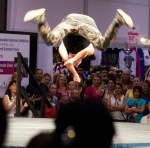
While wandering the Canadian National Exhibition (CNE, Ex) last month, I happened upon a team of acrobatic young men performing what could best be described as flight. Amazing ability to stay airborne.

These are the images that weren’t a complete blur.

Many levels of review – Part Two

Whenever someone asks me to review their writing, I try to be thorough and look at it from many levels. Yesterday, we looked at how I approach writing from the 30,000- and 5,000-foot levels. Below, we dig deeper.

1000_foot_view

The view from 1,000 feet: Now that I’ve identified the major structural and thematic issues and determined there is a reason to keep reading, I go back to the beginning and really start to peel things apart.

If I have a thing for character—and I do—I might follow an individual character through the story to see if I can reverse engineer the writer’s profile of that character. I am making this sound much more formal than it really is. Basically, what do I know about the character and are his or her actions and reactions consistent with that knowledge given: (a) where that character is now in the story; and (b) where he or she is trying to get or accomplish?

From the plot perspective, I begin to look at individual scenes and ask if the interplay between characters makes sense for their relationship and respective goals within the scene. For that matter, does each character in a scene have a clear goal?

How have the characters within the scene changed from one end of it to the other? Did one start with the upper hand and that power shift somewhere through the scene to the other character? This last point is not a necessity, but is merely one way a scene can experience reversal.

Likewise, is the scene clear with one predominant purpose or has the writer tried to accomplish too much too quickly, muddying the scene and leaving the reader uncertain as to what refers to what?

At a slightly broader level, how do the scenes play against each other? Are there smooth or logical segues from one scene to another, and if not, does the hard plot swing work? Does the scene in question set up a future one or pay off a previous one, and has it done this job effectively?

200_foot_view

The view from 200 feet: Now I really start to get into the weeds, looking at paragraphs and individual lines. From the narrative perspective, does the reader have all the information he or she needs to make sense of the story? Does the scenery or environment serve almost as another character at this point, representing a source of conflict or support for your characters? Again, this last point isn’t necessary, but can be quite effective such as in movies like The Perfect Storm.

Alternatively, has the writer massively over-written the narrative, demonstrating his or her superhuman vocabulary and/or visual imagination at the expense of the story and poor befuddled reader? As a personal aside, this is my greatest sin as a writer…but then you probably already knew that. Can I recommend any broad strokes edits (not copy edits) to help reduce the clutter and maintain the flow for the reader?

If it’s a screenplay, does the writer interrupt the reader too often with small directorial nods to the actors? For example, during a particularly heated scene of dialogue between the protagonist and antagonist, is the writer constantly reminding the actors to furrow their brows or shrug? I try to determine whether these narrative directions are absolutely necessary to get the idea of the scene across.

The problem here is that the regular intrusion of direction takes the reader out of the moment, disrupting the story and the emotional power of the characters. The senses, if only at the mental level, are forced to trip back and forth between things like subtle movements and emotive energy. Thus, in even the most action- or tension-packed scenes, too much narrative can sap the energy of the scene such that the read becomes plodding. By removing these superfluous lines, the reading speeds up and the energy of the scene is renewed.

This brings us to dialogue, which is easily my greatest challenge in screenwriting. I think novel writing gives you a bit more leeway with dialogue but I am less familiar with the medium from a writing perspective.

When I review dialogue, I try to sense how natural the dialogue feels…perhaps even reading it aloud, if I am not certain. Are these sentences that real characters would say and are the lines apt for the character who is saying them? From what I have surmised about the character, would he or she use those particular words in that way or to that purpose? Is the character saying exactly what he or she is thinking (on-the-nose) or is there some sense of subtext, whether known to the character or not?

Similarly, is the dialogue as tight as it could be, saying only what needs to be said and in the best way? Now, please note, I did not say or mean to imply in the shortest way, with the fewest words. People rarely keep their sentences to a minimum, but rather when caught up in the heat of the moment, tend to spew a bit more than necessary. There is a cadence to an individual’s speech patterns, so each of the characters should have their own cadences.

In a conversation between two or more characters, is the subject and banter clear or am I left with some uncertainty about what line corresponds as a response to what previous line or thought. To map it out somewhat mathematically, it might read something like A then A’, B then B’, C then C’, etc., rather than ABC then A’, D then B’C’, etc., where each of the letters and its prime counterpart represent a thought and its response or reaction. By the same token, however, I have to be alert and sensitive to cases where it is perfectly natural for that character to blurt out a series of thoughts and the resulting confusion may be consistent with the plot.

splashdown

Splashdown: Only once all of that has been settled, do I get to the cosmetic aspects of story review. This is where I might recommend copy edits and what have you to ensure the screenplay or novel is clean. This can include looking for stylistic inconsistencies (e.g., capitalization) or spelling errors. Personally, this part bores the hell out of me and I know that for every error or inconsistency I find, I have missed two or three others. As a courtesy, however, I will point out those that I do find and hope someone else catches the rest.

I find that by the time we reach splashdown, writers either love me or hate me…and I am okay with that. Although I prefer the former, I understand the latter and don’t take it personally. Putting your work out there for critique and possible criticism is difficult and not just a little nerve wracking. I applaud anyone who does that almost as hard as I applaud them for having written in the first place.

I just hope that, at the end of the day, I have helped the writer improve his or her work.

(Images are the property of their owners and are used here without permission because it’s more impactful.)

Antisocial media

Social

Oh, hey. Didn’t expect to see you here.

Love to talk but I have to run…I am completely jammed with social media today.

On the off chance that my face-to-face friends never see me again, do not worry. I am probably safe and sitting in my underwear in front of my computer, typing into one form of social media or another.

In the next little while, I will be initiating no fewer than two social media campaigns. One for a friend’s company and television show on which I am working and the other, a completely self-serving campaign to get a world-renown puppet company to come to Toronto (oh, you’ll know it when you see it).

But what that means is, I will cease to be a human in the visceral sense.

In my ironic efforts to reach out to friends and acquaintances, I will cease to actually reach out and do so much as shake a hand or give a hug.

Social media…people living in basements exchanging information with people living in basements, whether figurative or literal.

And note, I said exchanging information rather than communicating. Communication is possible with social media, but for the most part, it merely serves the role once served by the notice board in your local grocery store (if you have no idea what I just said, talk to your parents or grandparents).

It is a place to post things that are important to you and hope someone reads it. It is a place that allows you to yell loudly at everyone you know without actually straining your vocal chords. Case in point, this very post.

And the ability to interconnect social media streams (egad, I’m paraphrasing Ghostbusters) is tantamount to the echo of that voice off the electronic canyon walls.

So, must dash…you’ll be hearing from me, if not literally hearing from me.

Many levels of review – Part One

puzzle

Every time I read something, I find something I never found before. Thus, when someone has built up the nerve to ask me to read something he or she has written, I try to read it in several waves, each one moving deeper and deeper into the details of the subject or story.

30000_foot_view

The view at 30,000 feet: Particularly if it is a complex narrative, such as a novel or screenplay, I try to make my first read an uncritical one. This may sound counterintuitive to the requested task, but until I’ve read something from front to back, I don’t feel as if I have sufficient information to be critical.

A thought or comment made at first read may be rendered moot or significantly larger one, ten, fifty or a hundred pages later. I need context to see what the writer is trying to accomplish before I know what is working or what isn’t.

If possible, I will remove all writing implements from my pockets and move somewhere completely isolated so that I can give the piece my full attention. If I become immersed in the work, absorbed by the story and characters, then I know less work is needed, and I can drill to the deepest, most detailed level of comment quickly.

If, however, I find myself drifting from the story, or worse, struggling to move from page to page or scene to scene, then I know there are larger structural or thematic issues at play. Things that potentially make detailed feedback moot upon rewrite.

If you can’t resist using a pen at this stage, try just adding an asterisk next to the line of interest for a quick reminder later. Attention to details breeds attention to details, and you’re apt to miss the bigger picture.

5000_foot_view

The view from 5,000 feet: In the second read, I try to focus my attentions on the larger structural and thematic questions that arose in the first read. By being familiar with the story and knowing who is whom, I am less likely to need to flip backward through the pages to remind myself how I got here.

More importantly, I know where the writer is trying to go with the plot and characters, which should make it easier to identify bumps or inconsistencies along the way.

These moments typically take the form of a quick shuffling of pages to see if I’ve missed something or if two pages have stuck together. In my head, if not aloud, I find myself using phrases like “Wait. What…?” and “Hold it. I thought…”

If I did my first read well, I may remember struggling at this point in the story, and if it’s big enough, having to force myself to move on. Alternatively, I didn’t bump the first time through but now that I know the full story, this scene or moment has become a problem. What made perfect sense an hour or two ago has now become confusing. Regardless, it is a moment that has to be recognized, understood and adjusted.

Most writers in my experience have the greatest problem with notes at this stage because it often cuts to the core of their story and changes her can have a significant impact on the direction of the story. In some cases, this is where the writer might find out the story doesn’t work and needs a complete overhaul.

New writers, in particular, may either completely refute the notes to avoid being so fundamentally “off base” or simply give up the piece because they feel incapable of sacrificing all that hard work, ironically enough, and trying to rescue what was working.

At this stage, I’m asking pretty broad questions. Do I understand why this story is happening (why today)? Do I clearly see who is playing what role in the narrative (e.g., protagonist, antagonist, etc) and how they interrelate?

Can I recognize the plot and subplots, and do they make sense? How do they relate and am I seeing a coherent theme? Is there any conflict in the story and does it rise in scale or intensity as the story moves forward?

Part Two: In the next section, we will continue our journey into the depths of how I review stories with complex narratives, rapidly approaching ground level.

(The images are the property of their respective owners and are used here without permission because they’re beneath me.)

Occasionally, you need to write naked… or at least out of your comfort zone

Depending on your local climate, you may not want to get this far out of your comfort zone, but it’s good advice nonetheless

Ned's Blog's avatarNed's Blog

That unmistakable sound of jingling pocket change on Friday can only mean one thing: It’s time for Ned’s Nickel’s Worth on Writing! Unless Friday is your laundry day. Or the day you treat yourself to breakfast from the vending machine at work.

But let’s assume you’re here for my weekly writing tip, which is offered up from 15 years as a newspaper columnist. And let’s further assume that kind of writing pedigree was extremely impressive. Then you would understand why some of today’s most respected fictional writers and equally fictional educators have referred to my NWOW as:

Advice you’d expect from someone who is indeed a professional. Wait, I said in need of a professional…

and

Required reading for my students whenever I’m mad at them or too hung over to actually teach…

Admittedly, I am a bit embarrassed. Not only by those gushing accolades, but also because I am…

View original post 627 more words

Stealtown

On Toronto's Bay Street, the streets are paved with souls

On Toronto’s Bay Street, the streets are paved with souls

A thousand spires of concrete and glass

Etch their signatures into the clouds,

Holiest of shrines to commerce and wealth.

A soulless furnace of misspent energy

Or engines of tomorrow’s successes?

Streets bathed in shadow that hides

The scurrying shells of men and women,

Wan caricatures of the human spirit,

Decorated and dedicated to jobs

That pay their bills but rob their souls.

Where are the sounds of Life

In this chthonic chamber of horrors?

Who sings the songs of individuality?

Originality and free thought flit

From corner to corner, shadow to shadow,

Fearful of the crushing boots of conformity;

Chirruping into the noisy silence in hope

They are not alone.

Ins-EX-ts

Some of the critters I met while wandering the side streets and gardens of the Canadian National Exhibition (CNE).