From Equalizer to minimizer (a review)

equalizer movie poster

Eighties are the new teens…as in everything you loved about the 1980s is coming to a theatre near you. As the latest example, we have Denzel Washington in the role of Robert McCall in a revisit (can’t really call it a reboot) of the television series The Equalizer.

The central conceit of both the film and television series is that McCall is a retired special forces agent (think CIA) who tries to help people out when they get run over by criminals, corporations or malevolent government forces.

Whereas in the TV show, we see his mission fully formed, the movie is a bit more of a prequel, showing us the transformation of McCall from quiet man to vigilante.

The movie opens with McCall being the happy guy working at a Home Depot, jovially chatting with co-workers and providing something of a father figure to his younger compatriots. But away from the job, we see that he is a loner, a man with a heavy psychological burden that keeps him from sleeping.

And it is this insomnia that links him to young prostitute Teri (aka Alina, played by Chloe Grace Moretz) who is fascinated by this man who sits in a diner at 3 am, drinking tea (he brings his own bag) and reading classic literature (we open with The Old Man and the Sea…the books are a metaphor for the character). Again, the father figure comes into play as McCall is one of the few men who treat her as a human being and challenge her to be the woman she wants to be, not the victim she is.

denzel-washington

And it is this bond that causes McCall to act when Teri is hospitalized by her Russian mobster pimp. A noble man, McCall offers to literally buy Teri’s freedom, but when the mobsters simply laugh him off, a life of brutality surfaces in the scarred knight and the world dissolves into chaos.

To give you any plot details beyond this would be to potentially spoil the movie.

Denzel Washington is an amazing actor and is wonderful in the role of Robert McCall. Offering a very different take on the character than his television predecessor Edward Woodward, the two actors share the ability to display a man who is outwardly in control of all situations but at the expense of always holding onto an inner torment that they are afraid to acknowledge, let alone unleash.

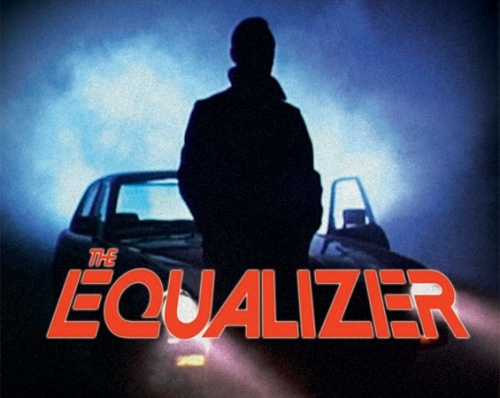
But whereas the TV equalizer rarely got his hands or his clothes dirty (compare TV poster below with film poster above), the film equalizer is willing to release a storm of martial arts and weaponry on the bad guys. Thus, the film is much more action packed than the TV show.
The-Equalizer-TV-Poster

To the credit of director Antoine Fuqua—who also directed Washington in Training Day—despite at least a dozen scenes of intense violence and blood-letting, he does an amazing job of minimizing the amount of actual blood that reaches the screen. In part, he accomplishes this by shooting the most violent scenes in darkness such that you only really see light reflecting off dark puddles. Likewise, when McCall does resort to using make-shift weapons (remember, he works in a Home Depot), the camera often switches to McCall’s face as he uses the weapon rather than to weapon and victim.

Unfortunately, McCall is such a cool and controlled customer that I never really worry about him. I cheer his victories when he vanquishes the dragon, but I find it difficult to really attach myself emotionally to the man. I like the quiet man, but I find the killing machine to be just that, a machine; an automaton that does not touch my heart. And with the exception of a handful of moments, we never really get a chance to appreciate the toll these actions take on him.

The other place I feel the story falls down is in the use of the Russian mobster sent to clean up the mess that McCall started, a man simply known as Teddy. Played by Marton Csokas, Teddy and McCall are equals. The same side of the same coin. Equally smart. Equally charming. Equally viscious. And as such, the only real threat in the entire film to McCall.

The-Equalizer-13-Marton-Csokas

(As a side note, if this role is any indication, we want to keep our eye on Marton Csokas. He will do amazing things.)

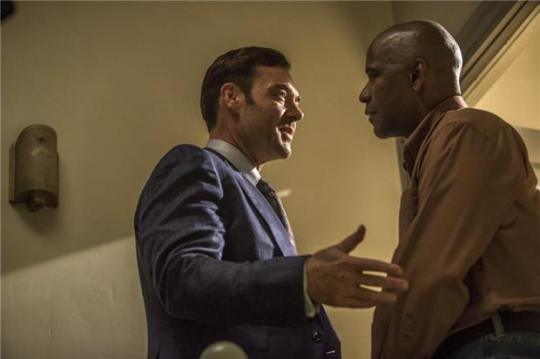
There are a couple of scenes where the two men literally face each other and calmly discuss the situation. One scene in particular is the best thing in this movie from my perspective. While on one level being the calmest moment in the movie, it is also the most chilling because of that calm. You really don’t know what’s going to happen.

And that’s where my problem lies.

Having set up the perfect opponent for McCall, the writer Richard Wenk (who also penned The Expendables 2) doesn’t really deliver. The audience was promised an epic show down between these two characters, but while they do clash, it is anything but epic (photo below is not from clash).
the-equalizer-marton-csokas-and-denzel-washington

The Equalizer is entertaining. It is a wonderful diversion that requires little thought of its audience. It is Jason Bourne for the middle-aged set (but with enough carnage to keep the young’uns interested). It should, however, have been better.

But when it comes right down to it, the studios don’t really care if you like it, because they are already working on the sequel.

Unlucky Lucy – a review

lucy_ver21_xlg

What if every time…

Number Line #1

someone tried to tell you something…

Whispering+in+ear_jpg

they inserted a photo or video…

student

that showed the same thing they said?

mirror

Pretty irritating, eh?

Welcome to the first 30 minutes of Luc Besson’s Lucy, released to theatres this weekend.

(I’ve done my best to avoid spoilers, below.)

What could have been—should have been—an amazing sci-fi thriller about the possible repercussions of a young drug mule who becomes exposed to the drug and slowly finds her brain building to 100% functional capacity, was instead a massive disappointment weighted down by a ton of metaphoric sledgehammers and drowning in a sea of over-exposition.

To be sure, there is a really interesting movie somewhere in the middle of the morass that ironically becomes its own metaphor by the end of the movie. But it’s as though Besson the Director didn’t trust the story written by Besson the Screenwriter to simply let the story explore itself.

As the drug takes hold of Lucy, she goes from being an interesting female character (if a little cliché) to an automaton who simply narrates…literally narrates…what is happening inside her.

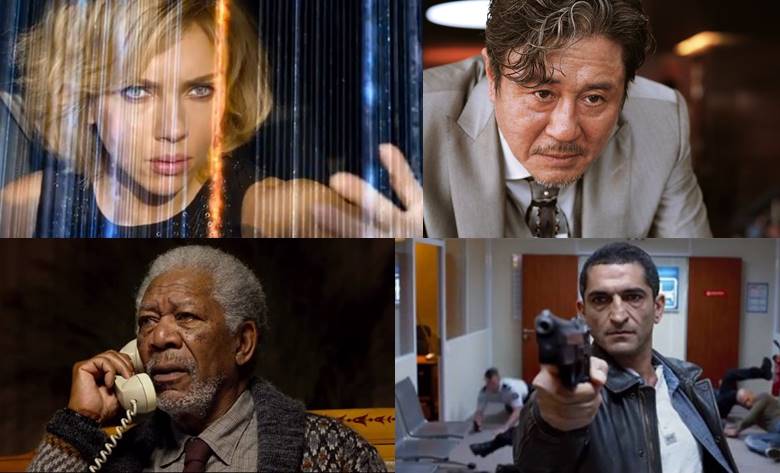
The drug lord Mr. Jang has the emotional range of complete indifference to mild irritation, which no doubt also expresses the feelings of acclaimed actor Min-Sik Choi, who portrayed him.

Even the calming voice and reason of Morgan Freeman’s Prof. Norman quickly gives way to befuddled camera-mugging and WTF?

The only truly interesting character was French police detective Pierre Del Rio, played beautifully by Amr Waked, who clearly functions as the eyes of the audience. As a friend of mine pointed out, even he at one point turns to Lucy and asks “What do you need me for?” What, indeed.

Lucy cast

To be certain, the visual effects in several parts of the movie were stunning, but as with so many movies I’ve seen in the past few years (e.g., Prometheus, Transcendence), the visual effects have become sleight-of-hand to keep you (or try) from seeing the weaknesses of plot and character.

The action sequences highlighted in the trailers take about as much time in the full movie as they did in the trailer, and so little is ever in doubt with the plot that the movie truly cannot be described a thriller.

But perhaps where the movie was most disappointing was in its promise to explore the nature of what it is to be human when faced with super-human capabilities. THIS is what the movie should have been about!

But Besson largely discards the question as quickly as he raises it in two short scenes involving a call home to mom and a simple kiss. And in both cases, Lucy coldly explains her conundrum, her human fears represented by the odd tear drop down an otherwise lifeless cheek. Rather than see Lucy struggle with her transformation, we watch her turn into a robot bent on a mission…a mission that she basically accomplishes without struggle.

But just to be sure we get the great metaphysical concepts behind the story, Besson then reverts to his earlier legerdemain, smacking the audience around with a brutally metaphoric journey through time and space. I give you intergalactic sperm meteors…you’ll know then when you see them.

And all this rancour without even touching on the biochemical, biomedical, anthropological and astronomical issues that run rampant in this mere 90 minutes.

This could have been an amazing movie. It wasn’t.

(Images are property of owners and are used here without permission.)

charACTer

Anyone writing stories NEEDS to read the blog post by Chuck Wendig listed below!

http://terribleminds.com/ramble/2014/06/03/just-what-the-humping-heck-is-character-agency-anyway/

Wendig blog

Seriously. Please read this!

His pivotal point: “The story exists because of the character. The character does not exist because of the story.”

Too often, I read screenplays where the protagonist is merely swept along like a bobbing cork on a sea of conflict. They merely REACT to the injustice around them rather than ACT to change it. They are the victim of the story.

To my mind, a much more interesting character is one who takes action when presented with conflict and then deals with the repercussions of that action. In some stories (the best ones to my mind), the protagonist is his or her own worst enemy, bringing conflict upon him or herself.

It is not enough to chase your hero up a tree and then throw rocks at him. He can also catch some of the rocks and throw them back, perhaps hitting innocent bystanders who then turn on him as well.

As a reader and viewer, it is through the actions of your characters that we learn their perspectives, their world views, and thus, their flaws. And if your story has a redemptive angle, it is through the complete failure of this world view and the character’s re-evaluation of it that he or she is reborn.

Just like giving the same premise to 12 writers results in 12 different stories, placing any of 12 different characters into the identical situation with identical opponents will result in 12 different outcomes if the characters are real.

Honour that in your writing and honour your characters.

They are called char-ACT-ers, after all, not char-REACT-ers.


Wendig is on Twitter: 

Screenwriting, not choreography

Write-dance

In her weekly blog Why The Face, my friend Marsha Mason (more “Hey, there!” than Goodbye Girl) hits briefly on two topics of particular angst in new screenwriters: camera directions and over-written action sequences.

For me, both of these come down to the same issue: the screenwriter’s need to choreograph his or her story so that the reader “sees” the movie as the screenwriter “sees” it.

Below, with permission, I have reproduced Marsha’s original post and my comments on it.

WTF

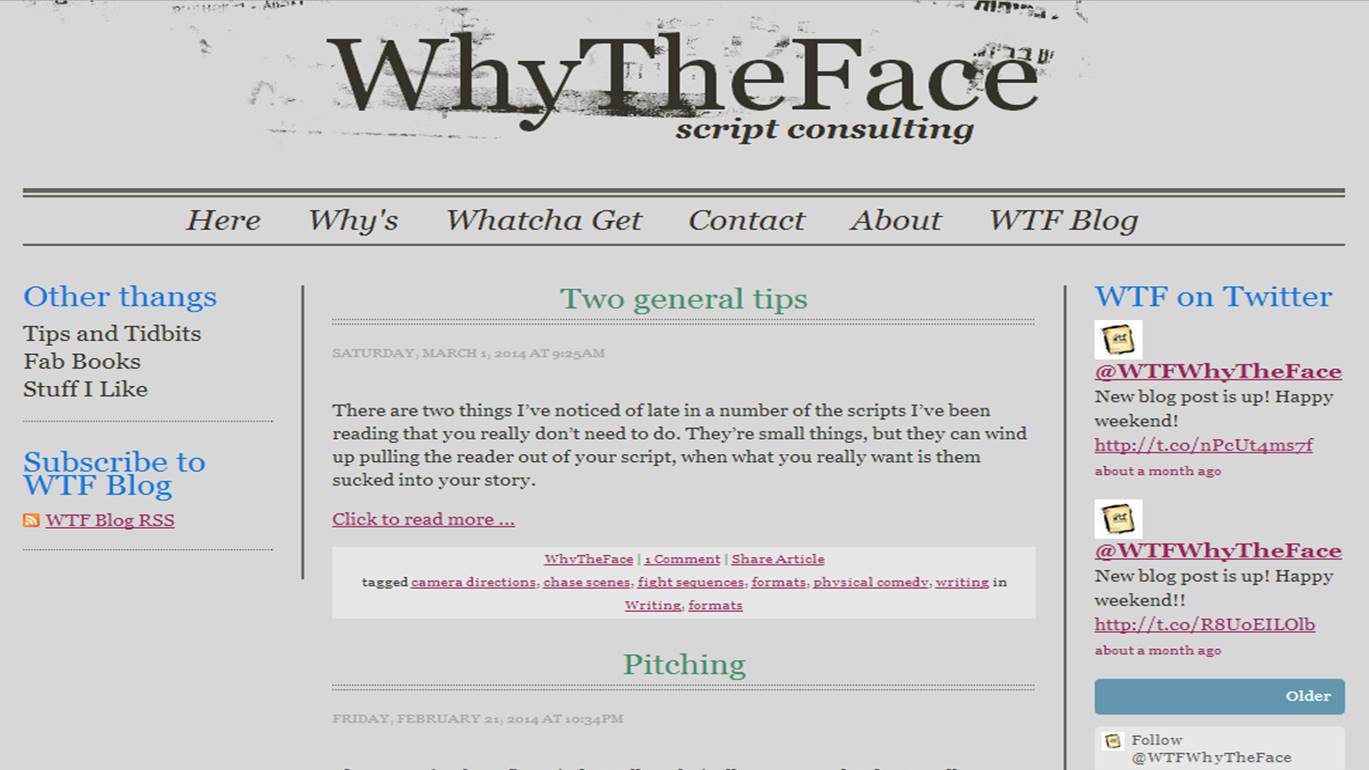
Why The Face, March 1, 2014:

There are two things I’ve noticed of late in a number of the scripts I’ve been reading that you really don’t need to do.  They’re small things, but they can wind up pulling the reader out of your script, when what you really want is them sucked into your story.

1) Camera directions: leave them out. When someone falls in love with your script, the director that attaches to it will be the one to figure out what camera angles they’ll use and when.

And…

2) Detailed descriptions of fight sequences/car chases/long physical comedy bits: once someone falls in love with your script, there will be stunt choreographers, fight directors, and your star actor/comedian, people whose specialty it is to design these sequences for the production, based on the needs/wants of the director/producer/star.

A better idea is to describe the feeling and the tone so the reader knows what you’re aiming for, rather than going on for a page or more.  Ie “An epic car chase ensues.   More Seth Rogen behind the wheel than Al Unser Jr., it goes for blocks, barely missing nuns and orphaned children.”

Essence of, then right back into your story.

My comments:

Couldn’t agree more. Too many people feel they have to direct their screenplay to ensure the reader “sees” what they “saw” in writing it.

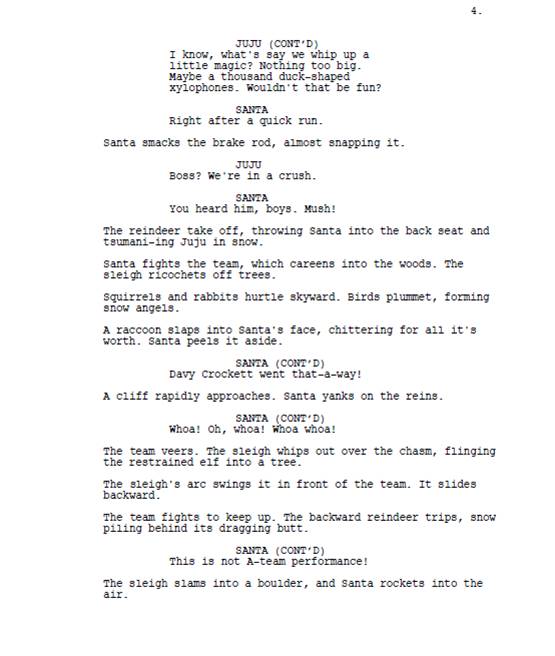
In a few screenplays I read recently, the writer went to great lengths to choreograph fight scenes, offering the minutiae of balletic movements.

“Raising his knee, he blocks X’s kick, and then twirls to chop X across the back of the neck. Stunned by the blow, X falls forward but recovers quickly enough to tuck and roll back to his feet. Etc. Etc. Etc.”

A fight sequence should have a sense of energy, urgency. These are people struggling. You want that to play out emotionally. You want the reader to break out in a sweat, his or her pulse elevating while reading the scene.

Instead, you slow down the reading with lengthy descriptions. The reader has to wade through line after line of description.

As Marsha describes, you can offer the fight in broader strokes to elicit feeling or tone.

Alternatively, you can present a sequence in short, staccato phrases and sentences. It is like having 20 hockey players firing pucks at you, at will. You become powerless in the onslaught, never precisely sure from where the next shot is coming.

Because the descriptions are short, they take little time for the reader to absorb before he or she moves onto the next one. Each line comes faster and faster, until the reader finds him or herself in the fight.

And then suddenly, it is over and the reader is left drained, but exhilarated.

In action sequences, less is more.

Sleigh


(Note: The above sequence is from my latest screenplay The Naughty List, a holiday-themed film for adults. Think The Santa Clause meets Good Morning, Vietnam.)

You’re quite the character

mirror

I just finished a post by fellow blogger Bare Knuckle Writer, entitled: Mutants: You and Your Protagonist. In it, she describes how her protagonists eventually end up being some version of herself; her beliefs, her mannerisms, her idioms. Not a carbon copy, you understand, but a variation on the theme that is she. (If you don’t know what a carbon copy is, talk to your grandma.)

This got me thinking about my own writing habits and quickly crystallized into the realization that all of my characters, or at least the major ones, are some variant of me.

Although I would never—or at least rarely—expect me to perform any of the actions or give any of the speeches of my characters, to make the characters believable, for me to truly get inside their heads, I have to give them free range inside mine.

I have no expectation that I will ever chase a murder suspect down an alley or cut off my enemy’s oxygen supply to get him to submit to my will, but I can’t say the idea is impossible given who I am (and what I have muttered in traffic).

To bring out the best and the worst in my characters, I have to be willing to reveal the best and the worst in me. The process is a variation on what makes other writers’ characters relatable to me.

othello-iago

If we look at one of my favourite plays—Shakespeare’s Othello—I can quite easily visualize aspects of my personality and even past behaviours in all of the main characters.

I have spit venom and schemed like Iago, been as empassioned as Othello, been as blinded by lust as Roderigo, as fawning for favour as Cassio, and as blinded by love as Desdemona. All various aspects of one person’s personality.

In an ironic footnote of life imitating art, my wife finally took me aside one day to explain that asides only work in the theatre. Although it was true that no one could hear Iago’s asides in Othello, everyone in the real world could quite easily hear mine. This, of course, helped explain why all of my evil and cunning plans failed so miserably.

I am my characters and my characters are me.

It is less “you are what you eat”, for people like me, and more “you are who you write”. Thus, to thine own characters, be true.

Do it

Image

Do it now!

Don’t think about it.

Go!

Don’t hesitate.

Aaaand now!

You’re stalling.

Now, Now, Now!

Suckage is encouraged.

Make it happen!

Don’t let fear stop you.

You are the [insert action]!

Do or do, there is no failure.

Dooooooo it!

It’s better than sex (unless you’re doing the sex, in which case, it is exactly like sex)

Go-go! Get’m-get’m! Ooh-aah!

Yay you!

(Image is property of owner and is used here without permission because I do’ed it!)

Waterfront birds

Another sunny day and another errand can mean only one thing: another day traipsing around with the camera.

A few more scenery shots than usual–different lens–but this first batch is dedicated to the most fowl of Lake Ontario.

Dialogue v Narrative

Image

Yesterday, my friend Marsha posted a short piece on her blog—Why the Face (WTF)—where she discussed her challenges in writing narrative/action for a scene and how she found scene writing to be so much easier if she started the dialogue.

“On its own, free of formatting and figuring out what characters are doing physically,” she wrote, “it lets me really get into what these people are actually saying to each other.”

When I read this, I thought, what a fascinating approach as mine is the complete opposite.

When I start a scene, I can go on ad nauseum about the setting and what the characters are doing or how they are behaving, but I find actually expressing the characters in dialogue to be daunting. When I do start writing dialogue, I find that I am writing exactly what my characters are thinking (on-the-nose) or that their emotions and motivations are incredibly superficial.

When I describe a character’s behaviour, however, his or her emotions surface more slowly through unconscious tics. The tensions that I intone in my mind’s eye then inform the word choice when I start to write his or her dialogue. It is as though I have to psych myself into the character’s body before I can express his or her desires and impulses to the fullest.

What makes this ironic is that while discussing this with Leela, another friend, she reminded me of the days when I first started writing sketch comedy, and all I could seem to manage were a series of “talking-head” sketches. At that time, action was unimportant to me as I felt the only way to bring my point across was through words.

On paper, my sketches could be very engaging, whereas on stage, they were significantly less so. Thus, I needed to learn the power of the unspoken word. Apparently, the pendulum has swung full tilt and I am now in the process of finding a happy medium. (No wonder writing is so tiring.)

Ultimately, like a good Oreo cookie, the best screenwriting comes from the combination of solid narrative (icing) and solid dialogue (cookie), so I am glad Marsha has my back and I have hers.