Too many voices (spoil the screenplay)

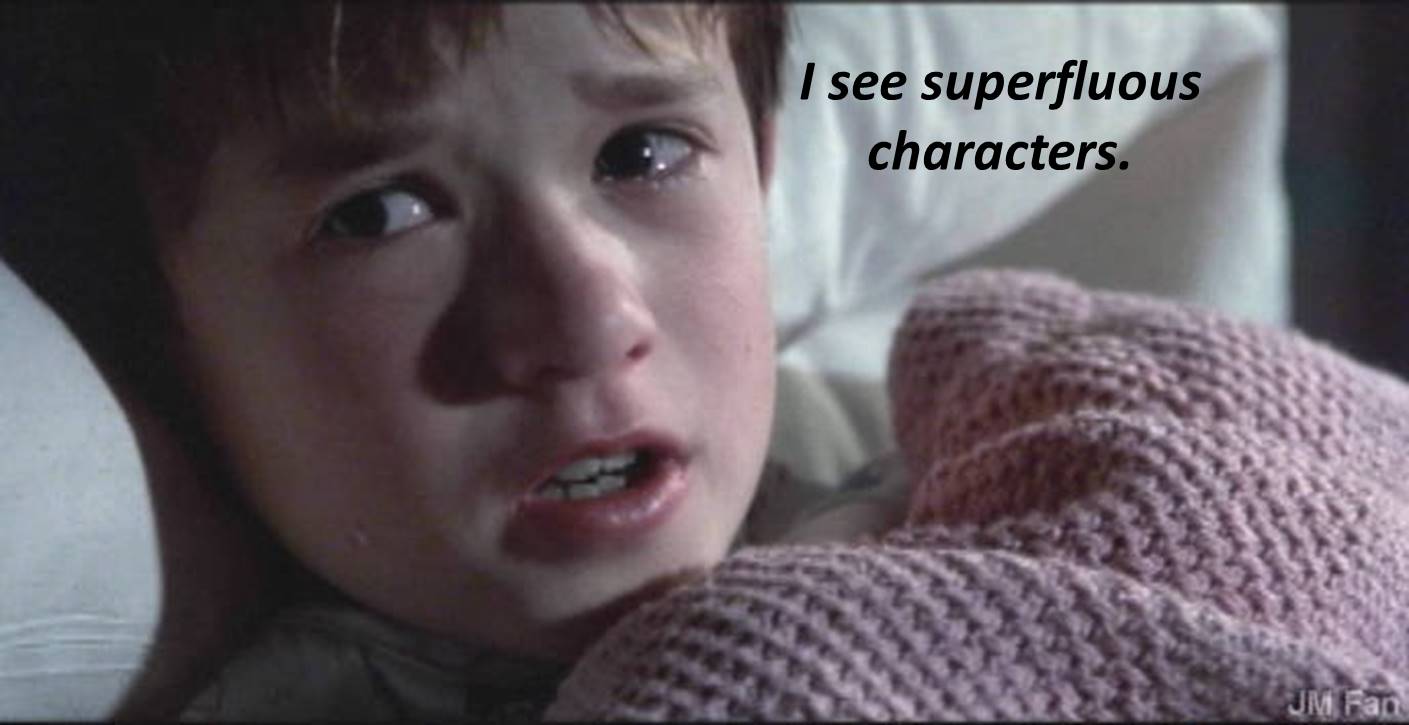
Superfluous

Congratulations! You have just outlined your next screenplay. Or maybe you’ve written “Fade Out”. That’s quite an accomplishment and you should be proud of yourself.

Go ahead. Take a moment to luxuriate. I can wait.

Okay, now I need you to kill one of your characters…or two…or maybe even three.

What? Oh, I know you’re not writing a thriller, but murder will be good for you. And even if you are writing a thriller, you’ll feel better after you pull the plug on certain characters.

Having written a few screenplays and having read 50X more, one common thread I find is that writers (me included) create too many characters, some of which are completely unnecessary.

Now, I’m not talking about the red-shirted cannon-fodder that fills the background…the cab driver, the concierge, waiter, ex-boyfriend, whatever. No, I’m talking about those characters just below the protagonist, antagonist, side kick/mentor/love-interest who help move your characters through a plot point (or several) and then disappear completely.
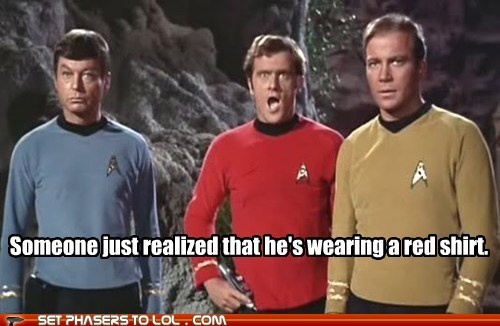
red shirts

Let me give you an example from a murder thriller collecting dust on my hard drive…The Children of San Miani.

In my story, a journalist provides a young detective with just enough information to introduce her to the lead suspect, a victim’s rights advocate with a major reason to want the first murder victim dead.

In reviewing my first draft, I realized that the moment the journalist connected the detective and the advocate, he completely disappeared from the story. He became superfluous to (story) need, so I simply stopped talking about him.

This begged the question: Did I need the journalist character at all?

With very little thought, I quickly realized I could accomplish all of the journalist’s plot points without the journalist, either by ascribing his actions to other main characters or to the story itself. And poof, he was gone.

The result was a story that was that much tighter. A story that was a bit less confusing and yet still maintained the mystery I needed for the thriller.

Look at your story. Focus on those second-tier characters.

Are there some that don’t make it to the end of your story; that simply trigger or drive a scene or two forward?

Can those triggers or drives be handled by another character in your story, maybe a main character? Or perhaps those actions can extend the life of another secondary character who just plops into your story from the ether?

In some cases, the answer may be no; that in the grand scheme of things, this character is vital if temporary.

Fine. Keep the character. You are the best judge of what is needed for your story. But I’ll bet at least one character can go.
1248-left4dead-no-mercy-wallpaper-wallchan-1280x960

Show no mercy. Cut the strings. Release the Kraken. (Oops, sorry. Wrong movie.)

Don’t smother your screenplay. By eliminating the unnecessary, people will better understand and appreciate your story more quickly.

And when you may only get one read (if that), the easier you make it on your audience, the better.

(Images are property of owners and are used here without permission, and may be completely superfluous.)
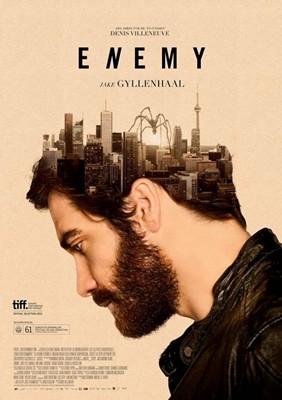
Enemy—The movie with the meta title

Enemy

So, it was $5-Tuesday yesterday at the Carlton Cinema in Toronto and a friend invited me to see a movie called Enemy, starring Jake Gyllenhaal. Like any weary movie-goer, I immediately jumped online to look at the trailer and thought, “Hmmm, weird, but interesting”.

I was half right. The movie was weird.

At this point, I should probably say “SPOILER ALERT”, but truth be told, I am not sure that if I laid out every event that occurred in this movie, you would know what was happening. I sat through it and I don’t know what happened.

As the trailer indicates, the movie is about a man who is dissatisfied with his life—never explains why, he just is—and is merely going through the motions of living until one day when he realizes that his exact doppelganger lives in town.

Terrified at this revelation—never explains why, he just is—he is nonetheless drawn to his twin and after jumping through a series of over-complicated hoops, he meets the twin. At which point, he second-guesses his decision and it is his twin’s turn to go neurotic—never explains why, he just does.

As you may have guessed from my above repetition of “never explains why”, my greatest issue with this movie is unclear character motivation. Perhaps it says more about me and my life history, but I have no idea why any of these characters acts as extremely as they do.

I am confident that it is part of the artistic conceit of the piece that at numerous moment are you fully sure which Jake Gyllenhaal character you are watching onscreen. The challenge with this is that the emotional rollercoaster of each of the characters is such that from cut-to-cut within the same scene, I am never sure which Jake Gyllenhaal character I am watching. I ended up watching the characters’ clothing rather than the actor’s face to try to follow the story.

And the motivations of the secondary characters are just as muddy for me, although at least here, we have different actors and so don’t have the Gyllenhaal rabbit hole with which to contend. Like a faucet tap, the emotions of these characters change with a flick—questioning in one moment, horny in the next, and angry in the third, and all in the span of 30-45 seconds.

A definite statement of who I am, I spent much of the movie trying to predict the reveal of the story based on the clues or purely on conjecture.

Twins separated at birth? Time travel with a glitch? Parallel universes collide? Psychotic episode of one man leading two lives?

No SPOILER ALERT to say none of these came to fruition, but that still doesn’t mean that any of them may not be true. Hell, all of them might be true. I don’t know.

And any hope of a conclusion is muddied by a massive metaphor that scurries through this movie—I won’t tell you what it is—and yet offers no satisfying explanation.

Enemy is described everywhere as a thriller. I’d be more inclined to call it a puzzler…and even that may be too lofty. Head-scratcher and headache-giver might be more accurate.

As I read up on the movie to write this, I learned the film won Canadian Screen Awards (our Oscar) for Best Director and Best Supporting Actress, and was nominated for Best Film. I find that disturbing.

The film was based on the 2002 novel The Double (O Homem Duplicado), by Portuguese author José Saramango. Part of me wants to find the novel to see if it is any clearer than the movie, but as of this moment, a bigger part of me just wants to walk away from this entire episode in my life.


Previous posts about characters in writing and film:

Just Tell The Story – Austin Film Festival

The Dignity of Characters

A Matter of Character

Can You Relate?

I Am Always Right (Motivation)

Dara Marks at Toronto Screenwriting Conference 2013

Unpacking Baggage (Part One)

Unpacking Baggage (Part Two)

Re: Rewrites (Part Two)—Toronto Screenwriting Conference 2014

Chitlik_2

In Part One of this post, we examined Paul Chitlik’s approach to reviewing the structural elements of a story, including the idea that a screenplay is actually comprised of four stories: The plot-based Main Story, the relationship-led Emotional Story, the protagonist’s internal Personal Growth Story, and the humanizing Antagonist’s Story.


Dissecting character

To truly understand your main characters, Chitlik recommends building something of a character profile that you can use as a steady reference while examining how the character acts and speaks within the screenplay. This is critical, Chitlik says, because often when you start writing a screenplay, you really don’t know your main characters and as you write, they will become more defined.

For assistance and more insights, Chitlik highly recommends Lajos Egri’s book The Art of Dramatic Writing.


Protagonist

Physiology – develop a sense of what your character looks like even if you don’t incorporate it into your story (something beyond “tall man in his mid-20s”)

Sociology – imbue the character with a social history: family life, school, jobs, etc.

Psychology – how does your character think and respond to his or her environment? Here is where the personal flaw comes to the fore

How is the character reflected in his/her dialogue? – in how he sounds, the word and grammar he uses, and how he acts

What is your character’s defining line? – Think Dirty Harry, a battle-weary cop with a strong moral center who is begging the criminal to make him shoot “Go ahead, make my day.”


Antagonist

Physiology

Sociology

Psychology

Human quality – what makes your antagonist more than a 2-D character? Why should we empathize with him or her?

How is the character reflected in his or her dialogue?

What is the antagonist’s defining line? – Think Terminator and “I’ll be back.”


Dissecting the screenplay itself

Chitlik then lifts his view slightly higher from the page, offering ways to dissect the screenplay in a more technical manner from its content to the paper itself.


Seeing the Scene

Each scene has all 7 of the structural elements of your story, so be sure you can identify them, although be aware that some elements may not occur within the lines of the scene but rather are implied or referenced within the lines.

Does the scene have any/enough/appropriate conflict? Chitlik finds conflict to be the #1 problem of new writers, which leads us to a discussion of goals

He is adamant that every character within a scene must have his or her own goal, however prominent or minimal to the plot. The conflict, he suggests, comes from the points at which these goals thwart or oppose each other.

Also, look at the emotions of the characters within the scene. Do you maintain them throughout the scene or when they change, do they change when something acts to cause the change?

And for emphasis, re-examine the conflict of the scene.


Looking for Cuts

Chitlik suggests he has never read a screenplay that couldn’t benefit from cutting about 10%.

He suggests you start by looking for scenes that lack conflict, don’t move the story forward (treading water) or fail to illuminate one or more characters in some manner.

Either eliminate these scenes or find some way to incorporate the missing ingredient.

Then look to cut off the heads and tails of scenes, starting later or ending earlier. An example he gives for the tails is leaving the scene when the final challenge arises or is issued, and he points at the work of David E. Kelley in this regard. The resolution of the challenge, he argues, can easily be worked out by the audience through the start or context of a subsequent scene. You don’t have to always spell things out.


Presently Presentable

This is the challenge of first impressions. Chitlik gives the example of a former student who sent him a screenplay she wrote and on the title page, she misspelled her own name. This, he says, did not bode well for what was to be found inside.

Chitlik describes this as the Mercedes Benz theory of script presentation. If you are going to spend $100K on a new Benz and you are presented with two cars—one that is absolutely beautiful and immaculate and one that is dinged up and dirty—which one would you choose to spend your money on?

Look at the pages of your screenplay and ask yourself how much of the page is black and how much white. Before looking at a single word, readers will be repelled by heavy screenplays with long descriptive sections or heavy dialogue. Find ways to break this up to leave more white space on the page.

Chitlik’s other cautions are: Spelling, Punctuation and Grammar.


The Rewrite Plan

Chitlik’s plan is straightforward and iterative:

  1. Write a biography of the protagonist in his/her own words/language
  2. Write a biography of the antagonist in his/her own words/language
  3. Reread the screenplay, making notes on the above topics
  4. Create a new beat sheet of the screenplay, adding new scenes that help your story play out and cutting old ones that don’t work or aren’t necessary
  5. Write new pages and rewrite old ones from the beginning
  6. Go back to Step 3

If it sounds like a lot of work, it is, but Chitlik promises that with each iterative run, the work gets easier and the outcome improves.

tsc-logo

Re: Rewrites (Part One)—Toronto Screenwriting Conference 2014

Chitlik

One of the definite highlights for me at this year’s TSC was the rewrite session offered by screenwriter, director and producer Paul Chitlik, who is now also a professor of screenwriting at Loyola Marymount University. For me, the practical sessions resonate much longer than the advice or adoration panels.

If there was one disappointment with Chitlik’s session it was that the 90 minutes apportioned to him were not nearly enough for him to really explain his process, try as he might. Thus, in many respects, the session was more of an appetite whetter for his book Rewrite: A Step-by-Step Guide to Strengthen Structure, Characters, and Drama in Your Screenplay.


Stages of review

For Chitlik, a good rewrite means taking 8 separate passes at your screenplay, which include:

  1. A review for structure
  2. A review for conflict
  3. A review of descriptive paragraphs
  4. A review of the protagonist’s dialogue
  5. A review of the antagonist’s dialogue
  6. A review of the supporting character’s dialogue
  7. A review of cuts that can be made
  8. A review of the presentation of the screenplay

According to Chitlik, this iterative review process causes many of his students to groan, but his attitude is that if you don’t like your script enough to read it eight times, you seriously need to rewrite your script or you need to throw it away and work on something else.


Structure: The main story elements

Before starting his specific rewrite techniques, Chitlik took us on a bit of an overview of the main elements of the main story, acknowledging that this number will vary depending on who you read or to what storytelling philosophy you ascribe.

His main points or pillars are: Ordinary life, inciting incident, end of Act I (goal or plan), midpoint, low point, final challenge, return to the now-forever-changed normal life.

In the ordinary life, we find our protagonist impressionable and naïve, and from Chitlik’s perspective, our first visual of the protagonist should give us some clue as to his or her character flaw. This is where we see the character in context and how the person’s flaw interferes with his or her normal life.

With the inciting incident, something external to the protagonist impacts his or her world, changing the world forever and forcing the character to take action. Chitlik acknowledges there is a lot of debate on where precisely within a screenplay the inciting incident should occur. He actually prefers later (toward page 15) to give us time to get to know the protagonist.

By the end of Act I, the protagonist has had a chance to reflect on the inciting incident and formulate a response. This is where the story really begins as the protagonist takes the lead. Chitlik acknowledges that this isn’t always the case, however, and offers the example of Thelma & Louise where Thelma doesn’t really take control of her world until the midpoint.

By the midpoint, the protagonist has been pursuing his or her goal but an external force spins the story on its axis, leaving the protagonist to come up with a new goal or plan. For Chitlik, the protagonist should also learn something new about him or herself when this happens.

By the end of Act II, though, the protagonist reaches the low point, ideally triggered by his or her flaw, where all is lost and the goal seems completely unattainable. As Chitlik notes the cliché, the dark night of the soul.

At some point, an external force triggers the protagonist to engage in the final challenge. Here, the protagonist must overcome his or her flaw, and often repairs a relationship. Chitlik notes that while this final challenge is often large and dramatic (e.g., a battle), it can also be quite small and subtle, but it must involve the protagonist overcoming the fatal flaw.

The protagonist then returns to the new normal. Life often moves just as it did in the beginning, but the protagonist’s approach or viewpoint is forever changed in some way.


Chitlik then suggested that the story is actually four stories, each of which has its own version of the 7 story elements, but are ideally intertwined with each other:

The Main Story included the basic plot points or challenges the protagonist faces

The Emotional Story describes the central relationship of the protagonist, whether with the antagonist, a love interest, or some other form

The Personal Growth Story shows how the protagonist comes to face and then overcome his or her flaw

The Antagonist’s Story highlights that the antagonist has his or her own goals in life (wants and needs)

Chitlik adds that we may never see the antagonist’s ordinary life and instead of a flaw, we want to show his or her human quality, which makes the antagonist both more empathetic to the audience and a bit more chilling.


In Part Two of this post, we will look more closely at Chitlik’s advice on dissecting first your main characters and then the actual screenplay itself.

tsc-logo

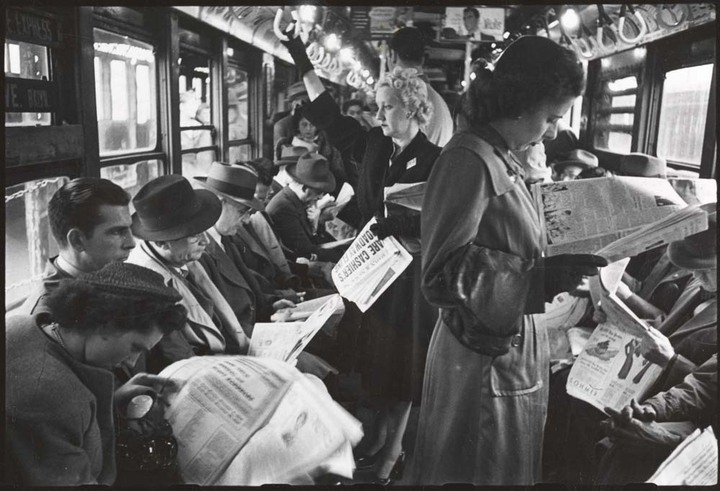
The subway ride

I don’t actually know what the following is, other than: the beginning.

subway-1

The subway was crowded that morning. It was always crowded when it rained.

It was like no matter how far people had to travel, they were terrified of getting wet. It’s probably closer to the truth to say that most of them had lost several umbrellas in the windy corridors created by the city’s office towers. And yet, to a person, every man and woman carried a neatly folded umbrella, their multiple layers showing nary a single bead of dampness.

By the second station on my route to work, I had lapsed into my typical fog of who cares. At this stage in my life, work was just something I had to do to make money. I had long ago given up on any hope of finding fulfillment or happiness on the job, if only because the company had a strict no-dating policy. Without interoffice sex, my desk was just another place to sort papers.

It didn’t take long before the fog in my head was matched by a fog on the windows of the subway car. The body heat of the mingled strangers turned damp coats and hats into instant humidifiers, rain water mingling with sweat and post-shower damp to coat the walls and windows of the subway with rivulets of diluted deodorant, cologne and perfume. All we needed were a few handprints on the window and the subway car would have looked like the back seat of a sedan parked at a drive-in where the kids inside were doing everything but watching the movie.

I had managed to grab a seat that morning, an unexpected bonus for getting up a little earlier. Even living at the end of the line was no guarantee of finding any comfort in local transit. Too often, I spent my time staring down the tops of flat-chested teens too self-absorbed to give up a seat or leather-skinned grandmothers so desiccated they made your tear ducts hurt. That morning, however, I had managed a forward-facing seat. So people could look down my top and I got to stare right into their crotches.

It was a rough ride into town that morning. The constant start and stop of the train as it waited for the guy up ahead to get his shit together, and the tropical humidity that was slowly growing in my shorts made the decorated plywood seat under my ass that much more uncomfortable. Within 20 minutes, I found myself chafing like a newborn in a day-old diaper.

Tugging at my trouser legs to try and unbunch the material from my crotch, I felt something soft and dry against the back of my left hand. Looking over, I realized it was a leg.

A gorgeous leg. A leg that begged to be touched, but could just as easily crush your balls with the slightest twitch. A leg that worked out regularly, but had never seen a gym in its life. And standing right next to it was another leg, which also shimmered in the grey opalescence of flawless stockings.

Recognizing my transgression and not wanting to be rude, I moved up from the legs. Past the immaculate tweed skirt, the crisp peach blouse, the mottled brown scarf and up to the reddest smile I have ever seen in my life.

This red, I was certain, existed nowhere else in the world. This was a red created for one woman and set aside, the formula for this colour being instantly destroyed as it would appear flawed on anyone else.

I smiled at that red, those lips, and nodded slightly. It was an apology for the unintended intimacy. Words seemed out of place for some reason. The slight rise of her right cheek told me I had been forgiven.

Summoning everything I had in me, I tore my eyes away from that mouth and back to the zoo I called my ride into work.

The fog had definitely lifted from my morning, but it had been replaced with an equally numbing intoxication that I couldn’t handle. Although numbing probably wasn’t the right word, because there was damned little I wasn’t feeling at this moment.

I don’t know if it was 10 seconds or 10 minutes later when the subway jostled around a bend, but what I do know is that the leg found my hand this time. And as the curve of the tracks lingered, so too did the leg, sliding its silken fibers up and down the back of my hand until it began to pull the hairs out one by one.

As the train pulled back onto a straighter course, however, the leg stayed exactly where it had landed, determined to either erase every hair off the back of my hand or gain my attention. It was about to complete the first, but it was mission accomplished on the second.

(Image is property of owner and is used here without permission but a lot of inner dialogue.)

Cadence and Orson Welles

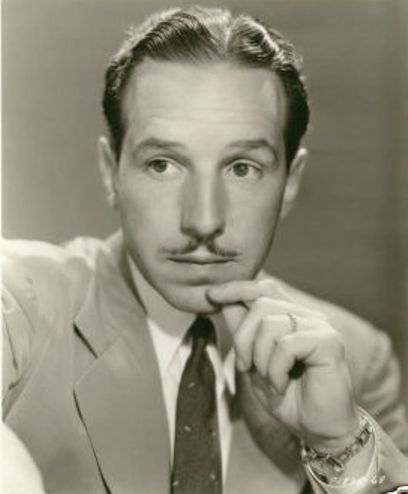
My favourite shot of Welles as I believe that smile and those eyes tell me everything I need to know about the man

My favourite shot of Welles as I believe that smile and those eyes tell me everything I need to know about the man

Being a good writer necessitates having a good eye and a good ear.

The good eye is the attention to details that will help you paint a word-picture of what you have seen with your physical eyes and processed in your mind’s eye. It’s not necessarily about writing long-winded passages of backgrounds or going into minute detail of a character’s physical attributes (I’ve done plenty of that), but rather in choosing the most precise and meaningful words to describe the environment or the person.

The good ear is the attention to how people communication and how they speak, not always the same thing. Again, it involves finding the right words and inflections (at least implied inflections) that give the reader and actor clues as to who this person is. And perhaps just as importantly, it is about finding just the right cadence for your character’s speech patterns.

If you listen really closely to a conversation, you’ll realize that there is little difference between speaking and singing. There is a rhythm, a cadence to speaking. Conversation is an improvised duet sung a capella. But unlike a traditional song which may have a subset of arrangements, each of us sings to our own tune, with our own rhythms and inflections. It is one of the many things that sets us apart from each other.

When writing characters, it is important to keep this in mind as all too often, a group of characters can have a certain monotone, which I use not to imply flatness so much as sameness. Often, I believe, it occurs when the writer neglects to add variety to his characters’ speech patterns and instead writes them with one voice; his or hers.

The best writers don’t make this mistake…or at least minimize its occurrences. Each character he or she presents us is truly unique, jumps off the page or screen, provides his or her own internal musical accompaniment.

One of my favourite writers of the last decade or so is Aaron Sorkin whose overall writing has its cadence but whose characters also tango (or more often tarantella) across the screen. Read the pilot to The West Wing or the screenplay for The Social Network and you will know you’re reading Sorkin.

But for me, perhaps a better example is Orson Welles, the man who would be Kane.

Recently, someone discovered a long-lost unproduced screenplay by Welles called The Way to Santiago, written in 1940-41. Another blogger discussed the find recently, and provided a link to the actual screenplay (see link below). You only have to read a couple of pages to remind yourself (or educate yourself on) how Orson Welles wrote and the energies he imbued in his characters, each one a snowflake of facets and reflections.

The opening page of The Way to Santiago

The opening page of The Way to Santiago

Now, listen to the films or read the screenplays of The Third Man, The Magnificent Ambersons, Touch of Evil. Although you may question the choice of actors, you can clearly hear or see the distinctions in the characters. Bathe in the richness and depth of each one as he or she is captured for this brief moment. This is the stuff of which dreams are made.

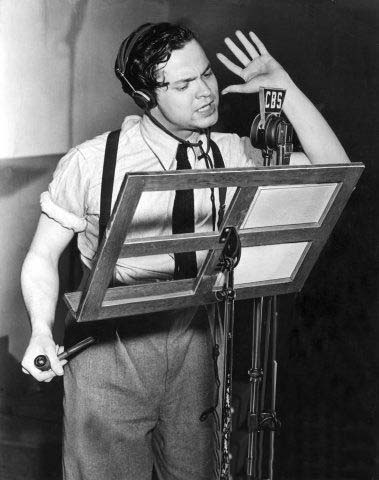
It is also interesting to consider that Welles got his start on stage and in radio, where the human voice plays such a larger role in conveying a story than it does in film. There is much less to occupy the mind onstage or in radio and so dialogue carries a significant burden of not only informing but also entrancing the listener.

Although the stories I write are distinctly different from the Wellesian oeuvre, there is much I can and do learn from this master of the written word. He is worth the read and the listen.

A classic image of Welles in his radio days

A classic image of Welles in his radio days

Links of interest:

The Way to Santiago at Cinephilia and Beyond

The Way to Santiago, starring Howard Hesseman on Vimeo (A valiant but not brilliant attempt)

“Thank You, Mr. Welles: Definitive actor, consummate director, and true auteur” at Curnblog.com

“Screenplays by Orson Welles” (listing) on Wikipedia

Me and Orson Welles A light but adorable movie that probably portrays Welles’ character better than Welles

Just tell the story – Austin Film Festival

Ron Nyswaner

Perhaps the most interesting advice I heard while attending the 2013 Austin Film Festival came from the Just Tell the Story session by screenwriter Ron Nyswaner, who suggested that not all stories are movie-worthy. It’s not that such stories are unimportant or not worth telling, but rather that film is a very specific medium—as are novels, videos, television, etc.—and therefore requires specific criteria be met for appeal.

1. Do you have a worthy protagonist? It is important that the audience understands the protagonist’s struggle, that the character is constantly dealing with questions of life, loss, yearning. There should be clearly understood interior and exterior conflict.

2. Does you protagonist have face worthy obstacles or a worthy antagonist? The antagonist should represent the opposing view, but that doesn’t necessarily mean the antipode to your protagonist’s views. Overall and within individual scenes, there should always be a sense of ideas in conflict. Nyswaner stressed the importance of the hope-dread axis—What do you hope is going to happen and what do you dread is going to happen in a scene—suggesting that the stronger the axis, the more tension you build in your story.

3. How strong is the central relationship? Sydney Pollack suggested that every story is a love story, and Nyswaner followed on that, suggesting that the relationships between your characters, and particularly the protagonist and antagonist, is what drives the story forward. The stronger that relationship (positively or negatively), the stronger the story. He also discussed the idea of triangulation; the effect of adding a third party into a scene to increase the tension or stakes.

4. Where am I (the writer) in the story? Who am I? All good art is personal, Nyswaner said, so the writer should look for his or her emotional connection with the story. By making the story personal to you, you develop a deeper story.

5. Take your audience into a world that’s interesting. If the audience cannot connect with the environment that you’ve created, they will find it difficult to get into your story. This doesn’t mean that the environment has to be familiar so much as understandable and relatable.

6. Do you have enough turning points to carry through a feature? A good film story is constantly changing direction, keeping the audience engaged and intrigued. Without sufficient turning points, audience members disconnect from the story or worse, get bored. Attitudes and powerbases should shift throughout the story to keep the audience guessing.

7. Does the audience love the story and its characters? Nyswaner suggests writers must be ruthless, paraphrasing a quote (trying to remember by whom) that a writer is a person who will betray the people he loves to impress people he will never meet. The key for a writer is to give everything to the story he or she is trying to tell, even at the cost of real-world expectations and relationships. This is not to say that success comes from being the biggest asshole, but rather that it is important to keep the focus of a film on the story and its characters to the detriment of other external factors (as best as possible).


Ron Nyswaner is perhaps best known for having penned the movie Philadelphia, but has also worked on television (Ray Donovan) and in print, and teaches film at the Columbia University School of the Arts.

The dignity of characters

Defiance

Every human has an inherent nobility and dignity, and it is only in the limits of that dignity that people differ. Some people (the snots) hold themselves to a very high standard, while others (the goofs) appear significantly more relaxed in their approaches to life.

Even within an individual, there may exist multiple levels of dignity befitting the person’s roles or functions throughout the day. As a corporate executive, she may hold herself tightly constrained to maintain her air of authority, while as a doting mother, she may release her inner child for a game of tag.

And yet, even with the role-playing variations of life, each of us has an underlying threshold across we are hard-pressed to pass.

What is true for people is true for the characters we create, or at least should be, I believe. And it is in finding that central sense of dignity that we truly begin to understand these characters.

It is pivotal to their thoughts, actions, words and silences. It is also critical to how they view the world and how the world responds to them.

The goofiest, the most nebbish and most loathsome of characters has a line they will not cross, which writers exploit by presenting each one with a crisis. And while the writer and reader may think of that line as representing different things to different characters—for example, a move from light to dark for the good guys and dark to light for the bad guys—it is important to view the line from the character’s perspectives and aspirations.

Thus, the line is always a move from my light to my dark, my good to my bad, my right to my wrong. To approach it any other way would weaken and potentially two-dimensionalize the character’s resistance to change.

Scar from The Lion King completely believed in the truth and the righteousness of what he was doing. He understood that his actions flew in the face of tradition, but truly believed he was acting for the greater good.

Likewise, the anti-hero Edmond Dantès of the Count of Monte Cristo felt completely justified in his criminal actions because he was removing men worse than himself.

In both cases, as I have said elsewhere, each character was the protagonist of his own story.

In the end, society consumed Scar when he reached his line (i.e., bow to his nephew Simba) and he refused to cross it, and almost consumed Edmond Dantès until he released his anger and found peace.

Regardless of how prominent or fleeting a character, they all have their dignity, and although we may not explore all equally—lest we never complete our works—an awareness of that line will make for amazingly richer and more memorable characters, and thereby, better stories.

Tired

Some interesting recent blog posts on character:

Caroline Norrington’s Get to Know Your Character: 15 Minute Character Development Prompter

Persikore’s Context Matters

Richard Ellis Preston Jr.’s Character Development: Finding a Friend for Life

Just a Tasmanian’s Character Development series: ProtagonistAntagonistSidekick/Supporting characters

You’re quite the character

mirror

I just finished a post by fellow blogger Bare Knuckle Writer, entitled: Mutants: You and Your Protagonist. In it, she describes how her protagonists eventually end up being some version of herself; her beliefs, her mannerisms, her idioms. Not a carbon copy, you understand, but a variation on the theme that is she. (If you don’t know what a carbon copy is, talk to your grandma.)

This got me thinking about my own writing habits and quickly crystallized into the realization that all of my characters, or at least the major ones, are some variant of me.

Although I would never—or at least rarely—expect me to perform any of the actions or give any of the speeches of my characters, to make the characters believable, for me to truly get inside their heads, I have to give them free range inside mine.

I have no expectation that I will ever chase a murder suspect down an alley or cut off my enemy’s oxygen supply to get him to submit to my will, but I can’t say the idea is impossible given who I am (and what I have muttered in traffic).

To bring out the best and the worst in my characters, I have to be willing to reveal the best and the worst in me. The process is a variation on what makes other writers’ characters relatable to me.

othello-iago

If we look at one of my favourite plays—Shakespeare’s Othello—I can quite easily visualize aspects of my personality and even past behaviours in all of the main characters.

I have spit venom and schemed like Iago, been as empassioned as Othello, been as blinded by lust as Roderigo, as fawning for favour as Cassio, and as blinded by love as Desdemona. All various aspects of one person’s personality.

In an ironic footnote of life imitating art, my wife finally took me aside one day to explain that asides only work in the theatre. Although it was true that no one could hear Iago’s asides in Othello, everyone in the real world could quite easily hear mine. This, of course, helped explain why all of my evil and cunning plans failed so miserably.

I am my characters and my characters are me.

It is less “you are what you eat”, for people like me, and more “you are who you write”. Thus, to thine own characters, be true.

Not for nothing – REQUEST FOR HELP

ssnolan3

How do you write about nothing?

I know how to not write. In fact, I was very good at that in the past, but gratefully not writing is no longer much of an option for me.

I’m not talking about not writing, however. Instead, I am talking about writing scenes where superficially nothing happens, where a character walks through the mundane actions of life. What they are doing is unimportant to them, a robotic response to an overwhelming thought or scenario. There is an astronomic exchange of information and yet no words are spoken.

In a novel or short story, you can have an inner dialogue, revealing the character’s thoughts, but in a film, you have only silence. Sure, there’s always the trusty voiceover, but I personally think that unless the character is recalling a past statement, voiceovers are a crutch. And a voiceover weakens a scene when you compare it with silence.

Think of the last time you were faced with silence in response to something you said or did. Think of the dis-ease (yes, that’s where “disease” comes from) you experienced as you tried to figure out what the other party was thinking. In many of those situations, I bet that shouting would have been preferable to silence.

In an improv class I took—I am sorry that this is my version of “This one time, in band camp…”—we were doing a status exercise wherein one character would try to take status away from the other one, proving themselves superior through statement or action. While many student pairs would do their best to out-pompous, out-preen or out-bravado each other, I took a different tack. I went completely silent.

No matter what my partner said or did, I faced him stoically or indifferently, deigning to give him the merest glance on occasion while going about my activities. And the louder or larger he got, the less I minded or acknowledged him. The more he talked, the weaker he appeared.

Silence is powerful. And even if the silence is due to idiocy, it comes across as thoughtfulness.

Think of scenes in movies where a character has chosen to deal with a problem by thinking about it. With a good actor, you can see all the thoughts as they play out in his or her mind. The body, the face, the eyes tell you all you need to know about the emotional swells washing through the actor. A single word breaks that tension and weakens the moment. As a storyteller, why would you ever give that up?

Which brings me back to my original question: How do you write nothing?

Perhaps I am delving too far into the domains of the director and actor, but there has to be a way to ensure both those artists know what you, the writer, intend. But I’ll be damned if I know how.

So, I open the question to you, my fellow artists.

What do you do, what have you learned, what have you seen that tells you how to write nothing and yet convey a world of thought and feeling?

Please share your thoughts here as I can’t be the only one who wants to know.