Stupid is pretty smart

Image

I find it interesting that most people seem to be less afraid of being stupid than they are of looking stupid.

I say this because of the inordinate amount of stupid material I find every day—the people posting this stuff obviously don’t think it’s stupid—and yet many of the brightest people I know (and not just those with whom I agree) are paralytically afraid of saying anything lest people think they’re stupid.

Now, I appreciate that stupid is subjective, but this is not a condemnation of stupid, it is a call to embrace our personal stupid and use it to move forward to brilliance.

If you watch a group of children as they age—not literally moment-by-moment; that would be stupid—you will see that they start out unfiltered and unhindered by subconscious voices that make them edit themselves. They are free to create amazing things and proudly display those things on refrigerators around the world.

As they get older, though, those subconscious voices creep in and you find the children become less enthusiastic about their art. They become more self-conscious about being seen as stupid, and so the refrigerators of the world become increasingly barren.

That is incredibly sad, and not just because the typical refrigerator is a featureless, oddly coloured box with little inherent fashion sense. It is sad because it creates a population of adults who are incredibly repressed and overwhelmingly self-conscious.

Image

As I have mentioned before, I have numerable friends who want to write, but they are routinely stopped from taking any action by an infernal firewall of what to write. They can’t just write anything. Writing just anything would be stupid.

No! No! No! Writing just anything would be freaking brilliant!

Writing just anything would make you a writer, rather than the non-writer you are now.

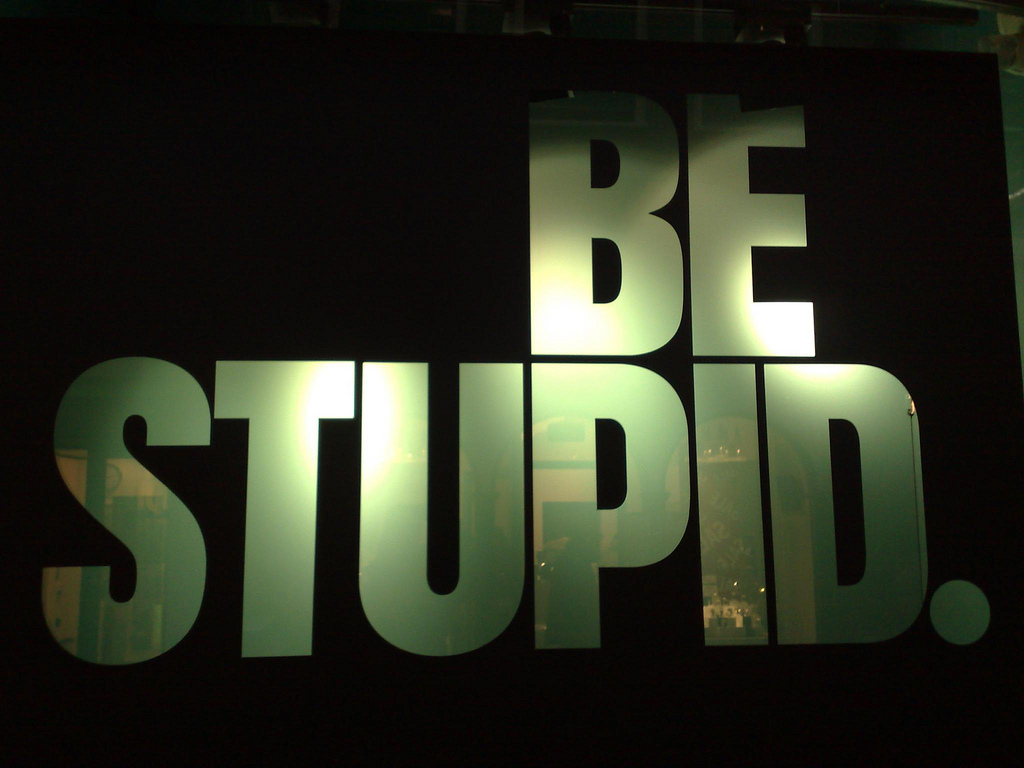
Write the word “stupid”. Write “stoopid”. Write “styupid”. Write “stewed pet”. And bloody screw AutoCorrect.

Let stupid be your creative scissors and run around the room not caring into whom you run or stab. Stupid begets intelligent, no matter how stupid that sounds.
Image

Besides, no matter how clever, intelligent or prosaic you are, someone is going to find your writing stupid. Stab them with your stupid scissors and move on.

I absolutely abhor the novel Crime and Punishment, routinely espousing that the crime was the writing of the book and the punishment is the reading, and yet many people find it a marvelous work of art. How stupid is that? (You can read that as I’m stupid or they’re stupid…I don’t really care.)

In King Lear (III, ii), Shakespeare wrote: “The art of our necessities is strange that can make vile things precious.”

As used in the play, this line has absolutely nothing to do with the point I’m making, and depending on how you read it, the line actually blows my thesis apart or completely justifies it. Now that is freaking stupid.

As Liam Neeson should have said in the movie: Release the Stupid!

You may just find that your stupid is pretty amazing…and even if it’s not, you’re one step closer to your brilliant.

Image

(Images used without permission. Pretty stupid, eh?)

Highway 401

Snowflakes hit the windshield / Like a swarm of angry bees

And are swept away as quickly / To make room for their brethren.


Clouds of frozen heaven / Scurry across the highway;

Riders on chaotic steeds / Dancing in a winter rodeo.


The car is buffeted / By the ever-changing winds,

And Zephyr’s howling wolves / Keep back all possible speech.


Ahead in the gloom, / Angry red eyes of devils

Waiver to and fro / Across sheets of black ice.


They slide into earthly clouds / Following well-worn lines,

The desperate marks of earlier travellers / In the uncertainty of the storm.


The normally limitless universe / Is bound on this night

By the visible few feet ahead.

The pathetic beams of headlights / Are white canes for blind drivers

Reaching cautiously into the unknown.

When life interferes

It has been an incredibly slow week on the blog as far as new posts are concerned. But whereas most people slow down periodically to take care of things that distract us from our writing like work, family obligations, vacations, etc, my absence from the blog has had more to do with writing than with not writing.

The past week has been an endless series of projects, all of which require some degree of writing.

Last Thursday, I started the latest of my screenwriting classes and needed to do some final edits before bringing my pages to class to be read aloud. As well, I needed to read the works of other students to get a handle on their work and to offer insights.

Friday brought meetings with potential clients to discuss their web and marketing strategies (and a lovely Indian buffet to boot). And the afternoon was spent doing research for an upcoming article on the anniversary of the elucidation of the structure of DNA (Happy 60th Birthday, DNA!), followed by an evening at baseball (yaaaaaawn) and then drinks with my screenwriting circle. I also picked up a new medical writing freelance gig.

Saturday and Sunday were chock-a-block full of my attempts to live-Tweet two hockey games between my Toronto Marlies and the St. John’s IceCap in the American Hockey League. You want to miss half a sporting event? Try live-Tweeting a hockey game. By the time you look up from your phone, you have another incident to Tweet.

The weekend and Monday were also spent on that freelance writing gig, so I buried my head into the wonders of neuropharmacology and tried to make sense of a chimera of a slide deck, trying to tease a coherent story out of the presentation. Yes, even medical information comes in the form of a story…or at least the better ones do.

And then to rattle my brain a little, I headed back to Art & Fear; a little book on the challenges that present themselves when trying to create art (more on the book in a later post). Step One: Go, create Art. The guilt from the book was enough to make me sit in front of my laptop and churn out 3 more pages for my latest screenplay…a lovely little family drama-comedy set in Eastern Canada.

And so, my poor blog languished in neglect. No doubt, feeling unloved and forgotten.

Not so, my blog, not so.

But you will need to learn to share my attentions with others. It’s all for the best, I promise.

Lucked into a team photo with the Toronto Marlies (me=last person, second row, right)

Lucked into a team photo with the Toronto Marlies (me=last person, second row, right)

Doubt

I have doubt.

Not in my skills, thank goodness, or the belief that with the right guidance, I can improve them steadily, but I have doubt.

I have doubt that I will find the right people to see the merits of those skills and help me to convert them into something meaningful. A video, a television program, a film, a novel, a photo exhibit. Something that I can share with all the world. Something that will touch the souls of others as the gestation and creation of the work has touched mine.

I have doubt that I can hold on to my new fantasy life and that reality, oh harsh reality, won’t poke its head into the mix and throw me back to where I was. That I will need to find resources to live, and that the need will draw me away from my art. Perhaps irreparably tearing me from it and setting me back upon the course I once journeyed of discontent and pain.

I have doubt that I won’t continue to find supporters and friends—my oh so wonderful friends—who will hold my hand on this journey. Who will provide a tether to keep me connected and yet free enough not to anchor me to the world.

I have doubt about what is around the next corner. About the shadows in the darkness. About the approaching ground in my free fall through life.

I have doubt.

But I will not let that change what I am doing. I cannot allow my doubt to prevent me from living the life I have finally discovered.

If around the corner is an oncoming train, in the shadows lay a vicious monster, and on the approaching ground shards of glass, I will not allow doubt to slow or still me.

I may not succeed in achieving my goals, but in overcoming my doubt, I will have succeeded in my journey. And for that, I will be eternally grateful and find peace.

Behind fences

As you may have noticed, I like to take the mundane in life and move it in a whole new direction, exploring avenues that are not obvious at first blush.

Such was the case with a series of scenarios that I photographed recently in Alexandria, Virginia, and Washington, DC.

Writer’s Block-ed – Part Two

In Part One, I discussed the idea that the only difference between creatives and non-creatives or people who are blocked is a psyche filter that has become clogged; a filter that sits between thoughts generated deep within and expression of those thoughts to the outside world.

Below, I offer some thoughts on what I have found effective in unclogging that filter.

Step over it or go around it. Nowhere is it written that you must solve this problem right now. Depending on the nature of the project in which you find yourself stuck, is there an opportunity to simply mark a placeholder for where you’re stuck and move to the next part? Personally, in any creative endeavour, forward momentum is key and once lost is hard to regain. It’s easier to push a car that is already rolling than to get one rolling. A number of my manuscripts contain notes to myself along the lines of [something exciting happens here].

Likewise, for a written work, don’t feel like you have to solve all of the plot details early on. I had one screenplay that required my protagonist be in disguise. I had no idea how to do this logically, but proceeded as though it would come to me later…and it did. If you’re in a good space, the spirits will guide you and you will find your answers. But you have to be open to those answers.

Walk away. For most of us, these are very personal projects the only deadlines for which we hold internally. So, screw the deadline. Walk away from the project for a bit. Go see a movie. Read a book. Listen to music. Go for a run.

The longer you focus on the problem, the more inflamed it becomes until it becomes a creative cancer. Let it rest. Give the rest of your brain something to do. Let it do the heavy lifting for a bit. You may just find that the rest of the brain has ideas your creative centre wasn’t able to deal with and those ideas may just sneak past the filter (so have a notebook in your pocket, just in case).

Move to another project. I think a mistake a lot of new writers make is only having one project, as that blows the importance of the project way out of proportion. At any given moment, I have at least a dozen different creative projects on the go, at various levels of completion. That way, the minute I see the first signs of boredom or frustration with a project, I can move to another one to maintain my personal forward momentum. Perhaps the one thing that clogs a filter quickest is creative fallowness as lack of movement breeds insecurity.

The nice thing about working on multiple projects is that the creative act on one project often stimulates the creative response on another. You may have your answer to project one; you may not just be able to see it until you work on project two. Which leads me to…

Try another creative activity. Creativity breeds creativity. For me, photography stimulates writing (I suspect it works the other way, too). When I’m taking pictures, I am focused on the task at hand, the object on the other side of my lens, but because I am a storyteller, part of my brain is applying context to that image. You may have seen examples of this in some of my other blog posts. It allows me to visually tap into other emotions and contexts not previously obvious in my mind and those may inform my writing dilemma.

The key is to actively engage your brain. If you want to do something more passive like reading a book, as suggested earlier, try reading it aloud. Forcing yourself to actually engage with the written material will stimulate different parts of your brain, including your auditory centres. Responding to the movie screen, however, will likely get you thrown out of the theatre.

Hang with other creatives. First off, I don’t think there is anything inherently wrong with a pity party. It can be good to commiserate and share war stories from the trenches. It helps us to understand that we are not alone and that there is another side to the current blockage. And who better to help you with that than fellow members of the society.

Likewise, simply sharing your dilemma opens the floor to multiple brains with filters at various stages of clogging. Hopefully, around the table, there is enough creative force to blow the walls of those filter pores and clear things out. Yes, it’s your project, but you don’t have to do it alone.

If you think screaming at the gods will help break your writer's block, give it a go! (Photo taken in Hope, BC, ironically enough)

If you think screaming at the gods will help break your writer’s block, give it a go! (Photo taken in Hope, BC, ironically enough)

Writer’s Block-ed – Part One

Anyone who has stared at a blank page or screen and been incapable of adding words to it understands the living nightmare that is writer’s block. The whiteness of the sheets or the blinking of the cursor mocks you as you struggle before it, desirous of wondrous expression but incapacitated and mute. You feel incapable, devoid of ideas, and worry that your creative ju-ju will never return.

But are we correct in feeling this way? What is writer’s block?

To my mind, the only difference between creatives and non-creatives is a willingness to create. We all have it within us; it is just that some of us move unbridled to the fore while others linger back. It is as though there is a psyche membrane or filter that separates us, or perhaps, to be more granular, it separates thought from expression.

Think of any filter in your house. The air filter in your car, for example. The filter keeps particulate matter—dust, dirt, debris—from damaging your engine while still allowing air to reach the combustion cylinders that convert fuel to power. When that filter gets clogged, however, less air can reach the cylinders and therefore the car underperforms or does not run at all.

I think the psyche filter works similarly but with a twist. In creatives (and likely in children), the filter is clear and wide open, allowing thoughts generated deep within to pass through freely and find expression in the outside world.

In non-creatives and people experiencing writer’s block, it is less that the pores of the filter have become clogged, so much as the pores have shrunk to microscopic size—a self-clogging filter, if you will. This prevents almost all of the generated thought from reaching the surface to be expressed.

You are generating ideas, but for whatever reason, your filter is keeping you from letting them free.

Alternatively, the filter works more like the car filter in that your psyche requires stimulating input to convert brain energy to creative power. In creatives, the filter lets in everything (or a large part of everything), whereas in non-creatives, again, the pores are too small to let anything more than the rudimentary information needed for survival enter and so the creative engine stalls.

In either case, the capacity to generate thought and to express those thoughts is the same in both groups of people. It is the nature of the filter that distinguishes us.

I wish I could present you with the secret answer for unblocking that filter when it becomes troublesome, but the working mechanisms of each filter are unique, yours attuned to your psyche.

In Part Two, I’ll offer some thoughts on what I have found effective in dealing with a clogged filter. They don’t always work, but by having multiple outlets, I hedge my bets that something will work.

The following gallery explores colour at one of my favourite buildings in Montreal, the Palais des Congres.

Great distances

I sat down recently to come up with some of the great distances in the known universe and think I have discovered the one that trumps them all.

Riding the elevator on Toronto’s CN Tower? Like falling off a log.

Leaping the chasm of the Grand Canyon? Pfft, nothing!

Swimming the Pacific Ocean? Like taking a bath.

Visiting the Oort Cloud at the edge of our solar system? A walk on a foggy day.

No, my friends, none of these is even close to the Greatest Distance in the Universe. That title goes to the space between the nib of a pen and the paper beneath it. I know this, because I have spent hours of my life watching people who cannot traverse this great gap.

The pen sits poised. Ink tantalizingly and agonizingly close to realizing its dream of spreading through the fibres of the paper. You can practically hear the Siren call of the note pad, seducing the ink to come join it in creative matrimony.

And yet, nothing.

The muscles of the hands tighten. The forearm presses harder into the table. The blood accelerates through the capillaries. Neurons in the brain fire in all directions. The spirit wails in unfulfilled lust.

And yet, nothing.

The gap is too large. The rewards uncertain. The risks too high.

Like a supportive father-to-be, I want to scream “Push!” and remind them to breathe.

Like a bicycle-training parent, I just want to nudge their hand to the paper and trail alongside it as it wends its way across the page, releasing just as it seems they have the hang of it.

Like a police psychologist, I just want to talk them down, let them know it will be okay.

But I am powerless in this process. This is something they have to do for themselves, much as I did for myself. When they are ready, they will write.

Until then, as a friend, I will stand with them at the edge of the abyss and imagine what is on the other side, awaiting them.

Any journey is an individual one, no matter how many people come along. (View from Mt. Baker in Washington State)

Any journey is an individual one, no matter how many people come along. (View from Mt. Baker in Washington State)

Giving Feedback – The Reviewer Strikes Back

Okay. So, now that we’ve discussed asking for and receiving feedback, is there anything we should consider before giving feedback.

We’ve all been on the other side, awaiting a kind word or a withering criticism from a respected compatriot or senior, so we should all be aware of the power of the right word at the right time. You have been given an honour by the recipient and should give him or her and the work the respect they deserve.

Below, I offer some thoughts on how to approach the feedback process when asked, but (sorry for the broken record) I want to hear what you think too.

Feedback is personal. It reflects who you are, what you believe and how you feel. Don’t try to make it otherwise, lest you lose any value it provides. The writer asked you for very specific reasons. To give them anything less than you is a disservice.

Make sure, however, that your feedback is more than just opinion, even though that forms the basis of it. There is a world of difference between superficial criticism and thoughtful critique. Criticism is about saying what you feel. Critique is about asking yourself why you feel that way and discussing what it means with the writer.

Ask questions. Be sure to ask questions both before and after you’ve completed your analysis. What kind of feedback are you looking for? Is there anything you specifically want me to keep an eye out for? What was your thinking behind this scene or character?

Without knowing the answers to these kinds of questions, I don’t think you can offer the most effective feedback. Likewise, the answers may provide you with a framework on which to build your feedback or tell if you’ve misunderstood something significant.

Be honest. Never be afraid to tell the truth, no matter how brutal. You’re the best judge of what you think the writer can handle, but by the same token, they’ve asked for your help and holding back may be counterproductive. It’s possible to be honest without crushing someone, and I don’t mean making a shit sandwich (good news-bad news-good news). Rather, walk them through your thinking as you read their stuff and, even if they don’t beat you to the conclusion, at least they understand your reasoning.

And wherever possible, don’t leave them hanging. Offer suggestions as to how the work could be improved or fixed. If you have no ideas pre-emptively, brainstorm it with them. If nothing else, it will show the writer that you’ve invested in his or her work.

DON’T COPYEDIT. That’s not feedback, it’s copyediting. Unless the spelling of a word or the punctuation of a sentence significantly impacts the meaning of a sentence, leave it alone. It ends up being a distraction from the important conversations. If their climax sucks (you’ll want to be more specific), who cares that they should have used a semi-colon or incorrectly used “its” instead of “it’s”?

Put it in writing. Even the most seasoned writer will miss important tidbits of information while scrambling to take notes on your feedback. By writing your feedback out, preferably within the manuscript itself, you give the writer the chance to follow what you’re saying and how you’re saying it, rather than focusing on the details of the feedback, which they can do at their leisure.

Look for the bigger picture. As you compile your feedback, look for trends or commonalities. As with receiving feedback, ask yourself if any groups of notes refer to the same issue; e.g., a lot of scenes take too long to get started or could be started later without losing the story. Be ready to provide examples, of course, as the bigger picture is typically less obvious, but try to avoid getting stuck in the weeds.

Besides, if there are fundamental issues with the story or its presentation, then all of the nitpicky stuff is unimportant and you’ll be wasting your and the writer’s time.

Your feedback; the writer’s work. Even if you inscribe your comments on stone (see “burning bush”), the writer does not have to agree with you. It is important as you analyze someone’s work that you remember it is their work. Although you can help them develop their voice and style, it is not your task to change their voice or style. Likewise, and more importantly, it is not your job to convert their work to your voice.

Me acting like I could ever teach anything about comedy to the very funny ladies Nicole Rubacha and Megan Mack

Me acting like I could ever teach anything about comedy to the very funny ladies Nicole Rubacha and Megan Mack

The word was “Thirsty”

The result of another writing exercise…and the slow recognition that almost everyone I write about is seriously messed from by previous relationships. Ah, hindsight.

“Thirsty?” Jim asked, as he watched Phil throw back yet another pint of beer without coming up for a breath.

“L’il bit,” was all Phil would say as he signaled the bartender for another round.

Jim had seen Phil drink before, but there was something different tonight; something desperate about the way Phil was pounding them back that reminded Jim of a man who was trying to drown himself 12 ounces at a time.

“Something you wanna talk about?” he asked, as he watched Phil connect the sweat rings left on the bar by the humid glasses; a massive game of connect-the-dots with no picture in sight.

Phil just sat there, head down, slightly slumped forward. The fact that his eyes were open was Jim’s only clue that he hadn’t fallen asleep; that and the random ministrations of a finger on autopilot, running across the bar.

Without Jim realizing it had happened, two more pints had suddenly shown up on the bar, bubbles rising skyward to form a frothy blanket across the top of the glass. Jim looked at his own mostly full glass and realized that he was falling seriously behind. Over the sound of his own gulping, he thought he heard Phil say something.

He looked over to see Phil staring at him with very weary eyes. Jim shuddered. Phil was only two years older than his own 42 years, but right now, he had the eyes of someone twice as old; someone who had been run over by life and was too tired to hide it.

“She called today,” said a voice that seemed to come from nowhere. “She called the office.”

Without explanation, Jim knew that “she” was Phil’s ex-wife Jacklyn; a wraith who liked to appear every so often to throw Phil off kilter. It wasn’t anything malicious, mind you. It was just that neither of them had ever really accepted that they were divorced. Phil and Jacklyn were proof that no matter how much two people love each other, no matter how much you live for the other’s company, that is still no guarantee of a successful marriage.

“How is she?” Jim asked, as much to fill the void as out of interest.

“Dunno,” Phil replied, between mouthfuls of beer. “I was out.”

A new low, Jim thought. Phil hadn’t even spoken to her and he was in a state. This didn’t bode well for the rest of the evening.

Beautiful sadness was the first thing I thought when I lined up this shot (Tofino)

Beautiful sadness was the first thing I thought when I lined up this shot (Tofino)