
Nature reclaims her right.
Man’s incursion a blip,
A tentative ownership
Of lands unpapered.
Rights and privileges
Once stolen, retaken.
We are all temporary,
Denizens of our day;
Reclaimed and resoiled,
We complete the cycle.
Nature reclaims her right.
Man’s incursion a blip,
A tentative ownership
Of lands unpapered.
Rights and privileges
Once stolen, retaken.
We are all temporary,
Denizens of our day;
Reclaimed and resoiled,
We complete the cycle.

A thousand years ago (give or take), I listened to a radio theatre program called X Minus One, which told a story about a society that makes its first attempts to leave its planet only to slowly realize it lives within a bubble of water in our universe.
I have not been able to look at a dew droplet in quite the same way ever since.

As I wrote yesterday in “Write what you…No!”, I wanted to talk about a variant of writing on a topic in which you have expertise: the true story.
Now let me start off by saying that I have never written anything directly lifted from a true story—at least never attempted to fictionalize one—but I have spent the better part of two years listening to people try to do same, and it seems to me the effort is fraught with pitfalls.
(Ironically, however, I am about to start a project with someone that will be based on his true story, so let’s see if my attitudes change once I’m on the inside.)
The biggest challenge I have seen is that many novice writers forget that they need to tell a story. On the surface, that may sound ridiculous. It is a story. I know. I was there. The problem it seems is that a lot of writers try to chronicle the actual events that occurred rather than try to tell a story. That is a history, not a story.
It’s like sharing a joke with someone and having a third party enter asking what’s so funny. When you think about it, you realize the joke itself is not the funny part and you respond “You had to be there.”
The same holds true for the true story. With rare exceptions, while experiencing the actual events, you experienced emotions and actions that are just too difficult to translate into a narrative. And without your context, the audience loses something.
Likewise, you may be leaving out critical facts that are obvious or second-nature to you but elude us. When this happens, characters do not feel fully developed or plot points don’t seem connected, because we don’t instinctively see the link.
And ironically, despite what I just said, novice writers working on such stories tend to want to stick to the facts as they know it to the detriment of any sense of story…they refuse to fictionalize their story beyond changing names, settings and the odd plot point because to do more would be to remove the truth of their experiences.
Let me give an example.
A friend of mine was trying to develop a screenplay about a family coping with young adult son with a psychological disability, and the young man’s attempts to find his personal space. It was very well written, but at least in its initial stages, it felt like there were plot and motivational holes throughout the manuscript. As we discussed it in class, we learned that this was effectively a fictionalization of the writer’s family.
In her manuscript, the protagonist—the young man—was largely shut down from his family and even they largely repressed their feelings with each other as a coping mechanism. As an audience member, this made it difficult to get into the characters and rather than feel empathy or any form of connection with the protagonist, he just pissed many of us off. We hadn’t lived the experience the writer had, so we couldn’t see her story the way she did.
Try as we would to get the writer to see our dilemma, she was equally adamant that to make the protagonist any other way would make him unrealistic given his condition; a defensible position within limits. She couldn’t let go of enough of the truth to develop a story.
The story must come first if you ever hope to engage an audience. Even fact-laden documentaries and news items focus on a story or narrative. Without that, you are reading a dictionary or encyclopedia entry.
The truth or reality of your personal experiences are vitally important, but only in so much as they are used to bolster or support the story you are trying to tell. It is almost impossible to successfully do it the other way around.
(Image used without permission, and that’s my true story.)

Strain,
Tug at the tethers
That hold you down.
Let race your heart
‘Til you’re deafened
By the pounding pulse.
You have a spirit,
A will to soar,
That cannot be quelled
By Earthbound anchors.
Cry freedom;
Deny fear;
Yours is beauty;
Yours is life.
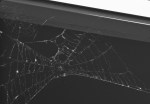
Kevlar strands of extruded protein
Home and snare in one
Patterns of neglect woven by time
Forgotten relics of a life now gone
Dusted, drowned and swept away
Urban renewal for insectine lives



Free-range
All natural
No preservatives
No fillers

Trim all you want,
I will not be held back.
Gird your domain,
I recognize no borders.
Offer me pain,
I respond with laughter.
You cannot limit me
If I will not allow it;
For I will grow,
Despite your best efforts,
To become more than
Either of us foresaw.
I am Life
And I will live.
Another sunny day and another errand can mean only one thing: another day traipsing around with the camera.
A few more scenery shots than usual–different lens–but this first batch is dedicated to the most fowl of Lake Ontario.
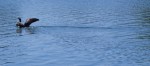

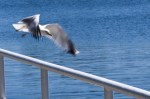


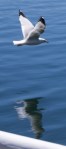


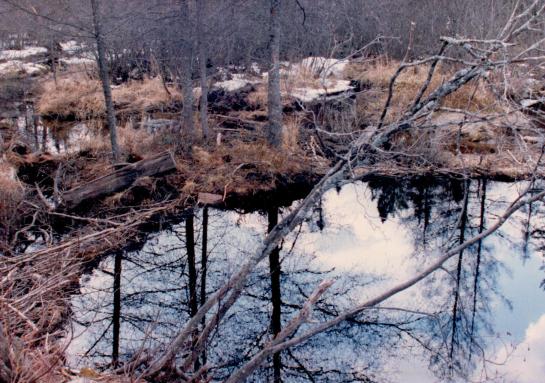
The mundane browns and greys of late Winter are slowly overwhelmed by the blue-skied hope of Spring yet to come. One of my favourite photos from Algonquin Park in Northern Ontario.
In another life, I could have been a cartographer. I simply love maps.
Road maps. Old maps. Topographical maps. Biological maps. I love maps.
It is probably truer to say that I love visual information presentation, but let’s stick with maps.

As a kid, I remember staring at maps that came out of the National Geographic or in my books and literally tracing the courses of rivers with my fingers, trying to understand what their winding patters told me about the lands through which they passed.
I would look at maps in history books, and see how topographical features literally and figuratively changed the course of civilization. There are several reasons, for example, why Montreal sits where it does, but most of them are geographical.
(Magazine art for my article on efforts to understand how proteins bind drug molecules.)
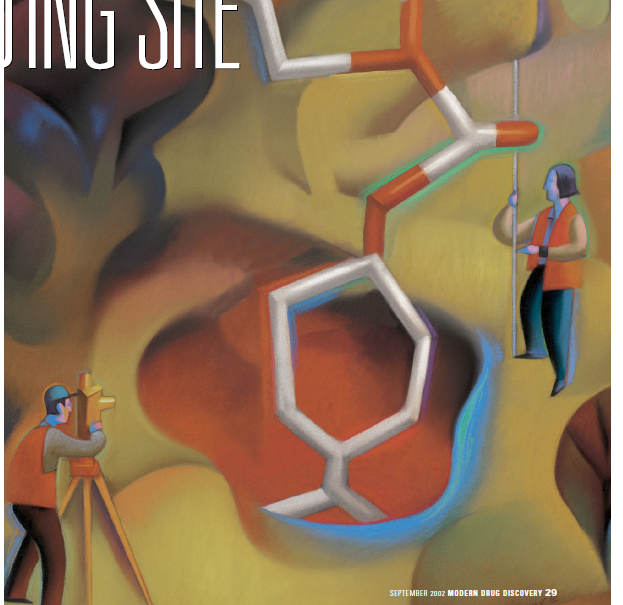
Later in my life, I would draw maps—at first geographical, but later biological. The biochemical mechanisms that cells and organs use to communicate, to rejuvenate, to function are maps unto themselves, each criss-crossing with others, offering alternate routes to the same destination. The latter point is why diseases like cancer are so hard to treat.
Maps allow me to take journeys, but not just in the physical sense of providing direction. They also give a factual tether to my fantastical imaginings. I can go places I may never visit, understand things unfathomable, while pouring over a map.
And map systems like Google Street View have added to those imaginings. Often, when I write, I will visit the setting of my story on Google Street View to help me paint a more vivid picture of the location. Sometimes this makes my narrative sound more like a travel brochure, but that’s my fault and can easily be handled with editing. The important thing is that the reader gets the essence of what I’m trying to convey.
(Lake Maggiore in northern Italy. Setting for the climax of my murder thriller screenplay)

My writing itself is a map. Like Google Street View, I am only giving the reader what fits within a specific frame, in essence guiding the reader. But at the same time, I cannot control what the reader thinks or how the reader feels as he or she journeys through my word jungles.
Just as with my childhood adventures of following rivers and mountain chains, the reader is free to layer his or her own imaginings on top of mine. And so, I have written not just one story, but hundreds or thousands.
Hunh?
I guess I became a cartographer, after all.
(Overview of my neighbourhood in downtown Toronto.)

PIECES OF ME...
Mother, Nehiyaw, Metis, & Itisahwâkan - career communicator. This is my collection of opinions, stories, and the occasional rise to, or fall from, challenge. In other words, it's my party, I can fun if I want to. Artwork by aaronpaquette.net
Life at any age can be amazing! We only need to grab hold & experience it!
The internet web log of Michael Cedarwood. I used to be a stripper. Now I'm a writer.
Thoughts on creativity, Pharma and whatnot
Mindfulness, Philosophy, Spirituality, Meditation, Awareness, Religion, Nature Photography
Living for Happiness
A perspective from the other side of the hockey ocean
Romance Author
Author of Kritsotopoula, Girl of Kritsa and Rodanthe's Gift
Our opinions don't stink!
Rantings and Ravings on all things Screenwriting and Movies
My Elicits, an Inception... Learning to Live in Perfection
 createdbyrcw