Shapes and colours – Toronto style

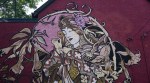
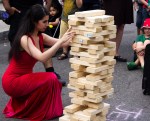
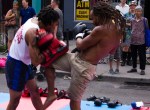
A seemingly random assortment of images highlighting the unusual and unexpected.

Summer in the City – Toronto-style

No monsters today, just people taking in the sights and enjoying the beautiful weather on a Sunday afternoon.

Do you see what I see?

How can you NOT want to describe this place?

How can you NOT want to describe this place?

Now that I have worked on several screenplays, which I have shared with a number of friends and fellow writers, I have come to a conclusion: I am a novelist.

Fret not, fellow travellers. I say this not to suggest I will cease to write screenplays but more in recognition of an inherent weakness in my screenplays, or perhaps more accurately, in myself. I am addicted to narrative.

The problem is I instinctively write what I see, even when I only see it with my mind’s eye. If I were a painter, I would own brushes that only had one or two hairs. The concept of a paint roller would be anathema.

Nothing in a scene is unimportant to me. I see people, things, phenomena in terms of metaphor, although I do my best to avoid poetry.

I cannot simply write: The boat bobbed wildly on the waves. (Even writing that line now was taxing to me.)

Instead, I’m inclined to write: The battle-weary skiff, a patchwork of wood and fibreglass, tossed helplessly on the ocean swells, each wave of its own purpose, refusing to work together toward anything resembling a current.

The former is what is happening. The latter is how I envision it. To me, everything is a character in a story—an antagonist, an ally, a victim—and as such has its own story arc, however small.

I also want to make sure that my reader “sees” the movie I would like to make—the challenge of a pictorial and aural medium presented literally. I want the reader to “feel” the scene before the first word of dialogue is spoken, both to establish the mood of the scene and give a sense of how the line is said.

Unfortunately, in my zeal to be informative, I instead become onerous or tedious. My screenplay becomes a challenge to read as long tracts of narrative slow the story to a crawl. Instead of making it easier to read my manuscript, I’ve made it more challenging and less desirable.

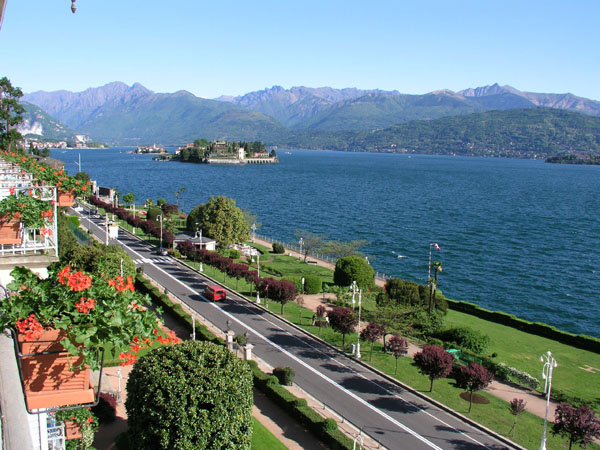
I was once accused of writing a travelogue of Northern Italy in a screenplay. Oh, what I had written was beautiful and made some people dream of travelling to the region—Lago Maggiore—but 90% of what I had written was completely unnecessary to the telling of the story.

So, what to do?

As of this moment, my writing process is my writing process, and I believe that any attempt to significantly change it would simply increase my challenges in writing at all. No, better to have written a first draft badly than to have never written.

Instead, I have chosen to rely on this little miracle I have discovered. They call it Draft Two. This will be my chance to go through my screenplay with a harsh eraser, and remove all of the lines or description that is not absolutely necessary to tell my story or to explain a character’s behaviour.

Sure, this may necessitate some rewriting of dialogue so that I don’t end up with mile-long verbal tracts. But in all likelihood, these speeches were too long and in desperate need of shortening.

One step at a time, though, for today, I continue to write Draft One of my screen-novel.

(Image is property of owner and is used here without permission, but plenty of description if you read my screenplay.)

Something from nothing

“I don’t know what to write about.”

It is the clarion call of procrastinators worldwide.

There is this pervasive belief that if you are not writing about something then you are not really writing. As though words have no power, no authority unless they are tied to some portentous subject. Free association, it would appear, is not free. And yet, ironically enough, nowhere is this written. It is a myth.

It is just as valid to write about nothing as it is to write about something. To make no conjectures, to postulate no theories, to hold no opinions aside from the personally pleasing juxtaposition of two or more words.

Just as people can speak forever and yet say nothing of lasting import, so too can people wax jibberish and yet speak volumes.

In painting, we can view both delicately rendered images of nature in all its glory (my personal favourite is Robert Bateman) or the seeming chaotic void of splatter on canvas. Both are art, but speak to different tastes and preferences. Why too cannot words, which are merely the medium that in and of themselves hold little meaning?

Write about nothing. Tap into your inner anarchist, your inner artist, to express yourself in splashes of verbiage that may mean little in isolation but so much more in toto.

Embrace the freedom and release the fear that comes from working without a destination or plan. Fill the void with noise of your soul and spirit, only to discover the noise is in fact a song the tune of which you don’t yet recognize.

I think you’ll find that in writing about nothing, you will find something, and you will stand amazed.

Nothing is rarely nothing

Nothing is rarely nothing

I had no idea

Ideas are everywhere, but they don't always look like ideas

Ideas are everywhere, but they don’t always look like ideas

“How the heck did you come up with that?”

It’s a common question I get when talking about my latest ideas, and for years, my answer was a resounding “I dunno…just came to me.”

To a limited extent, the response is correct, but it suggests the process of ideation is much more passive or deus ex machina than it really is.

Ideas surround me, as they do you. They are in the nouns, verbs, adjectives and adverbs that make up our moment-by-moment reality. They are in the streetcar in which I presently ride, the streets down which I presently travel.

In the dark-haired beauty two rows before me who is fixated on adjusting her hair rather than close the window through which the hair-mussing breeze blows. And in the armada of free-range humans who occupy the parkette we just passed, proving themselves houseless rather than homeless.

The challenge for many would-be writers is that these are starting points for ideas rather than fully fledged stories or subjects. These are the writers who wish to be reporters or chroniclers rather than explorers.

Think instead of these idea kernels as pieces of clay, as something that can be moulded into any of a thousand other shapes. Take the kernel and play with it for a while. Give yourself a chance to see what it feels like, smells like, sounds like, tastes like.

Twist it. Turn parts of it over. Reverse its halves.

What is something were feasting on Toronto’s homeless? Imagine a mobile service that will do your hair and makeup while you commute to work. What if a terrorist planted a bomb on a streetcar and it had to travel no slower than 50 mph? Or an aesthetician to the deceased in From Hair to Eternity.

All of these are probably bad ideas, but the ideas have evolved.

Twist it again. Mould it again. Press it onto something else, like so much Silly Putty, and see what sticks.

Keep the good. Set aside the bad. But keep working it until something you really like begins to show itself.

You have no idea the wonders you will discover.

Onward creative spirits

Image

Once more unto the breach, dear friends, once more.Henry V III, i, 1

In his thrilling speech to his troops (see excerpt below), who stood exhausted before the walls of Harfleur, Henry V challenges them to try yet again to take the city, that now is not the time to back off. Keep moving forward.

As it was expressed dramatically about war, so it is with Art and with life itself. It is vital that once you gain some momentum, you should do everything in your power to maintain that momentum.

Several years ago, I took up running. I hated it. I hated every living moment of it. But I was trying to improve my health and I knew that it was important. And so every couple days, when I would head out for my run, I had but one thought in my mind: keep moving forward. I knew that if I stopped, I might never run again.

As it was with running, so it is with writing. I write because I desire to, but also because I fear that if I stop, there is every chance that other aspects of life will creep in and keep me from it. My fear of losing writing is bigger than my fear of writing crap.

If I’m working on a screenplay and hit a creative sticking point, I try to move around it rather than dwell on it and lose the forward momentum. Sometimes, moving around it means writing another scene elsewhere in the same screenplay, but more often, it means jumping to another screenwriting project, developing another blog post or riffing wildly on Twitter or Facebook. My poor keyboard owes me nothing.

Even when I am simply writing some notes for a scene yet to be written, I do not allow the “correct” word choice to block me from writing…I simply add a placeholder where the right word should be and keep the thoughts flowing onto the page. The placeholder can be a blank underline (fill it in later) or a close enough word so I will know what I meant later, or it can be the word “shit”. It doesn’t matter.

It’s the artistic version of Newton’s First Law of Motion: An object at rest remains at rest unless acted upon by a force. An object in motion remains in motion, and at a constant velocity, unless acted upon by a force.

In this case, the object in question is me and/or my creative spirit.

In fact, forward movement doesn’t even have to be the same art form. I often use photography to keep me going. But you can also read a book, see a movie, sit in a park. Do whatever it takes to keep the creative parts of your brain and soul moving forward.

But how will I ever get anything done if I keep flitting back and forth from distraction to distraction?

Unless you’re specifically working to a deadline for your creative project—and there will be times when this is true—creativity is about the process, not the product.

Most artists (and we are all artists) live and act to create, not to have created.

And even if you are working to deadline, forcing your way through a challenge will likely result in a work that requires significantly more reworking than if you had simply let the creative spirit take you where it would. Thus, I don’t know that you’ve really gained much by pushing on something that isn’t coming naturally.

The natural direction of the universe is forward. You have it in you to continually move forward. Why would you give that up?


In peace there’s nothing so becomes a man
As modest stillness and humility:
But when the blast of war blows in our ears,
Then imitate the action of the tiger;
Stiffen the sinews, summon up the blood,
Disguise fair nature with hard-favour’d rage;
Then lend the eye a terrible aspect;
Let pry through the portage of the head
Like the brass cannon; let the brow o’erwhelm it
As fearfully as doth a galled rock
O’erhang and jutty his confounded base,
Swill’d with the wild and wasteful ocean.
Now set the teeth and stretch the nostril wide,
Hold hard the breath and bend up every spirit
To his full height.
– Henry V III, i, 3-17

(Image used without permission.)

Take notes

Image

Dear Diary: I couldn’t believe that this type of thing would happen to a guy like me, but when that woman got out of the pool, she wasn’t wearing any…

Oops. Wrong diary.

We are all incredibly talented, witty, sophisticated, creative people. Unfortunately, for most of us, we are incredibly talented, witty, sophisticated, creative people who would have trouble remembering our names if they weren’t on our drivers licenses.

I personally have a brilliant memory. I remember that the most common form of cockroach in the United States and Canada is Periplaneta americana. I recall that the parasitic Paragonimus westermani is a lung fluke. And I am quite certain that Tycho Brahe had history’s first rhinoplasty, however involuntarily on his part.

I also remember that I had three really good ideas for blog posts yesterday…I just can’t remember today what they were.

We never know when the creative spark will light us up, but as often as not, it is likely to happen when we are least prepared to act on it. A mall parking lot. Dinner with the family. Police interrogation. And inevitably, because we’re in the middle of that distraction, we forget the idea.

Carry a note book and pen or pencil at all times. Capture that fleeting moment, no matter how (in)conspicuously. Whether you’re a writer, sculptor, painter, musician, whatever your art, the important thing is to give yourself some form of reminder that you can use for inspiration later.

As I believe I’ve mentioned in earlier posts, my first screenplay grew out of a four-word pun (a song parody) that I wrote in a note book several years earlier.

When the pun occurred to me, I had no idea what to do with it, but I wrote it down any way. Over the next two years, when I would struggle for inspiration, I would flip the pages of my notebooks, and one day, I read the pun and an idea began to ferment. 18 months later, I had the first draft of my first screenplay.

Too often, I fear, we let these moments of inspiration slip away, and while we may kick ourselves momentarily on realizing we’ve lost something, we shrug our shoulders and simply move on. Fine, move on, but don’t keep repeating the mistake.

We all know how hard to come by moments of creative insight can be. Those moments are precious gifts, even if we can’t see the application today. So, the last thing we need to be doing is simply letting them float by and be lost.

Write it down. Save it for later, when you have the time or creative inclination to turn the idea into something special.

In any event, I just had to get this off my chest before I forgot it too.

(Image is the property of Biodiversity Explorer and is used here without permission.)

Death by a Thousand Meetings

Committee (n): 1) a group of individuals specializing in irreversible creativity vivisection; 2) last known location of a good idea. See also: elephant’s graveyard.

Perhaps the greatest challenge facing anyone creating art is less the generation of new ideas and more the knowledge that at some point, you will have to release your art to an awaiting world; aka, relinquish control.

Now, we can (and have) discuss the illusion of control at any phase of the creative process, but there is no denying that if you want your art to be appreciated by others, you will have to pass your newborn into someone else’s hands…or worse, someseveral else’s hands.

For writing—my predominant area of interest—that moment can come quite early in the creative process, whereas for other art forms, such as sculpture or painting, it may appear quite a bit later (please correct me, if I under- or misstate things).

You must respect your art. You must protect your art. But you must also realize that if you intend to share your art, and perhaps even make money from it, you must be somewhat flexible with your art. When you bring it to the world, it ceases to be all about you.

A teacher once suggested that upon completing a play, Shakespeare merely became another critic of the work. His opinions on meaning and significance within the play were simply one more voice and held no more sway than those of any other critic. I don’t know that I agree—what self-respecting writer would?—but I see the point.

When I write a screenplay, I need dissenting and diverging voices to ensure that I am not leaving things out or glossing over important plot or character points that are clear in my head. At the same time, I must be sure that my vision is protected, lest I start writing someone else’s screenplay.

I understand, however, that if I want to turn this screenplay into a movie or television episode, I will have to relinquish some of the control to the hands of studio executives, producers, directors, actors, directors of photography, sound teams, and in all likelihood, the third cousin of the guy who runs the craft services table. I have to be comfortable with the idea that each of these people wants to (actually, must) contribute in some way to the final product to give them a sense of ownership. They too are artists.

I am struggling at this stage with several television projects I have been developing. I have a computer filled with TV series concepts and/or pilot scripts, and I am trying to decide with what production companies to share my babies. Like Smeagol, I stroke my precious and have a rampant distrust of everyone.

How do I know the company I choose shares my vision, will protect my baby, isn’t just a group of ravenous Orcs? I don’t. I can’t, ahead of time.

What helps is watching fellow writers who rabidly protect their newborns at a much earlier stage in development. Who in a reading group, spew buckets of foamy spittle while savagely defending the use of the word “vivisection”, or primal scream that their protagonist’s motivations are obvious to anyone with half a brain.

I am doing the same thing with my projects, only at a later stage and mostly in my head (and possibly with just half a brain). Just as they have to learn to let go or at least lighten up, so do I.

In writing this post, I am coming to realize that my art is in the writing of the screenplay, not in the making of movies or television. Thus, when the screenplay is ready to move on, I must let it go and hope it flourishes…even if I am not ready to let it go. The art must grow and breathe, regardless of my personal reluctance and fears.

Committees are still evil…you will never get me to say otherwise…but unless I am willing to do everything on my own, which would not do justice to my babies, committees are a necessary evil and less dangerous to my babies’ successes than on overbearing, overprotective parent.


For a humourous take on the evils of meetings, please also see the recent blog post by Ben’s Bitter Blog: Meeting Bitterness.