What more did you need?

Image

There is an allegory that was better told by Karl Malden on The West Wing, but it goes something along the lines of:

There was a man who lived by a river, and one day, he heard a weather report that said the river was going to flood and that everyone should move to higher ground. A devout man, he said, “God will protect me. I do not have to leave my home.”

The rains started and a policeman came knocking on the man’s door, telling him he had to evacuate. The man smiled and said, “The Lord will protect me. I’ll be okay.”

The river flooded and the man was stranded on his roof, when a rescuer in a boat rowed by, telling him to get into the boat. The man shook his head and said “I have prayed and God will protect me.”

Eventually, the river swept the house away and the man drowned, and when he got to heaven, he stood confused before God and asked, “Lord, you let me drown. I am a good man, why did you not protect me?”

And God looked down and replied, “I sent you a weather report, a police officer and a rescuer in a boat. What more did you need?”


I recount this story because I have a colleague who is going through similar stages with her screenplay.

After months of feedback from writing groups and instructors that suggested several issues with her screenplay, the most prominent being the passivity of her protagonist and complete lack of conflict in her story, my colleague stood fast by her story. She defended her choices vigorously and left us in no doubt that she was going down the right road.

As it is her story, that is her right, and so many of us stopped discussing these issues with her.

More recently, she’s had the opportunity to send her screenplay to a film producer she knows, who was more than happy to give my colleague her thoughts. A few days later, she shared the feedback with us and smack in the middle was several issues related to the behaviour and actions of the protagonist. My colleague was unimpressed and vaulted upon her Steed of Rationalization, charging into the night.

A week or so later, my colleague received feedback from a film director and again, was smacked with a lack of central conflict and a passive protagonist. And again, this elicited response of being misunderstood and dismissive anger.

And the screenwriting gods looked down and replied, “I sent you a screenwriters group, a film producer and a film director. What more did you need?”


We all want people to agree with our views, particularly when it comes to something as personal as our art. Agreement validates us as individuals and confirms that our art has merit in the world beyond.

But in the search for that agreement, we must be prepared for disagreement. And while it is always our prerogative to ignore contrary opinions, we lose the right to complain when the contrary feedback is consistent and still we choose ignore it (or worse, rail against it).

I don’t believe that anyone has to accept external feedback; positive or negative. But if you want your art to be more than mental masturbation, you should be prepared to listen to all input and incorporate what makes sense to improve your art.

Otherwise, shut up and let the rest of us evacuate the flood plain.

Between the Signs

One thing I love about signs is they can say so much more than the words written on them. Whether there is a subtext within the words or it is simply a matter of context, each sign tells a story that you might not see at first glance.

PS I just realized that a lie (li) takes you from “obvious” to “oblivious”…lovin’ me some words today.

(Re)Learning to Swim – Art vs Technique

I love to swim. It is one of my favourite activities and one of the only forms of exercise I don’t begrudge, perhaps because I can’t tell if I’m perspiring. I am by no means athletic or proficient with it, but I enjoy doing it and have decent stamina.

Several years ago, a friend of mine decided she wanted to learn to swim. As an adult, however, she was embarrassed that she didn’t already know how, so she asked if I could help her learn the basics. Being a good friend—and not just a little bit infatuated with her—I said sure, happy to help.

A few days later, we got to the pool and I tried to break things down for her. Unfortunately, unlike many other exercises, with swimming you are in water and therefore much of the mechanics are difficult to view directly. Thus, I had to show her the mechanics above water, as though swimming to the ceiling. And that’s when everything started to fall apart.

No sooner did I begin teasing out the various movements in swimming than I realized that I was rapidly losing the ability to swim. Eventually, I just had to thrash about for a bit to remind myself how to do it.

It was unnerving.

I had been swimming (swum? swam?) for so many years that it was just something I did. It was never something I analyzed. You get in the water. You swim. It was muscle memory.

In teaching my friend to swim, I had separated the technique from the art, and for a brief few minutes, lost the art in the process.

The same can happen with writing.

In the earliest phases of our development as writers, it is important to develop a basic understanding of the mechanics of writing and story, to have someone walk us through the process. But at some point, we have to step forward and simply practice our art.

If writing is purely a mechanical exercise, then it is very dry and boring. It lacks the spirit that it needs to live. It is the difference between an animatronic deer and a biological deer. They may look very similar, but one is alive and the other is inert.

As a more seasoned writer, I have found that there will be times where I try to focus on the more mechanical, structural aspects of the stories I am writing. I want to make sure all the right elements are in the right place. But when I read the material over later, it always sounds forced, wooden, bereft of life.

In my effort to teach someone how to write properly—in this case, teach me—I have, however briefly, lost the ability to write. I have sacrificed the art for the technique.

Technique and process are vital, but they are not art. Art comes as you build the spiritual, intellectual, psychological muscle memory to allow yourself to immerse yourself unthinking into your writing and simply allow the story to flow.

As I’ve said before, story before structure. Art over technique.

Do fish ever think about swimming? And if so, do they then sink to the bottom? (Manuel Antonio, Costa Rica)

Do fish ever think about swimming? And if so, do they then sink to the bottom? (Manuel Antonio, Costa Rica)

10 Steps to Writing a Pilot That Sells

No, no! Not that kind of pilot. Although, cute photo. (Image used without permission)

No, no! Not that kind of pilot. Although, cute photo. (Image used without permission)

1) Watch a lot of television; especially stuff you don’t like or think is bad. This will establish the belief within you that you could write something at least that bad and still get it on the air.

2) Conceptualize a show that combines one of your siblings or cousins, the second job you ever had, and a famous moment in history. Every idea after this will sound entirely plausible; and hell, this might actually work as a sitcom.

3) Conceptualize an idea that is morally offensive to you and then see if it was one of the shows in Step 1. If not, then the market is ripe for the picking.

4) Describe the absolute worst day of your life, a day when everything went wrong. Then switch one of the disastrous elements. Then, switch another element. Do this 10 more times. Season One!

If you can’t create 13 variants, your day wasn’t that bad and your life is too good for you to be writing for television. Go write greeting cards.

5) Grab a copy of Bulfinch’s Mythology and reset all of the stories in modern-day Seattle or the smallest town you’ve ever visited. Warning: Brace for complaints that it’s a rehash of Dallas or Friday Night Lights.

6) Grab a copy of Bulfinch’s Mythology and do not reset the stories. Hell, if it worked for The Borgias and The Tudors, it might work here. Call it The Olympians.

7) Start with Episode Two, because pilots suck and you’ll never want to show it to anyone. You need to know/believe your idea works.

8) No matter what your current idea is, when you go to pitch it and you think you’re losing your audience, suddenly reveal “And the protagonist is a ghost!” Vampire, werewolf and zombie are equally acceptable.

9) Stop reading advice on writing a successful pilot and just write your story, already. There is no telling why someone in a suit will get excited by your story, but I can guarantee they won’t if you’re not.

10) If all else fails, generate a top-ten list of ways to write a pilot that will sell and use it as the basis of a book you will later turn into a sitcom.

Covering your ass-ets

So often, when I start a new series of classes or attend a conference on screenwriting, I hear the same refrain: How can I register my stuff so no one steals my ideas?

And, as logic would dictate, the question always comes from the most junior writers in the room, if they have yet to write at all.

There is no denying that the universe is a dangerous place. Global climate change necessitates we choose higher floors in a high-rise to ensure our laptops are not flooded by rising sea levels. I always write with my back to the wall so that people in the condos across the street can’t take telephoto shots of what I’m writing. And whenever I publicly speak the word “tadpole”, I actually mean screenplay…likewise, “garlic”, “symbiont” and “purse” for protagonist, antagonist and onomatopoeia. (Don’t bother memorizing those; I have already changed them.)

All in an effort to make sure that no one steals my ideas. They are mine. I created them. They are owned by me. (Much as with Miss Ann Elk’s theory about the brontosaurus.)

Ah, but wait a tic. Just a mo’. Hold your horses and tell them that you love them.

I forgot one teensy little thing.  A bit of a fly in the old ointment. You see: YOU CAN’T PROTECT IDEAS!

1) I defy you to actually show me a completely new idea, and not just something old that you’ve redecorated.

2) The idea is not the important bit…it’s what you do with the idea. Give 12 people the same idea and you will end up with 12 very different stories.

3) There is every reason to believe that your idea is shit. No offense intended. Most of my ideas are shit. That’s how you find the truly brilliant ones, by moving the shit out of the way so the good ones are more visible. (See also: Miss Ann Elk’s theory about the brontosaurus.)

I applaud you for having ideas, shit or otherwise, because it’s not easy to do and is a valuable first step in your art. But not until you’ve completed your story, however, do you have something to protect.

You have completed your story, haven’t you? If your idea was solid, then you should be anxious to tell the story. If your idea is good, I want to hear your story. Seriously. No kidding. We need more good stories.

The story—not the idea—is where you will shine as an artist. The story tells me everything about you. It puts multiple facets of your personality and belief system on display and says: Hey universe! Here I am!

That, my friends, is worth protecting. That is what you register somewhere so that no one can tell exactly your story without your permission.

Once you’ve reached that point, I then recommend:

Writers’ Guild of America – West (web site is easier to use than the East chapter)

Writers Guild of Canada

The organizations have a reciprocal agreement, so registry with one is sufficient for both the United States and Canada.

Unfortunately, I only know of these two organizations, so if anyone wants to contribute others in Europe, Asia or anywhere else, please do.

Yes, you want to protect your assets, but you’ll be a lot better off putting your energies into creating assets that are worth protecting.

Fort Knox isn’t meant to be a kitty litter box.

A strange jobs program in British Columbia. (Whistler)

A strange jobs program in British Columbia. (Whistler)

Maps quest

In another life, I could have been a cartographer. I simply love maps.

Road maps. Old maps. Topographical maps. Biological maps. I love maps.

It is probably truer to say that I love visual information presentation, but let’s stick with maps.

Image

As a kid, I remember staring at maps that came out of the National Geographic or in my books and literally tracing the courses of rivers with my fingers, trying to understand what their winding patters told me about the lands through which they passed.

I would look at maps in history books, and see how topographical features literally and figuratively changed the course of civilization. There are several reasons, for example, why Montreal sits where it does, but most of them are geographical.

(Magazine art for my article on efforts to understand how proteins bind drug molecules.)

Image

Later in my life, I would draw maps—at first geographical, but later biological. The biochemical mechanisms that cells and organs use to communicate, to rejuvenate, to function are maps unto themselves, each criss-crossing with others, offering alternate routes to the same destination. The latter point is why diseases like cancer are so hard to treat.

Maps allow me to take journeys, but not just in the physical sense of providing direction. They also give a factual tether to my fantastical imaginings. I can go places I may never visit, understand things unfathomable, while pouring over a map.

And map systems like Google Street View have added to those imaginings. Often, when I write, I will visit the setting of my story on Google Street View to help me paint a more vivid picture of the location. Sometimes this makes my narrative sound more like a travel brochure, but that’s my fault and can easily be handled with editing. The important thing is that the reader gets the essence of what I’m trying to convey.

(Lake Maggiore in northern Italy. Setting for the climax of my murder thriller screenplay)

Image

My writing itself is a map. Like Google Street View, I am only giving the reader what fits within a specific frame, in essence guiding the reader. But at the same time, I cannot control what the reader thinks or how the reader feels as he or she journeys through my word jungles.

Just as with my childhood adventures of following rivers and mountain chains, the reader is free to layer his or her own imaginings on top of mine. And so, I have written not just one story, but hundreds or thousands.

Hunh?

I guess I became a cartographer, after all.

(Overview of my neighbourhood in downtown Toronto.)

Image

Dara Marks at Toronto Screenwriting Conference 2013

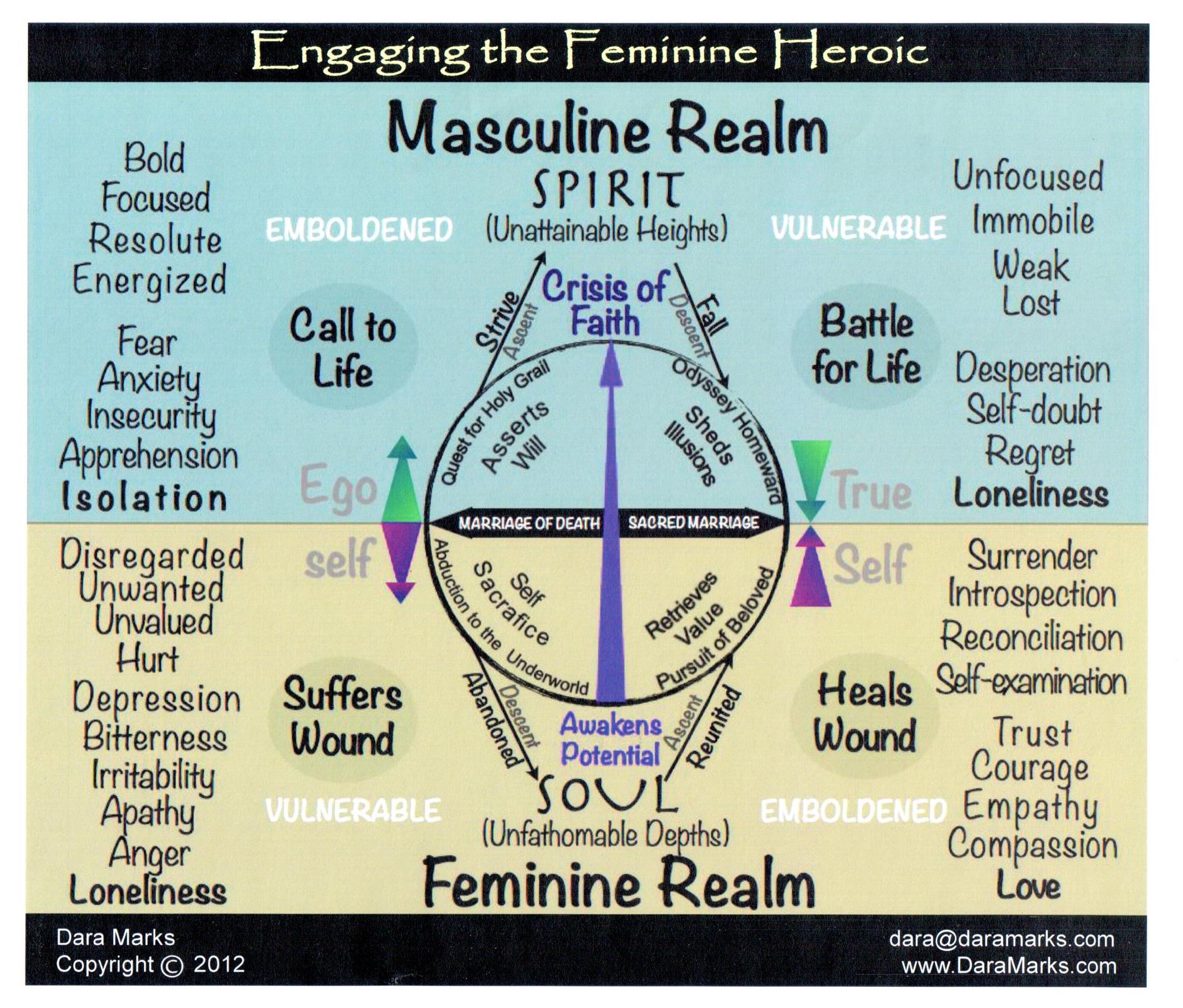
Engaging the Feminine Heroic

Dara Marks

In a follow-up to her very popular Transformational Arc talk of previous years, Dara Marks took us through another aspect of character development, something she calls the feminine heroic. A counterpart to the well known hero’s journey, the feminine heroic completes the hero’s character and thus is not necessarily tied simply to female heroes. Rather, it encapsulates the feminine side of everyone’s natures.

Transformational Arc

She explains, as writers, we are constantly trying to understand the narrative in which we are living, but we experience that narrative from a very personal perspective. Thus, in her canonical transformational arc, there is both an outer realm, where external forces act upon the hero, and an inner realm, the more personal influences. We grow, she says, only in relationship to demands on us to grow, and the external realm stimulates the internal reckoning.

The union of the feminine and masculine brings about wholeness in the character. It is a combination of the masculine spirit, which represents all that we can be, and the feminine soul, the deepness of our authentic self. Marks offers the example of a tree, which may reach toward the sky, but is only as strong as the root system that provides it nutrients.

Everything we are in life is what comes from deep within ourselves.

Marks presented this relatively complicated diagram that illustrated the hero’s external and internal journey (and in many ways, reflects our own journey through counseling or life itself). To the left, we find the Ego Self, where the onus is on my aspirations and beliefs of me. To the right is the True Self, which is understood after reflection and denotes my understanding of myself in the universe.

The union of the masculine and feminine sides of a character creates a wholeness

The union of the masculine and feminine sides of a character creates a wholeness

Ego Self: All early development, even that of a child, relies very heavily on the development of the Ego, a sense of will and determination. We believe that we’re in charge, despite all evidence to the contrary.

So if we start the journey in the Ego Self realm, we can look at the External or Masculine side and the Internal or Feminine side of ourselves.

Masculine Ego: In the top left quadrant, we have the Call to Life, the external mission that demands we strive or ascend to a greater level. We assert the force of our will on the universe. This area therefore is associated with a youthful and energetic quality. We have to move forward. We cannot let fear hold us back. To do this, we must sacrifice our feminine side, pushing those feelings down, or we cannot move forward.

Marks suggests that the tragedy of Hamlet was that he couldn’t get beyond his feminine side when he needed to move forward. She also gives the very literal example of Agamemnon, who was forced to sacrifice his daughter Iphigenia before the Greek ships would be allowed to voyage to Troy.

Feminine Ego: In the lower left quadrant of the diagram, we see the influence the masculine decision has on the feminine ego. We suffer a wound because part of us is no longer valued. We are literally abandoning a key part of our self and this will have a lingering effect. While we appear invincible externally, we are very vulnerable internally.

Thus, the feminine side needs to be rescued by the proverbial knight on a white charger. Marks is quick to point out that this is no time for political correctness as at this stage in our development, we just don’t have the internal skills to rescue ourselves.

She goes back to Greek myth to show how this works, focusing on the story of Demeter and her daughter Persephone, the latter of whom was abducted to the underworld by Hades to become his wife. Demeter was distraught at the loss of her daughter and journeyed to the underworld to bring her back to the surface.

The underworld experience may be difficult, but it is educational and we need to journey through it to come out more whole in the next stage.

Marriage of Death: The combination of the masculine and feminine ego is what Marks calls the Marriage of Death. Anytime we strive to become something new, it means the death to other aspects of our being. We just can’t strive at all things at the same time. But this marriage is not designed to last.

As Marks points out, the problem with striving is that it is doomed to failure. We can’t be rich enough, strong enough, famous enough, whatever enough. And it is at the moment of realization that our dreams are doomed that we have a Crisis of Faith (masculine side), which leads to an Awakening of Potential (feminine side). We move closer to the discovery of our true self, the right hand side of the diagram.

Masculine True Self: As the masculine ego passes through its crisis of faith, it suffers a fall from the unattainable heights, which converts the Call to Life into a Battle for Life. For self-renewal, it is essential that our delusions and illusions are shed during this descent, such as the belief that we are in control of our lives. And thus, at this stage, it is the masculine self that needs rescuing.

Marks offers the example of Odysseus (a popular subject at TSC this year) and the knowledge that his journey home was his great undoing as he loses more and more of his ego self (including his ships, crew, etc). The second half of his journey is literally the journey homeward toward his true self.

Feminine True Self: And who rescues the masculine true self? As the masculine side becomes more vulnerable, the feminine side becomes emboldened. We heal our wounds and reunite, turning pain and suffering into love and creativity.

The way out of our self-imposed purgatory is through compassion. We have to hear the story and then feel and acknowledge the pain. And it is only when the pain is given voice that it can move back from the underworld into life.

Marks exemplifies this aspect with the myth of Inanna and Erishkegal (which I do not know as well and so simply provide a link).

Sacred Marriage/True Self: It is at this point, through the sacred marriage of the masculine and feminine that we finally achieve the true self.

NOTE: All images and illustrations are property and copyright of Dara Marks and are used here without permission.

Writer’s Block-ed – Part Two

In Part One, I discussed the idea that the only difference between creatives and non-creatives or people who are blocked is a psyche filter that has become clogged; a filter that sits between thoughts generated deep within and expression of those thoughts to the outside world.

Below, I offer some thoughts on what I have found effective in unclogging that filter.

Step over it or go around it. Nowhere is it written that you must solve this problem right now. Depending on the nature of the project in which you find yourself stuck, is there an opportunity to simply mark a placeholder for where you’re stuck and move to the next part? Personally, in any creative endeavour, forward momentum is key and once lost is hard to regain. It’s easier to push a car that is already rolling than to get one rolling. A number of my manuscripts contain notes to myself along the lines of [something exciting happens here].

Likewise, for a written work, don’t feel like you have to solve all of the plot details early on. I had one screenplay that required my protagonist be in disguise. I had no idea how to do this logically, but proceeded as though it would come to me later…and it did. If you’re in a good space, the spirits will guide you and you will find your answers. But you have to be open to those answers.

Walk away. For most of us, these are very personal projects the only deadlines for which we hold internally. So, screw the deadline. Walk away from the project for a bit. Go see a movie. Read a book. Listen to music. Go for a run.

The longer you focus on the problem, the more inflamed it becomes until it becomes a creative cancer. Let it rest. Give the rest of your brain something to do. Let it do the heavy lifting for a bit. You may just find that the rest of the brain has ideas your creative centre wasn’t able to deal with and those ideas may just sneak past the filter (so have a notebook in your pocket, just in case).

Move to another project. I think a mistake a lot of new writers make is only having one project, as that blows the importance of the project way out of proportion. At any given moment, I have at least a dozen different creative projects on the go, at various levels of completion. That way, the minute I see the first signs of boredom or frustration with a project, I can move to another one to maintain my personal forward momentum. Perhaps the one thing that clogs a filter quickest is creative fallowness as lack of movement breeds insecurity.

The nice thing about working on multiple projects is that the creative act on one project often stimulates the creative response on another. You may have your answer to project one; you may not just be able to see it until you work on project two. Which leads me to…

Try another creative activity. Creativity breeds creativity. For me, photography stimulates writing (I suspect it works the other way, too). When I’m taking pictures, I am focused on the task at hand, the object on the other side of my lens, but because I am a storyteller, part of my brain is applying context to that image. You may have seen examples of this in some of my other blog posts. It allows me to visually tap into other emotions and contexts not previously obvious in my mind and those may inform my writing dilemma.

The key is to actively engage your brain. If you want to do something more passive like reading a book, as suggested earlier, try reading it aloud. Forcing yourself to actually engage with the written material will stimulate different parts of your brain, including your auditory centres. Responding to the movie screen, however, will likely get you thrown out of the theatre.

Hang with other creatives. First off, I don’t think there is anything inherently wrong with a pity party. It can be good to commiserate and share war stories from the trenches. It helps us to understand that we are not alone and that there is another side to the current blockage. And who better to help you with that than fellow members of the society.

Likewise, simply sharing your dilemma opens the floor to multiple brains with filters at various stages of clogging. Hopefully, around the table, there is enough creative force to blow the walls of those filter pores and clear things out. Yes, it’s your project, but you don’t have to do it alone.

If you think screaming at the gods will help break your writer's block, give it a go! (Photo taken in Hope, BC, ironically enough)

If you think screaming at the gods will help break your writer’s block, give it a go! (Photo taken in Hope, BC, ironically enough)

Writer’s Block-ed – Part One

Anyone who has stared at a blank page or screen and been incapable of adding words to it understands the living nightmare that is writer’s block. The whiteness of the sheets or the blinking of the cursor mocks you as you struggle before it, desirous of wondrous expression but incapacitated and mute. You feel incapable, devoid of ideas, and worry that your creative ju-ju will never return.

But are we correct in feeling this way? What is writer’s block?

To my mind, the only difference between creatives and non-creatives is a willingness to create. We all have it within us; it is just that some of us move unbridled to the fore while others linger back. It is as though there is a psyche membrane or filter that separates us, or perhaps, to be more granular, it separates thought from expression.

Think of any filter in your house. The air filter in your car, for example. The filter keeps particulate matter—dust, dirt, debris—from damaging your engine while still allowing air to reach the combustion cylinders that convert fuel to power. When that filter gets clogged, however, less air can reach the cylinders and therefore the car underperforms or does not run at all.

I think the psyche filter works similarly but with a twist. In creatives (and likely in children), the filter is clear and wide open, allowing thoughts generated deep within to pass through freely and find expression in the outside world.

In non-creatives and people experiencing writer’s block, it is less that the pores of the filter have become clogged, so much as the pores have shrunk to microscopic size—a self-clogging filter, if you will. This prevents almost all of the generated thought from reaching the surface to be expressed.

You are generating ideas, but for whatever reason, your filter is keeping you from letting them free.

Alternatively, the filter works more like the car filter in that your psyche requires stimulating input to convert brain energy to creative power. In creatives, the filter lets in everything (or a large part of everything), whereas in non-creatives, again, the pores are too small to let anything more than the rudimentary information needed for survival enter and so the creative engine stalls.

In either case, the capacity to generate thought and to express those thoughts is the same in both groups of people. It is the nature of the filter that distinguishes us.

I wish I could present you with the secret answer for unblocking that filter when it becomes troublesome, but the working mechanisms of each filter are unique, yours attuned to your psyche.

In Part Two, I’ll offer some thoughts on what I have found effective in dealing with a clogged filter. They don’t always work, but by having multiple outlets, I hedge my bets that something will work.

The following gallery explores colour at one of my favourite buildings in Montreal, the Palais des Congres.

Book larnin’

Last week, one of my fellow bloggers expressed interest in screenwriting and wondered if I could recommend any good books to help him navigate this format of storytelling, and I promised to do it in a future blog post…well, guess what?

To be honest, my first piece of advice to anyone interested in getting into screenwriting would be to simply tell your story in whatever format comes easiest to you. Because, as I’ve said in a previous post, the most important thing is story. No matter how well formatted your screenplay, if your story doesn’t work, it doesn’t work.

Okay, that soap box being out of the way, my next advice is to take a class in screenwriting, because no matter how much you think you’ll write, there is nothing like the pressure of a deadline for 10 more pages to keep you motivated. And ultimately, until you’ve heard your pages read out loud, you have no idea if you’re getting your thoughts across or using the right words.

So now, on to books. There are few really good books to tell you what a script should look like, so I recommend you simply try to get your hands on several different scripts, whether film or television (although pick your preferred medium, because there are differences in presentation). There are several places on the Internet where you can get free scripts (and when I remember what they are, I will tell you), but for those with a couple of bucks to spare, I highly recommend Planet MegaMall for their breadth of scripts that you can purchase rather cheaply.

No one book will give you everything you need, so I recommend sitting in a bookstore and perusing as many books as possible to see which one fulfills some unconscious need today. Then, repeat the process several weeks later, because your unconscious needs will have changed.

For the best understanding of story as a whole, you can’t go wrong with Chris Vogler’s The Writer’s Journey. Using mythic structure, Vogler breaks down story into its key components and then contextualizes those concepts using popular movies. Knowing almost nothing about screenwriting, I wrote my first screenplay using these elements as a template.

To get more into the structure and execution of screenplays and plots, then Linda Cowgill’s The Art of Plotting is very good. Written very approachably, Cowgill goes through the fundamentals of a good plot (e.g., conflict, character, action) and helps you understand where your story may be faltering or be improved.

A little more into character and how character changes through the screenplay, Dara Marks’ Inside Story helps you understand the concept of theme, which will lead you to better understand the motivations of your characters. In a similar vein is Stanley Williams’ The Moral Premise, which examines how opposing forces within and between your characters will move them forward in your story and more importantly, make them much richer.

Somewhere between individual scenes and broader acts of a screenplay are sequences, which one of my instructors described as being equivalent to book chapters where a single idea is explored before moving to the next one. Paul Joseph Gulino’s Screenwriting: The Sequence Approach is your guide here, helping you pull your scenes together into the right order.

And the chief poobah of screenwriting books is Robert McKee’s Story. I was actually afraid of getting this book for quite some time as people warned me that reading it too early would make me too intimidated to keep writing. I can see where they were going, but it’s not that McKee’s writing is difficult to follow, it’s more that he talks about a huge variety of topics. Suddenly, you realize how many balls you’re juggling when you’re writing a screenplay.

Ellen Sandler’s The TV Writer’s Handbook is a great step-by-step, but you have to do the exercises to make it worth it. Pamela Douglas’s Writing The TV Drama Series is a little dated but still gives a fantastic overview of hour-long programs, spending the bulk of its time on how to break down and analyze a program, before it gets into actually writing an episode.

Scott Sedita’s The Eight Characters of Comedy is an interesting analysis of comedic archetypes in sitcoms. Written more from an actor’s perspective, it still offers valuable insights to the writer trying to understand or create characters. And finally, Peter Desberg and Jeffrey Davis’s Show Me The Funny offers amazing insights into how the minds of comedy writers work, but even more importantly, shows you that no two people will develop the same story from the same premise…so don’t sweat starting with cliché ideas.

That’s a lot for a first kick…I hope you find something in here to get you started.