In other words

Word up!

Word up!

According to a Global Language Monitor survey from 2014, there are 1,025,109.8 words in the English language. (Not sure what the 0.8 word is.) And based on further research, this tally makes English anywhere from 5- to 10-times larger than most Western European languages.

Depending on who you ask or possibly where, a native English-speaking adult has a functional vocabulary of anywhere from 10,000 to 75,000 words. Thus, on a regular basis, we use about 1-10% of the words available to us.

Many of those words have similar if not identical meanings and can often be used interchangeably with slight variations in implied meaning or significance. Hell, a British clinician with a list-making fetish famously went out and tried to catalogue these word relationships, offering encyclopedic lists of alternates to the most commonly used English words.

A man with a list (or maybe that's just how he sits)

A man with a list (or maybe that’s just how he sits)

So, given this profusion of synonymic wonder, why am I seeing an increasing number of stories—novels, screenplays, etc.—that seem only capable of the low end of the vocabulary spectrum?

And I’m not even talking the big words here. I am talking the simple words we use every day and yet which hold little more meaning than their strictest definition. Words like “said”, “walk”, “enter”.

Now, I am not suggesting people necessarily have to write with a copy of Roget’s Thesaurus next to them, something of which I have been accused on occasion. But while exsanguinating your latest cerebral machinations into the fibrous folds of the human record—sorry, I digress—why not make the most of the words that are at your disposal?

For example:

Hearing a cry from the other room, Cecily walked through the door.

Now, Cecily may indeed have “walked” through the door, but that tells me absolutely nothing other than her transitional geographic location.

What was Cecily’s emotional state and how eager was she to discover the source of the cry?

There are so many other words—common words—in the English language that will tell us so much more about Cecily than the fact that she moved.

What about strutted, strode, skipped, crashed, bolted, dashed, raced, blasted, crept, snuck (sneaked?), sauntered, staggered, bounded, tripped, stumbled, inched, crawled, or fell?

Each of these words tells us so much more about Cecily’s relative state of confidence and sense of urgency, and any one of these in place of “walked” prevents the writer from having to later explain her emotions with a second sentence.

In some cases, people will append adverbs to offer greater insights into the emotional state of a character, but again, even this can often be avoided through use of more descriptive verb.

For example:

“You’re crazy,” Philip replied angrily.

Definitely better than just “Philip replied”. But what if Philip did more than reply? What if he screamed, shouted, barked, bellowed, screeched, roared, or cried?

Again, each word offers a slightly different take on Philip’s emotional state and gives us a sense of whether he is angry at his target or terrified by her.

All the kids are doing it

All the kids are doing it

And what holds true for verbs, also holds for adjectives, and particularly as some of the simpler ones can be relative.

The precise height of a tall man varies significantly between someone who is 5 ft 2 versus someone who is 6 ft 1. And again, the adjective has an opportunity to add an emotional or psychological angle to the description.

Rather than “tall”, what about towering, mountainous, tree-like, statuesque, cloud-scraping, looming, or neck-straining?

Or instead of a specific age (unless the precise number is vital), what about world-weary, worn down, spry, vivacious, ancient, wizened, infantile or cadaverous?

Got your back, kid!

Got your back, kid!

Again, I don’t think we need to discard the presocialized anthropoidal biped with the bath water, but particularly in our writing, I think we need to make better use of the wealth the English language affords us and open ourselves to more precise and effective word choices.

Together, we can strut the walk and hallelujah the talk.

Snow drifting

(Image property of Duncan Rawlinson; http://duncan.co/tag/snowing/)

(Image property of Duncan Rawlinson; http://duncan.co/tag/snowing/)

From thousands of feet, the snowflake made its way from its misty nursery to a gentle caress of Henry’s cheek, slowly melting where ice meets the dampened skin to puddle with its fallen brethren.

Henry faces the sky, his back firmly planted in the snow bank, the drift slowly cocooning him as the crystalline waters descend, tears of boreal gods.

Flakes weave with the hairs of his beard, completing the whitening that age has yet left undone, his thinning scalp protected by the few remaining threads of a toque too old to be merely ancient.

Pedestrians trundle by, eyes held askew, muttering their disapproval as they bow their heads against the wind and cold. But he remains oblivious to their stares and sneers, in a world of his own, one with the thickening storm that swaddles him.

Henry doesn’t feel the cold they feel. He doesn’t feel the wind they fight. Nor does he feel the latex-gloved hands that lift him to the gurney as an unusually cold winter claims another life.

Heart of Coppola

Zeotrope

Francis Ford Coppola likes me! He really likes me!

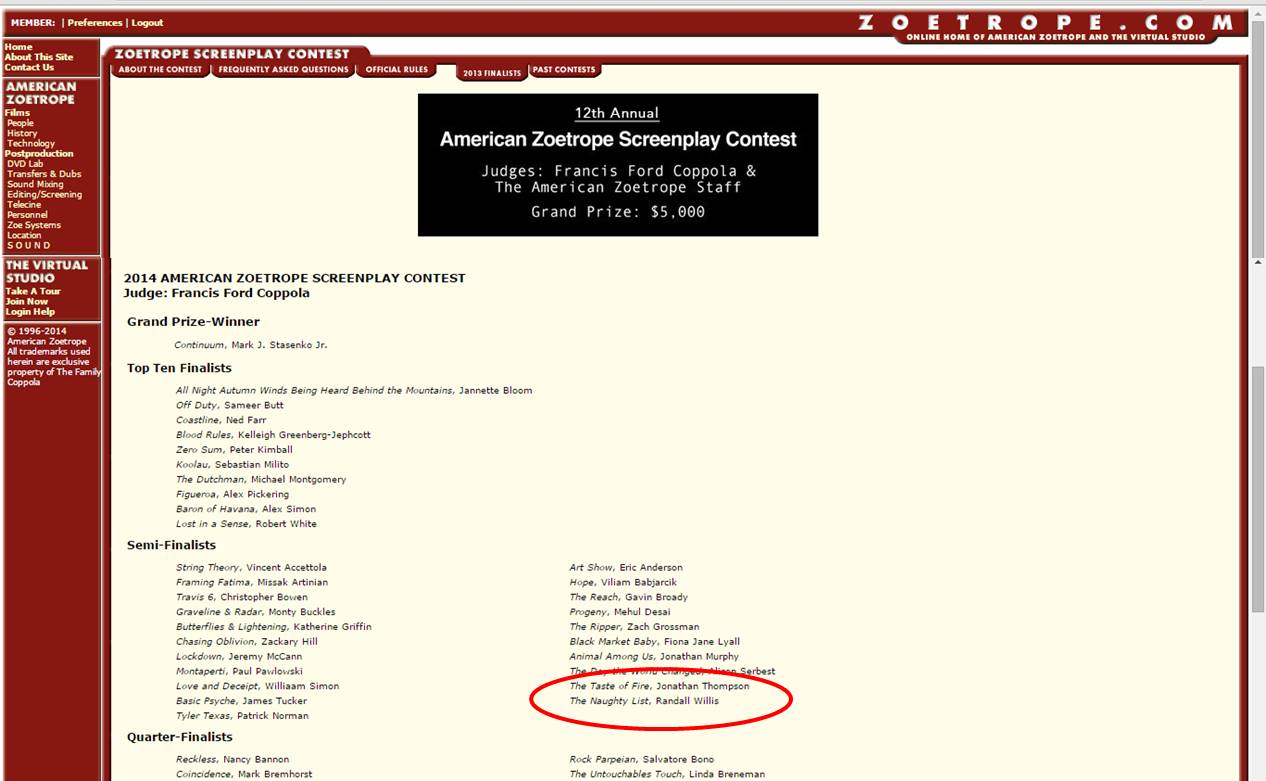
So, no sooner do I finally get around to posting my laurels from Nashville than I find out that my screenplay The Naughty List was selected as a semifinalist in the 12th Annual American Zeotrope Screenwriting Competition, an organization run by Francis Ford Coppola (I seem to recall he was a director of geopolitical documentaries).

I had started to wonder if the screenplay was going to see any love in the competitive world…this is good!

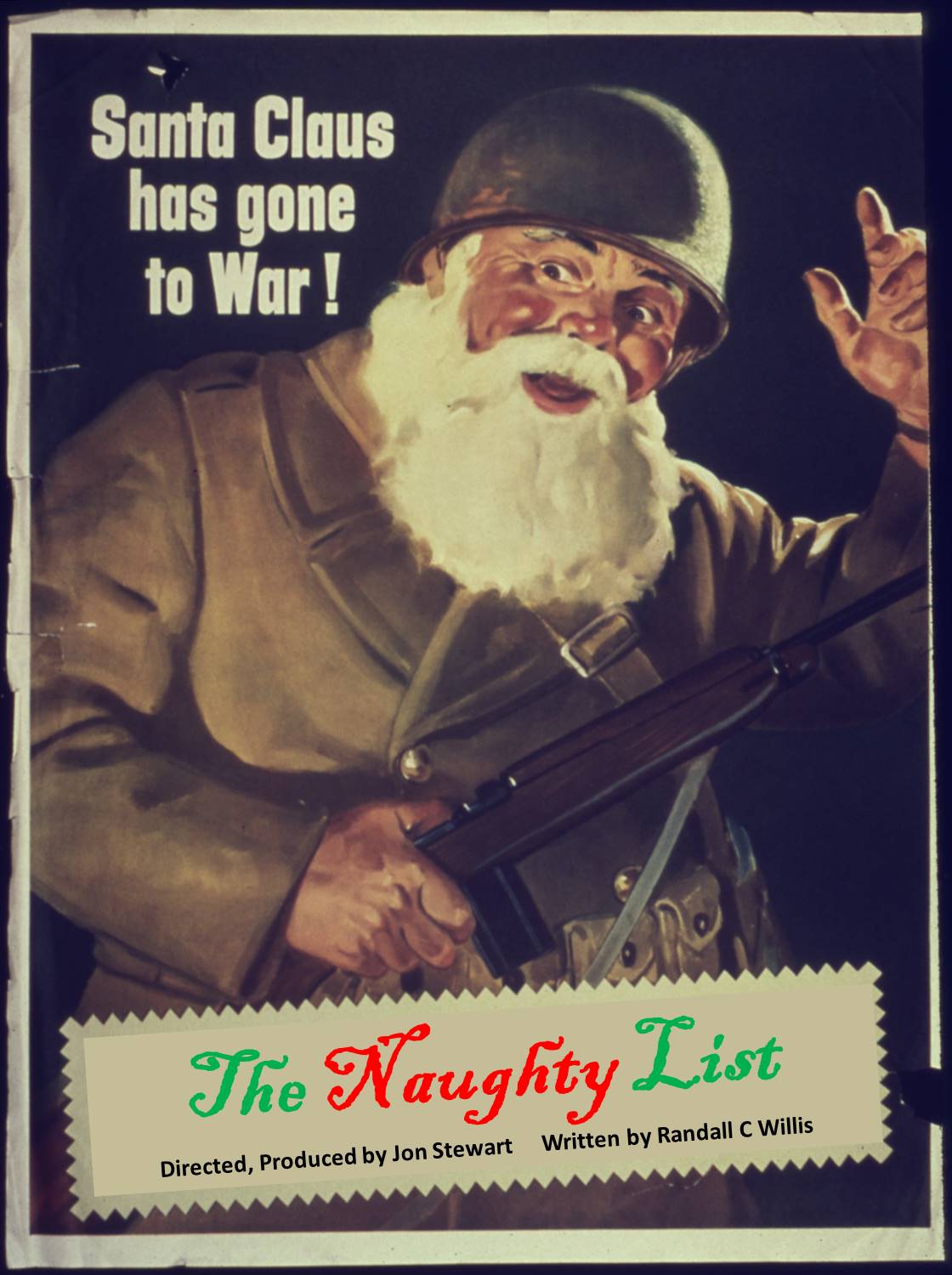
Coming to a theatre near you (please, please, please)

Coming to a theatre near you (please, please, please)

So, what is the story of The Naughty List?

What would you do if you learned decisions you make every year ruin the lives of millions of children?

Oh, and your name is Santa Claus.

After a brush with death just days before Christmas, Santa rescinds the Naughty List only to learn that for some kids, the lump of coal started a life-long downward spiral. In fact, two kids—now warlords—are about to unleash hell on each other and their people.

With a loving heart and snowy balls, child-like Santa dives into the fray. But his magical meddling only makes things worse.

He greases the wheels of war. More children suffer, including a girl desperate to save her family. As his magic fails, Santa knows he must face the oncoming storm as a mortal.

One man. Two armies. Can Santa stop the madness and save a crumbling Christmas?


Belated laurels

Ah yes, almost forgot. This showed up in my in-box back in December. The laurels for my Best Animated Feature Screenplay at the 2014 Nashville Film Festival.

The winner was my screenplay for Tank’s, a story that proves even a fish in water can be a fish out of water.

Tank's for the love!

Tank’s for the love!

To read the opening pages of Tank’s, visit:

Tank’s (Part One)

Tank’s (Part Two)

Do what you want to be

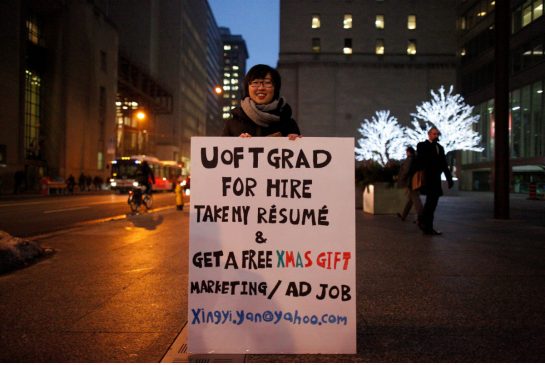
University grad Xingyi Yan, 21, has taken a placard to the street in a bid to land a job in advertising or marketing. (Credit: MARTA IWANEK / TORONTO STAR)

University grad Xingyi Yan, 21, has taken a placard to the street in a bid to land a job in advertising or marketing. (Credit: MARTA IWANEK / TORONTO STAR)

This past week, I read an item in The Toronto Star about a young university graduate who was finding it difficult to get a job. To highlight her availability, she took to standing outside Union Station, Toronto’s main transit hub, wearing a placard.

She’s hardly alone, unfortunately, and I applaud her moxy for putting herself in the middle of the pedestrian business traffic, but I question how effective her plan will be.

The young woman is interested in a career in marketing and advertising. Unfortunately, her sign suggests she does not have the creative talent for such a job. It’s a white sign with black letters that tells me her problem, not how she’ll solve mine. Even her choice of location tells me she doesn’t understand modern marketing and advertising.

>99% of commuters at Union Station not in a position to hire

>99% of commuters at Union Station not in a position to hire

More than 99% of the people walking past her every day are not interested in her goals and cannot do anything for her. She’d have been much better off jumping online for a couple of minutes to learn the locations of all the major marketing and advertising firms in the city and camping outside their doors.

That’s what I did when I was looking for a job years ago, after completing my M.Sc. studies. I didn’t wear a placard, but I did post “Lab Technician Available” signs around the research wings of the universities and teaching hospitals around Toronto and nearby Hamilton.

And the signs didn’t just announce that I was available. They also listed the laboratory techniques in which I was proficient, and therefore, how I could help your lab.

I got a lot of interviews out of that campaign and landed a couple of job offers.

Just over a decade ago, while working for a couple of science magazines in Washington, DC, my group needed to hire a couple of writers. As one of the hiring managers, I met all of the candidates and routinely participated in the same conversation:

“I’ve always loved writing,” the candidate would gleefully tell me.

“Well, that certainly helps with this job,” I would smile. “What have you published?”

The candidate’s smile would waver.

“Well, nothing,” he or she would hesitate. “But I love writing.”

“Great. Do you have any samples?”

An embarrassed shuffle in the chair.

“Um, no,” the candidate would visibly shrink in the seat. “It’s mostly just personal writing.”

By this point, I would have been willing to look at that.

To a person, I would offer the same advice at the end of our conversation:

“I can’t say how this process will go, but if I can make a recommendation: If you want to write science, write science…for anyone…whether paid or for free. If I can’t see your writing, how do I know you can write?”

If you say that you’re dying to do something, then prove that to prospective employers by actually doing it.

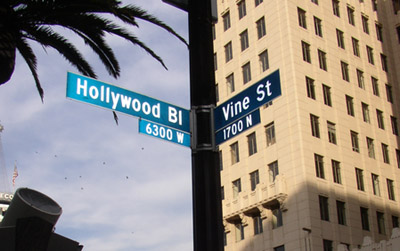
I would never apply for a job as a screenwriter without several screenplays in my pocket. And I’m pretty confident that it is not enough to stand on the corner of Hollywood & Vine in Los Angeles offering my services (at least not screenwriting services).

hollywood_and_Vine3

And when you do the thing you’re dying to do, make sure you do it well.

If my screenplays are shit, why should anyone hire me? If the placard you’re using to market yourself is unimpressive, why would a marketing company hire you?

Your effort doesn’t have to be professional-grade necessarily—what individual had that kind of budget?—but if it’s not exceptional in some manner, why would I make an exception and hire you?

I wish the young student well. She has taken the first step, but has so many more to go before she is likely ready.