Miss Sloane misses mark – review

sloane-poster

I am a sucker for politics and intrigue, shows like The West Wing and House of Cards (British & American versions) forming a regular staple of my creative diet. Thus, it was with great anticipation that I lined up to see Miss Sloane (trailer), an inside look at the cut-throat world of DC lobbyists, whom many consider the parasitic infection that Washington just cannot (and will not) shake.

Sadly, Jonathan Perera (writer of Miss Sloane) is no Aaron Sorkin or Beau Willimon. In his defence, however, it is likely that neither were Sorkin and Willimon on their first produced screenplays.

The movie follows the string-pulling machinations of Elizabeth Sloane (Jessica Chastain), an ice-water-in-her-veins win-at-all-costs lobbyist who works for one of the most powerful firms in Washington. This woman has no scruples and is willing to get behind anything that earns a paycheque and raises her status inside the Beltway. Anything, it seems, except for the gun lobby.

And when she is presented with an opportunity to make guns more appealing to women in the hopes of killing gun control legislation coming to the floor, she instead jumps ship to a boutique firm (read “poor”), run by Rudolpho Schmidt (Mark Strong), and takes up the opposing cause.

sloane-pairing

More could have been made of Strong’s moral angst over hiring nuclear weapon Chastain

Once the ball starts rolling down hill, it steamrolls over everyone in its path, and the story becomes a ballet between Sloane’s new firm and her old one, led by a very angry George Dupont (Sam Waterston) and his lead hitman Pat Conners (Michael Stuhlbarg). Until recently, Conners was Sloane’s partner in larceny. The rest of the movie is simply watching puppeteers pull strings.

Thus, this movie is a character study of people without character; a morality play completely lacking in morals.

As such, it is incredibly dark and even with its climax and moment of supposed triumph, you leave the theatre positively suicidal at the prospect that this story even starts to approximate reality.

In one way, it is fascinating to watch completely manipulative characters toss around human lives and feelings as though pieces in a game of Risk or Stratego. I think it strikes at our voyeur nature, tying in with the modern fascination in so-called reality television and amounting to little more than emotion porn. This movie could easily have been titled 50 Shades of Sloane.

sloane-puppetry

The strings may be invisible, but the puppet dances

At the same time, with no shred of humanity in these characters, it is difficult if not impossible to invest in the main combatants. At best, we mourn the cannon fodder that litters the field of combat. It is like watching a movie about the invasion of Normandy and really only being able to appreciate the kid who is killed as he steps off the landing craft.

And this is precisely where Perera’s developing skills let him down and his contrast with the current political masters is at its most notable.

Despite the sheer malevolence of Francis and Claire Underwood in House of Cards, there is a vulnerability that helps us understand their razor-clad shells. Go further back to the true master of political intrigue—William Shakespeare—and you see the frailties of the otherwise horrific Macbeth and his Lady. Or perhaps my favourite: Iago from Othello.

frailty-in-venom

Underwood, Macbeth and Iago: Human frailty lies behind the face of a monster

Despite the play’s title, Iago is the true hero of Othello. It is his story that unfolds as he manipulates all those around him, working their weaknesses and frailties against them, truly uncaring of the destructive impact his actions are likely to have on even his own future. And yet, for all the venom and disturbing glee with which Shakespeare imbues his malevolent beast, the Bard is also sure to insert short references to why Iago is so morally misshapen.

To his credit, Perera refused to go in the opposite direction and give us some long-winded sob story of a slight or wound from Sloane’s past to explain her motivations, and in fact, makes it a point, several times, to complain about just such an approach.

But in the absence of any contextualization for the character, even the climax itself comes across as academic exposition rather than revelation. At best, the climax has audacity rather than soul.

There is no moment to cheer the outcome of the story because the outcome is as soul-less as the morass that preceded it.

sloane-perils

That which cannot be controlled must be destroyed

As though sensing this, the final scenes of the movie felt like a bit of a negation of what came before, attempting to soften the edge of Sloane and the story itself. I really wish the movie had ended with the climax.

Given these character challenges, the stellar cast performed well despite being largely wasted.

Chastain does ice well, her face and mannerisms giving away little. Mark Strong was mostly missing in action, through no fault of the actor. His character simply had little to offer. And Stuhlbarg is quickly making a name for himself as malevolent toady, and for that very reason, really needs to find another role to utilize other aspects of his obvious talent.

Miss Sloane was a great idea that suffered in the execution, and I am perhaps being a bit unfair to put the onus on Perera. Director John Madden—best known for Shakespeare in Love and The Best Exotic Marigold Hotel—would have had some influence on how this story played out, and given the pre-diabetic sweetness of his other movies, this story was a surprising choice.

As an academic exercise, I would love to see what Sorkin or Willimon would do with this concept. Each would create very different movies, I think.

In the meantime, I will be interested in seeing where Perera goes next.

See also:

Chastain enlivens political thriller ‘Miss Sloane’ (Lindsay Bahr, Metronews)

Jessica Chastain dominates as a Washington power player (Nigel Smith, The Guardian)

Richard Crouse (video, CTV News)

Cheadle reaches Miles Ahead – a review

MrsMiracle_DVD_Sleeve

I don’t know much about jazz other than to say that almost everyone who has ever been considered a giant in the genre spent a lot of time facing very dark demons; demons so dark as to put rock & rollers to shame. Such was the case with Miles Davis.

In a quadruple-threat performance as writer, director, producer and star, Don Cheadle has created an interesting film that touches on a brief period in the jazz icon’s life through a never-ending series of timeline jumps that takes a little bit to get into.

The main plot of Miles Ahead revolves around a Rolling Stone reporter Dave Braden (Ewan McGregor) looking to get a glimpse into Miles Davis, who five years earlier, went into seclusion to nurse his drug addiction and failing muse. Desperate for a story, Braden inadvertently allows a scheming manager of another jazz performer to steal a tape of Miles’ comeback music, sending Braden and Davis on a chase caper worthy of the Scooby Doo gang.

Interspersed throughout this caper, Cheadle and his co-writer Steven Baigelman weave flashbacks of Davis’s relationship with dancer Francis Taylor (Emayatzy Corinealdi). Through whispered voices, they seem to suggest Davis might have suffered mental illness, and they show the musician’s slide into drug addiction through pain medication taken for a degenerative hip disorder.

cheadle-mcgregor

As a director, it seems Miles Ahead is Cheadle’s attempt at creating jazz in a visual form.

Scenes bounce back and forth. Visions flit through Davis’s mind. There is almost an ad lib feel to the performances as the actors seem to react rather than perform. And yet, once the piece gets moving, it feels whole.

That said, this is but the briefest of songs in a larger repertoire that was Davis’s life, and in many ways, I wanted to understand better what was behind the great artist’s fall from grace. As such, the movie feels very light despite its heavy subject matter and in several scenes, degenerates to slapstick cops-and-robbers. As biopics go, this is not Ray or Ali.

The choppiness of the scenes and lightness of plot also means that we never really get a good sense of most of the characters or the actors’ performances.

McGregor’s Braden doesn’t act, so much as mug from scene to scene, reacting to the antics of Cheadle’s Davis and the chaos that swirls around him. In fact, the one decision he does make—trying to steal the tapes himself—is a colossal failure and about the last decision he makes.

cheadle-wife

Similarly, Corinealdi’s Taylor largely remains a mystery to the audience. A creative spirit in her own right when she first meets Davis, she quickly falls into the role of cheated-upon wife who struggles to cope with a brilliant husband who is rapidly falling apart. The arguments could easily have been lifted from Ray, and for all I know, were lifted from Get On Up, the James Brown biopic also penned by Baigelman.

For his part, Cheadle eats up the screen with his portrayal of Davis at two very different times in his life. There were times when I almost couldn’t tell you that this was the same actor in each role.

The Davis of the 1960s is Cheadle as we know him; a cool customer who possesses the room in which he stands. The fallen Davis of the 1970s, however, is an entirely different creature, prone to lash out rather than control with a stare. And full marks to the make-up team for the physical transformation into the older Davis.

two-cheadles

This movie won’t be for everyone, and in fact, I have no idea who it is for.

There isn’t enough music for the jazz fans. Not enough character depth for the serious drama fans. And it feels too dated for those interested in amusing drug-laced comedies.

And yet, it works.

And for a budget of less than half-a-million, why wouldn’t Cheadle at least try?

I’m glad he did.

See also:

Miles Ahead (Angelica Jade Bastien)

Ode to a Jazz Giant (The Guardian)

Miles Ahead (Rolling Stone)

Doctor Strange quite ordinary – a review (UPDATED)

doctor-strange-city-bending-179855

As a disclaimer, you should know that I have grown weary of comic book movies and the various universes involved. Thus, I understand if some of you stop reading here.

Are they gone? Is anyone left?

Doctor Strange is the latest entrant to the ever-expanding Marvel universe. In this origin movie, it is the story of a brilliant, ego-driven neurosurgeon (Benedict Cumberbatch) who suffers a debilitating accident that destroys his career and therefore his reason to live. In trying to regain use of his hands, he finds a mystical Eastern retreat and begins a journey into magic, multi-planed realities and lessons in humility through the guidance of the Ancient One (Tilda Swinton).

The arrival of Strange might not be totally of his choosing, however, as he reaches the retreat at a time when it is facing its greatest threat, a former student (Mads Mikkelson) who has moved to the Dark Side and wants to feed the Earth to a Dark Entity (Dormammu) that swallows universes whole. And so the battle ensues, Dark vs Light (well, mostly Light), with weapons of magic, shifting realities, and literally shifting buildings that hearken back to the movie Inception.

And this is where I struggle with this movie. There is little here that is in any way original.

For me, this is The Shadow (look back in the archives for that one) meets Inception, with a soupçon of Kung Fu Panda and Harry Potter And The Who Gives A Damn, each of which I felt were better movies than Doctor Strange.

strange-bendy-streets

From Inception to Strange with little improvement

On the plus side, Cumberbatch is perfectly suited to this role, his droll delivery of cornball one-liners perfectly pitched—a la Robert Downey, Jr.’s Tony Stark. And the visual paintings of colour, perspective and sound are insanely rich and dazzling, worthy of the best recreational pharmaceuticals (so I am told).

But that is really all that this movie has going for it: big-screen kaleidoscope and Tony Stark 1.1 (can’t even manage 2.0).

The story is pretty linear with zero twists or turns. And even with that, the writers felt they needed to explain the story every 30 minutes or so with long streams of exposition. Apparently, all of the budget was spent on special effects and so they were forced to break the “show, don’t tell” writers’ convention. These aren’t reveals; they’re explains.

And aside from Cumberbatch’s waltz through ego and bon mots, all of the performances by the supporting actors are largely wasted.

Tilda Swinton’s Ancient One couldn’t hold the chopsticks of Dustin Hoffman’s Master Shifu (Kung Fu Panda). Mads Mikkelson’s Kaecilius is totally silly-us and I don’t recall any explanation as to why he chose to leave the school and work for the Dark Side.

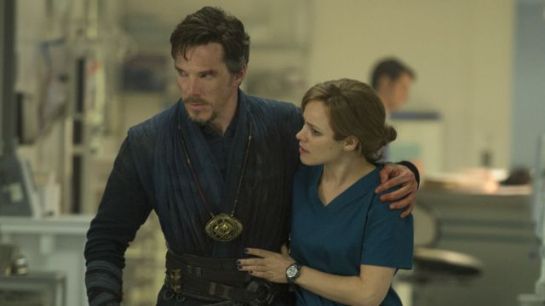
And what the hell happened to Rachel McAdams’ career? Here, she plays Strange’s estranged love interest Christine Palmer and is given nothing to do aside from roll her eyes, squeal at loud noises and apply defibrillator paddles every half-hour or so.

mcadams-strange

Sometimes, it is just about cashing the cheques (Benedict Cumberbatch, Rachel McAdams)

As my friend and Movie Review 360 partner Danny suggested (see link to his review below), origin stories are throwaways, their only job being to set up the characters for the following movies and cross-overs. I can’t disagree with him on that point…this movie should have been thrown away.

As just the latest piece in the Marvel cinematic universe, the real meat of Doctor Strange will come as he begins to interact with all of the other tight-wearing, planet-razing whackos—and stick around through the credits for the first hints of that.

So, why even bother with this movie?

Nothing in Doctor Strange was necessary for any of what follows, I am confident.

Okay…comic book fans can come back in the room!

If you’re looking for some dazzling eye candy and a few choice ripostes worthy of Tony Stark, Doctor Strange is the perfect popcorn muncher. For everyone else, check out 1994’s The Shadow…it really is better than it should be.


See also:

Movie Review: Doctor Strange (Danny F. Santos)

Lively Doctor Strange breathes new life into Marvel Universe (CTV News)

This is the champagne of Marvel movies (Global News)

Movie Review 360 (reviews Doctor Strange & Fury)

Jack Reacher? Yes, he did

jr-poster

Never has a movie been more aptly subtitled than the newest Tom Cruise action thriller Jack Reacher: Never Go Back. I really wish he hadn’t.

In the tradition of Jason Bourne and Taken, this is yet another dip into the former military man living life off the grid, but ceaselessly being drawn back in to save the world or a daughter; and in the case of this film, both.

There are two basic plots in this movie. First, Tom Cruise rescues and then helps Cobie Smulders (How I Met Your Low Expectations) find out who killed soldiers under her command, ultimately uncovering what looks like an arms-dealing conspiracy with its fingers in the U.S. military.

jack-reacher-2-movie-images

Back to TV for Smulders after this stinker

Complicating matters, however, is the idea that Cruise may have a daughter, played by Danika Yarosh in what appears to be her first major role. And in keeping with the schtick of man who is invulnerable because he has no ties, Cruise reaches out to his erstwhile daughter only to have the bad guys see this and take advantage.

Now, whenever watching a movie billed as Action-Thriller, you forgive a lot. If everyone did the right thing, this would be neither active, nor thrilling. But in this movie, the two supposedly smartest people in the room—Cruise’s Jack Reacher and Yarosh’s street-wise Samantha—behave incredibly stupidly, routinely telling the world “Hey, we’re over here!”

danika-yarosh-samantha-dayton-jack-reacher-2

Maybe Yarosh can act…not given a chance in this movie.

But again, this is all about the action, right?

Well, it would be if the action were more than a mere nod to those better films involving Jack Ryan, Jason Bourne, James Bond, and Rob Roy (okay, maybe the better Liam Neeson parallel is Taken). Instead, the action is sparse, predictable and formulaic. Cruise may be known for doing his own stunts, but he was at little risk of being injured on this set.

Okay, but it has thrills, right? Twists and turns that constantly kept you guessing?

The only thing that kept me guessing in Jack Reacher: Never Go Back was what time it was and how close we were to the end of the movie. From almost the opening moments, you knew exactly who the bad guys were and how they were connected to each other.

This was a film that was totally devoid of reveals and reversals. It played out exactly as you thought it would, and in some cases, the dialogue was so telegraphed that the climactic (if only in where it occurs in the movie) scene bored you because you knew exactly how it was going to play out.

How bad could it possibly have been?

With about 10 minutes left to play, the theatre in which I watched the movie brought the houselights up. It was as though they wanted to protect everyone who worked on this movie from being outed by keeping us from seeing the credits clearly.

As my friend Danny and I discussed the movie (video to come), we agreed that this was a wink or two away from becoming a very fun satire of action-thriller movies. Sadly, those ocular gestures never arrived and the movie remained a sad reflection on the genre.

It’s movies like this that will send Cobie Smulders back to television and sadly, may stunt the career of Danika Yarosh. That it won’t crush Tom Cruise’s career is a sign that he probably is Lestat.

lestat

See also:

Movie Review – Jack Reacher: Never Go Back (Danny F. Santos)

Sentimentality and Spinal Injuries (Richard Crouse)

Jack Reacher is a family guy thug in Never Go Back (Toronto Star)

Pearls of Writing Wisdom – a review

pearls-cover

There is something inside you constantly threatening to explode; an urgent feeling that simply refuses to be ignored. It keeps you from focusing on conversations. It keeps you from sleeping. It tears at the very fabric of your existence.

Now, unless you have recently ordered the taco salad at Chipotle or travelled interstellar space with Sigourney Weaver, these symptoms suggest you might be a writer.

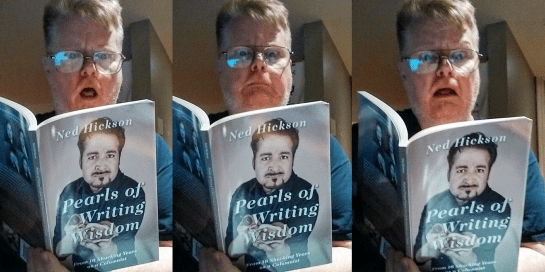
Ned Hickson knows these feelings well, and recounts some of his own experiences in his latest book Pearls of Writing Wisdom: From 16 Shucking Years as a Columnist.

In many ways, the book is a writer’s version of that dreaded conversation between a child and loving parent/teacher about sex…and it’s just as awkward.

In his own nervously jovial way, Ned tries to encourage writers to explore their budding bodies of work and yet caution them about the challenges that lie ahead without scaring (or scarring) them into creative celibacy.

Without photos or illustrations, Ned routinely contextualizes the lessons he is giving with self-deprecating anecdotes—like that time he walked around a mall for four hours before someone mentioned his participle was dangling. The point being (I think) to highlight that even with these personal failings, he still managed to fool people into reading (and paying for) his stuff.

Given the subtitle, I originally expected this book to be a chronicle of things he’d learned in his day job with Oregon’s Siuslaw News, a newspaper for which he is Editor and writes a syndicated humor column.

Nedwork

Ned offers insights on sex…I mean, writing

Instead, I found a book that covered all aspects of writing from understanding the inherent urges to the mechanics of satisfying wordplay to dealing with the social and legal ramifications of your actions…hunh, this really is about sex.

And speaking of sex, Ned’s book isn’t very long (97 pages) but what he accomplishes in those short, floppy pages is quite effective in nurturing new talent, as well as reminding those of us sliding into senescence why we write.

Whether you are a writer or know someone wanting to act on those urges, I highly recommend Pearls of Writing Wisdom as a way to bolster courage and encourage good practices, and maybe laugh a little.


P.S. If Sigourney Weaver happens to read this review, I would happily risk alien infestation to meet you at the Chipotle of your choosing.

sig

See also:

Humor at the Speed of Life (Ned’s blog)

Humor at the Speed of Life (Ned’s other book)

Port Hole Books (Ned’s publisher)

Jason Bourne should have stayed home (review)

bourne poster

Super-assassin Jason Bourne is trying to figure out who he really is. In doing so, he falls into a web of deceit and potentially world-crippling black ops, including the one that gave birth to him. People try to neutralize him…silly people.

Cars race through crowded streets. Shots are fired from every direction. People die just as they start to provide answers. More shots are fired. Bourne gets answers but no real resolution or peace.

If you expected any more from a Jason Bourne movie, then you will be seriously disappointed with the latest installment of the series based the lead character of the novels by Robert Ludlum. In fact, if you want more from a Jason Bourne story, read the novels by Robert Ludlum because they are insanely better than any of the movies.

[Some SPOILERS hereafter]

In the latest installment of the series, Matt Damon’s titular character is brought out of hiding by his former nemesis-turned-ally Nicky Parsons (Julia Stiles), who has hacked into the CIA server and stolen the complete dossiers of the agency’s Black Ops. She wants to turn the information over to a Julian Assange kind of character, but asks for Bourne’s help, enticing him with information about his father’s involvement in his creation as super-killer (think X-Files Fox Mulder).

After a momentary “I’m getting too old for this shit” and some personal sacrifice on the end of a bullet, Bourne is alone again and we are off to the races.

Bourne cast

The CIA Director (Tommy Lee Jones) wants him dead, relying on another super-assassin The Asset (Vincent Cassel) to get the job done, while IT-savvy CIA analyst Heather Lee (Alicia Vikander) sees an opportunity to advance her career and maybe replace her boss by bringing Bourne in. Oh, and in the background, there is something about the CIA having access to the personal information of everyone on the planet via the Internet and a Sergey Brin-like character.

Unless this is your first Jason Bourne movie, you know how this all plays out…and if it is your first Jason Bourne film, why should I spoil it for you?

If you are looking for 123 minutes in which to simply check your brain at the door, then this is an entertaining way to do that. Stuff blows up, people fight, lots of car chases. But nothing really happens that hasn’t happened in the previous movies. Much like a roller coaster, the ride can be exhilarating at moments, but once the ride stops, so does the exhilaration.

And that was my problem with the movie…the thrill is quite literally gone for me. Jason Bourne has become his own cliché, and the writers and directors of this series are simply repeating moments from the other incarnations.

Where they had an opportunity to do something truly interesting with this story—the moments we spend exploring Bourne’s relationship with and confusion about his father—the writer-director Paul Greengrass and writer Christopher Rouse give us the barest taste and scurry back to blowing shit up. Rather than offer any sense of discovery and revelation, they simply have a former agency hack fill in the background under threat of death.

Is toady ex machina a thing?

In the earlier incarnations of this series, I never knew what to expect. In this incarnation, I knew exactly what to expect and it was delivered each and every time with a pretty pink ribbon. Or was that faded red tape?

I’m going back to the books. At least Robert Ludlum knew how to write.

As for shit blowing up, back-stabbing political conspiracy, and disquieting Internet voyeurism, 123 minutes of Jason Bourne just can’t compete with 20 minutes of CNN.

Bourne books

Brian Henson talks to me (sorta)

Brian and me

It could’a happened

As many of you know, I am a massive puppetry fan and have even written comedy for puppets (nasty beggars). And one of my favourite puppet performances–only after my own SomeTV!–is Puppet Up! – Uncensored, produced by the Henson Company under the leadership of Brian Henson, son of Jim (sounds biblical, doesn’t it).

In preparation for their upcoming run in Las Vegas (July 21 – August 31 at the Venetian), Puppet Up! put out a call for people to submit questions to Brian…so you know I had to.

Tweet

Well, kudos for Brian’s bravery, as he just responded in a two-part video (unfortunately, cannot embed video from Twitter so please click on link).

Cheers to the entire group for taking the time to do this…it was fun (at least, for me).

And if you’re even thinking of heading to Vegas, be sure to check out Puppet Up! – Uncensored at the Venetian. I guarantee you will have a great evening.

PUVegas

Randy_2

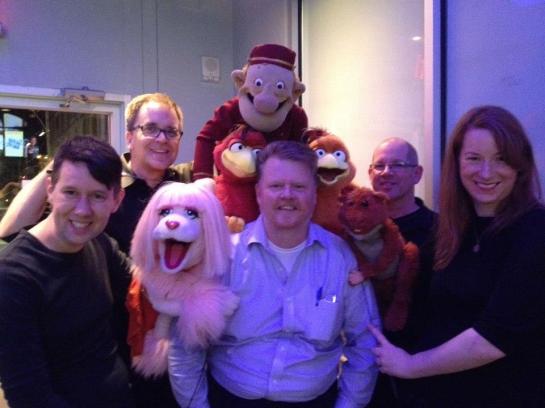
Hanging with the Puppet Up! cast and characters after the Toronto finale

See also:

Puppet Up! visits Toronto

SomeTV! spreads like herpes at Burning Man

Behold, easily the best of Fringe Toronto

BtB-Subway-Poster-For-Web

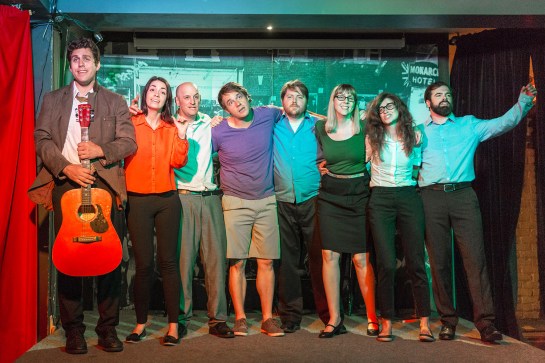
I may have to give up comedy writing. Based on the sold-out sketch comedy show I saw last night at Toronto’s Monarch Tavern—part of the annual Fringe Festival—I am a flailing hack or self-deluded pretender.

Brought to us by the disturbed mind of Justin Haigh under the umbrella of Spoon vs. Hammer, Behold, the Barfly is a delightful show that is possibly the most consistently funny sketch comedy performance I have seen in ages, and if its run is limited solely to Toronto Fringe, we all lose out.

Trying not to spoil any of the sketches, let me just say that they are all really solid…even the ones that opened weak only to demonstrate that this was done on purpose. As a comedy fan and writer, I often found myself anticipating the direction of a sketch only to be surprised by a solid twist that never felt manipulative or like a bad M. Night Shyamalan moment.

The casting was amazing, each performer bringing his or her unique absurdity to the performance, and presenting the sketches with such vitality that they almost felt improvised (in the good sense). These are performers comfortable with their material, which is critical for sketch comedy.

Singer

Ned Petrie is the classical Everyman who just wants to be loved (Credit: Laura Dittman)

Ned Petrie is clearly the anchor for this show. He does one delicious take after another on the Everyman, a stoic witness to the world gone mad. Eric Miinch is the clown, doing his damnedest to break up his scene partners with ad libs that enhance rather than disrupt the scenes in which he finds himself.

Elizabeth Anacleto is the shape-shifter, becoming whatever her role requires with mercurial fluidity even when required to shift smoothly within a single sketch. Marsha Mason—whom I should note I know personally—is a talent who can say more with a single facial expression than with the best written dialogue.

Jeff Hanson and Steve Hobbs are mesmerizing on stage, each one bringing an intensity to their performances that cannot be ignored, especially in one particularly disturbing turn by Hobbs. Kevin MacPherson and Sarah Thorpe, meanwhile, ably glue the entire construction together, the former largely coming in from left field at every turn.

If I have one criticism of the show, it is that it completely under-utilizes the amazingly talented women in the cast, the male performers generally taking the most significant roles.

As a male comedy writer, I completely understand the challenge of consciously writing female roles without looking like you’re writing female roles. It is not sufficient to simply lop the penis off a male character.

If Haigh and his team are given the opportunity to remount this show—dear comedy gods, let this be so—I would hope he takes time to tap more deeply the talents of these wonderful women.

In the meantime, if I want to keep writing comedy—because it’s all about me—I am seriously going to have to up my game.

Behold, the Barfly Cast

Seamless casting: (L to R) Hobbs, Thorpe, MacPherson, Miinch, Petrie, Mason, Anacleto, Hanson (Credit: Laura Dittman)

Behold, the Barfly continues at Monarch Tavern until July 10. After that, we can only hope.

When Gods evolve

In the beginning, God created the heaven and the earth.

And the earth was without form, and void; and darkness was upon the face of the deep. And the Spirit of God moved upon the face of the waters.

And God said, Let there be light: and there was light.

Genesis; 1; i-iii

Ancient of Days

Ancient of Days (William Blake)

I know the feeling.

I am the Creator and the Destroyer. I am Fate pulling the strings of Destiny. I am Existence itself. The Void remains until I choose to illuminate it.

A tad full of myself? Perhaps.

But it comes with the territory, because I am a writer.

Despite all present evidence to the contrary, I am an introvert; and as a child, I tended to avoid contact with others out of fear of injury and a touch of self-loathing.

My escape from this fear was my imagination and the worlds I created.

Where the world around me was filled with questions, uncertainty, chaos, the worlds of my mind were clean, certain, orderly. Good was good. Bad was bad…and even bad was good given time and understanding.

And over all of it, I was God.

The world didn’t exist until I put pen to paper, and just as quickly, it blinked out of existence when I lifted that pen.

I am no longer that child—well, perhaps a less fearful child.

The world in which I live is coloured with all shades. It has texture. It has flavour. And while it still has chaos and uncertainty, I am better able to embrace that chaos, to find freedom in uncertainty.

Likewise, the worlds I create have become more nuanced. Nothing is either good or bad, but instead is delicate and needful.

And over all of it, I am God. But even Gods evolve.

God Creating The Universe

God Creating the Universe (Layne Karkruff)

Where once I enslaved my worlds to my control, I am now more apt to offer degrees of freedom, to allow my worlds to ride the wave of existence.

I completely reserve the right to rain fire and brimstone, but am more likely to use a gentle hand with my charges. What were once caricatures are now sentient beings with a full range of emotions and thoughts, prone to mistake and capable of wonder.

And perhaps, in allowing my worlds to move beyond me, I achieve true Godhead. For as much as I no longer define their existence, they no longer define mine, and I am free to be me.

Ehyeh asher ehyeh.

I am that I am.