SomeTV! spreads like herpes at Burning Man

Kevin Nic puppets

Nicholas Lemon (left) and Kevin Scott completely ignore the script…again.

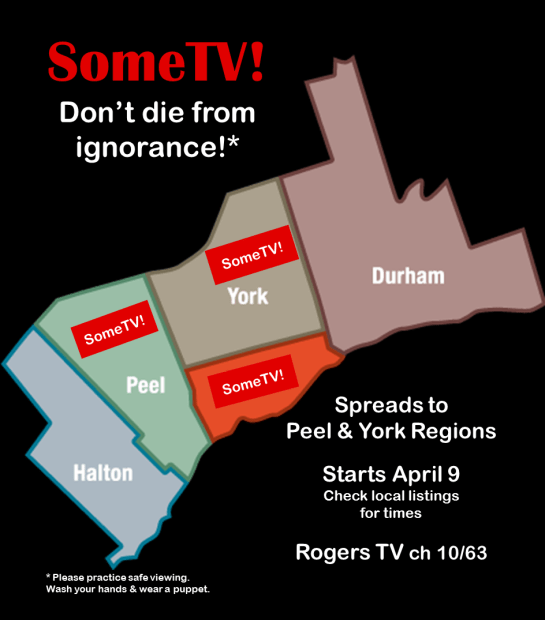
After a successful run in the City of Toronto – success measured by lack of lawsuits – SomeTV! is spreading its infectious laughter into the suburbs…specifically Peel and York regions of the GTA.

Don’t know what SomeTV! is?

Imagine a short-armed tennis ball fluffer boxing with your uvula via your rectum. Got it? Well, SomeTV! is nothing like that (but now you have plans for the weekend).

Kevin chicken

Uvula boxing champion Kevin Scott (with Nicholas Lemon)


SomeTV! is what happens when fans of The Muppet Show and Monty Python’s Flying Circus don’t listen to reason, and go all Andy Hardy with puppets and Canadian actors.

Or perhaps our God-head Nicholas Lemon explains it better in this clip from a Toronto talk show:

In any event, once we scab over and the blemishes stop itching, we are hoping to take this phenomenon worldwide – pending a CDC and WHO investigation. Wish us luck…and ointment.

Ignorance_timeless

See also:

Writing for puppets

Lemon Productions Inc.


SomeTV! is alive!

SomeTV! poster

As some of my ever-patient followers of long ago may remember, there was a time that I co-wrote a sketch comedy show called SomeTV!, that we essentially described as the love-child of Monty Python’s Flying Circus and The Muppet Show.

Like any good creative project, this was a labour of love and mass insecurity…and took for-freakin’-ever to see the light of day. Well, seems that day is next Friday (March 11) at 10 pm (ET).

Kevin Scott

In its inaugural run, SomeTV! will air as a one-hour special on Rogers Television in Toronto (think Wayne’s World), but it should be available shortly thereafter online. So happy to see this project and all the hard work that went into it (not just mine) finally come to life.

Still waiting for my producer, director and Godhead Nicholas Lemon to post the teaser trailer…will update this post when he does!

See also:

Writing for puppets

SomeTV Pulse

NeoHuman podcast, starring me

Willis NeoHuman

My friend Agah Bahari is interested in everything, which is one of the things that I love about him.

Not that long ago, he decided to indulge his interests by starting something he calls the NeoHuman podcast (which matches nicely with his NeoHuman blog), inviting many of the interesting people he knows to discuss pretty much anything that comes up.

Well, seems he ran out of interesting people and so he invited me to participate…and we talked about anything: biotechnology, pharma, global healthcare, designer babies, creativity, writing, screenwriting, 9/11, marketing, and the novel he and I are writing about his life.

But my favourite part is the question he asks all his guest, which is roughly:

If you met an intelligent alien life-form, what would you describe as the greatest human accomplishment and as the worst human accomplishment?

Never boring, my friend Agah.

Agah-me

(Photo stolen with love from Kelly Brienz Showker)

Surprise, but never lie

Roff

I recently saw the following advice from filmmaker and screenwriter Don Roff posted on the Facebook page of the PAGE International Screenwriting Awards:

Always mystify, torture, mislead and surprise the audience as much as possible. — Don Roff

Although I agree with the sentiment, I don’t think it is complete (Note: I was unable to locate the source of the quote to learn if Roff said more on the subject). Thus, I offer the following codicil:

Mislead and surprise, but NEVER lie to your audience. Everything must be possible within the context of the universe you have built in your story. If you lose the trust of the audience, you’ve lost them forever.

Pet Park in Peril


SONY DSC

Only chicken wire and wood separate the canines from the under-nines

In what is set to be the battle of the ages, dog owners along Toronto’s Beaches boardwalk are up in arms over an invasion that has them frightened for the safety of their four-legged family members.

A new disease-bearing tick?

Someone leaving poisoned treats?

Marauding coyotes looking for a snack?

Nothing so mundane.

Instead, pet parents are angry that the dog park at the foot of Lee Avenue has been invaded by terrors of the bipedal kind as parents throughout the area have literally unleashed their children within the wood beam and chicken wire compound.

“It’s just not fair,” cries local Peke-a-poo owner Jolene Carpenter. “They have a wooden fortress and wading pool right there in Kew Gardens, and full playgrounds at either end of the boardwalk.”

“How would they like it if we turned their sandboxes into litter boxes?” adds Henry Ratsburg, collie-enthusiast and former cat owner.

As though proving their point, the fence bordering the dog park resembles a sand-covered drive-in as strollers of all sizes, colours and designs sit parked along the fence. Meanwhile, their parental owners relax at the nearby ice cream bar and coffee shop, chatting with other parents while their children run amok beyond the gates.

“I really don’t understand the fuss,” chimes Cyndy Jacobson, mother of two. “My kids need a safe place to run around, and this is the only designated off-leash section of the beach.”

baby_boy_on_leash

Docile when leashed but muscles braced for freedom

Ironically, the dog park, which is actually comprised of an open sandy section and a larger shrub-laden section, was established by the City of Toronto several years ago after many parents in the area complained about dogs littering their waterfront fun.

“It was a total mess out there,” remembers long-time Beaches resident Jackson Brink. “At best, people would just bury the dog droppings in the sand, but it doesn’t take long on a hot summer’s day to realize you’ve parked your beach towel on a fermenting pile left by a mastiff or Great Dane.”

Play time

Frolicking in the sand or burying the evidence?

The park’s transition from canine to kiddie has been a slow but inexorable one that started with delayed summer temperatures last year and parents’ worries about letting their children play in the frigid surf. One by one, as stressed parents discovered the relative calm of the dog park, they began to release their children into its confines.

“The first few actually showed up with both kids and dogs in tow, but they didn’t fool us,” says Carpenter. “Within minutes, you’d see them skulk out of the park with their dogs, the kids nowhere to be found.”

Several residents have demanded the City step in, if only to deal with the potential health and safety risks.

“They bite; they scratch; they’re full of germs. I just don’t feel that my babies are safe in there,” complains Ratsburg, anxiously stroking the fur of his tri-colour collies.

Rebel lake

Ratsburg and friend in better days

Nobody from the City of Toronto was willing to go on the record, but one unnamed source suggests there is little the City can do given the way current bylaws are written.

“All we can do is caution people to make sure their little ones have all their shots and don’t get trampled,” the source suggests. “Residents with children might want to do the same.”

Auto(populate)bots Assemble!

robot-n-women

Reports suggest that within the next two decades, robots will take responsibility for upward of 50% of jobs currently handled by humans, who simply remain inefficient and cannot work 24 hours a day.

Already, we are seeing automation in manufacturing and order-entry kiosks in the services industry. It is assumed the next stage will involve a complete takeover of the social media industry, with timelines auto-filled by trivia and rumour bots.

This post brought to you by the Xorblat 3-11A

Photo stolen without permission from The Robot State blog.

For a legitimate discussion of such topics, check out The NeoHuman Blog.

Substance over volume

ddnews

When you meet someone who does not speak your language, there is a cliché response of talking louder to make yourself understood. There is something within many of us that says if we simply pump up the volume, we can overcome the disconnect.

A couple of months ago, Tufts University released their latest estimates for the average cost of developing a new drug: $2.6 billion (I’ve seen estimates up to $5 billion). Eleven years ago, the same group calculated the costs at $0.8 billion.

Now, every time these estimates arise, the hand-wringing begins over how the costs were calculated, which factors make sense and which are over-reaching. What no one seems to argue, however, is that drugs are less expensive to develop today than they were a decade ago.

So what has this to do with speaking louder?

The same period has seen amazing technological achievements designed to facilitate and accelerate drug discovery and development.

Combinatorial chemistry was heralded as a way to expand compound libraries from hundreds to hundreds of thousands. High-throughput and high-content screening, as well as miniaturization and automation, were lauded as ways to screen all of these compounds faster under the paradigm of “fail early, fail often”. And given the masses of data these technologies would churn out, the informatics revolution was supposed to convert data into knowledge and knowledge into healthcare.

And yet, for all of these improvements in throughput, I question whether we have seen much improvement in the number or quality of drugs being produced. We certainly haven’t made them less expensive.

Please understand, I don’t place any fault in the technologies. These are truly marvels of engineering. Rather, I question the applications and expectations of the technologies.

Almost two years ago, GSK CEO Andrew Witty told a London healthcare conference: “It’s entirely achievable that we can improve the efficiency of the industry and pass that forward in terms of reduced prices.”

The pivotal question here, I believe, is how one defines efficiency.

I wonder how many people simply felt economies-of-scale would improve discovery, much as mass production made Henry Ford a rich man. But drugs are not cars, and where throughput and scale make sense when you have a fully characterized end product, they have their limitations during exploration.

When I was a protein biochemist in an NMR structural biology lab, I spent some time trying to wrap my head around two concepts: precision and accuracy. A 3-Å protein structure is very precise but if the structure isn’t truly reflective of what happens in nature, it is meaningless. A 30-Å protein structure is much less precise, but if it is more accurate, more in tune with nature, then it is likely more useful.

By comparison, I wonder if our zeal to equate efficiency with throughput hasn’t improved our precision at the cost of our accuracy. If you ask the wrong question, all of the throughput in the world won’t get you closer to the right answer.

In researching the DDNews Special Reports over the last couple of years, I have spoken at length to several pharma and biotech specialists about this topic, and many feel that the industrialization of drug discovery and development has underwhelmed if not outright failed. Several have suggested it is time to step back and learn to ask better questions of our technologies.

But getting back to the costs issue.

I know many will rightly point out that the largest expense comes from clinical trials. To address this challenge, new technologies and methodologies are being developed to get the most useful information out of the smallest patient populations.

Here again, however, no one segment of the drug development process stands in isolation, and I think back to the compounds reaching the clinic and question the expense of incremental improvements.

Oncolytics CEO Brad Thompson discussed the challenge in Cancer in the Clinic (June 2014 DDNews).

“If you could double [overall survival], you could show that in a couple of hundred patients. If you want to do a 10-percent improvement, you’re talking thousands of patients to do it to the statistical level that everybody would prefer to see. How do you run a study like that?”

That is a huge difference in financial expenditure that begs the question is an efficacy improvement of just 10 percent of value.

From an individual patient perspective, assuredly. From a pharmacoeconomic perspective, maybe not, and particularly with the growing prevalence of high-cost targeted biologics. Maybe we need to aim for bigger improvements before moving candidates forward, which happens long before the clinic.

Again, I’m not placing blame. The history of any industry is filled with experimentation in different methodologies and technologies. Everyone involved had the best of intentions.

But after a couple of decades of middling results, perhaps it is time to question how and when many of these advancements are applied. Simply yelling at a higher volume doesn’t seem to be enough.

[This piece was originally published in the January 2015 issue of DDNews. A lot has happened in the year since, including some amazing results in the field of immuno-oncology that might just address the demand for high-performance treatments even if only for a select patient population. For more on that, see my June 2015 Special Report “Body, heal thyself”.]