Giving Feedback – The Reviewer Strikes Back

Okay. So, now that we’ve discussed asking for and receiving feedback, is there anything we should consider before giving feedback.

We’ve all been on the other side, awaiting a kind word or a withering criticism from a respected compatriot or senior, so we should all be aware of the power of the right word at the right time. You have been given an honour by the recipient and should give him or her and the work the respect they deserve.

Below, I offer some thoughts on how to approach the feedback process when asked, but (sorry for the broken record) I want to hear what you think too.

Feedback is personal. It reflects who you are, what you believe and how you feel. Don’t try to make it otherwise, lest you lose any value it provides. The writer asked you for very specific reasons. To give them anything less than you is a disservice.

Make sure, however, that your feedback is more than just opinion, even though that forms the basis of it. There is a world of difference between superficial criticism and thoughtful critique. Criticism is about saying what you feel. Critique is about asking yourself why you feel that way and discussing what it means with the writer.

Ask questions. Be sure to ask questions both before and after you’ve completed your analysis. What kind of feedback are you looking for? Is there anything you specifically want me to keep an eye out for? What was your thinking behind this scene or character?

Without knowing the answers to these kinds of questions, I don’t think you can offer the most effective feedback. Likewise, the answers may provide you with a framework on which to build your feedback or tell if you’ve misunderstood something significant.

Be honest. Never be afraid to tell the truth, no matter how brutal. You’re the best judge of what you think the writer can handle, but by the same token, they’ve asked for your help and holding back may be counterproductive. It’s possible to be honest without crushing someone, and I don’t mean making a shit sandwich (good news-bad news-good news). Rather, walk them through your thinking as you read their stuff and, even if they don’t beat you to the conclusion, at least they understand your reasoning.

And wherever possible, don’t leave them hanging. Offer suggestions as to how the work could be improved or fixed. If you have no ideas pre-emptively, brainstorm it with them. If nothing else, it will show the writer that you’ve invested in his or her work.

DON’T COPYEDIT. That’s not feedback, it’s copyediting. Unless the spelling of a word or the punctuation of a sentence significantly impacts the meaning of a sentence, leave it alone. It ends up being a distraction from the important conversations. If their climax sucks (you’ll want to be more specific), who cares that they should have used a semi-colon or incorrectly used “its” instead of “it’s”?

Put it in writing. Even the most seasoned writer will miss important tidbits of information while scrambling to take notes on your feedback. By writing your feedback out, preferably within the manuscript itself, you give the writer the chance to follow what you’re saying and how you’re saying it, rather than focusing on the details of the feedback, which they can do at their leisure.

Look for the bigger picture. As you compile your feedback, look for trends or commonalities. As with receiving feedback, ask yourself if any groups of notes refer to the same issue; e.g., a lot of scenes take too long to get started or could be started later without losing the story. Be ready to provide examples, of course, as the bigger picture is typically less obvious, but try to avoid getting stuck in the weeds.

Besides, if there are fundamental issues with the story or its presentation, then all of the nitpicky stuff is unimportant and you’ll be wasting your and the writer’s time.

Your feedback; the writer’s work. Even if you inscribe your comments on stone (see “burning bush”), the writer does not have to agree with you. It is important as you analyze someone’s work that you remember it is their work. Although you can help them develop their voice and style, it is not your task to change their voice or style. Likewise, and more importantly, it is not your job to convert their work to your voice.
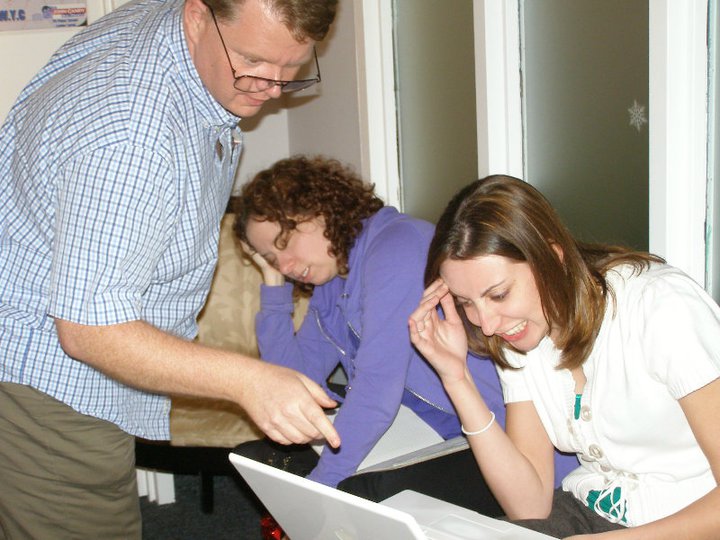
Me acting like I could ever teach anything about comedy to the very funny ladies Nicole Rubacha and Megan Mack


Me acting like I could ever teach anything about comedy to the very funny ladies Nicole Rubacha and Megan Mack

Spring takes wing – Washington, DC

So, it seems to be the season of the sparrow this year as they were out in profusion across Washington, DC, although the starlings did their best to make an appearance or two.

The hardest part about getting some of these photos was keeping vacationing children on the Washington Mall from scaring potential subjects away.

Receiving Feedback – Part Two

In Part One, I talked a bit about the challenges of asking for and receiving feedback. Below, I offer some thoughts on how to resolve some of those issues, but again, want this to be an open discussion.

When to ask. Feedback can be valuable at any stage of an exercise, but the type of feedback you need will change as your work progresses. Out of the gate with draft one, you really just need to know if the story works. After that, you’ll begin to explore things like character arcs, scene/event order (plotting), etc. Give specific direction on what you want from the reviewers.

Whom to ask. Ask for feedback from people whose sensibilities and/or writing you respect. If they think in a manner that attracts you or write in a style that you find interesting, then they are more likely to give you feedback that meshes with your goals for your work. As your skills mature, you can venture further afield and test yourself against people who think significantly differently from you.

Give direction on what you want. If you simply give someone your work and ask them to let you know what they think, then you deserve what you get. Ask for their thoughts on specific aspects of your writing so that they can focus on just that aspect. Alternatively, tell them what you worry about and let them interpret how to give feedback to address that need.

Ask questions. When you receive feedback, don’t simply say thank you and then go read it in a corner, deciding whether to commit hari kiri. Make sure you understand their feedback so that you know how to use it. It may be that they have totally misunderstood what you have tried to do—which is itself something to look at—so the specifics of their feedback may be of limited use.

Think about the feedback. In some cases, simply incorporating some feedback will make sense; however, you generally want to see what the feedback is telling you at a broader, more basic level. Does all the feedback come down to the same one or two things? For example, if a lot of the feedback is asking why your characters did certain things, then maybe the bigger issue is a need to more deeply or transparently explore character motivation. Not an easy task, but ultimately more rewarding than simply explaining away the why’s through exposition or on-the-nose dialogue.

NO FEEDBACK IS GOSPEL. If a burning bush offers you insights on your project, always remember that this is just one plant’s opinion. The smouldering conifer a few feet over may have totally different or contrary suggestions.

Don’t rely on one source of feedback, as it will include personal biases that may not be germane to your work. And even when you get feedback from multiple sources, look for patterns in the feedback. If 70% of people have issues with your climax, it’s probably time to review your climax. If, however, 30% don’t get your antagonist, you may want to look at that, but it’s not a priority.

This is also why it is important to request specific feedback. If 10 people give you 10 thoughts each and none or few of them overlap, you have no idea what is important and what is personal taste.

Remember who’s in charge. This is your work and you should be prepared to defend it while being open to ways to improve it. You DO NOT have to incorporate feedback you get. You may feel it’s off base, doesn’t really fit with what you were trying to do or the story you wanted to tell. Fine. Stick to your guns (or weapon of choice). Just because you asked for the feedback, doesn’t mean you have to take it (not even mine).

Tell your story, your way.

As my first and only tattoo, I wanted something that spoke to how I wished to be remembered

As my first and only tattoo, I wanted something that spoke to how I wished to be remembered

Receiving Feedback – Part One

Feedback is always difficult, or it should be.

When a sound system suffers feedback, it is a loud resonant noise that increases in pitch as it slowly and achingly bores a hole into your head. Feedback on a piece of writing (or any other piece of art) can feel very much the same.

Unlike the sound system example, however, feedback is vital to the survival and improvement of your art. It will help you understand the places in which people struggle to see your vision. But just as importantly, it helps you see where your efforts resonate—in a positive way—with your audience. The challenge is understanding how much weight you should put on the feedback.

When we first start writing, we tend to wait forever to ask for feedback, often for fear of being told our work sucks. And when we finally do receive feedback, we take all the negatives to heart and may never hear the positives. We then destroy our work by either shelving (deleting) it or by trying to incorporate every piece of feedback into the work. The latter effort results in a work that is either a complete mess that makes no sense, or worse, reflects the tastes and preferences of the person providing feedback and not us, the artist.

We also tend to ask the wrong people for feedback—friends, parents, partners—perhaps in the hope they’ll be gentle with us. Unfortunately, these people don’t tend to have experience with this kind of thing—the “but I know what I like” syndrome—and so the feedback runs the brevity gamut from “I really like it” to “I’m not sure I get it”, none of which is particularly useful or informative.

As we mature in our writing, we may ask a larger number of people to review our stuff, but then we run into the problem of conflicting opinions. And as with the eggs in one basket scenario, we may try to please everyone with changes—destroying our own voice—or simply shelve the whole project. There’s also the possibility that we’ll take the attitude that everyone’s crazy and we’re brilliant, but that doesn’t happen very often at this stage.

We still may not be asking the right people, but we’re more likely in the right ballpark, focusing on other writers. If those writers aren’t at our level or higher, however, the feedback we receive will be helpful but probably won’t get us to the next level. Nobody’s fault. They just probably haven’t developed the critical skills needed to help us find not just challenges but also ways to solve them.

So, what’s a poor writer to do?

In Part Two, I’ll offer some thoughts on how best to approach the challenge of asking for and receiving feedback.

I want this to be an open conversation, however, and welcome you to contribute your experiences or thoughts to the conversation as well.

My brother has his own way of dealing with feedback, but he's a pretty good guy nonetheless.

My brother has his own way of dealing with feedback, but he’s a pretty good guy nonetheless.