No

Not yet

I love what I do.

I love writing. I love coming up with new ideas to write. I love helping other people put their ideas into words and then into action.

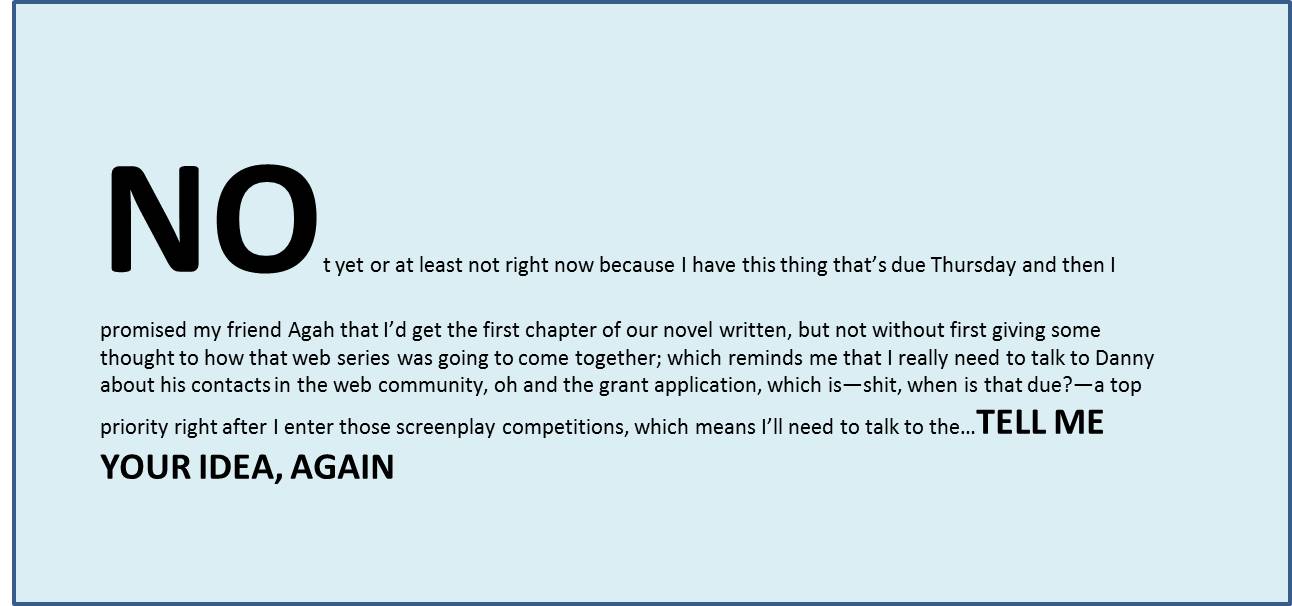
This is why I struggle with one of the shorter words in the English language: No.

Hello, my name is Randy, and I am addicted to new projects.

There was a time when my inability to tell people no stemmed from my fear of letting them down. Or more accurately, my fear of them never asking again and my value as a person being reduced to zero.

Not so now, luckily. Now, I find my value internally. I am, therefore I have value.

Interestingly, though, I still struggle to say no. But now, it’s a curse of enthusiasm and confidence, now fear and self-loathing.

And to complicate things further, that same enthusiasm and confidence attracts people who are more timid in one or both. People with ideas but lack voice, or with voice but lack means.

I am glad that they see me as a vector through which to explore and advance their visions. At the same time, I have to remember that my bandwidth is limited. It is less the hours in a day and more the daily ration of creative energy that limits me.

(BTW, this is why I don’t upbraid myself for spending hours on the computer or playing Solitaire. That is my period of recharge.)

At some point, I have to limit my involvement in others’ works. I have to save enough space for my paying gigs, lest I be hungry and homeless, and for my creative projects, lest I be frustrated and unhappy.

I have to say “No”.

You recently published a book and want to turn it into a screenplay? Great!

You’ve got an idea for a comedy sketch event? Fantastic!

I came up with another great concept for a movie? Congratulations! (Yes, even I drain my batteries.)

I’m not saying I won’t help, but don’t take it personally if I limit my involvement. It is not a reflection on you or your idea but rather on me and my limitations.

Today, I can work with you. Tomorrow, I may only be able to listen to you. The next day, I may not even be able to do that.

Oh, and I’ll do my best to recognize and respect those same boundaries in your life.

No doesn’t mean your idea sucks. No doesn’t mean I never want to work with you. No simply means I can’t, not right now, no matter how much I might want to. There are shades of No.

I can’t because I already have plenty on my plate. I can’t because I have to keep myself a priority. I can’t simply because I can’t.

But I wish you all the best in your efforts.
Yellow sub no2

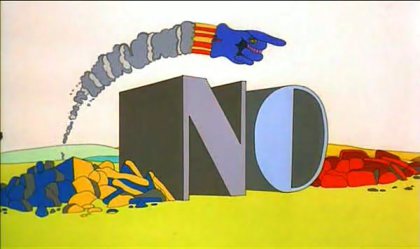
In a slightly unrelated brain fart, the concept of No reminded me of one of my favourite revelations from the movie Yellow Submarine, the animated Beatles film.

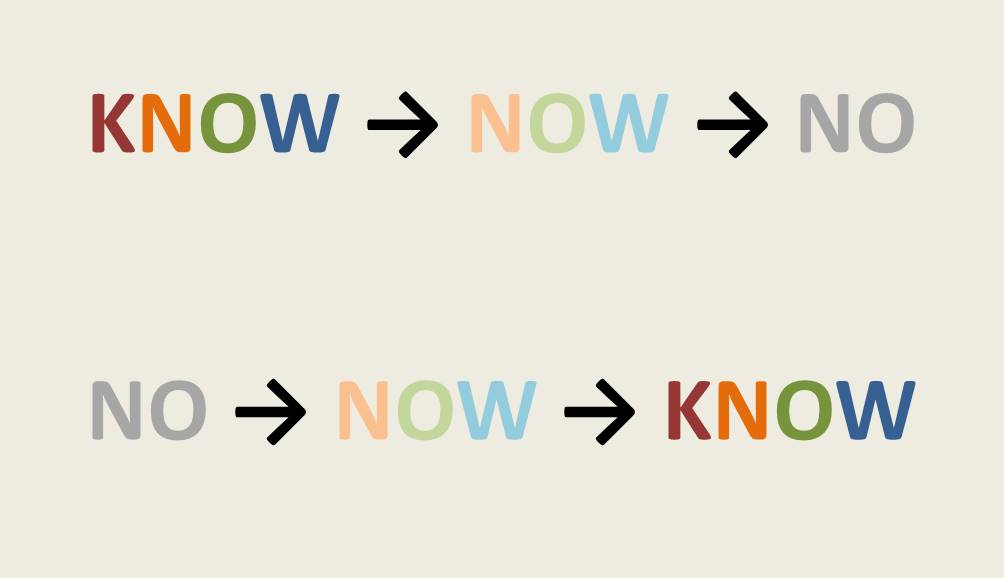
Early in the film, as the forces of evil are over-taking Pepperland, a ballistic glove called Glove chases people and smashes things with his giant fist, including the letters in the giant Technicolor word “KNOW”. First, he smashes the K to make the word “NOW”. He then smashes the W to make the word “NO”, which becomes black-and-white.

Late in the movie, when the Beatles—disguised as Sgt. Pepper’s Lonely Hearts Club Band—lead the people’s revolt to reclaim their land, the smashed letters reverse and become colour again.

What surprised me was that having watched the film at least a dozen times before, it wasn’t until late in my “adulthood” that I realized the message embedded within the two events.
No pic


Consider my mind blown!

Ergo ego

(Property of evolution.berkeley.edu)

(Property of evolution.berkeley.edu)

Be as egocentric as you want, but always remember: You were one point mutation away from being somebody else.

(PS To the genetics nerds out there, I know they messed up the “original” strands in this diagram as the originals from different strands cannot be identical but rather should be complementary.)

Engage me, don’t yell at me

While on LinkedIn earlier today, an acquaintance posted the following image that has been circulating lately; an image humourously designed to explain social media.

Look at me!

Look at me!

What this also highlights, however, is our complete lack of understanding when it comes to social media…that it has to be social.

Well, it doesn’t have to be social. Plenty of examples on the Internet (probably some written by me) where an individual or company has used social media to scream out their own message, not bothering to wait for a response or worried whether they are engaging the individuals on the other end. Just one giant game of: Look at me! Aren’t I clever? Love me!

Again, I recognize my own culpability in this. I too can be accused of approaching social media like a dog barking at a window, with little or no concern about those at whom I am barking. I do my best to have a point and always enjoy engagement.

Social media should be about engaging and building a community of which you and I are just one member. It should be more about listening than talking. It’s about starting a conversation, not a speech.

Thus, I offer the following revision of the white board presentation above.

Look at us!

Look at us!

In social media, everyone can hear you scream…but how many of us are listening to what you are screaming?

(Of course, this could all be high-handed holier-than-thou BS…in which case, I expect you to hold me to account. Go ahead, prove me right!)

Hoar-ror Show

The silence screamed

As unyielding steel

Violated the ground.

Frozen corpses flung

To cadaverous skies,

Plummeting anew

O’er sacrificed brethren;

Unwelcomed freefall

Not insult enough

To be ignored

By violent injury.

Territory reclaimed,

Only to await

New fodder,

New victims.

Winter, it seems,

Is getting to me.

(Image is property of owner and is used here without permission…the horror…the horror.)

Screenwriting, not choreography

Write-dance

In her weekly blog Why The Face, my friend Marsha Mason (more “Hey, there!” than Goodbye Girl) hits briefly on two topics of particular angst in new screenwriters: camera directions and over-written action sequences.

For me, both of these come down to the same issue: the screenwriter’s need to choreograph his or her story so that the reader “sees” the movie as the screenwriter “sees” it.

Below, with permission, I have reproduced Marsha’s original post and my comments on it.

WTF

Why The Face, March 1, 2014:

There are two things I’ve noticed of late in a number of the scripts I’ve been reading that you really don’t need to do.  They’re small things, but they can wind up pulling the reader out of your script, when what you really want is them sucked into your story.

1) Camera directions: leave them out. When someone falls in love with your script, the director that attaches to it will be the one to figure out what camera angles they’ll use and when.

And…

2) Detailed descriptions of fight sequences/car chases/long physical comedy bits: once someone falls in love with your script, there will be stunt choreographers, fight directors, and your star actor/comedian, people whose specialty it is to design these sequences for the production, based on the needs/wants of the director/producer/star.

A better idea is to describe the feeling and the tone so the reader knows what you’re aiming for, rather than going on for a page or more.  Ie “An epic car chase ensues.   More Seth Rogen behind the wheel than Al Unser Jr., it goes for blocks, barely missing nuns and orphaned children.”

Essence of, then right back into your story.

My comments:

Couldn’t agree more. Too many people feel they have to direct their screenplay to ensure the reader “sees” what they “saw” in writing it.

In a few screenplays I read recently, the writer went to great lengths to choreograph fight scenes, offering the minutiae of balletic movements.

“Raising his knee, he blocks X’s kick, and then twirls to chop X across the back of the neck. Stunned by the blow, X falls forward but recovers quickly enough to tuck and roll back to his feet. Etc. Etc. Etc.”

A fight sequence should have a sense of energy, urgency. These are people struggling. You want that to play out emotionally. You want the reader to break out in a sweat, his or her pulse elevating while reading the scene.

Instead, you slow down the reading with lengthy descriptions. The reader has to wade through line after line of description.

As Marsha describes, you can offer the fight in broader strokes to elicit feeling or tone.

Alternatively, you can present a sequence in short, staccato phrases and sentences. It is like having 20 hockey players firing pucks at you, at will. You become powerless in the onslaught, never precisely sure from where the next shot is coming.

Because the descriptions are short, they take little time for the reader to absorb before he or she moves onto the next one. Each line comes faster and faster, until the reader finds him or herself in the fight.

And then suddenly, it is over and the reader is left drained, but exhilarated.

In action sequences, less is more.

Sleigh


(Note: The above sequence is from my latest screenplay The Naughty List, a holiday-themed film for adults. Think The Santa Clause meets Good Morning, Vietnam.)