Happy Thanksgiving to all of my Canadian friends and truthfully anyone who just likes the narcosis of turkey and pumpkin pie, no matter what time of year.
I have an abundance of reasons to be thankful this year, as with all previous, but perhaps my greatest thanks is for my ability and resources to give back to my communities: financially, spiritually, however love is needed.
Below, I describe a couple of projects I have underway that will hopefully bear fruit for any number of groups.
Opportunity #1
As an avid fan of the Toronto Marlies hockey team and avid photographer, I have been combining my passions by photographing the home games.
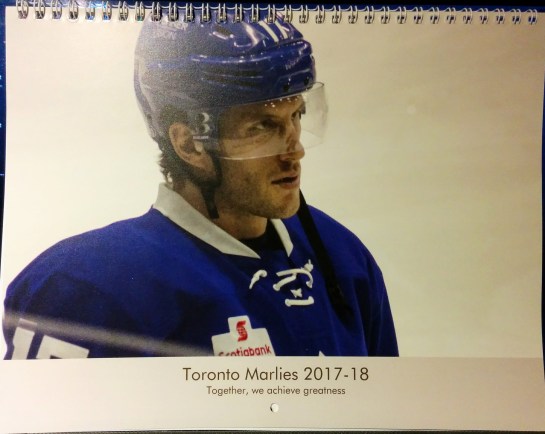
A couple of years ago, I took that one step further by designing a photo calendar for the hockey season (Oct to Sep), listing all the games & many player birthdays.
The first year, it was just a gift from me to many of the other season seat holders.
Last year, I sold them to anyone interested simply to cover my expenses. At the end of last season, however, my ticket agent & friend Wayne arranged to have the team sign the calendar and we auctioned it off with a team-signed stick on Facebook.
I was blown away.
Between the winning bid and two matching bids, we raised $1050 for You Can Play (American link), a group that supports inclusiveness in sports with a focus on the LGBTQ community.
This year, I am doing the same, but donating $5 from every sale (calendars are $20) to the MLSE Foundation, an org that uses sports to build communities.
Of the 75 calendars I ordered, I only have 16 left after the two-day home opener this weekend (both Toronto victories). Fans from as far away as the United Kingdom are jumping on-board to help support my effort, the team and the MLSE Foundation.
If you’re interested in supporting the effort by purchasing a calendar, feel free to reach out to me on my Facebook page or via my Twitter page. And you can find my photography (not just hockey) on my Instagram account.
Also, Wayne is again having one signed by the team, so watch another auction in the coming months!
Opportunity #2
I love walking all over the city of Toronto and pretty much anywhere else I visit, photographing both the wildlife and the urban art landscape of graffiti and murals. With that in mind, I recently decided to see if I could use that walking habit to raise some money for charity.
For 100 days (to Dec 25), I will record my daily walking distance and my total to-date, inviting people to sponsor my distance (per km).
When the 100 days is completed and the cumulative distance is known, those lovely individuals can then donate their total sponsorship to a charity of THEIR choice.
Rather than focus on a charity I think is worthy, I want to convince people to give their money to groups they think are worthy. We spread the love.
To date, with the generous support of many people, I am earning about $3.30/km.
As of October 8 (Day 23), my total distance is 263.41 km (158 miles); so, we have already raised $870 for various charities.
I appreciate that some people may have an upper limit on what they can afford – in case I go crazy and hit 1000 km (I am frighteningly on pace for that). No problem.
If they can’t afford any money but are willing to cheer me on, then I am honoured to have their support.
Just in doing the exercise, in having the conversation, I feel that I am making this a better world. That charitable organizations may also benefit is the icing.
Making a difference in the world doesn’t have to be difficult or even cost you anything financially.
It can centre on your passions, the things you do in everyday life and/or that bring you joy. It is as much about offering your time and spirit as anything.
It is about being open and loving. It is about being thankful.
I wish everyone all the best both in this season of thanks and throughout the months and years ahead.
The life of anyone practicing an art form—whatever you do with passion is your art—is a continual balancing act between impassioned self-expression and self-questioning despair. For me, this duality revolves around my efforts in fiction writing (i.e., screen, novel, poetry, short stories, etc.).
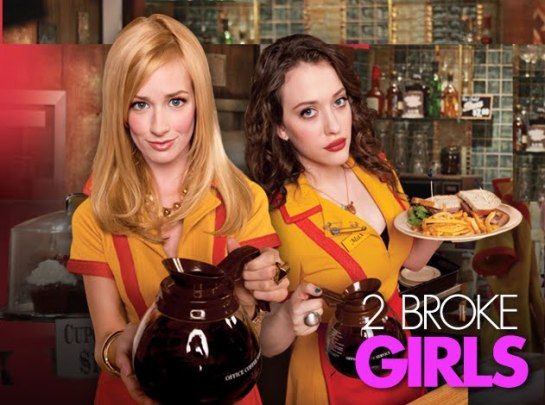
Earlier today, I learned that the television series 2 Broke Girls ended its six-season run on CBS, and the news briefly shifted my balance toward despair.
On a couple of occasions, I tried to watch the sitcom about two broke girls plying their trade as diner waitresses while targeting a dream of opening a cupcake shop. But each time, I had to turn the show off after a few minutes because I found the comedy so excruciating.
Every 15 seconds, there was yet another wink-wink nudge-nudge one-liner that I felt lacked any art whatsoever, dialogue that but for an incessant laugh-track would likely have been met with complete silence in front of a live audience.
And yet, the series aired for six seasons. It had enough of an audience for CBS to keep it on the air.
I like broad comedy; truthfully, I do. I even write it on occasion.
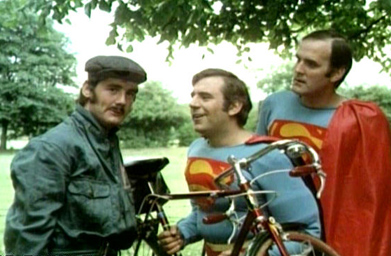
I live for Mel Brooks’ comedies, for Monty Python’s Flying Circus, for Blackadder, for The Muppet Show, for SCTV, In Living Color and Kids in the Hall.
Anyone who has followed me for any period of time—especially on Twitter—knows I am up for any joke-opalyse.
But the appeal of 2 Broke Girls and its ilk—looking at you, Two-and-a-Half Men—simply eludes me. It feels like one-liners in search of a higher purpose.
But here’s the thing I constantly need to remind myself:
This difficulty rests entirely within me, and has nothing to do with the creators or writers of any of these shows.
Celebrate, don’t negate
Getting ANY television show to air, getting any screenplay turned into a movie is difficult, even in this era of seemingly limitless venues and diminishing equipment costs.
That any show manages more than a pilot episode is amazing. So, six seasons of broadcast should be celebrated from every mountain top.
As an artist, I applaud 2 Broke Girls creators Michael Patrick King and Whitney Cummings for getting their show on the air. I congratulate the people behind the Sharknado series for continuing to produce films.
To denigrate these efforts simply because they do not suit my tastes is not only unfair, it is also blatant hubris.
Who the hell am I—a writer who has one television special to his credit (thank you, SomeTV!)—to say that these efforts are unworthy of attention?
For that matter, even if I were more routinely lauded and vastly more accomplished, it would not be my place to dictate what should be valued as Art.
And as an artist, as someone exploring my passions:
Dwelling on this topic is useless. More importantly, it is detrimental to me and the craft as I exercise it.
Remembering why
It would be naïve to suggest that trends in comedy and writing have no influence on my career as a writer, but honestly, my career is secondary to my writing; a beneficial side effect, if you will.
Comparing my efforts to those of others is therefore unimportant.
My only true comparator is what I wrote yesterday and any internal sense of whether I am getting better at making the points I wish to make, telling the stories I want to tell.
I write because I have something to say.
I write because I don’t know how not to.
I write because it brings me joy.
Certainly, part of understanding my craft is seeing how others approach the same challenges and opportunities I face.
Just as I must choose my path forward, so too must they theirs. Although I may not see the merits in their choices, they are doing what is right for them and I must honour that.
There is room enough for all of us.
Disclosure:
I own complete series collections of Get Smart and Hogan’s Heroes, which I appreciate others might consider as insipid as I do 2 Broke Girls.
When I have told a story well, I have merely put in place the elements from which you will create your own version of the story.
You meld these elements with your own perspectives, histories, moods and experiences to go places that I can’t begin to imagine.
In this way, Art is a communal exponential experience, and the Universe is as blessed by the one who receives the gift as by the one who first shares it.
I just finished watching the last episode of Tales by Light, a series originally produced by National Geographic but released in Canada on Netflix.
The series follows several different photographers (mostly of nature), and at least in the first season, spent a lot of time discussing their personal journeys of exploration and processes of photography, a subject close to my heart.
Although my personal interest is in nature photography, with a dabbling in other forms such as sports photography, the final episode of Season Two was particularly poignant, focusing on Stephen Dupont‘s exploration of death.
A documentary photographer, Dupont has covered many war zones and had developed something akin to PTSD from his years surrounded by carnage and mayhem. To cleanse himself, he set out to explore the more honoured rituals of death and the celebrations of lives lived.
I have no intention of photographing war zones, but one thing that struck me in Dupont’s episodes was a comment he made about photography and his reverence for his subject matter. The comment epitomizes my approach to photography, and I feel blessed to have heard it described so eloquently.
I’ve always seen photographs as gifts. You do not take them; they are given to you.
I agree and am eternally grateful.
I am routinely blessed by my subjects, who give me their time and patience as I fumble to capture a moment.
Discovering characters who aren’t THE HERO (thank you, Monty Python)
When you are developing a story, how do you construct your characters?
With the possible exception of the hero, it can be challenging to build characters that populate the universe you have created.
As the universe (and your concept) revolves around the hero, we often start with a very clear idea of what that character is up against and how he or she will respond. But in the myopia of storytelling, the other characters are often fuzzier.
In some cases, we do not know who these characters because we haven’t met them yet. We haven’t gotten to the part of the story in which they enter. They are nebulous possibilities.
Alternatively, until our hero has explored his or her world some and maybe faced a challenge or two, we don’t know what the hero requires in terms of an antagonist, a sidekick, a mentor, a love interest.
What if we create a character only to determine later that he, she or it is ill-suited for our hero?
Then you rewrite that character…or perhaps you don’t, and the character lives with its flaws within your story.
It would be supremely wonderful to have everything completely mapped out in your story before you uttered or typed the first word, but creativity simply doesn’t work that way.
Like life itself, stories evolve as our characters live them, and even the hero may undergo profound change from your first impressions when you formulated your concept.
To my mind, that is actually the exciting part of storytelling. I am just as surprised by what my characters do as my audience is…I just get to see them first.
So, when you are first developing your characters, take the pressure off yourself. You are not going to get it perfect, so don’t try.
Find your placeholder
Cast your mind’s eye
Cast your characters like a film or stage producer and director might cast their projects. Invite characters in to audition and then go with your gut until you know better.
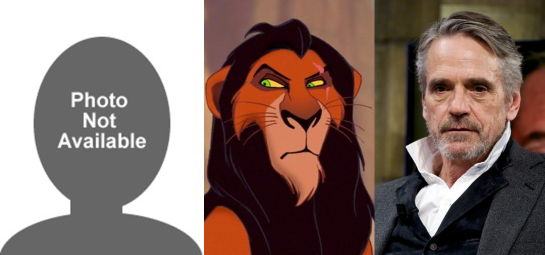
When I wrote my animated screenplay Tank’s, I didn’t have a great handle on the antagonist of the story, so I stole The Lion King’s Scar (Jeremy Irons) until I did. Mentally seeing and hearing Scar whenever my antagonist appeared allowed me to keep writing without worrying about getting it right.
In a few comedy sketches I wrote, I would see and hear Mad TV’s Stephanie Weir (see YouTube clip below). In fact, I worked as though I was writing my sketch for Stephanie. Because I knew that wonderful comedian’s style, I immediately knew how my character would respond to a situation, what words she would use.
The four Kates
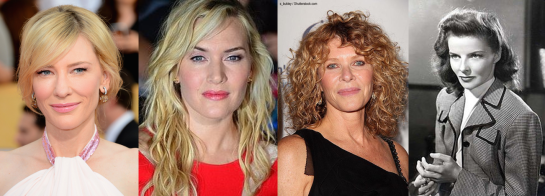
If I have a female role I am trying to fill, might I consider the four Kates?
Is the character a Kate Winslet; strongly independent but coming from a place of softness and wonder?
Is she a Kate Capshaw; the hapless victim, eternally floating with the current until pushed too far, who then comes out swinging?
Is she a Cate Blanchett; internal strength incarnate but with an intellectual prowess that cuts a foe down before anyone knows the fight is on?
Is she a Katherine Hepburn; fierce brawler one minute, playful kitten the next?
Choose any one of those four (sorry Katherine Heigl, but I don’t see me writing parts for you) and I never consciously have to consider that character again…the words, actions and reactions are obvious to me.
Isn’t that cheating?
No.
First, all story and character is based on what has come before it. What makes the story unique is the writer, then who ever works on it next (editor, director), and then the audience who takes it in.
When I use Scar, Stephanie Weir or Cate Blanchett as a placeholder and guide, I am interpreting those characters/people through my personal lens.
And ultimately, I am fitting those visions into the story I am developing, demanding different things of them than others have or might. It is simply a starting point.
My antagonist Kang is not Scar, although there are overlaps as there are with pretty much all Disney villains (not implying that Disney is interested in Tank’s…but I am accepting calls).
The point here is to remove or at least temper the roadblocks that stand between you and the completion of your story.
Remain open to the possibilities with your characters and I think you’ll find they will ultimately tell you who they are.
And who knows? Maybe your character will be so wonderful that the three living Kates will vie for the role.
If you’re interested in learning more about story and storytelling, check out:
Note: Until I assembled this piece with its images, I hadn’t noticed how monochrome my experiences were. I want to leave this post as is, but will give greater thought moving forward.
Mother, Nehiyaw, Metis, & Itisahwâkan - career communicator. This is my collection of opinions, stories, and the occasional rise to, or fall from, challenge. In other words, it's my party, I can fun if I want to. Artwork by aaronpaquette.net

 Where are the troubadours?







 createdbyrcw