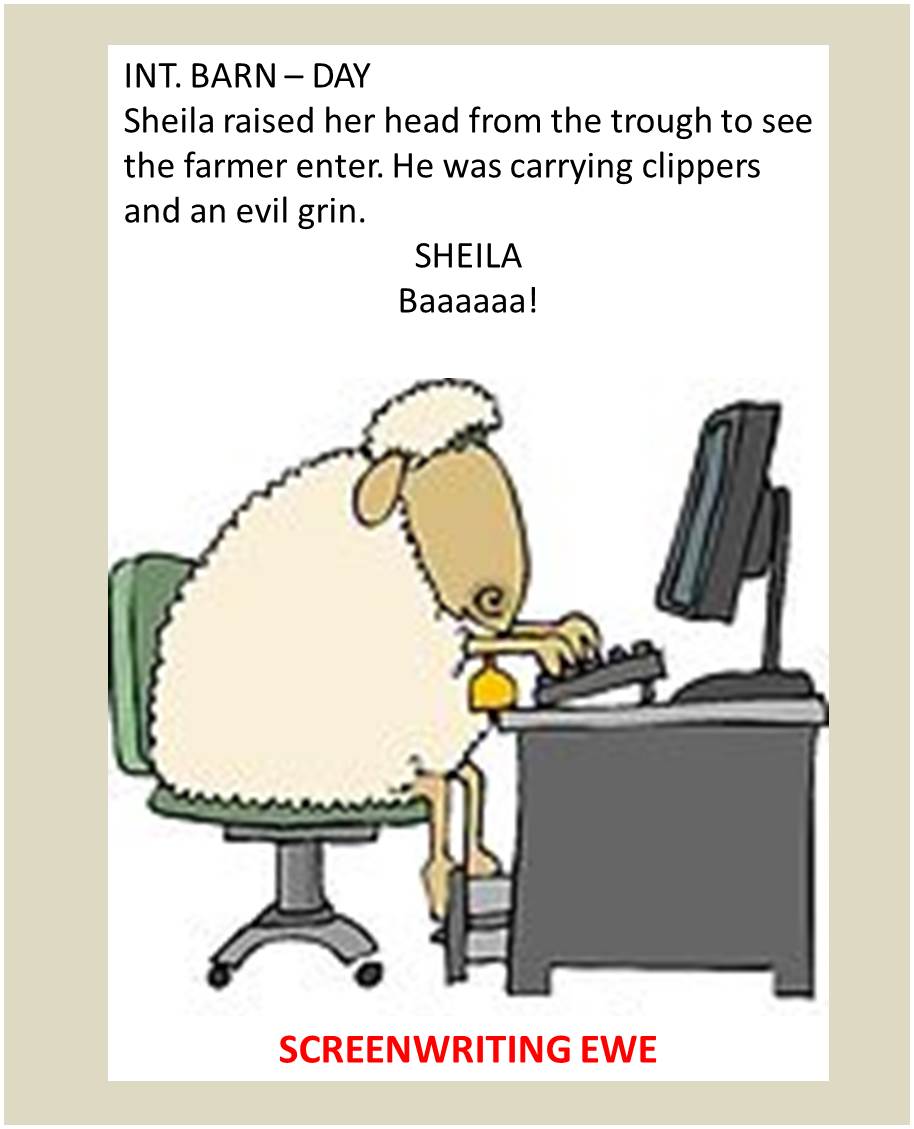
Feel this, would you?

I used to stare at this poster trying to gauge what I felt...sometimes it worked, sometimes not

I used to stare at this poster trying to gauge what I felt…sometimes it worked, sometimes not

I have to admit I find it difficult to write characters. No create them, but to actually make them come alive on the page.

To develop a truly realistic character, you need to be able to give a sense of his or her emotional state, and this is where the wheels tend to fall off for me.

For most of my life, you see, I have focused on facts, not feelings. I might even go so far as to say I have completely shut feelings out of my life—or at least as completely as possible without (yet) ending up in prison as a socio- or psychopath. Thus, I have been ill-equipped to deal with the myriad emotions that form the human condition.

If I look or think back to the writing of my youth, I seemed to be able to manage moral outrage and on occasion, actual rage, but any other emotions, no matter to what extreme, came across as flat. And forget any of the subtle shades in between. I did not do subtlety.

About the only character I could develop was the noble stoic who was a tad self-involved. Hmmm. Seems familiar somehow.

Lacking experience with these various emotions, how could I hope to bring them to my characters?

I’ve never believed emotions were something you could study in the traditional sense.

If I want to understand a polar landscape, I can go online or check a variety of books. Determine the behaviour of a jet that loses one engine? I’m sure there’s a Wiki for that. But emotions, by their very nature, preclude such an academic approach.

Ah, but what about other books and movies?

Good in theory, but without a personal foundation, you run the risk of simply reproducing Glenn Close’s interactions with the rabbit or Peter Lorre’s fear of Moroccan Nazis.

No, to be able to realistically reproduce emotions in my characters, I needed to have experienced them to some extent in my life. Call it Method Writing, if you wish.

Luckily, for a variety of reasons having nothing to do with screenwriting, I have been accessing my emotional centre over the last couple of years. Through a challenging process of self-examination and “coaching”, I have started to feel—allowed myself to feel—emotions like sadness, irritation, pleasure, enthusiasm, boredom and the like. And the impact in my writing has been immediate, if continuing to develop.

When my character is angry, I find myself getting angry. When my character feels loss, I can remember when. Ecstasy? I’m all over it (the emotion, not the chemical).

And I’m not the only one who notices this. As friends, colleagues and classmates read my material, I sense they too experience the emotional rainbow. And sometimes they introduce feelings I never envisioned for a scene.

This isn’t a threat to what I wrote. It is a bonus prize I receive for paying attention and sharing, for they have found something in my words that I did not see or did not know I was channeling.

Maybe it’s gold. Maybe it’s lead. But always, it is valuable.

Like my characters, I am still a work in progress, but at least I feel like I’m progressing.

(Image is property of its owner and is used here without permission. I don’t know how I feel about that.)


Child’s play isn’t child’s play

Colloquially, when someone—an adult—states that some activity was child’s play, they are trying to convey that the action was simple or easy, that it took no effort. And yet, their use of the expression couldn’t be more wrong.

I had the pleasure of spending the afternoon yesterday with a few friends and their kids at the local beach. The kids ranged in age from infant to teen, although the majority were in the 3-5 range, I think—at my age, anyone under 30 looks 12.

Regardless, when lunch was over, the younger set and a few doughy adults headed to the water, where things got serious. Not for the adults, you understand, whose toughest job was to retrieve a tossed flip-flop from the frigid waters of Lake Ontario. No, it was at this moment that the child’s play began in deadly earnest, for four of the middling sprites decided to build a canal system that would have made the Panama and Suez engineers blanch.

Miran, the eldest of the group, became overseer, designing a series of causeways that challenged the imagination. Mounds of sand became islands in the stream. Canal walls were carefully constructed, through trial and error, to ensure sturdiness in the face of aquatic onslaught.

Cole, the lone boy in the group, became a human bulldozer, carving access channels to the lake itself that would help fill the channels with each invading wave. Samantha and Hana, meanwhile, worked bucket brigade, supplementing Cole’s efforts with frequent trips between lake and canal system.

This was not child’s play, despite it being play by children.

With each set back—a minor sand slide, a misplaced deluge, pee break—there would be a momentary expression of frustration followed quickly by brief meeting to discuss options and then an action plan to right the wrong. A lot of adult companies could stand to learn from this lesson.

This is not to say the process was flawless. At one point, Miran decided that she wasn’t crazy about the canals under construction and instead wanted a massive lake, which would have necessitated the removal of a large island. A new corporate executive is born.

She was quickly talked out of this by her subordinates who felt challenged enough to complete the canal system, let alone initiate island removal.

The children worked tirelessly for an hour or so and made substantial headway, but like all good infrastructure projects, senior management (parents) eventually got bored (and not just a little sun-stroked) and wanted to head back to the house.

Reluctantly, the children packed up shop and abandoned the construction site. Unbeknownst to them, however, as quickly as they left the site, another altitudinally-challenged crew appeared to continue the job.

This is how I want to live my life; playing with fervent intensity. I accept there will be momentary setbacks—as I approach 50 years, pee breaks are a necessary evil—but I will not let those setbacks deter me in my goals or disturb the pleasure I get in pursuing them.

I am embracing child’s play 2.0.

Faith

Image

Faith is believing when common sense tells you not to.

– Fred Gailey (John Payne), Miracle on 34th Street


We all have doubts.

Doubt that we are good enough to accomplish our goals. Doubt that our goals are even realistic or rational.

And sadly, most if not all of us have had or currently have a long line of people who are more than willing to feed those doubts with their own. Often, their superficial motive is to be supportive, to help cushion the blow of failure, to save you from certain doom. But more likely, their motive is to take comfort in the belief that your doubts make it okay for them to have doubts about their own lives.

But, if you’re lucky, you have those special few in your life who have absolutely no doubt in your future success. They’re the ones who listen to your ideas with a smile, an eager nod, and perhaps some sage constructive advice to help make your goals even more realistic.

The latter group are the people you need to heed, for they see the potential of your efforts in the absence of your fears and just as importantly, in the absence of their own.

I am not a religious man—although I have become quite spiritual—so faith has never been top of mind for me until recently. It’s not that I didn’t have faith, in hindsight, but rather that I had a very narrow definition of it. And, like my friends for me, it was easy to have faith in things external. It was faith in myself that I lacked.

More recently, however, I have realized that faith isn’t about rejecting the possibility of failure. Rather it is about accepting the possibility of failure but with the further understanding that failure does not mean your journey has ended.

Failure does not put your destination off limits. It is merely a diversion from your original path to that destination.

I know I am a good writer and story teller, but I also know I have challenges ahead in translating those skills into the money I need to make to continue writing and story telling.

Faith comes in telling myself (and believing) that through hard work on my part (e.g., networking, classes, practice) and unknown forces outside of my control and understanding, those challenges will dissipate at the appropriate time.

Like those well-intentioned naysayers, drawing a line in the sand about giving up (e.g., going back to my former career) only gives voice to my doubts. I will not allow myself to do that anymore.

I have faith that I will endure failure and that I will succeed at whatever it is I am to accomplish, no matter what street I live on.

I wish you that faith as well.


For an interesting piece on questions about talent and faith therein, check out this post from Plotting Bunnies: The ingredients of Writing: Talent…?

(Image is property of owner and is used without permission because I have faith they’ll get my point.)

The writer who… (UPDATED)

As an advertising copywriter, I was constantly called upon to summarize a client’s product with a single line, as few words as possible that would capture the brand essence of the product or service. The almighty tagline.

As a magazine writer, I am also called upon to summarize the stories I write into a sentence or fragment. Something that will give the reader the kernel of the story so they can decide whether they want to read it or move on.

And finally, as a budding screenwriter, I am asked to summarize my entire story in a single sentence so prospective producers can get my idea and see the possibilities, artistic but mostly commercial.

And yet, with all of this practice in concise summarization, there is yet one product that eludes my abilities: me as a writer.

At last year’s Austin Film Festival, during a session on how to work the festival, the Langlais brothers—that’s how they describe themselves, but Gene and Paul, for the record—challenged each of us to define ourselves in a single sentence as “the writer who…”. They suggested that if we could define ourselves as producing one type of screenplay, it would make it easier for producers and directors to wrap their heads around who we were and where to go when they needed that kind of screenplay. Call yourself something and then be the best that you can be.

The challenge for me was that I couldn’t even decide on a medium or genre, let alone determine what types of stories I wrote.

About the only medium I have not yet written for is radio and that’s more the result of lack of opportunity than lack of interest.

I am naturally inclined to write comedy, but my last two screenplays have been family drama and murder thriller with the possibility of a horror on the horizon.

For nine months or so, the question has plagued me. I am “the writer who…”

Recently, however, because of a screenwriting course and completely separate conversations about life with a friend, I have had a bit of a breakthrough, if not an actual answer.

Maybe, I’m looking at this challenge on the wrong level. Rather than focusing on the details of what I have done—genres, media, angles, etc—I need instead to take everything I have done to its most basic level. Stripped of the decorative details, what is the essence of what I create?

What is at the core of my favourite comedy sketches? My screenplays? My television shows? My magazine articles? And what am I doing that makes it mine?

I still can’t tell people I’m “the writer who…”, but I think I’m a little bit closer.

(Image is property of owner and is used without permission, about which I am of two minds.)


UPDATE

Interestingly, the Canadian film organization Raindance Toronto just posted an article called Creating a Personal Genre. Although aimed at filmmakers, the article clearly has overtones of what I presented above. Check it out.

Awake with love – Canada

Image

I have been a very lucky man.

I was lucky enough to be born in a great country. In my almost 50 years, I have not known war. When I have been sick, I have been able to find treatment. When I have been poor, I have been able to find support. When I have been lonely, I have been able to find friends. And a lot of that is because I live in Canada.

Canada is not a perfect country—it is no Shangri-La—but it is a good proxy. And today, July 1, it is 146 years old.

Being so free, however, I have often been complacent about how good things are for me. I have forgotten what went into creating this haven. Forgotten how my life has compared to those living elsewhere.

One of the great things about living in a cosmopolitan centre like Toronto is that I get the opportunity to meet many of the people who started elsewhere.

Several years ago, in the span of just a few months, I played host to a couple of post-doctoral researchers who came to Toronto to work at the Hospital for Sick Children. One was a researcher from Moscow, the other a student from Beijing. Both rented a room in my house, and while the rent money was nice, the life lesson was more valuable.

Wei marveled at the space available in this thriving metropolis; that he could go for a walk and find places where he saw no one. He also marveled at the speed and insanity of NHL hockey on Saturday nights (just because it’s cliché doesn’t, mean it’s untrue).

Sergei was reminded of home in some ways, and amusingly found Torontonians a bit repressed (ah, our Scottish banker roots were showing through). At the same time, when I informed him that yes indeed, public consumption of alcohol was illegal in our parks, he marveled that no one stopped him or that the police didn’t arrive suddenly. And he was grateful at the open welcome he received from everyone including my family. Our cookies were a little stale, but then, I didn’t have the heart to tell him that he’d mistaken dog biscuits for cookies (we call them Sergei cookies, now).

As I would listen to both of these men recount their lives back home, I gained a new appreciation for what I had…and for what I took for granted.

From my geographically central location, I have had the luxury of traveling most of my country. I’ve taken in its historical sites—Fortress of Louisbourg, Quebec Citadel, Plains of Abraham—visited some of the most majestic landscape I could hope to see—the Shield of Northern Ontario, the Fraser River valley, the Bay of Fundy, the Lachine Rapids—participated in amazing cultural festivals—the Stratford Festival, Pride Week, Fringe Toronto, Caribana—and met amazing people.

I am a lucky man to live in such a beautiful, dazzling country.

Happy birthday, Canada. I love you more today than I did yesterday, and I will love you even more tomorrow.

Image

(Ab)Use your imagination

Image

Four more reps! C’mon, you can do it. Three more reps! Don’t quit now. Two more reps! You’re a champion. One more rep! Almost there. Annnnnd, you are done. Way to go!

Phew!

As you may be able to tell, I recently started a fitness routine, a boot camp if you will. The nice thing about it is that I can still eat and drink whatever I want and the only reason I break into a sweat is because Toronto’s experiencing a nasty heat/humidity wave.

Just over a week ago, I started a screenwriting boot camp of sorts called Screenwriting U, which is designed to teach you how to create the most stunning and saleable scripts that Hollywood will eat up. (My apologies if this sounds like an infomercial.)

All I know right now is the program—the ProSeries—is kicking my ass.

For the next six months, I will have an assignment practically every day (including weekends) that is designed to push me to excel at EVERY aspect of screenwriting; e.g., concept, plotting, character, conflict, narrative, marketing.

I won’t go into any detail as to what we are doing—that would be improper and unethical as the fine folks at Screenwriting U have to make a living—but I can tell you about the outcomes.

At the moment, we’re working on concepts.

Once most of us come up with a concept that really interests us, we typically start writing right away, whether actual dialogue or mapping out plot points. We’re excited. We want to see our amazing idea come to life. Tomorrow is too far away.

No such luxury here.

In the true Full Metal Jacket sense, the instructors are making us break our ideas down to build them back up. And once we’ve done that, we do it again. And again. And again. Each time with a slightly altered method and/or goal.

In nine days, what was six interesting ideas (to me, at least), has become 30 new ideas, some of which are completely lame whereas others are pretty damned good, and more importantly, a hell of a lot more solid that the originals.

It’s a brainstormers wet dream and nightmare all rolled into one.

No matter how thoroughly I think I have developed an idea, just a little more time (or time away) shows me that I can go a little further with the idea or take it in new directions. As with the writing process itself, it is the permission to fail spectacularly with an eye toward finding something truly amazing.

And like physical exercise…what, I did that once…it is painful as hell in the early going, but it does get easier. And when it gets easier, I’ve got to make it hurt like hell again. I’m building imagination muscle memory. I’m making these thought processes second nature.

Now, if you’ll excuse me, I have to go change…oh, wait, that would be telling.

PS Hal Croasmun, our drill sergeant, is nothing like the guy in Full Metal Jacket, unless you wanted to imagine verbal enthusiasm replacing verbal abuse.

(First image is used without permission because I like to push the envelope, or any other piece of stationery, for that matter. Clip art below clipped without permission.)

Image

Brothers by birth

Image

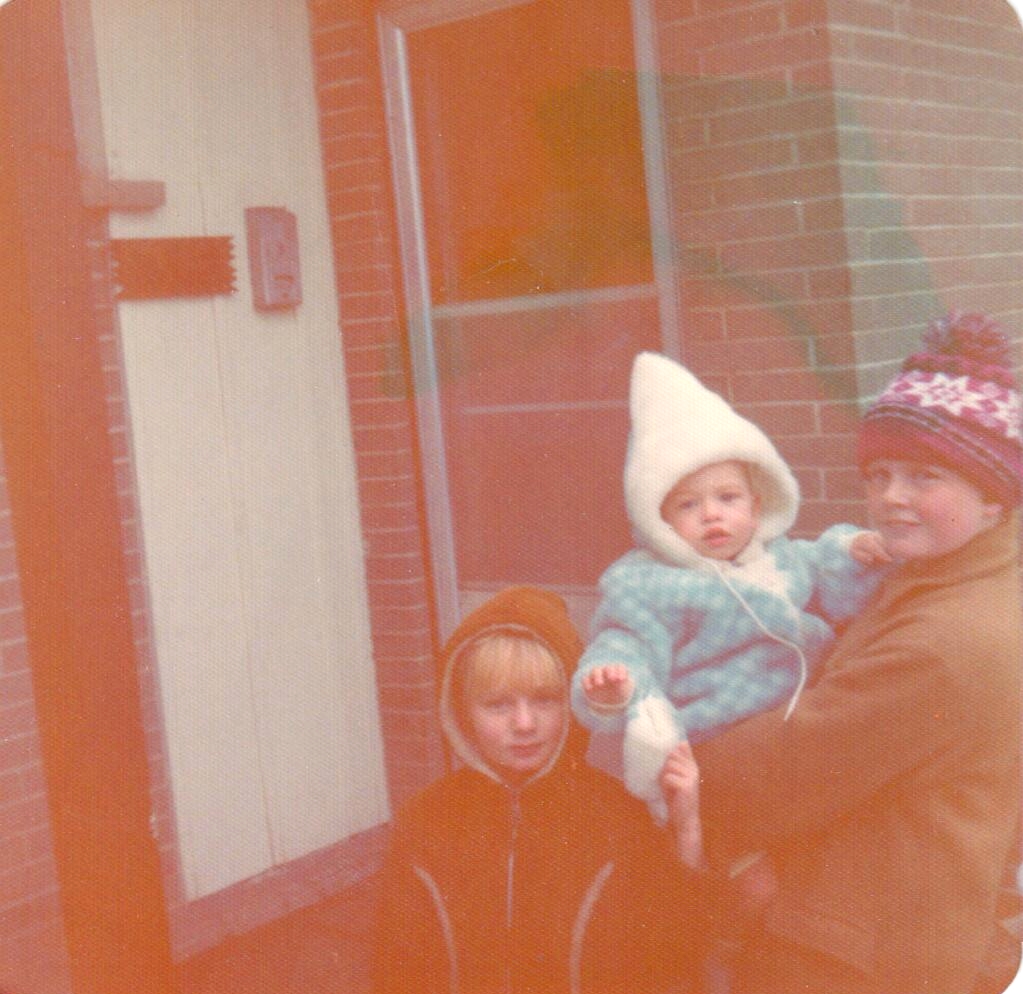
When we were young, my brothers and I were very close. The house was so small, we had little choice.

We moved a lot when we were kids, so we tended to see each other as playmates as much as anything, even though we were 5 and 5 years apart, me being the eldest. My brothers were constants in a sea of change.

At our youngest, spending time together was easy. Scott and I would use Shawn as cannon-fodder for any number of experiments, and he would respond as though it was great fun. The fact that Shawn did not die in childhood or does not suffer the after-effects of brain damage today is a testament to the strength and resiliency of the human skull.

As we got older, though, the strengths and directions of our individual personalities began to interfere with our genetic and social bond. I was the studious, overly verbose nerd. Scott was the quiet and reserved one; the observer. Shawn was the independent freedom fighter.

What were once common goals became more fractious, and as Shawn became older, he began to realize that his lot in life didn’t have to be guinea pig, and with his fiery temper, he in fact became a weapon of filial destruction. Only my decadal seniority kept him from killing Scott, who wasn’t always in my good books.

The genetic link continued to sever as we continued to age and each of us found less reason to spend time with the others. Our interests were different. Our needs were different. And our attitudes about the other two changed.

Around the time that I buggered off to college, Shawn’s rebellious streak took solid hold and he headed across the country to do his own thing. And Scott folded more into his own world.

In one way or another, we had effectively abandoned the family unit, and more important to my mother, the family unity. I can appreciate now how hard this must have been on her, but at the time, it all sounded like mom whining.

Over the next bunch of years, I think I saw Shawn twice…both weddings, one his. I saw Scott more regularly, but a lot of it felt forced as we would often meet at my mother’s place. I can only speak for me, but it felt like we were trying to maintain an illusion of what was.

There were good interactions between us. And I like to think there was still love. But there was no friendship. Genetics just wasn’t enough.

We parted company and lives. If asked, I am confident that any two thought the third was a complete asshole.

Time passes. We evolved and continue to become the men we need to be for ourselves. And from my perspective, something great has come out of that. We have been given a second chance at friendship.

As full-grown men with our own lives, interests and goals, we have chosen to welcome each other into our lives in one way or another. It is not the bond we shared in our youth, but I don’t know that any of us are too worried about that. (Shawn’s still too big and strong to let Scott and I pile drive him into the basement floor.)

The friendship I have with Shawn is different than the one I have with Scott, but both friendships are meetings of equals. One of the only bonds we seem to share as a trio, other than our familial link to our mother, is a neurological link to alcohol (damn, that’s one hell of a pub tab).

Shawn is the successful restaurateur, who is still the independent freedom fighter.

Scott is the dedicated family man, who is still the observer.

I am the raconteur, wit and writer, who is still the sexiest man in town (okay fine, the studious, overly verbose nerd).

But none of these descriptions is sufficient. We are simply the men that we are.

Shawn, Scott and I are brothers by birth, but we’re friends by choice. And that’s the way it should be.

Dads: Not just an oatmeal cookie

Image

A wondrous Father’s Day to all of you men and women who have provided guidance, structure and love to the next generation.

Being a Dad is about more than genetics; it’s about putting yourself out there for another human being and making sacrifices to help them be the best human being they possibly can. It’s about knowing when to cling tight and when to let go. It’s about providing rules while allowing freedom.

When you put a child on your shoulders, you put all of us on your shoulders, for the connections you make with that child today will resonate with everyone that child touches in later life.

Today, we lift you on our shoulders and say thank you for helping create so many beautiful people.

I celebrate all of my friends who are fathers and in particular, my brother Scott, who I respect more than he can imagine for what he has done with my nephew and nieces. That is the true mark of a man. Well done, bro.

And more personally, thank you Grandad. You meant the world to me.  You gave me guidance, you gave me love, you gave me beer when no one was looking. You were not perfect, but that didn’t make you any less a role model.

My Creative Journey – Part Two

Picking up from my first realization that my passion might also be a gift, as explained in Part One.

Image

Over the years, I’ve had opportunities to display my creative demons before an audience. An effective little soap opera episode in Grade 12. Geeky science humour in my own magazine. Heart-wrenching poetry following the end of a close friendship that might have been much more.

I worked my way into the magazine world, writing interesting stories about interesting discoveries and advances, but it wasn’t the same. The words poured forth and the story-telling skills improved, but I was always a chronicler of someone else’s story.

Creativity expressed itself in my approach to the story. In seeing a story that no one else saw. In context that was invisible to everyone else. Creativity manifested itself in identifying authors and writers from all walks of life to fill gaps in the magazines. I may not have been the best project manager, but I was definitely the most creative.

As I matured in my jobs, I extended this creativity to everything I did. Looking for effective solutions to seemingly intractable problems. But it wasn’t enough. That voice within me cried out to be heard. And the more I worked—and overworked—to distract it, the louder it screamed. So loudly, that even my wife could hear it.

While sitting in an Orlando hotel bar one night, she finally challenged me and my workaholic tendencies, demanding that we come up with a hobby for me. When pressed, I admitted that I had always felt like I’d been born 30 years too late. That if I could have any miracle in my life, it would be to work on those old sketch comedy shows from the 1950s as a comedy writer. Sid Ceasar’s Show of Shows came to mind. Imagining myself in the writers’ room with Mel Brooks, Larry Gelbart, Woody Allen and Neil Simon.

Neither of us knew how to make that happen, but my wife challenged me to find something at home that would set me up in that direction. The next week, I signed up for my first improv class at Second City.

Although it still wasn’t where I wanted to be—more performance than writing—the improv classes were amazing; therapeutic on a variety of levels. Eventually, though, I stumbled onto their sketch comedy writing program and that’s when I hit my stride. A wonderful instructor, talented zany fellow students.

The words flowed incredibly quickly. Within weeks, I had dozens of sketches and felt like I was making serious headway in my education of what worked and why. If there was a problem with the class, it was that my production vastly outstripped the need. I tried new things. I broke out of my comfort zone. I pushed my limits. My only goal was funny.

As I honed my sketches, I prepared for the reality of rehearsals with actors, when all of this work would really come true; when my efforts became more than an academic exercise. Rehearsals went well. Out actors seemed genuinely grateful to be performing our work. I saw what worked and what didn’t, even in the work of others.

Interestingly, I wasn’t in control of the process and I was okay with that. There’s something to be said for being so far out of your element that you recognize the limitations of your control. I had complete faith in the director and our actors. I believed they too wanted this to work as badly as I did.

And then the day of the performance arrived. Nervous energy ran through my body and I couldn’t sit still. I could barely communicate. There was no fear. Only anticipation and potential validation. Was I funny?

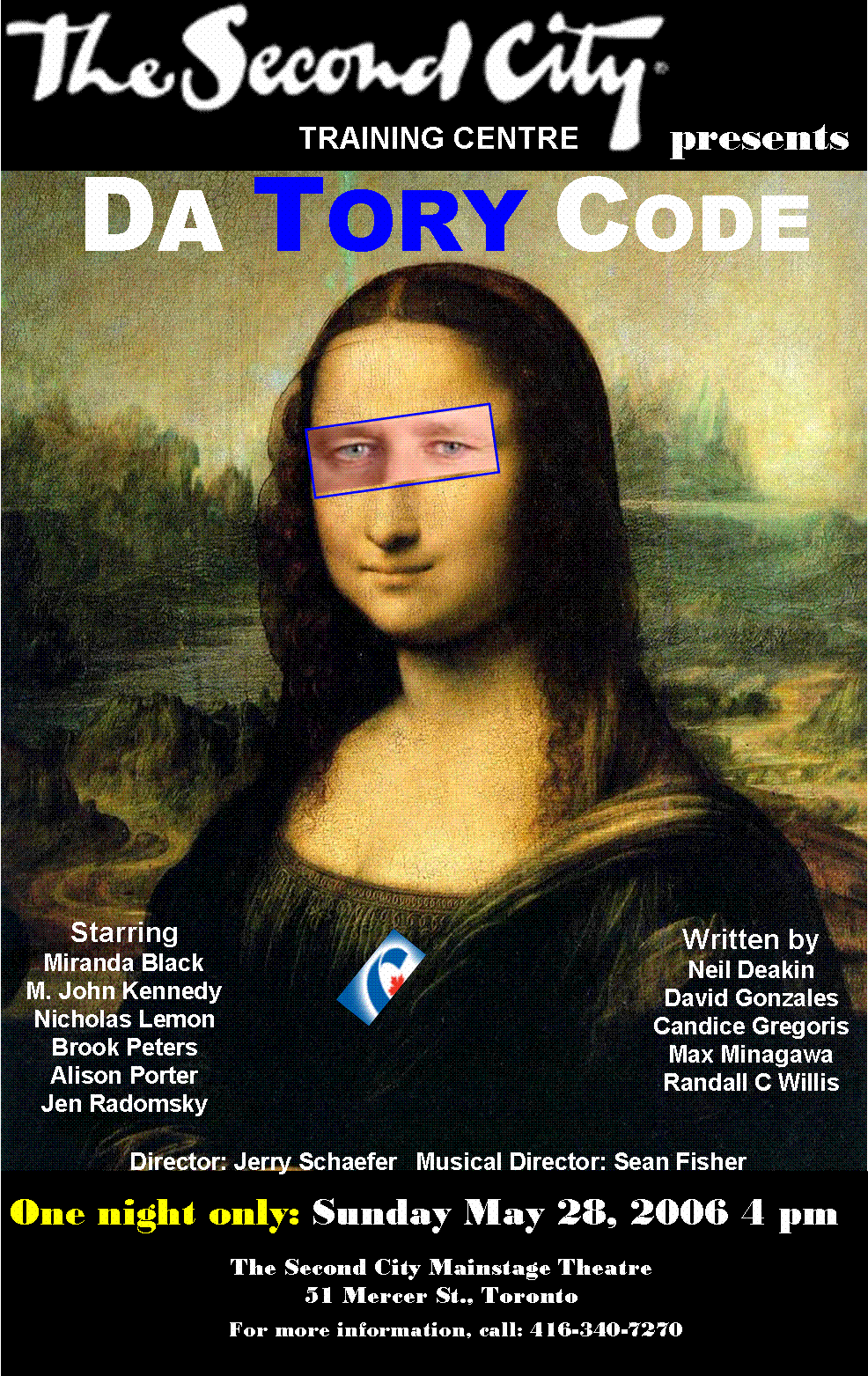
The day we premiered Da Tory Code was easily one of the best days in my life. The audience laughed. Not at everything, which was a valuable lesson, but they laughed at enough to validate my talent.

Image

My Creative Journey – Part One

What follows are a few thoughts on why I write…the moments in my life that led me to embrace my passion. It is an incredibly personal story and I hope it doesn’t make anyone uncomfortable, but rather helps them reflect on why they embrace their own passions.

Image

I need to be creative on my terms.

When I was younger, it was all about acquiring knowledge and being recognized for having acquired that knowledge. In hindsight, I’m not exactly sure what I was planning to do with that knowledge.

In some respects, it was about solving a puzzle, which could range from how does this alarm clock work to how does the universe work. On another level, I think it was about control. Knowing how the universe worked meant knowing that there was a broader sense of organization out there; that the laws of physics and mathematics still held even when my own life seemed in constant flux. The subtle irony of entropy only occurred later.

But it was also about control in the sense that I couldn’t be expected to come up with answers, with solutions, until I had all the information I needed to make that decision. The aggravating reality of that method of control is it only works when you’re the one asking the questions. Nobody else is willing to wait until I have all of the info I need.

At the same time, I needed the safety of analysis and knowledge, I’ve also had a need to be creative. A need that has only recently blossomed as a regular part of my life.

When I was young, I was constantly creating new worlds through my stories. First, as play scenarios and then as the written word. I constantly developed short stories that took me in a million directions. Again, this might have been an attempt at control.

When I wrote, I was the master of my universe. I was the one who decided who lived and who died, who was allied and who was the enemy. I was the protagonist and the antagonist.

It was in 1977, as I started high school, that I first noticed the strength of my writing. That summer, my life changed with the release of Star Wars. So deeply effected was I by the characters and the story, that I immediately went home and started working on the sequel. My version took a very different turn than George Lucas’s—although there were some subplot overlaps—but over the next few weeks, I hand wrote 400 pages of dialogue.

I shared the script with my Grade 9 English teacher, who was impressed with the volume if not the content (my words, not hers). It was in her class that I first realized the power of my words to still and disturb an audience.

On day, Ms. Philp gave us a writing assignment that started with the sentence “I couldn’t believe it when I heard that sound.” It was supposed to be an in-class assignment, but I was onto something and asked if I could take it home to finish it. I guess she sensed something—that this was important to me—and she said yes. While I didn’t finish the story, I did hand her several pages the next day.

After reading the story herself, she decided to read it to the class. Whereas most people had written stories about funny sounds, spooky sounds or weird sounds, I had written about a man who comes upon a murder in an alleyway, first by the sound of bone and sinew breaking, and then by sight. I wrote about the fear and indecision in the witness’s heart as the murderer sees him and he flees for his life.

As Ms. Philp read the story aloud, there was silence in the room—a room of 14 and 15 year olds. No one said a word until she was done reading. It was magical for me.

I wish I could say that there was a rousing round of applause at the end and that this was the day that I decided to become a professional writer. There was no round of applause—although my class seemed to appreciate my story—and Ms. Philp continued to be supportive of my efforts, but there was no effort to foster this creative desire in a young boy struggling to define his world.

The opportunity was there. Everything was laid out for someone to recognize, but nobody tapped into it. Writing continued to be a strange little quirk of my life. I guess it was just easier to find ways to support my interest in science and history by buying me more books, taking me to the Science Centre.

What do you do for a budding writer? Get him a pen and a notebook? Buy him a typewriter?

Eventually, someone did buy me a typewriter—a vehicle to do my homework. But it quickly became the vehicle for my creative outlet, much to my mother’s chagrin. The muse hits me when I have time to be alone with my thoughts. When my day isn’t cluttered with requests for attention and responsibilities. Unfortunately, in my childhood home, those times only tended to occur when my family was asleep.

Routinely, my mother would yell down from her bedroom for me to stop wailing away at the keys. Loudly pounding them into submission. Watching the letter hammers get stuck because the thoughts occurred to me and be translated through my fingertips faster than the typewriter could accommodate. She wanted to be supportive, but not at the cost of a good night’s sleep.

It took no time at all before I had an incredible portfolio of work—half-finished thoughts, short stories—but they languished unread by anyone other than me. I had given voice to the creative urges in my soul but no one heard that voice. It was the proverbial tree in a forest. With no one to even acknowledge the existence of my efforts, did they really exist.

Where was my mentor to guide me through this process? Someone to help me hone my voice. To make my stories better. To help me get my voice heard.

To be continued…