Music and the soul

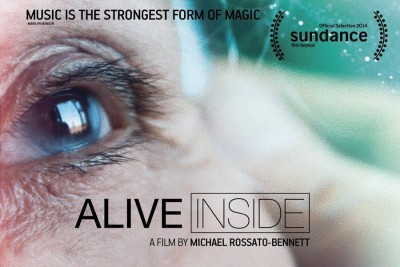
Alive Inside movie poster from the Sundance Film Festival

Alive Inside movie poster from the Sundance Film Festival

I am not a musician. I do not play an instrument, nor do I sing (not well, at least), and I do not understand how music is constructed. I do, however, like music and firmly believe that if we ever discover proof of a human soul, it will translate itself to us in the form of music.

I have, of course, no evidence to support this belief, although a recent experience at the Nashville Film Festival suggested I may be on the right track. The event was the showing of a documentary called Alive Inside: A story of memory and music.

The film, directed by Michael Rossato-Bennett, follows the story of social worker Dan Cohen who has spent the last several years bringing iPods to nursing homes across the United States. Cohen has found that even with the most neurologically shut down senior (e.g., clients with Alzheimer’s disease or other forms of dementia), revive when they music from their youth.

Director Michael Rossato-Bennett (l) and social worker Dan Cohen (r)

Director Michael Rossato-Bennett (l) and social worker Dan Cohen (r)

Slowly, as the story plays out, we are introduced to human husks that reside in these homes and palliative care centres. People who had once been husbands and wives, mothers and fathers, sons and daughters, but who have been reduced to masses of barely interactive biological matter by their medical conditions.

And yet, when the headphones are placed over their ears and music pours down thin white wires into ear buds, those husks are infused with life. Like a balloon that only shows its true form upon inflation, the inert bodies and death masks take the form and substance of the human beings they once were.
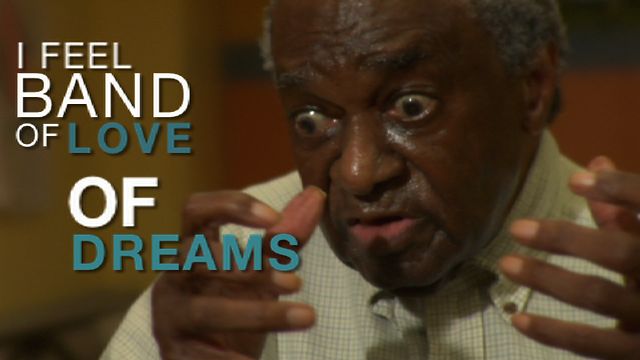
Henry comes alive again as the music reaches inside

Henry comes alive again as the music reaches inside

Eyes glow with life, spines regain flexibility, paralysis becomes movement, and disengaged spirits connect with the world. If only for a few hours, the catatonic fog lifts and a human is reborn.

The science—discussed in part with Dr. Oliver Sacks—suggests that the familiar, beloved music of the individual’s past activates that part of his or her brain as yet left untouched by disease, effectively relinking the connections between their worlds within and without. That may be true, scientifically.

What was certain to me was that the music either reignited the spark that makes us human or provided the fuel that converted a seriously diminished spark into a sputtering flame. The results were miraculous.

Even in cases where disease hadn’t erased the person’s individuality but dampened it with manic-depression or multiple sclerosis, the music seemed to quieten the internal maelstrom enough for the person to re-emerge. The woman immobile without her walker, shoved it aside to dance to Spanish guitar.

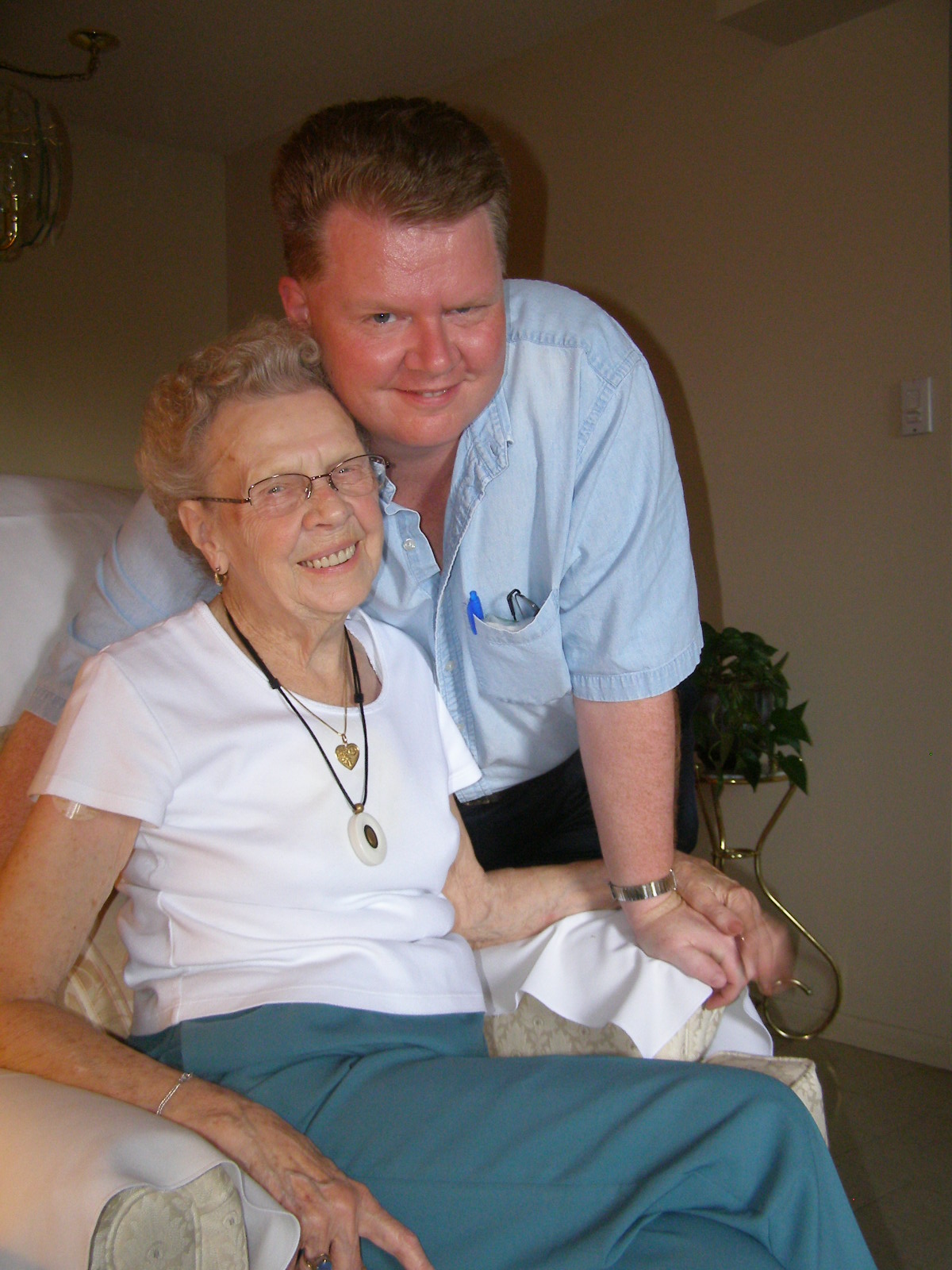
The story of Alive Inside had a personal connection for me as I immediately thought back to my now-deceased grandmother Dorothy who fortunately had maintained her mental faculties except at the very end. Her apartment, as I remember it, was constantly filled with music, her CD player rarely turned off. New CDs coming into her home every Christmas, every birthday. Elvis, Michael Buble, The Mills Brothers, Motown and light opera. She was at her most contented when listening to music.

The caregiver...

The caregiver…

...becomes the care-receiver.

…becomes the care-receiver.

But the world was completely different when she was in the hospital—a life of cardiac issues catching up with her eventually. In the anemic, lifeless wards where wonderful warriors did their best to stave off the inevitable, I could see Dorothy’s spirit wane with each passing day. Even if I didn’t always think she was physically ready, my happiest days were knowing she was going home.

When something upsets the norm, ceases to function correctly or goes completely dormant, it is easy to set it aside and forget about it. When that something is a loved one, setting them aside is never easy but it is often easier than coping with the problem. And once set aside, forgetting becomes that much easier.

Seeing that a person is still inside that morbid husk of a human, however, changes everything. Knowing that we have committed a living, breathing, connectable loved one to solitary exile becomes less palatable, less conscionable.

Music isn’t the solution. It doesn’t reverse what has happened to the person biomedically. Within minutes or hours of the music ceasing, the individual typically deflates to his or her former shell.

But we who have witnessed the transformation, we have been permanently changed because we can never see that human shell the same way ever again.

We know that shell is not lifeless, and once we know that, there is no going back.

If you get the opportunity to see Alive Inside, please do. And be sure to bring plenty of facial tissues.
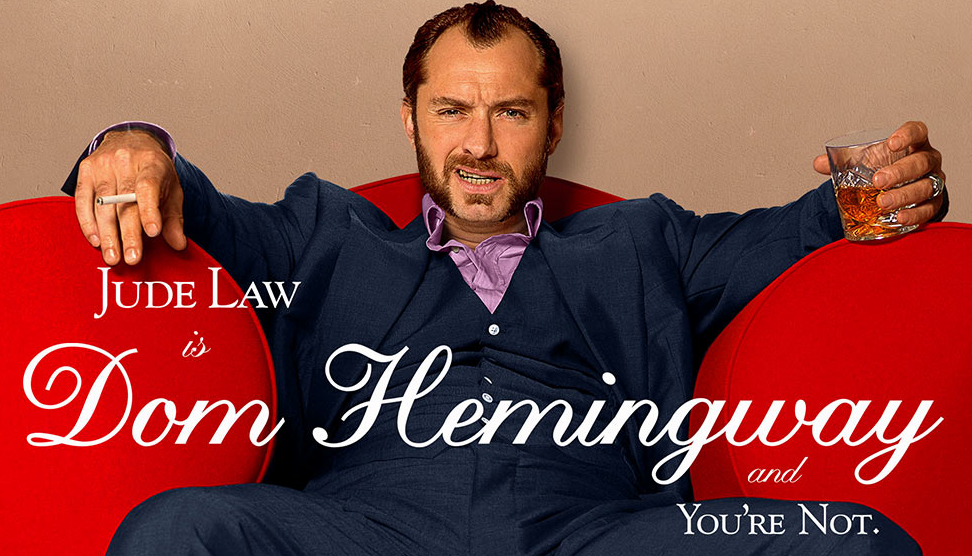
Dom Hemingway – A Review

CN_DomHemingway

A redemption story of a career criminal who has played the game by an unwritten code, who has done his best to do right by people within the criminal world and been screwed at every turn. The only people he hasn’t done right by, in fact, are his ex-wife and daughter, whom he completely screwed over. (Trailer)

Written and directed by Richard Shepard, who brought us The Matador, Dom Hemingway works on so many levels—from its amazing opening soliloquy (no better way to describe it), through astounding montages of decadence that can only be described as balletic, to tender moments of friendship punctuated with foul language.

But sadly, because it works on so many levels, the places where it doesn’t are glaring. And there is perhaps no bigger failure than the actual story.

There is no doubt that Shepard can write. His use of words to express universal ideas and human frailty are musical. Unfortunately, those skills only serve to create islands of poetry in a story that slowly drowns in conflicting tides. The movie bogs down into little more than a series of fortunately/unfortunately vignettes that ultimately don’t go anywhere.

Likewise, the moment we leave the criminal aspects of the story and Dom has to face the wreck that is his life and relationships, the dialogue becomes wooden and cliché.

Even the redemption angle is eventually undercut by additional scenes that suggest Dom has learned little. Not sure what Shepard’s thought was here—that people don’t really change, perhaps—but it might simply be an unverbalized acknowledgement of Shepard’s own limitations.

The performances of Jude Law and Richard E. Grant cover for many of the story flaws. Law’s Dom is a man who can’t get out of his own self-destructive behaviours long enough to actually succeed and let his skills prove himself. Grant, meanwhile, plays the long-suffering conscience who just wants his friend to be happy, but doesn’t have the energy to watch Dom implode in his own fear yet again. Unfortunately, the minute these amazing men leave the screen, the movie flat lines.

(Side note: Just before the movie started, the theatre screened an ad for Filth (trailer). It was amazing how similar the lead characters of the two movies appear, as Law seemed to be channelling his inner James McAvoy at times.)

Perhaps the best way to describe Dom Hemingway is to say you will feel energized watching it, but a little empty of dissatisfied as you leave the theatre.

I wanted this movie to be better. I wanted it to be the best movie I’d seen all year, the most complete movie. Alas, it wasn’t.

Bible or Anachronism – The Elements of Style

EoS

As we approach the 100th anniversary of this well worn tome on writing correctly, I would like to survey my social media environment to determine how often Strunk & White’s The Elements of Style is actually referenced by people on a regular basis.

NOT do you own it.

NOT have you cracked it open at some point.

BUT do you actually use it to improve your writing.

OR do you not even know about what I am talking.

Those of you who know me well, already know my stance on the book. At the same time, as I have seen the book referenced countless times as a classic must-have, I have come to consider that my bias regarding the book may have been a product of the era in which it was thrown at me, and thus, I should be open to reconsidering the tome.

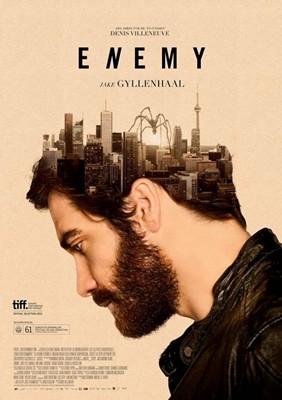
Enemy—The movie with the meta title

Enemy

So, it was $5-Tuesday yesterday at the Carlton Cinema in Toronto and a friend invited me to see a movie called Enemy, starring Jake Gyllenhaal. Like any weary movie-goer, I immediately jumped online to look at the trailer and thought, “Hmmm, weird, but interesting”.

I was half right. The movie was weird.

At this point, I should probably say “SPOILER ALERT”, but truth be told, I am not sure that if I laid out every event that occurred in this movie, you would know what was happening. I sat through it and I don’t know what happened.

As the trailer indicates, the movie is about a man who is dissatisfied with his life—never explains why, he just is—and is merely going through the motions of living until one day when he realizes that his exact doppelganger lives in town.

Terrified at this revelation—never explains why, he just is—he is nonetheless drawn to his twin and after jumping through a series of over-complicated hoops, he meets the twin. At which point, he second-guesses his decision and it is his twin’s turn to go neurotic—never explains why, he just does.

As you may have guessed from my above repetition of “never explains why”, my greatest issue with this movie is unclear character motivation. Perhaps it says more about me and my life history, but I have no idea why any of these characters acts as extremely as they do.

I am confident that it is part of the artistic conceit of the piece that at numerous moment are you fully sure which Jake Gyllenhaal character you are watching onscreen. The challenge with this is that the emotional rollercoaster of each of the characters is such that from cut-to-cut within the same scene, I am never sure which Jake Gyllenhaal character I am watching. I ended up watching the characters’ clothing rather than the actor’s face to try to follow the story.

And the motivations of the secondary characters are just as muddy for me, although at least here, we have different actors and so don’t have the Gyllenhaal rabbit hole with which to contend. Like a faucet tap, the emotions of these characters change with a flick—questioning in one moment, horny in the next, and angry in the third, and all in the span of 30-45 seconds.

A definite statement of who I am, I spent much of the movie trying to predict the reveal of the story based on the clues or purely on conjecture.

Twins separated at birth? Time travel with a glitch? Parallel universes collide? Psychotic episode of one man leading two lives?

No SPOILER ALERT to say none of these came to fruition, but that still doesn’t mean that any of them may not be true. Hell, all of them might be true. I don’t know.

And any hope of a conclusion is muddied by a massive metaphor that scurries through this movie—I won’t tell you what it is—and yet offers no satisfying explanation.

Enemy is described everywhere as a thriller. I’d be more inclined to call it a puzzler…and even that may be too lofty. Head-scratcher and headache-giver might be more accurate.

As I read up on the movie to write this, I learned the film won Canadian Screen Awards (our Oscar) for Best Director and Best Supporting Actress, and was nominated for Best Film. I find that disturbing.

The film was based on the 2002 novel The Double (O Homem Duplicado), by Portuguese author José Saramango. Part of me wants to find the novel to see if it is any clearer than the movie, but as of this moment, a bigger part of me just wants to walk away from this entire episode in my life.


Previous posts about characters in writing and film:

Just Tell The Story – Austin Film Festival

The Dignity of Characters

A Matter of Character

Can You Relate?

I Am Always Right (Motivation)

Dara Marks at Toronto Screenwriting Conference 2013

Unpacking Baggage (Part One)

Unpacking Baggage (Part Two)

Unexpected surprises: Steve Allen autobiography

Steve Allen

So, as I was waiting to join my friends in a taping of our sketch comedy show SomeTV!, I decided to check out a nearby second-hand book store.

Under normal circumstances, this would be a complete love-fest for me, but as funds have been a tad tight lately, I was really only in the store to browse (yeah…that could happen). Well, as I moved through the section of film and television books, I happened across an autobiography of Steve Allen, who among other things was the first host of The Tonight Show.

As I had nothing but respect for Allen’s comedic timing and his ability to get amazing, ad-libbed comments out of pretty much anyone, I picked the book up only to see that they were only asking $2.99 for the book, entitled Mark It And Strike It.

Despite this price being five times the cover price of the book, I decided I could afford the few dollars and bought it.

Wow! Was I in for a surprise!

That Allen manages to include information about his childhood, marriages and early jobs is the only reason that this volume could ever be called an autobiography. The reality is that a full two-thirds of the book are dedicated to a vast range of subjects that reflect more Allen’s thoughts on and opinions about the world in which he lives in 1960 (yes, the book is three years older than me).

Allen discusses the vast gulf that separates Art from Science. The loss of spirituality, or perhaps more accurately, the misappropriation of spirituality in the United States. McCarthyism and anti-Communist terrors that permeated society. Issues of racism and sexism that were tearing the country apart. The nature of humour and comedy and its tortuous demise at the hands of populism.

Aside from my surprise at finding such topics in an autobiography and in the ideas being expressed within the pages, the greatest reflection came as I reached the end of the book and realized that almost 55 years later how little has changed.

The Arts still suffer in a school system fixated on the STEM disciplines (science, technology, engineering, mathematics).

There is still rampant use of God and Jesus as weapons across the United States in defense of excluding other cultures.

Admittedly, anti-Communist sentiment has subsided as Communism itself has subsided, but it was quickly replaced by anti-Muslim sentiments.

One need only look at the leadership of the United States and the parasitic pundits to realize that racism and sexism still cling like so much fecal matter.

And the recent controversy over the Colbert Report shows that satire and wit remain under constant attack.

Yes, this was possibly the most effective $2.99 I have ever spent in my life as it gave me more than a few hours of entertainment…it gave me a never-ending stream of subjects to contemplate.


(PS This is not intended as a comment on the United States as we have more than our share of problems in Canada. I simply discussed the US as that was Steve Allen’s context.)


For more about Steve Allen, check out these links:

Frank Zappa on The Steve Allen Show

Steve Allen’s Man on the Street

Steve Allen Online (official web site)

Screenwriting, not choreography

Write-dance

In her weekly blog Why The Face, my friend Marsha Mason (more “Hey, there!” than Goodbye Girl) hits briefly on two topics of particular angst in new screenwriters: camera directions and over-written action sequences.

For me, both of these come down to the same issue: the screenwriter’s need to choreograph his or her story so that the reader “sees” the movie as the screenwriter “sees” it.

Below, with permission, I have reproduced Marsha’s original post and my comments on it.

WTF

Why The Face, March 1, 2014:

There are two things I’ve noticed of late in a number of the scripts I’ve been reading that you really don’t need to do.  They’re small things, but they can wind up pulling the reader out of your script, when what you really want is them sucked into your story.

1) Camera directions: leave them out. When someone falls in love with your script, the director that attaches to it will be the one to figure out what camera angles they’ll use and when.

And…

2) Detailed descriptions of fight sequences/car chases/long physical comedy bits: once someone falls in love with your script, there will be stunt choreographers, fight directors, and your star actor/comedian, people whose specialty it is to design these sequences for the production, based on the needs/wants of the director/producer/star.

A better idea is to describe the feeling and the tone so the reader knows what you’re aiming for, rather than going on for a page or more.  Ie “An epic car chase ensues.   More Seth Rogen behind the wheel than Al Unser Jr., it goes for blocks, barely missing nuns and orphaned children.”

Essence of, then right back into your story.

My comments:

Couldn’t agree more. Too many people feel they have to direct their screenplay to ensure the reader “sees” what they “saw” in writing it.

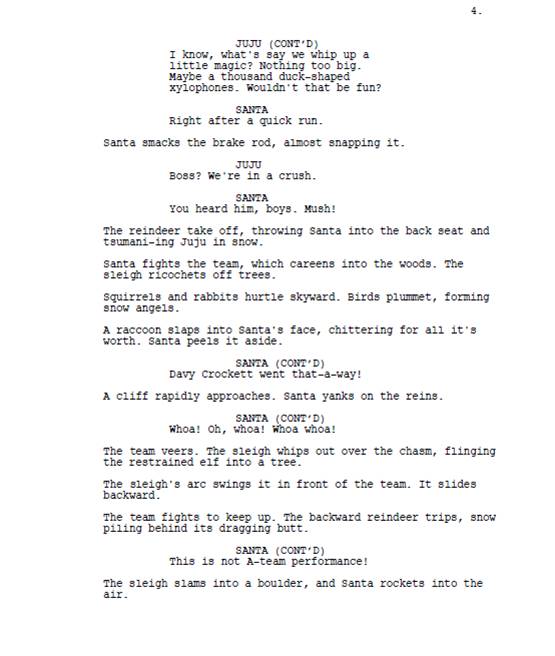
In a few screenplays I read recently, the writer went to great lengths to choreograph fight scenes, offering the minutiae of balletic movements.

“Raising his knee, he blocks X’s kick, and then twirls to chop X across the back of the neck. Stunned by the blow, X falls forward but recovers quickly enough to tuck and roll back to his feet. Etc. Etc. Etc.”

A fight sequence should have a sense of energy, urgency. These are people struggling. You want that to play out emotionally. You want the reader to break out in a sweat, his or her pulse elevating while reading the scene.

Instead, you slow down the reading with lengthy descriptions. The reader has to wade through line after line of description.

As Marsha describes, you can offer the fight in broader strokes to elicit feeling or tone.

Alternatively, you can present a sequence in short, staccato phrases and sentences. It is like having 20 hockey players firing pucks at you, at will. You become powerless in the onslaught, never precisely sure from where the next shot is coming.

Because the descriptions are short, they take little time for the reader to absorb before he or she moves onto the next one. Each line comes faster and faster, until the reader finds him or herself in the fight.

And then suddenly, it is over and the reader is left drained, but exhilarated.

In action sequences, less is more.

Sleigh


(Note: The above sequence is from my latest screenplay The Naughty List, a holiday-themed film for adults. Think The Santa Clause meets Good Morning, Vietnam.)

Antisocial Media : A thought process

An interesting thought on the distinction between online and on-planet socialization

Ionia Froment's avatarreadful things blog

I’ve been thinking a lot lately about how many people the average person “knows” in the digital age. This post is not really so much an opinion as it is a question posed to everyone who makes use of social media, be that blogging, Facebook, Twitter, or the various other platforms out there. Do you think that we are more social or less social than we used to be thanks to technology?

What does the word social really mean? You can find plenty of definitions for it in the dictionary and plenty of different forms. The one we will use here comes from the Mirriam-Webster Dictionary. so•cial /adjective:

2. Marked by or passed in pleasant companionship with friends or associates. <An active social life>

I have met some of my very best friends (and Julian, sweet Englishman that he is) through blogging. I know these people now as “real people”…

View original post 400 more words

It’s a sad, sad, sad, sad world

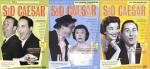
Go to YouTube and search for Sid Caesar.

Right now. Don’t wait.

I’ll still be here when you get back.

Comedy lost another titan today with the passing of Sid Caesar at the age of 91.

A man who defined television sketch comedy as we know it today.

A man who trained and/or gave voice to some of the greatest comedic minds of the 20th century, including Carl Reiner, Mel Brooks, Mel Tolkein, Danny Simon, Larry Gelbart, Neil Simon and Woody Allen through shows like Caesar’s Hour and Your Show of Shows.

A physical giant, Caesar was capable of playing the brutish husband or the nebbish boyfriend. He brought laughs and tears. And he was the first to let his co-stars shine. Stars like Imogene Coca, Nanette Fabray, Howard Morris and Carl Reiner.

I am confident that all of these people would have influenced my life in one way or another without the likes of Sid Caesar, but he formed the nexus around which my comedic galaxy spun.

Thank you, Sid. Know that you were loved.


Related posts:

My Favorite Life

My Creative Journey

Jonathan Winters


You can’t go ROM again

One of my childhood thrills was going to the Royal Ontario Museum (ROM) in Toronto, and by childhood, I mean lifelong, never-too-old eternal childhood. Visiting those familiar hallways and displays has always been like wrapping myself in a comfortable blanket of love.

Until yesterday.

I spent 3.5 hours wandering many of those same exhibits with my camera and left somewhat depressed. So much of that familiar charm feels gone or is relegated to a back corner of the hallowed halls.

Back in 2007, as part of the museum’s revitalization and expansion program, the ROM unveiled The Crystal, which the museum describes as:

“Considered to be one of the most challenging construction projects in North America for its engineering complexity and innovative methods, the Lee-Chin Crystal is composed of five interlocking, self-supporting prismatic structures that co-exist but are not attached to the original ROM building, except for the bridges that link them.”

Depending on whom you ask, this structure is either the most beautiful addition to Toronto architecture ever or the biggest monstrosity of ill-conceived architectural hubris.

I tend to fall into the latter category, as the addition feels like something that was slapped onto the old façade rather than something that is an organic extension of the pre-existing structure. And to make matters worse, although there has been some nod to design on the outside of the building, the inside still displays unfinished work that looks like particle board held together with visible screws and grated flooring. Only the lack of builders’ chalk marks signal that this is not a work in progress but rather is the final product.

But back to my depression.

As I ate lunch in the ROM cafeteria, I realized that I hadn’t been through a couple old familiar displays, including the old dinosaur dioramas that I loved as a child. Flipping through the museum guide, I suddenly realized: they were gone. The dinos of the Crystal were all that remained. A significant part of my childhood was gone.

Sigh.

Of the 170+ photos I took yesterday, I will likely only keep a dozen or so…and of that dozen, I may only be happy with 2 or 3.

Apparently, the camera was willing but the spirit was gone.


Additional note: While I am unlikely to wander the ROM’s halls much in the future, I will still visit on occasion when a new exhibit comes to town. The present show—Wildlife Photographer of the Year—is stunning.

Music to my ego

Like fish

When you first start exploring any art form, you are typically rapt in the joy of expression, but you are also at your most ego-vulnerable. Thus, it is nice every now and again to receive some positive feedback and it is even better when that feedback comes from someone who represents your art’s industry (rather than your mom).

As many of you know, one of my screenplays was a Second Rounder in the 2013 Austin Film Festival screenplay competition. Part of achieving that status is receiving readers’ notes that explain why you moved forward in the competition and why you stopped. A couple of days ago, I received the notes for my feature Tank’s.

Wow.

Below, I offer some of the positive feedback (I received negative too).

An exhilarating, imaginatively conceived, meticulously crafted, professionally polished animation intended fairy tale, a love story set in the cosmos of fish.”

Obviously the work of a talented, experienced writer who knows animated light comedy, how it works, and how to do it.”

The linear narrative is redeemed, however, by the enthralling depiction of fish as people, their humanly drawn nautical universe, and a buoyant, lighthearted mood pervading the narrative.”

Is the writer competitive here with, say, the creative minds at Pixar? Without question, yes.”

“The storytelling is befitting of the silly/adult humor of Dreamworks while still maintaining the light family-friendly air of a Disney cartoon musical.”

Kind of makes me want to keep writing, you know?

JB

(Images are property of owners and are used here without permission because I am that good)