No

Not yet

I love what I do.

I love writing. I love coming up with new ideas to write. I love helping other people put their ideas into words and then into action.

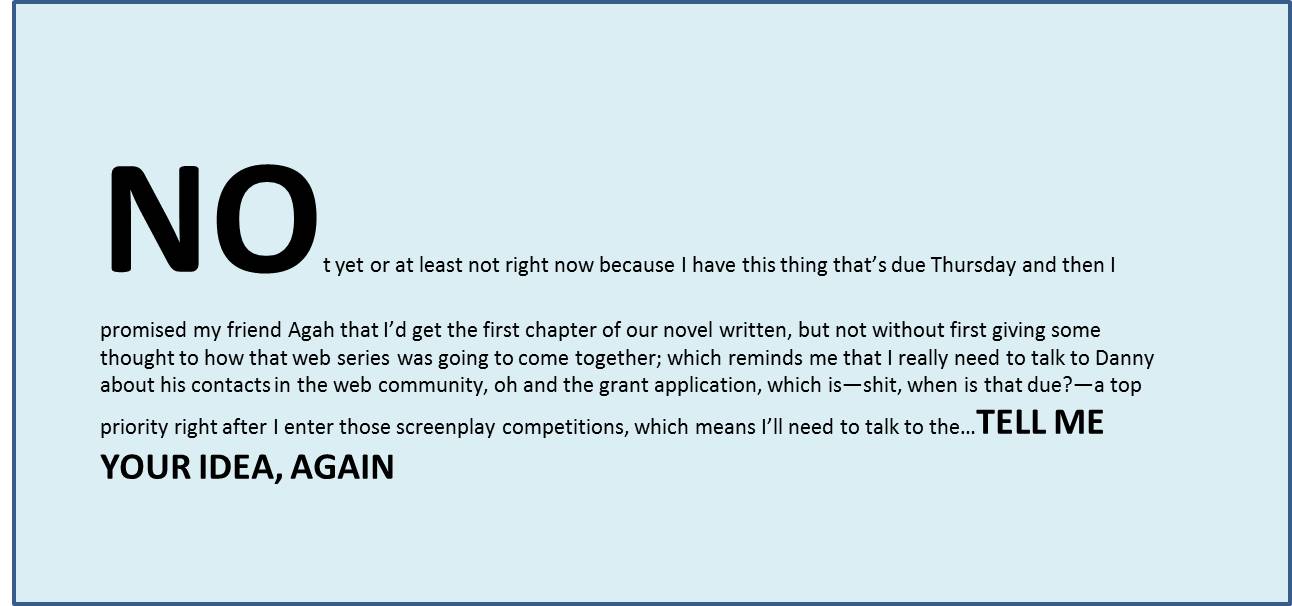
This is why I struggle with one of the shorter words in the English language: No.

Hello, my name is Randy, and I am addicted to new projects.

There was a time when my inability to tell people no stemmed from my fear of letting them down. Or more accurately, my fear of them never asking again and my value as a person being reduced to zero.

Not so now, luckily. Now, I find my value internally. I am, therefore I have value.

Interestingly, though, I still struggle to say no. But now, it’s a curse of enthusiasm and confidence, now fear and self-loathing.

And to complicate things further, that same enthusiasm and confidence attracts people who are more timid in one or both. People with ideas but lack voice, or with voice but lack means.

I am glad that they see me as a vector through which to explore and advance their visions. At the same time, I have to remember that my bandwidth is limited. It is less the hours in a day and more the daily ration of creative energy that limits me.

(BTW, this is why I don’t upbraid myself for spending hours on the computer or playing Solitaire. That is my period of recharge.)

At some point, I have to limit my involvement in others’ works. I have to save enough space for my paying gigs, lest I be hungry and homeless, and for my creative projects, lest I be frustrated and unhappy.

I have to say “No”.

You recently published a book and want to turn it into a screenplay? Great!

You’ve got an idea for a comedy sketch event? Fantastic!

I came up with another great concept for a movie? Congratulations! (Yes, even I drain my batteries.)

I’m not saying I won’t help, but don’t take it personally if I limit my involvement. It is not a reflection on you or your idea but rather on me and my limitations.

Today, I can work with you. Tomorrow, I may only be able to listen to you. The next day, I may not even be able to do that.

Oh, and I’ll do my best to recognize and respect those same boundaries in your life.

No doesn’t mean your idea sucks. No doesn’t mean I never want to work with you. No simply means I can’t, not right now, no matter how much I might want to. There are shades of No.

I can’t because I already have plenty on my plate. I can’t because I have to keep myself a priority. I can’t simply because I can’t.

But I wish you all the best in your efforts.

Yellow sub no2

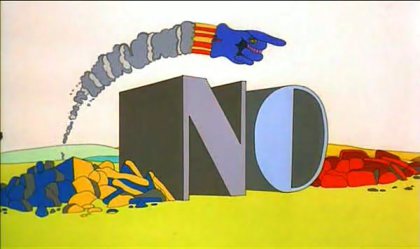
In a slightly unrelated brain fart, the concept of No reminded me of one of my favourite revelations from the movie Yellow Submarine, the animated Beatles film.

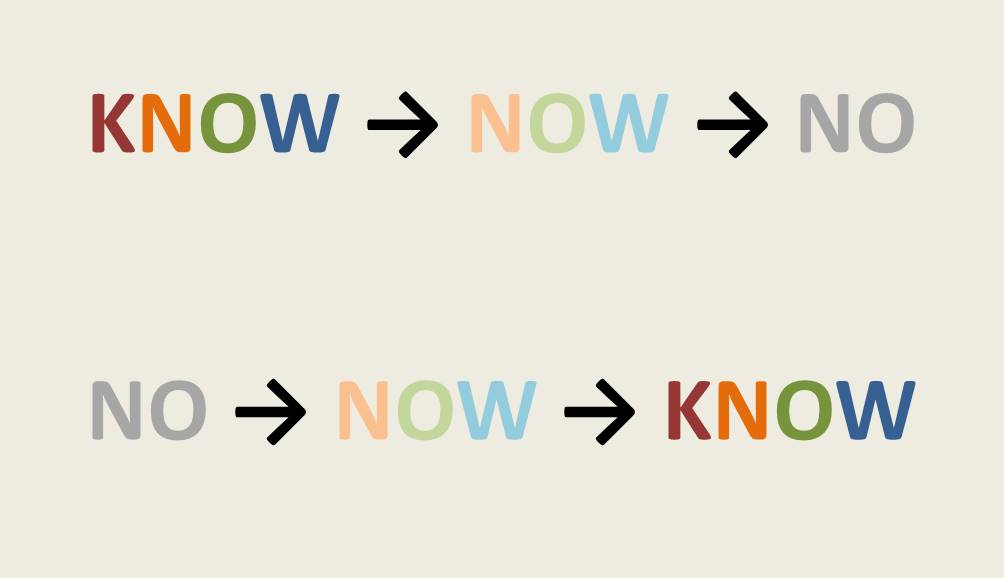
Early in the film, as the forces of evil are over-taking Pepperland, a ballistic glove called Glove chases people and smashes things with his giant fist, including the letters in the giant Technicolor word “KNOW”. First, he smashes the K to make the word “NOW”. He then smashes the W to make the word “NO”, which becomes black-and-white.

Late in the movie, when the Beatles—disguised as Sgt. Pepper’s Lonely Hearts Club Band—lead the people’s revolt to reclaim their land, the smashed letters reverse and become colour again.

What surprised me was that having watched the film at least a dozen times before, it wasn’t until late in my “adulthood” that I realized the message embedded within the two events.

No pic


Consider my mind blown!

Engage me, don’t yell at me

While on LinkedIn earlier today, an acquaintance posted the following image that has been circulating lately; an image humourously designed to explain social media.

Look at me!

Look at me!

What this also highlights, however, is our complete lack of understanding when it comes to social media…that it has to be social.

Well, it doesn’t have to be social. Plenty of examples on the Internet (probably some written by me) where an individual or company has used social media to scream out their own message, not bothering to wait for a response or worried whether they are engaging the individuals on the other end. Just one giant game of: Look at me! Aren’t I clever? Love me!

Again, I recognize my own culpability in this. I too can be accused of approaching social media like a dog barking at a window, with little or no concern about those at whom I am barking. I do my best to have a point and always enjoy engagement.

Social media should be about engaging and building a community of which you and I are just one member. It should be more about listening than talking. It’s about starting a conversation, not a speech.

Thus, I offer the following revision of the white board presentation above.

Look at us!

Look at us!

In social media, everyone can hear you scream…but how many of us are listening to what you are screaming?

(Of course, this could all be high-handed holier-than-thou BS…in which case, I expect you to hold me to account. Go ahead, prove me right!)

Screenwriting, not choreography

Write-dance

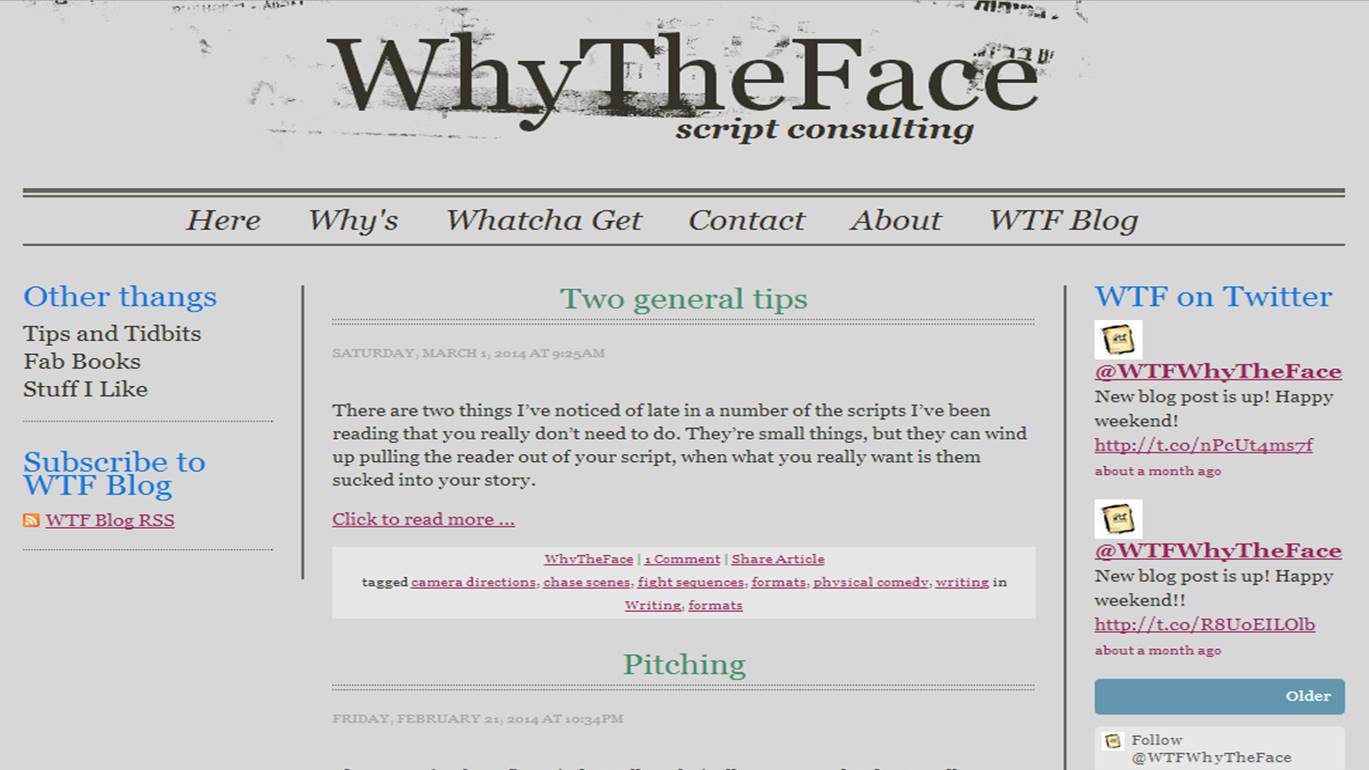
In her weekly blog Why The Face, my friend Marsha Mason (more “Hey, there!” than Goodbye Girl) hits briefly on two topics of particular angst in new screenwriters: camera directions and over-written action sequences.

For me, both of these come down to the same issue: the screenwriter’s need to choreograph his or her story so that the reader “sees” the movie as the screenwriter “sees” it.

Below, with permission, I have reproduced Marsha’s original post and my comments on it.

WTF

Why The Face, March 1, 2014:

There are two things I’ve noticed of late in a number of the scripts I’ve been reading that you really don’t need to do.  They’re small things, but they can wind up pulling the reader out of your script, when what you really want is them sucked into your story.

1) Camera directions: leave them out. When someone falls in love with your script, the director that attaches to it will be the one to figure out what camera angles they’ll use and when.

And…

2) Detailed descriptions of fight sequences/car chases/long physical comedy bits: once someone falls in love with your script, there will be stunt choreographers, fight directors, and your star actor/comedian, people whose specialty it is to design these sequences for the production, based on the needs/wants of the director/producer/star.

A better idea is to describe the feeling and the tone so the reader knows what you’re aiming for, rather than going on for a page or more.  Ie “An epic car chase ensues.   More Seth Rogen behind the wheel than Al Unser Jr., it goes for blocks, barely missing nuns and orphaned children.”

Essence of, then right back into your story.

My comments:

Couldn’t agree more. Too many people feel they have to direct their screenplay to ensure the reader “sees” what they “saw” in writing it.

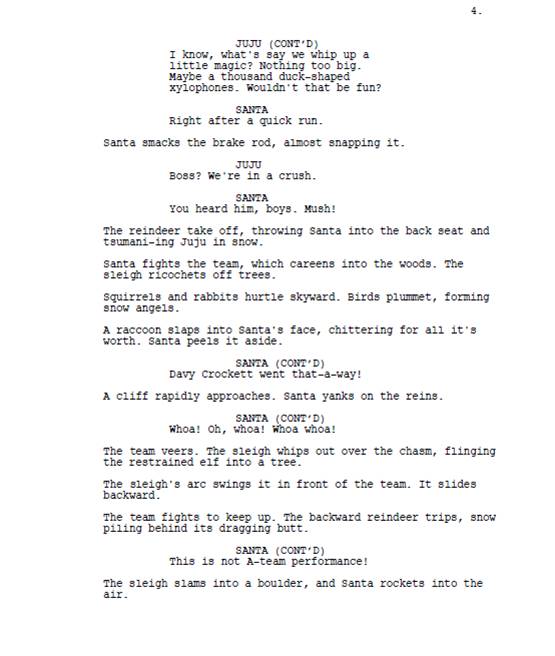
In a few screenplays I read recently, the writer went to great lengths to choreograph fight scenes, offering the minutiae of balletic movements.

“Raising his knee, he blocks X’s kick, and then twirls to chop X across the back of the neck. Stunned by the blow, X falls forward but recovers quickly enough to tuck and roll back to his feet. Etc. Etc. Etc.”

A fight sequence should have a sense of energy, urgency. These are people struggling. You want that to play out emotionally. You want the reader to break out in a sweat, his or her pulse elevating while reading the scene.

Instead, you slow down the reading with lengthy descriptions. The reader has to wade through line after line of description.

As Marsha describes, you can offer the fight in broader strokes to elicit feeling or tone.

Alternatively, you can present a sequence in short, staccato phrases and sentences. It is like having 20 hockey players firing pucks at you, at will. You become powerless in the onslaught, never precisely sure from where the next shot is coming.

Because the descriptions are short, they take little time for the reader to absorb before he or she moves onto the next one. Each line comes faster and faster, until the reader finds him or herself in the fight.

And then suddenly, it is over and the reader is left drained, but exhilarated.

In action sequences, less is more.

Sleigh


(Note: The above sequence is from my latest screenplay The Naughty List, a holiday-themed film for adults. Think The Santa Clause meets Good Morning, Vietnam.)

Rule breakers

Broken Rules Falls to Chaos Anarchy Pieces

Oil and water do not mix because, well, they are oil and water. This is a rule. We made a cliché out of it, so it must be a rule.

And yet, it is not a rule.

Oil and water can mix. You just have to screw around with it by adding another component to the mix…an emulsifier. True, this isn’t the same kind of mixture as blue Kool-Aid plus red Kool-Aid makes purple Kool-Aid, but the colloidal suspension of oil droplets in water is still a mixture.

So what about combining oil painting with water colour painting? Anathema, you say. They are two distinct media, you cry.

So what, I respond.

Because we’ve never seen it done (or at least, I haven’t), doesn’t mean that it cannot be.

Each medium offers its own strengths and limitations, and magnificent works have been created with either. Is there a way, however, to enhance those strengths, moderate those limitations by combining the media within a single work?

Every day, new rules are created, new schools of thought founded that try to define a panoply of Art forms. This is good, as these institutions form the parameters in which new Artists learn and understand their craft.

Can you imagine the panic of being told to go make art and being given nothing to do so: no instruction, no media, no resources?

And yet, those very institutions can strait-jacket the unwary and the unthinking, as rules become commandments rather than guidelines. When any attempt to step outside of the school is med with derision, contempt and blinkered exclusion.

The very congresses and champions established to support the growth and evolution of Art can easily become the prison wardens of that Art, confining aberrant Artists in an attempt to petrify the one true form.

(By the way: The same is true for Science, where journals and textbooks are rife with examples of explorers being squashed for daring to suggest something that didn’t fit within scientific canon.)

It would be naïve and harmful to suggest that rules should not only be broken, they should be shattered. If you wrote a novel using numbers rather than letters, you might find a very small audience for your work and little understanding from peers. There is much to be said, however, for grazing, nicking or wounding the rules.

Rules should be constantly questioned, viciously challenged if Art is to evolve. Without such a challenge to the nucleotides that comprise our genetic material, we would not exist and the planet would be lifeless.

But just as we demand mutation and adaptation to facilitate Artistic evolution, so must we accept the other half of the Darwinian equation. Only those most fit to survive will. The majority of mutations and adaptations will be for naught and that Art will perish.

It is a harsh reality, but look at what it has wrought in just 40,000 years since humans first applied colour to walls.

All this to say, break some rules. Test the limits. It is your evolutionary destiny as an Artist.

Break-the-Rules-e1331912129855

(Images are property of owners and are used here without permission and against the rules.)

Failure is not an option…it’s a skill

Fear-of-failure

I used to be terrified of failure. If I couldn’t know that I would succeed at something, I would put it off and potentially never do it.

And this was true in all aspects of life.

Driving. Dancing. Playing musical instruments. Talking to girls and later women. Athletics.

I became the best I could at one or two things—the things for which I seemed to have a natural aptitude—to avoid having to worry about being asked to do any of a thousand other things.

To me, failure was not an option. (I could spend months discussing why, but I won’t…at least, not here).

It has taken me a long time, but I have finally realized that I was only half right.

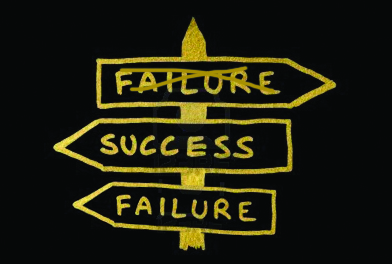
failure_success

Failure is not an option…it is an imperative.

It is a skill that I must practice time and time again in all aspects of life.

At its simplest, if I succeeded at everything to which I turned my hand, I would stop doing it.

I succeeded. I achieved my goal. What more could I hope to accomplish? Everything after that is pure redundancy and repetition.

When harnessed, however, failure and imperfection can be that thing that drives me forward, when purely creative urges do not.

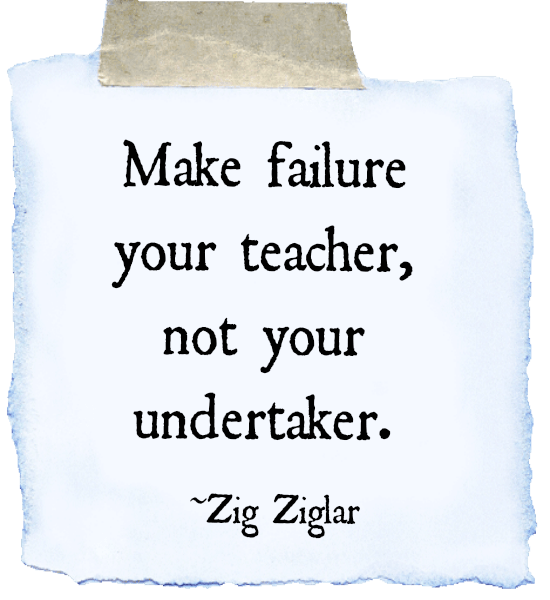
ziglar

Failure is my teacher. Failure is my drill sergeant and mentor. And yes, failure can be my devil.

Perfection is an illusion and is therefore unattainable. This means that even at our zenith, we have failed. So what?

Even if we do not strive for perfection, but for an attainable, measurable goal, we are likely to fail if for no other reason than once we have achieved that goal, we instinctively move the goal posts. Our best is always a thing of the past and acts as a goad for us to do better.

Herein also lays the further challenge of failure in Art. There typically is no real metric other than external opinion. Rare is the individual who targets using 7.83% magenta in his next painting.

coyote

Wile E. Coyote is about the only artist I know who can actively test the realism of his Art. He has achieved his goal if the Roadrunner runs into the cliff wall painted to look like a tunnel. Ironically, his downfall was the hyperrealism he achieved such that the painting actually became a tunnel. In succeeding, he found failure.

Where I used to fear failure, I now embrace it. I use it to stretch myself and my skills. I use it as a lesson plan.

Failure-is-not-falling-down-but-refusing-to-get-up

But for this to work, I must envision failure as something internal and self-defined rather than something external and based on the opinions of others. There lies madness.

Yes, I rely on feedback garnered from others to determine my degree of success, but I do not allow others to define that success.

It is my Art. I define it and in doing so, define myself. And to do that, I must fail and fail again.

failure-and-success

(Images are property of owners and are used here without permission, which may be an epic failure on my part.)

Do you feel a draft? It’s time to revise your manuscript

Because the only thing more tedious than a reblog is a reblog of a reblog, but at least this time, it is someone else’s voice (although in fairness, I have never heard Ned speak, so he may actually use my voice).

Ned's Blog's avatarNed's Blog

Do you feel a draft? Hey, it’s Friday! What? Still not good enough? What if I also told you it’s time for Ned’s Nickel’s Worth on Writing! Okay fine. But it’s still Friday and you should be happy. I know I am. Especially after Publisher’s Weekly recently called my Nickel’s Worth “…writing tips that are worth every penny, unless you factor in the cost of inflation.” So we obviously both have a lot to be thankful for today. However, before we get to this week’s NWOW, I’d like to point out how the image accompanying this post is…

Uhhh ladies? Eyes over here please.

Thank you. As I was saying, the image is one I’m sure many of you remember — some in amazing detail. Although my wife still isn’t completely convinced, I’d like to clarify those are not my actual cheeks. Sorry. But as a journalist, I felt the need to explain that…

View original post 1,183 more words