What more did you need?

Image

There is an allegory that was better told by Karl Malden on The West Wing, but it goes something along the lines of:

There was a man who lived by a river, and one day, he heard a weather report that said the river was going to flood and that everyone should move to higher ground. A devout man, he said, “God will protect me. I do not have to leave my home.”

The rains started and a policeman came knocking on the man’s door, telling him he had to evacuate. The man smiled and said, “The Lord will protect me. I’ll be okay.”

The river flooded and the man was stranded on his roof, when a rescuer in a boat rowed by, telling him to get into the boat. The man shook his head and said “I have prayed and God will protect me.”

Eventually, the river swept the house away and the man drowned, and when he got to heaven, he stood confused before God and asked, “Lord, you let me drown. I am a good man, why did you not protect me?”

And God looked down and replied, “I sent you a weather report, a police officer and a rescuer in a boat. What more did you need?”


I recount this story because I have a colleague who is going through similar stages with her screenplay.

After months of feedback from writing groups and instructors that suggested several issues with her screenplay, the most prominent being the passivity of her protagonist and complete lack of conflict in her story, my colleague stood fast by her story. She defended her choices vigorously and left us in no doubt that she was going down the right road.

As it is her story, that is her right, and so many of us stopped discussing these issues with her.

More recently, she’s had the opportunity to send her screenplay to a film producer she knows, who was more than happy to give my colleague her thoughts. A few days later, she shared the feedback with us and smack in the middle was several issues related to the behaviour and actions of the protagonist. My colleague was unimpressed and vaulted upon her Steed of Rationalization, charging into the night.

A week or so later, my colleague received feedback from a film director and again, was smacked with a lack of central conflict and a passive protagonist. And again, this elicited response of being misunderstood and dismissive anger.

And the screenwriting gods looked down and replied, “I sent you a screenwriters group, a film producer and a film director. What more did you need?”


We all want people to agree with our views, particularly when it comes to something as personal as our art. Agreement validates us as individuals and confirms that our art has merit in the world beyond.

But in the search for that agreement, we must be prepared for disagreement. And while it is always our prerogative to ignore contrary opinions, we lose the right to complain when the contrary feedback is consistent and still we choose ignore it (or worse, rail against it).

I don’t believe that anyone has to accept external feedback; positive or negative. But if you want your art to be more than mental masturbation, you should be prepared to listen to all input and incorporate what makes sense to improve your art.

Otherwise, shut up and let the rest of us evacuate the flood plain.

First d(r)aft

Three days. I have three days to come up with another 10 pages from my latest screenplay for a reading and critique in my screenwriting class. And I have nothing.

Well, that’s not technically true. I have something. I have the architecture of my screenplay written out…I know where I want to go and what steps I need to take, broadly speaking, to get there.

But those are just a series of incomplete sentences that barely fill a page. I need 10 pages of a screenplay. I need narrative (not too much, as is my wont) and dialogue, and yet everything I write right now reads like crap. Absolute, utter drivel.

Welcome to the first draft.

I love to brainstorm and come up with new ideas. Ideas for new screenplays. Ideas for scenes within those screenplays.

Brainstorming is exciting. Everything is possible, so I am at my most creative. Nothing comes off the table, and every idea leads to several others.

I love to plan. I like to arrange those ideas into a semblance of order…it is quite literally the assembly of a puzzle. What if I moved this scene from the first part of Act II to just before the climax? How does that change the story?

But at some point, I have to stop brainstorming and planning. I have to start writing. I have to take those incomplete sentences and turn them into coherent scenes of people interacting with people—directly and indirectly—to accomplish goals and thwart those of others.

And even that description of the process sounds interesting. But then I begin typing and my words take on the feel and smell of two-week old cod.

Image

If the mom character was any stiffer, you could iron shirts on her. Why not just have the son respond “Oh yeah!” and euthanize all of your creative ambitions?

You want the boat captain to do what? Even the most psychotic of fishermen wouldn’t contemplate that idiotic move! What was your research: old Popeye cartoons?

You suck! You suck! You suck!

Okay. Feel better now? Had your little tantrum. Your little pity party. Ready to move forward? Take a deep breath.

This is your first draft, and it’s gonna suck. That’s what first drafts do. But it’s the first draft that sucks, not you.

The idea is still sound. Story improvements you can’t see right now will arise in the workshopping process. The dialogue can be massaged and the narrative edited…in your second draft. You can move some of the scenes around to enhance the conflict…in your third draft.

The only thing about what you are doing today that is anywhere near a final draft is the name of the screenwriting software. [NOTE TO FINAL DRAFT: Give some thought to changing the name of your software. Too much pressure for some of us to handle.]

You’ll be fine. Your story will be fine.

Just start typing…

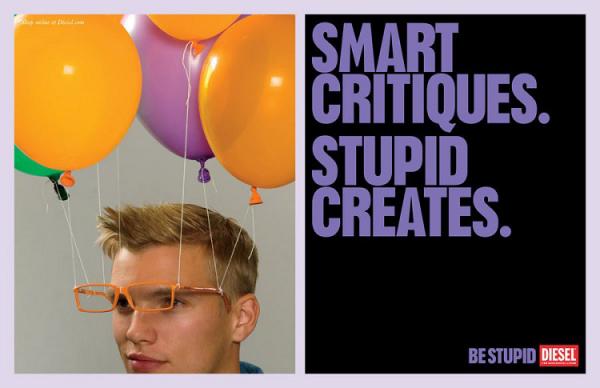
Stupid is pretty smart

Image

I find it interesting that most people seem to be less afraid of being stupid than they are of looking stupid.

I say this because of the inordinate amount of stupid material I find every day—the people posting this stuff obviously don’t think it’s stupid—and yet many of the brightest people I know (and not just those with whom I agree) are paralytically afraid of saying anything lest people think they’re stupid.

Now, I appreciate that stupid is subjective, but this is not a condemnation of stupid, it is a call to embrace our personal stupid and use it to move forward to brilliance.

If you watch a group of children as they age—not literally moment-by-moment; that would be stupid—you will see that they start out unfiltered and unhindered by subconscious voices that make them edit themselves. They are free to create amazing things and proudly display those things on refrigerators around the world.

As they get older, though, those subconscious voices creep in and you find the children become less enthusiastic about their art. They become more self-conscious about being seen as stupid, and so the refrigerators of the world become increasingly barren.

That is incredibly sad, and not just because the typical refrigerator is a featureless, oddly coloured box with little inherent fashion sense. It is sad because it creates a population of adults who are incredibly repressed and overwhelmingly self-conscious.

Image

As I have mentioned before, I have numerable friends who want to write, but they are routinely stopped from taking any action by an infernal firewall of what to write. They can’t just write anything. Writing just anything would be stupid.

No! No! No! Writing just anything would be freaking brilliant!

Writing just anything would make you a writer, rather than the non-writer you are now.

Write the word “stupid”. Write “stoopid”. Write “styupid”. Write “stewed pet”. And bloody screw AutoCorrect.

Let stupid be your creative scissors and run around the room not caring into whom you run or stab. Stupid begets intelligent, no matter how stupid that sounds.

Image

Besides, no matter how clever, intelligent or prosaic you are, someone is going to find your writing stupid. Stab them with your stupid scissors and move on.

I absolutely abhor the novel Crime and Punishment, routinely espousing that the crime was the writing of the book and the punishment is the reading, and yet many people find it a marvelous work of art. How stupid is that? (You can read that as I’m stupid or they’re stupid…I don’t really care.)

In King Lear (III, ii), Shakespeare wrote: “The art of our necessities is strange that can make vile things precious.”

As used in the play, this line has absolutely nothing to do with the point I’m making, and depending on how you read it, the line actually blows my thesis apart or completely justifies it. Now that is freaking stupid.

As Liam Neeson should have said in the movie: Release the Stupid!

You may just find that your stupid is pretty amazing…and even if it’s not, you’re one step closer to your brilliant.

Image

(Images used without permission. Pretty stupid, eh?)

Death by a Thousand Meetings

Committee (n): 1) a group of individuals specializing in irreversible creativity vivisection; 2) last known location of a good idea. See also: elephant’s graveyard.

Perhaps the greatest challenge facing anyone creating art is less the generation of new ideas and more the knowledge that at some point, you will have to release your art to an awaiting world; aka, relinquish control.

Now, we can (and have) discuss the illusion of control at any phase of the creative process, but there is no denying that if you want your art to be appreciated by others, you will have to pass your newborn into someone else’s hands…or worse, someseveral else’s hands.

For writing—my predominant area of interest—that moment can come quite early in the creative process, whereas for other art forms, such as sculpture or painting, it may appear quite a bit later (please correct me, if I under- or misstate things).

You must respect your art. You must protect your art. But you must also realize that if you intend to share your art, and perhaps even make money from it, you must be somewhat flexible with your art. When you bring it to the world, it ceases to be all about you.

A teacher once suggested that upon completing a play, Shakespeare merely became another critic of the work. His opinions on meaning and significance within the play were simply one more voice and held no more sway than those of any other critic. I don’t know that I agree—what self-respecting writer would?—but I see the point.

When I write a screenplay, I need dissenting and diverging voices to ensure that I am not leaving things out or glossing over important plot or character points that are clear in my head. At the same time, I must be sure that my vision is protected, lest I start writing someone else’s screenplay.

I understand, however, that if I want to turn this screenplay into a movie or television episode, I will have to relinquish some of the control to the hands of studio executives, producers, directors, actors, directors of photography, sound teams, and in all likelihood, the third cousin of the guy who runs the craft services table. I have to be comfortable with the idea that each of these people wants to (actually, must) contribute in some way to the final product to give them a sense of ownership. They too are artists.

I am struggling at this stage with several television projects I have been developing. I have a computer filled with TV series concepts and/or pilot scripts, and I am trying to decide with what production companies to share my babies. Like Smeagol, I stroke my precious and have a rampant distrust of everyone.

How do I know the company I choose shares my vision, will protect my baby, isn’t just a group of ravenous Orcs? I don’t. I can’t, ahead of time.

What helps is watching fellow writers who rabidly protect their newborns at a much earlier stage in development. Who in a reading group, spew buckets of foamy spittle while savagely defending the use of the word “vivisection”, or primal scream that their protagonist’s motivations are obvious to anyone with half a brain.

I am doing the same thing with my projects, only at a later stage and mostly in my head (and possibly with just half a brain). Just as they have to learn to let go or at least lighten up, so do I.

In writing this post, I am coming to realize that my art is in the writing of the screenplay, not in the making of movies or television. Thus, when the screenplay is ready to move on, I must let it go and hope it flourishes…even if I am not ready to let it go. The art must grow and breathe, regardless of my personal reluctance and fears.

Committees are still evil…you will never get me to say otherwise…but unless I am willing to do everything on my own, which would not do justice to my babies, committees are a necessary evil and less dangerous to my babies’ successes than on overbearing, overprotective parent.


For a humourous take on the evils of meetings, please also see the recent blog post by Ben’s Bitter Blog: Meeting Bitterness.

Costume storage

Last week, I walked through my neighbourhood and passed a theatrical costume store called Malabar, a place through which I love to rummage for the sheer joy of the pageantry. And that brief moment would have been forgotten had not fellow blogger Madelin Adena Smith posted a hyper-caffeinated blog and vlog early this morning.

In it, she challenged her readers/listeners to consider the roles they play in their day-to-day lives and asked us to consider the real us that lay hidden beneath those performances, which made me think of my psychosocial closet and all of the costumes I have worn throughout my life.

(Before proceeding, this is not a complaint against family or friends. These costumes were of my own choosing and it is only now in later life that I am realizing what I did to myself.)

Here is the schoolboy outfit…god, I was so small back then…the dutiful student who wanted to explore storytelling, but knew that this was not the accepted route to success. Oh, I was supported in my storytelling, but only as a hobby. My real future lay in science and medicine.

And the eldest son/man-of-the-house costume…almost looks like a football uniform with its broad shoulders and firm back…heady responsibilities for a young boy growing up and not having a clue as to who he is supposed to be, let alone actually is.

The clown costume…my go-to in times of stress…a protective device against a world in which I didn’t feel I belonged or related. Make ‘em laugh, make ‘em laugh, make ‘em laugh. Then run away.

The Creative Director costume…the true song-and-dance man of my repertoire. This was perhaps my biggest role in life and is a costume I still wear on occasion, if only because it is expected by clients.

My psychosocial closet is filled with these things and all of them served to block my art because they stifled the real me.

You see the problem with the bars of a cage is that they work in two directions. Yes, they keep the world from getting at you, but at the same time, they keep you from reaching your true self and that is where your art lives.

During my eldest son phase, my art would express itself in the wee hours of the morning, long after everyone had gone to bed, until my mother would finally yell downstairs for me to cease the deafening machine-gun fire of my electronic typewriter.

The clown phase almost cost me the love of my life but when the silly girl challenged that I was simply a clown, my hackles rose and I gave her reams of painfully personal poetry I had written. Her preconceptions shattered, we were married within a year and were so for 13 years.

Interestingly, it was the new costumes we donned during our marriage that led to our separation last year. Luckily, in shedding those costumes, we remain very close friends and confidantes.

Ironically, even my Creative Director guise stifled my art. Sure, I was creative, but for others, not me. This is the main reason why I chose to quit my job last year and pursue my art as a career unto itself. I had to sacrifice something, and it was the job.

With rare exceptions, my psychosocial closet is now just a relic of my past; a yearbook at which I can reflect on lives lived and mistakes made. It is not, thank goodness, something into which I feel the need to dip.

The only real costume I wear now is my Randall C Willis (please, call me Randy); the only costume that was ever truly mine. The artist has no clothes, if you will.

And because I have finally divestmented myself, my art can flow freely and keeps me warm at nights.

I am, therefore I create. It’s a great feeling.

And in the meantime, I wonder if Goodwill accepts old costumes.

So, now that I stand here naked (don’t think about it), I feel free to ask: What costumes you have worn in your life or do so now that have blocked your art?

The only costume I am apt to wear these days is on my hand

The only costume I am apt to wear these days is on my hand

Use the Force NOT the force

Earlier this evening, I had dinner with a lovely friend of mine (yay). Eventually—like 3 minutes in—we got around to discussing our blogs, and my friend starting talking about feeling the pressure to post. Not that any of her followers had specifically requested she post, but rather that she felt like she was letting down the side by not posting.

I understand this feeling at quite a personal level, as I spent most of my life feeling like I had to act lest I let down the side. Eventually, though, I realized this was something I was doing to myself and not something that was being imposed on me by outside forces (or at least not most of the time). Those in my life who were going to be dissatisfied if I didn’t act were probably going to be dissatisfied if I did act.

As my friend discussed her blog, she felt there were nights when she would sit in front of her computer with nothing to say and yet the page was blank and she hadn’t posted in a few days. Should she force herself to post something or should she just remain mute until she had something to say?

From my perspective, we blog for ourselves not others—this was a conversation many moons ago with my friend—and so the decision to post should be based on whether we feel the desire or personal need to post, an internal urge to channel whatever thoughts or emotions or essence bubbles within us awaiting expression.

I think it’s that honesty with ourselves, serving our own deeper need to share, that attracts and sustains followers. People are smart. They can see when you’re pressing out blog content like so much blood from a stone…if not on your first post, then on subsequent ones.

I talk a lot about our Art and how my personal art channels through me like something from the ether, whether I’m talking about writing or photography. I am a lightning rod through which the spirits anchor themselves—make that mean whatever you would like it to mean. That’s why I think the metaphor of the Force is so strong (okay, now I’m starting to channel George Lucas).

You cannot force your Art. It will happen when it is ready to happen…when you are ready for it to happen.

You must practice it, of course, while waiting for inspiration to take you to new levels, much as a hockey player practices skating and shooting drills in anticipation of the game when he or she won’t have time to think about those mechanical actions.

Perhaps you can practice on your blog, but I have yet to read a blog that suggests people are practicing. To this point in my reading, our blogs are our Art…or at least, part of our Art.

I know this is true for me, and I am confident this is the case for my friend. Thus, any attempt on her part to force a post will be a lie—to followers, more importantly to her Art, and most importantly to herself. She deserves better than that.

I can do better than that

Almost a year ago, I had the opportunity to substitute teach a class of would-be advertising copywriters at a local community college. I was quite excited because it would give me the chance to talk to people at the beginning of their careers, while they were still fresh with anticipation and ready to take on the world.

Out of the gate, I let them know a little about myself and background, and then went straight for the “So, what made you decide to become a copywriter?”

To a person, the response was largely the same: “Well, I saw so many terrible advertisements and knew I could do better than that.” I am extremely happy to report that this was not all that they had going for them. Each was amazingly talented in his or her own way and it was a great couple of weeks.

But their original motivation hangs in the air, like a persistent echo that refuses to die.

No matter what our art, I would not be surprised to find that out that we have all said at some point in our lives “I can do better than that”. It’s only natural. It is how society has raised us.

I would like us to stop, however, because I fear it is killing our spirit and therefore threatens our art.

First, it’s just negative thinking on a topic for which we do not have a full understanding.

Having worked in advertising for a few years, I have a much better understanding of the great divide between what we came up with creatively and what finally made it to the magazine page or television screen. Trust me, the average ad you watch bears almost no resemblance to the original concept.

And even if my head exploded a little at the thought of the movie Piranha 3DD, I have to give the writers and producers some credit for getting it made and into theatres. They’re well ahead of where I am with my screenplays, which currently sit on my laptop computer and in a few competitions.

But more important than simply being the “why can’t we all just get along” guy, I think we denigrate our own efforts by focusing our attention downward.

Art should inspire and the artist should aspire. We shouldn’t look down and sneer. We should look up in awe at works that truly stir our hearts; that shake us to our artist core and make us strive to be better.

If all we do is attempt to be slightly above the dirt, then we merely set ourselves up to be the target of the next person in line.

If, however, we push ourselves to reach further, attempt more, climb higher, then there is every reason to believe that we will be the one who inspires the next person to stretch beyond our grasp.

I don’t want to write a screenplay that’s slightly better than Walk Like A Man. I want to write one that surpasses The Usual Suspects.

I want to write sketches funnier and more pointed than Sid Caesar and Monty Python.

I want to take the most beautiful photos that tell the most intricate stories, using every other photo as my muse.

By looking up, we become a lightning rod for our art, attracting the energy and inspiration that drives our passion. Looking down, we shut ourselves off from those same spirits, blocking out the positive input that surrounds us.

Simply in aspiring to something greater, we raise our art and therefore ourselves to new levels. And as difficult as each incremental step may be, the rewards are exponentially greater.

When we look up, we are bathed in the light of our truth. Looking down, we see only the threatening abyss of failure.

Aspire or expire, the choice is yours.

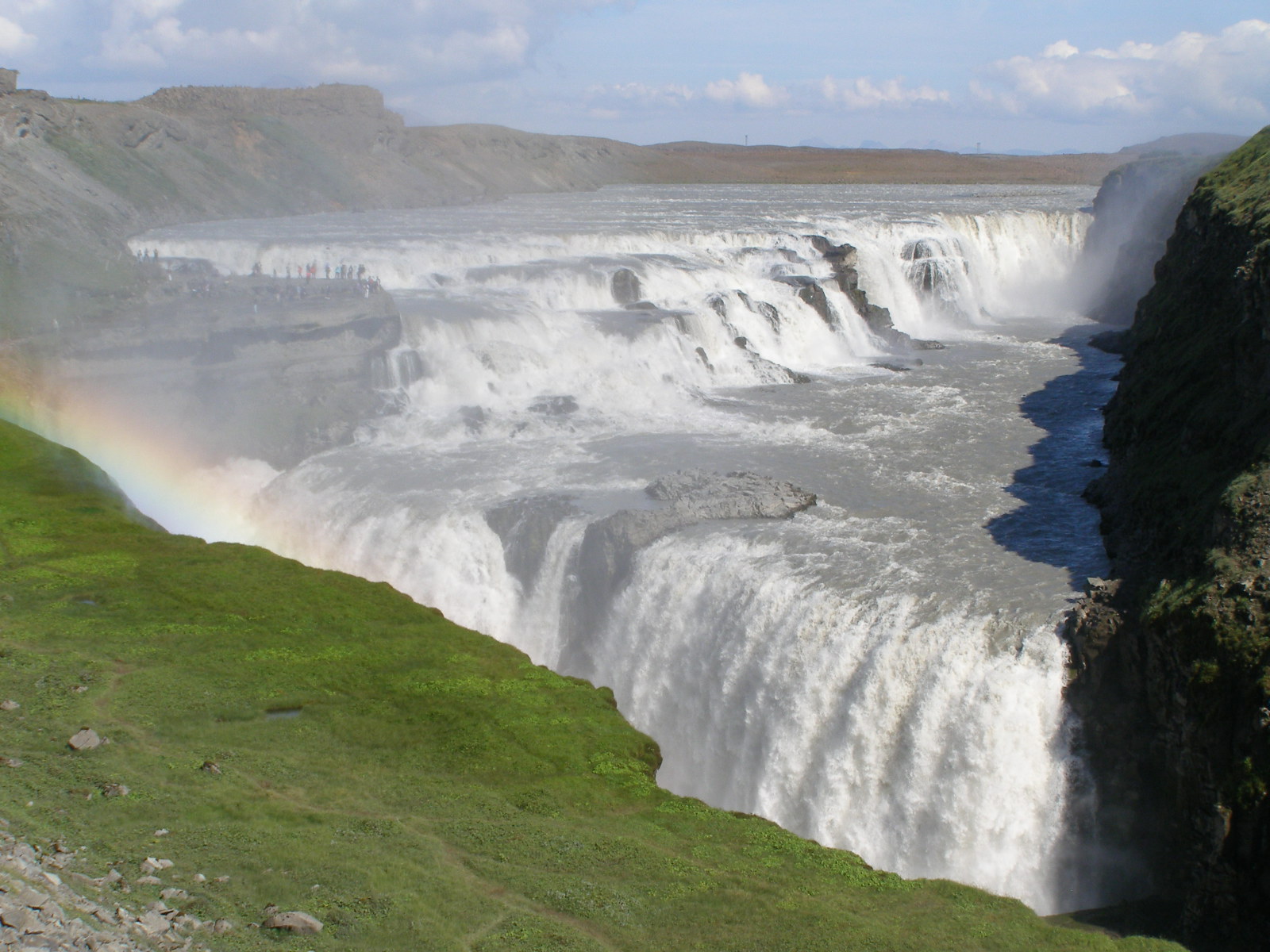
The sheer scale of these falls was only overtaken by the thought that they followed a geologic fault separating Europe from Greenland.

The sheer scale of these falls was only overtaken by the thought that they followed a geologic fault separating Europe from Greenland.

Consciously unconscious

When a writer is on her game, when she has found a creative groove, she writes at two levels.

At the conscious level, she weaves the stories of her various characters and environments into a literary carpet of amazing delicacy. She understands the work won’t be flawless when she’s done, but she knows and is comfortable in the belief that she can surgically pull the extraneous threads later.

This is a beautiful thing. But an even more dazzling spectacle is happening at the unconscious level.

This is the level at which the writer’s subconscious creates delicate near-invisible tendrils of connections between characters and themselves, their surroundings and other characters. It is at this level that amazing nuance and metaphor is added to a story. Without the harsh distractions of planning and plotting (both very important, mind you), the subconscious is free to perform magic that we may not recognize or appreciate until much later in the creative process.

One way you witness this is when you realize that conscious concerns you had before sitting down to write have been miraculously addressed, as though story-writing elves snuck onto our computers overnight.

Interestingly, this is one reason why it’s important to have other people read your stuff. They will see things you cannot. In some cases, it is because of what they bring to the table—their personal biases and experiences. But more importantly, it is because they aren’t encumbered by your blinders.

Other readers see your work more clearly because they are untainted with what comes before and after, whether on the page or in your head.

I witnessed and shared this personally in two reading group sessions where my fellow writers created incredible metaphors that deeply informed their lead characters. Yet, when pressed directly as to whether they were conscious of those decisions, both were the most shocked people in the room.

Both demurred that the incidences were quite accidental, but whereas I might agree that they were unintentional, I don’t believe they were in any way accidental.

We make choices for a reason (or several) even when we don’t know what those reasons are. The truth is our truth no matter how ignorant we may remain to what that truth is. We cannot help but splay that truth across our pages.

To some extent, I think creative harmony lay in not caring what those reasons are. For if we try to dissect them, I fear we run the risk of killing them. It is enough, I think, to let our subconscious guide us while we work consciously.

Let the magic within you happen. Your work will be the better for it.

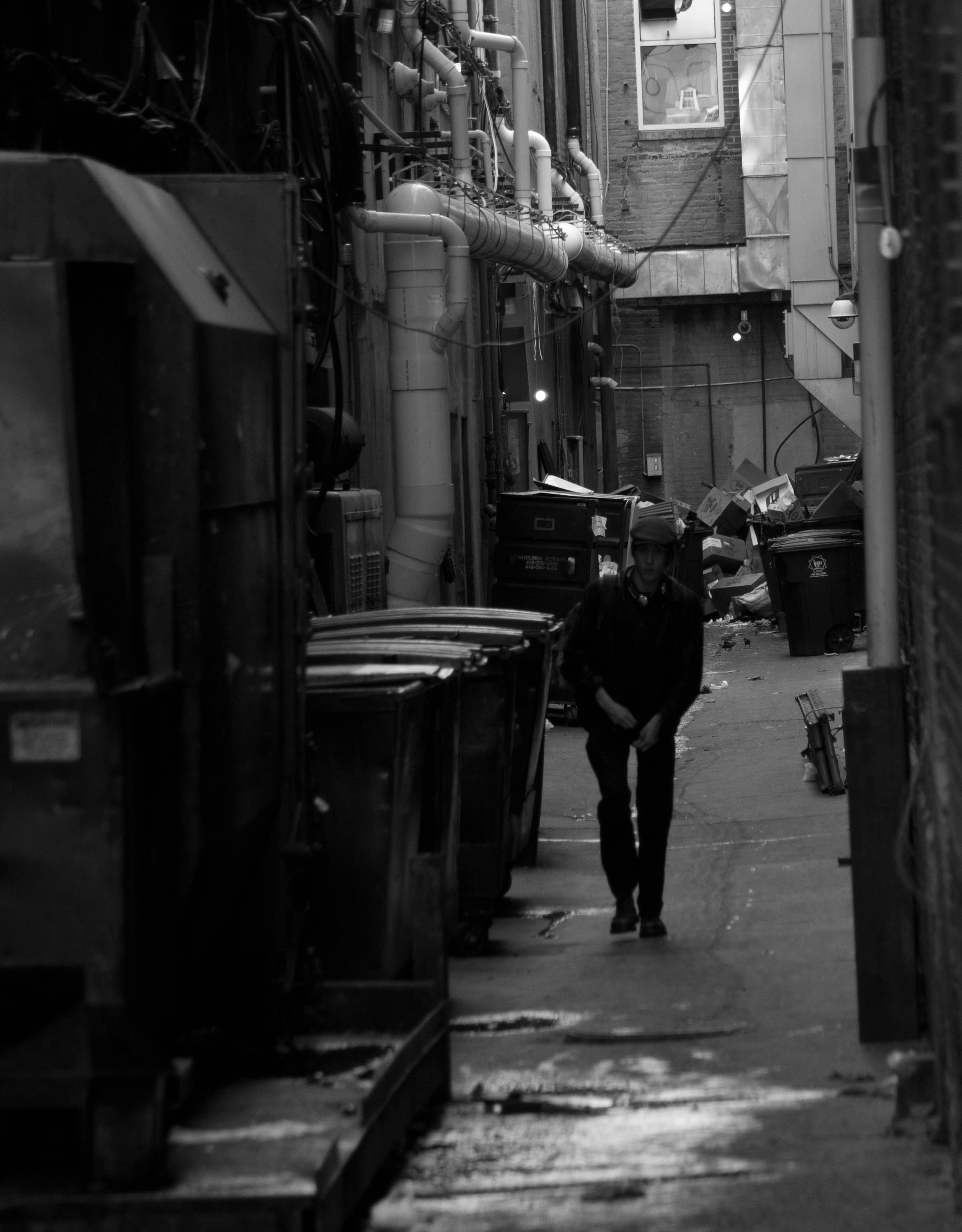
I never intended to take a photo of someone urinating in a Washington, DC alley way, but am tickled I did...especially as he realizes he's been caught

I never intended to take a photo of someone urinating in a Washington, DC alley way, but am tickled I did… especially as he realizes he’s been caught

Two’s company, three’s a story

As I read through a lot of early-stage screenplays and stage plays (including my own), I have noticed an interesting trend: Any scene that only involves two characters is boring.

No matter what the posturing, no matter how violent or loving, no matter whom the characters are, a scene with only two characters quickly loses steam for me. The dynamic peters out, and I find a lot of writers try to overcompensate for that by simply making the characters’ gestures larger. As though they believe talking louder to someone who does not speak your language will make you any more intelligible.

I speak for the trios: Turns out there may be some behavioural psychology behind this…at least, if you’re a rock hyrax—no, no, not “Lorax”.

Last week, a research paper was published in the journal Animal Behaviour that looked at the dynamics of triad relationships between these small creatures living in the hills of Israel, and the results were fascinating.

In a dyad relationship (two individuals), the authors say, you cannot make any predictions about the future other than friends will likely remain friends and enemies will likely remain enemies. With a triad (3 individuals), however, a social power dynamic is established that can morph in any number of directions, although some directions are inherently more likely and more stable than others.

The researchers found plenty of examples of the standby relationships, such as the friend of my enemy is my enemy (+ – -) or the friend of my friend is my friend (+ + +), and found that these relationships were highly stable in that they were likely to remain unchanged from year to year for any set of three individuals.

Enemy mine: What was fascinating, however, was that the seemingly unstable and counter-intuitive state of the enemy of my enemy is my enemy (- – -) occurred a lot more often than expected by chance and that it could be quite stable from year to year. This completely flies in the face of the standard that the enemy of my enemy is my friend (- – +).

From a story perspective, however, it can make complete sense. What if all 3 of you are vying for the same objective? As one of the enemies, you have to be constantly wary that any effort to thwart one enemy will provide an advantage to the other enemy.

Friend of a friend: What was also interesting was how gender played a role in the evolution of the unstable triad the friend of my friend is my enemy (+ + -). In females, this triad tended to morph toward (+ + +), while in males, it tended toward (+ – -), suggesting the need for female cooperation in raising young and male competitiveness in breeding. Typical men, eh?

From a story perspective, though, consider the power of (+ + -). What if the friend of your friend pushed them to do something contrary to your desires? This would make them your enemy—whether you’re being altruistic or selfish. A much more interesting dynamic as you may inadvertently push your friend into making a choice between the two opposing forces.

Dynamite dynamics: Regardless of the way your scenes play out, the triad dynamic gives you so much more room to play with emotionally and socially than a dyad. At any given moment, one of the trio can switch poles and the dynamic changes. With a dyad, the sudden switching of poles better have a good rationale in your story or it won’t be believable. That brings me to my next point.

Two characters: Now, before you go out and scrub all your two-person scenes from your screenplays, novels and stage plays (because yes, my hubris states I am that influential), let me remind you I said two characters, not two people.

Environment, situation and unseen third parties can also be characters in a scene between two individuals. It is those subtextual elements that convert a vomitously dull scene into one that sizzles. The challenge is in making sure the reader/viewer knows it’s there through carefully selected word choice and narrative (NOT exposition).

Two friends meet, but one hides a secret from a previous conversation that muddies their exchange in ways unexpected by the ill-informed (- + – or + + -) (e.g., plot to every spy movie ever made).

Two men with diametrically opposed viewpoints have to set aside their differences to deal with an external threat (- – -) (e.g., Hooper’s shark to his Quint is his enemy), which turns into (- + -)).

So, when you find yourself creating a scene with only two people, ask yourself who or what is influencing this scene aside from the two people and remember to incorporate them or it into the dialogue and narrative.

As Jed Barlett said to Sam Seaborn while playing chess in a scene from West Wing, “Look at the whole board.”

Didn't want to play your silly games, anyways

Didn’t want to play your silly games, anyways

(Re)Learning to Swim – Art vs Technique

I love to swim. It is one of my favourite activities and one of the only forms of exercise I don’t begrudge, perhaps because I can’t tell if I’m perspiring. I am by no means athletic or proficient with it, but I enjoy doing it and have decent stamina.

Several years ago, a friend of mine decided she wanted to learn to swim. As an adult, however, she was embarrassed that she didn’t already know how, so she asked if I could help her learn the basics. Being a good friend—and not just a little bit infatuated with her—I said sure, happy to help.

A few days later, we got to the pool and I tried to break things down for her. Unfortunately, unlike many other exercises, with swimming you are in water and therefore much of the mechanics are difficult to view directly. Thus, I had to show her the mechanics above water, as though swimming to the ceiling. And that’s when everything started to fall apart.

No sooner did I begin teasing out the various movements in swimming than I realized that I was rapidly losing the ability to swim. Eventually, I just had to thrash about for a bit to remind myself how to do it.

It was unnerving.

I had been swimming (swum? swam?) for so many years that it was just something I did. It was never something I analyzed. You get in the water. You swim. It was muscle memory.

In teaching my friend to swim, I had separated the technique from the art, and for a brief few minutes, lost the art in the process.

The same can happen with writing.

In the earliest phases of our development as writers, it is important to develop a basic understanding of the mechanics of writing and story, to have someone walk us through the process. But at some point, we have to step forward and simply practice our art.

If writing is purely a mechanical exercise, then it is very dry and boring. It lacks the spirit that it needs to live. It is the difference between an animatronic deer and a biological deer. They may look very similar, but one is alive and the other is inert.

As a more seasoned writer, I have found that there will be times where I try to focus on the more mechanical, structural aspects of the stories I am writing. I want to make sure all the right elements are in the right place. But when I read the material over later, it always sounds forced, wooden, bereft of life.

In my effort to teach someone how to write properly—in this case, teach me—I have, however briefly, lost the ability to write. I have sacrificed the art for the technique.

Technique and process are vital, but they are not art. Art comes as you build the spiritual, intellectual, psychological muscle memory to allow yourself to immerse yourself unthinking into your writing and simply allow the story to flow.

As I’ve said before, story before structure. Art over technique.

Do fish ever think about swimming? And if so, do they then sink to the bottom? (Manuel Antonio, Costa Rica)

Do fish ever think about swimming? And if so, do they then sink to the bottom? (Manuel Antonio, Costa Rica)