Rogue One clearly satisfies (no spoilers)

rogueone_one-poster

The latest in the Star Wars galaxy of offerings launched last night to rousing applause, and I was there, in the audience, wearing my 3D goggles.

What did I think of the movie? I’m not really sure that it matters.

Like so many movie franchises out there, if you have bought into the Star Wars series, you are going to see this movie and there is damned little that any number of reviewers could say to dissuade you from that. Personally, I have been invested in this cultural icon since it first launched almost 40 years ago.

So, what is the point of reviewing the movie? None, other than an effort to satisfy my own self-importance.

This was a good movie that opens slowly, offers little in the way of character development, fulfills all of the expected (demanded?) tropes of battles and mentors and silly robots, and essentially adds nothing to the canon of Hollywood history or the art of filmmaking. I don’t know that the movie ever had the opportunity to be great, but if it did, it certainly walked the other way.

That said, the audience applauded or cheered several times throughout the movie, and I think it is fair to say that pretty much everyone left the theatre satisfied with their experience.

And there is my problem with the series, as much as the movie: satisfied.

[Hereafter, I will talk more about specifics within the movie, so you may wish to stop reading now. I will avoid spoilers, speaking more in generalities out of respect for movie-goers.]

star-wars-universe

Ep IV and V changed movies forever. Everything else was merely adequate.

Movies have evolved extensively since the launch of A New Hope in 1977, especially in the area of special effects. With franchises like Alien and Star Trek getting complete reboots, comic book universes unfolding in myriad interwoven ways, and standalones like Interstellar and Inception dazzling the eye, it is becoming increasingly difficult for individual movies to stand out from the crowd, to chart new ground.

If for no other reason, this is why I raved about the recently released Arrival (my review), which stands apart not through its special effects, but rather the execution of its central theme. There is great intelligence behind a beautiful film.

When A New Hope arrived on the scene, it changed the game of movie-making by bringing the scale of a biblical epic to hokey old Westerns and WWI dog fight movies. If Jaws initiated the summer blockbuster craze, A New Hope solidified the idea. And if that’s where it stopped, this crazed then-teenager would have been quite satisfied.

But then came The Empire Strikes Back, which somehow managed to make A New Hope look hokey and dated, although I still contend that the first movie had a better, more complete story. For a young movie goer, The Empire Strikes Back was like riding in a bullet train only to have someone throw on after-burners; it was a whole new level of acceleration that pinned me to my seat.

That feeling has never been duplicated by a Star Wars movie since.

[In fairness, there is one interesting technical achievement in Rogue One, but to describe it would be to spoil a couple of moments in this film.]

Hollywood, instead, has caught up and moved past the franchise. And perhaps even more broadly, entertainment has surpassed even Hollywood in the form of immersive video games, which I do not play.

For its part, the Star Wars universe struggles to achieve the bar, if it really even tries. And each successive movie feels like it was designed with a check list of tropes George Lucas did not invent, but that he executed perfectly in the early films.

Thus, for a Star Wars film, Rogue One is completely adequate.

rebel-crew

Adequate to their task, offering little more

Character development has largely been dispensed with. As the movie opens, we are presented with a seminal moment in the life of Jyn Erso (Felicity Jones), the central character of this movie, and then we catapult ahead 10+ years to find her in imprisoned, where our adventure begins. And with the exception of the odd note dropped into the dialogue, we have no idea what happened in those lost years.

The same is true for almost all of the other characters. Each offers the briefest allusions to why they have arrived in this place at this time, but there is little to hold onto as the story careens forward. Cassian Andor (Diego Luna) has done some bad things in the name of the Rebellion. Chirrut Imwe (Donnie Yen) clings to his belief in the Force like a child clutching a blanket, while his partner Baze Malbus (Jiang Wen) scoffs good-naturedly, mourning his lost faith.

And I have to say that I have no idea why rebel renegade Saw Gerrera (Forest Whitaker) is even in this movie. If his subplot had been written around, the story would not have suffered one iota. Like so many other movie franchises these days, I will put this choice down to something in the cartoon, novel or comic book series.

Perhaps this reveals something about me, but much as I did with Prometheus, I found the robot character to be the most evolved. In Rogue One, K-2SO (Alan Tudyk) stole the show, having the best lines of dialogue and routinely offering broader perspective on the chaotic stumblings of the inferior humans around him.

And as with the original movies, the villains proved the most exciting element of the story.

krennic

Mendelson’s Krennic brings life and depth to this movie

Somehow, the writers and director managed to make Darth Vader even more imposing than he was in any of the other movies. This was something between the uncontrolled fury of Anakin Skywalker in Revenge of the Sith and Lord Vader’s iron control in The Empire Strikes Back. Here, Vader was a cold-hearted menace who toyed with his food as time allowed, but was also happy to get his light saber dirty.

And then we have Orson Krennic (Ben Mendelson), the man charged with the construction of the Death Star and who, but for an inability to tap into the Force, might have made a delicious challenger to Darth Vader. If they do more parallel timeline movies in the future, I would love to see the evolution of this character.

Aside from these few characters, however, the movie was merely passable as a Star Wars film. The plot was straightforward, if a little padded in places, with well-choreographed battles and requisite deaths (no spoilers).

And there must be at least 837 easter eggs in this movie, tiny moments that tie in to the other movies in the series, and as my friend Danny tells me, into the cartoons, as well. While a younger me might have been enthralled by these inserts, the present day me found them distracting, particularly as they almost always served no purpose to the plot and jerked me out of the story as I realized, “Hey, those are the guys from…” (no spoilers).

But as I said at the beginning, none of this likely matters to you if you are a Star Wars fan. You will see this movie, enjoying some parts and complaining about others. It is just what Star Wars has become…and I find that a little sad.
Miss Sloane misses mark – review

sloane-poster

I am a sucker for politics and intrigue, shows like The West Wing and House of Cards (British & American versions) forming a regular staple of my creative diet. Thus, it was with great anticipation that I lined up to see Miss Sloane (trailer), an inside look at the cut-throat world of DC lobbyists, whom many consider the parasitic infection that Washington just cannot (and will not) shake.

Sadly, Jonathan Perera (writer of Miss Sloane) is no Aaron Sorkin or Beau Willimon. In his defence, however, it is likely that neither were Sorkin and Willimon on their first produced screenplays.

The movie follows the string-pulling machinations of Elizabeth Sloane (Jessica Chastain), an ice-water-in-her-veins win-at-all-costs lobbyist who works for one of the most powerful firms in Washington. This woman has no scruples and is willing to get behind anything that earns a paycheque and raises her status inside the Beltway. Anything, it seems, except for the gun lobby.

And when she is presented with an opportunity to make guns more appealing to women in the hopes of killing gun control legislation coming to the floor, she instead jumps ship to a boutique firm (read “poor”), run by Rudolpho Schmidt (Mark Strong), and takes up the opposing cause.

sloane-pairing

More could have been made of Strong’s moral angst over hiring nuclear weapon Chastain

Once the ball starts rolling down hill, it steamrolls over everyone in its path, and the story becomes a ballet between Sloane’s new firm and her old one, led by a very angry George Dupont (Sam Waterston) and his lead hitman Pat Conners (Michael Stuhlbarg). Until recently, Conners was Sloane’s partner in larceny. The rest of the movie is simply watching puppeteers pull strings.

Thus, this movie is a character study of people without character; a morality play completely lacking in morals.

As such, it is incredibly dark and even with its climax and moment of supposed triumph, you leave the theatre positively suicidal at the prospect that this story even starts to approximate reality.

In one way, it is fascinating to watch completely manipulative characters toss around human lives and feelings as though pieces in a game of Risk or Stratego. I think it strikes at our voyeur nature, tying in with the modern fascination in so-called reality television and amounting to little more than emotion porn. This movie could easily have been titled 50 Shades of Sloane.

sloane-puppetry

The strings may be invisible, but the puppet dances

At the same time, with no shred of humanity in these characters, it is difficult if not impossible to invest in the main combatants. At best, we mourn the cannon fodder that litters the field of combat. It is like watching a movie about the invasion of Normandy and really only being able to appreciate the kid who is killed as he steps off the landing craft.

And this is precisely where Perera’s developing skills let him down and his contrast with the current political masters is at its most notable.

Despite the sheer malevolence of Francis and Claire Underwood in House of Cards, there is a vulnerability that helps us understand their razor-clad shells. Go further back to the true master of political intrigue—William Shakespeare—and you see the frailties of the otherwise horrific Macbeth and his Lady. Or perhaps my favourite: Iago from Othello.

frailty-in-venom

Underwood, Macbeth and Iago: Human frailty lies behind the face of a monster

Despite the play’s title, Iago is the true hero of Othello. It is his story that unfolds as he manipulates all those around him, working their weaknesses and frailties against them, truly uncaring of the destructive impact his actions are likely to have on even his own future. And yet, for all the venom and disturbing glee with which Shakespeare imbues his malevolent beast, the Bard is also sure to insert short references to why Iago is so morally misshapen.

To his credit, Perera refused to go in the opposite direction and give us some long-winded sob story of a slight or wound from Sloane’s past to explain her motivations, and in fact, makes it a point, several times, to complain about just such an approach.

But in the absence of any contextualization for the character, even the climax itself comes across as academic exposition rather than revelation. At best, the climax has audacity rather than soul.

There is no moment to cheer the outcome of the story because the outcome is as soul-less as the morass that preceded it.

sloane-perils

That which cannot be controlled must be destroyed

As though sensing this, the final scenes of the movie felt like a bit of a negation of what came before, attempting to soften the edge of Sloane and the story itself. I really wish the movie had ended with the climax.

Given these character challenges, the stellar cast performed well despite being largely wasted.

Chastain does ice well, her face and mannerisms giving away little. Mark Strong was mostly missing in action, through no fault of the actor. His character simply had little to offer. And Stuhlbarg is quickly making a name for himself as malevolent toady, and for that very reason, really needs to find another role to utilize other aspects of his obvious talent.

Miss Sloane was a great idea that suffered in the execution, and I am perhaps being a bit unfair to put the onus on Perera. Director John Madden—best known for Shakespeare in Love and The Best Exotic Marigold Hotel—would have had some influence on how this story played out, and given the pre-diabetic sweetness of his other movies, this story was a surprising choice.

As an academic exercise, I would love to see what Sorkin or Willimon would do with this concept. Each would create very different movies, I think.

In the meantime, I will be interested in seeing where Perera goes next.

See also:

Chastain enlivens political thriller ‘Miss Sloane’ (Lindsay Bahr, Metronews)

Jessica Chastain dominates as a Washington power player (Nigel Smith, The Guardian)

Richard Crouse (video, CTV News)

Close Encounters with Arrival – a review

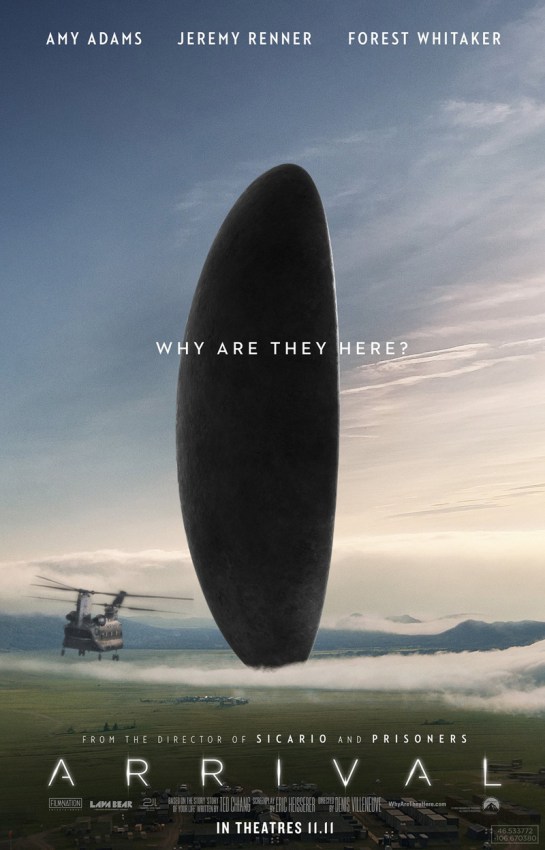
arrival-poster

Although Star Wars will remain the apex of my formative years as a young writer and dreamer, Close Encounters of the Third Kind plays a close second. At the risk of blasphemy, the latter film was significantly superior to the Lucas’ space western, offering insights into humanity and our possible place in the Universe that I couldn’t begin to fathom until later in life.

Such films are rare.

Arrival, which premiered at the Toronto International Film Festival and opened widely this week, is one of those films and is a worthy successor to Close Encounters.

Directed by Denis Villeneuve and written by Eric Heisserer, a man better known for horror films like the reboots of The Thing and A Nightmare on Elm Street, Arrival opens with the arrival of 12 alien space craft—looking a bit like fat Pringles—at strategic positions around the globe.

Almost the entire story is told from the perspectives of linguist Louise Banks (Amy Adams) and physicist Ian Donnelly (Jeremy Renner) and shows their efforts to communicate with the aliens under the watchful eye of military commander Colonel Weber (Forest Whitaker), as scientists and military commands near the other 11 craft attempt the same.

While the trio works to simply comprehend the existence of the aliens, let alone try to communicate with them, the outside world falls apart as fear and a sense of insignificance grasps at the hearts of populations being told largely nothing, feeding the paranoid darkness that resides within all of us.

Without giving key aspects of the story away, the movie deals with broad metaphysical questions about existence and time, while at the same time, providing insights into our species at both its greatest apex and deepest nadir. And at its very base, it encapsulates the importance of trust in our evolution as individuals, as a society and as a species.

arrival-adams-dreyfuss

Amy Adams channels Richard Dreyfuss in her awe at the miracle before her

This is Amy Adams’ movie, and so all of these concepts are displayed through her fears and growth. She must learn to trust her human colleagues. She must learn to trust her alien counterparts, adorably nicknamed Abbott and Costello. And most importantly of all, she must learn to trust herself despite flashes of what seems like madness.

To tie back to Close Encounters, Adams is this movie’s Richard Dreyfuss, and she embues her character with both the same manic trepidation and child-like wonder as Dreyfuss’ Roy Neary.

Renner and Whitaker, for their parts, are incredibly subdued in this film.

Renner’s Donnelly is an emotional anchor for Adams. Coming from the academic world, his tone is at once familiar and playfully combative.

arrival-duo

The photographic focus on Adams is representative of Renner’s role in this film.

Whitaker’s Weber is authoritative and yet unthreatening. He is the calm in the intellectual storm, grounding the two academics for what they are about to witness and becoming increasingly appreciative of the miracle that unfolds before him.

What I found particularly interesting about Heisserer’s story was that the antagonist of the film was Fear.

Fear of the unknown. Fear of mortality. Fear of our own insignificance. And more importantly, our deepest fear that as individuals, we simply don’t measure up.

And breaking the rules of screenwriting, this fear was not embodied in a single antagonist, but in all characters, and it was only in fleeting moments that any individual character acted upon his or her fear. And yet, as fleeting as those moments were, each was vital to the evolution of the story and the critical relationships to their next stages.

arrival-trust

Connection relies on trust

Again, these moments fed back to the question of trust, particularly in the face of betrayal.

To assure everyone that this film isn’t simply a cerebral exercise—although it is beautiful in what it does accomplish—there is also a very deep emotional thread that runs through this movie, again centering on Adams. And from the opening, it seems like this personal journey is completely disconnected from the sci-fi plot.

But as the story unfolds and we begin to explore what is possible in an infinite cosmos, we begin to realize that the external and internal journeys are one and the same. There is no distinction. The line between physical and emotional is an artifact of our choices as humans and society.

arrival-2001-close

Arrival continues the saga that started with 2001: A Space Odyssey and Close Encounters of the Third Kind

Will Arrival be to adolescent minds today what Close Encounters was to mine in 1977?

Probably not.

It is a much more adult film that its predecessor, with many fewer action sequences to engage the eye. And Villeneuve’s views and sensibilities are very different from Steven Spielberg’s.

But Arrival is the closest thing to those seminal films that we have seen in a generation or more. And for the more engaged child or adolescent, it will open a window to another plane of storytelling.

See also:

Movie Review: Arrival (Danny F. Santos)

Amy Adams supplies emotional core of alien invasion film “Arrival” (Richard Crouse, CTV News)

Amy Adams has a sublime word with alien visitors (The Guardian)

Pearls of Writing Wisdom – a review

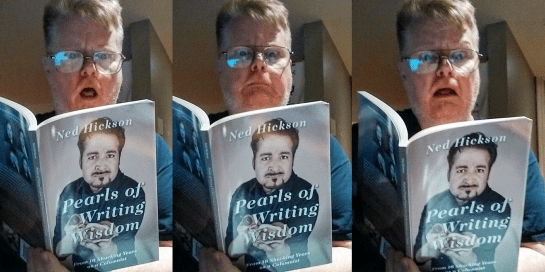
pearls-cover

There is something inside you constantly threatening to explode; an urgent feeling that simply refuses to be ignored. It keeps you from focusing on conversations. It keeps you from sleeping. It tears at the very fabric of your existence.

Now, unless you have recently ordered the taco salad at Chipotle or travelled interstellar space with Sigourney Weaver, these symptoms suggest you might be a writer.

Ned Hickson knows these feelings well, and recounts some of his own experiences in his latest book Pearls of Writing Wisdom: From 16 Shucking Years as a Columnist.

In many ways, the book is a writer’s version of that dreaded conversation between a child and loving parent/teacher about sex…and it’s just as awkward.

In his own nervously jovial way, Ned tries to encourage writers to explore their budding bodies of work and yet caution them about the challenges that lie ahead without scaring (or scarring) them into creative celibacy.

Without photos or illustrations, Ned routinely contextualizes the lessons he is giving with self-deprecating anecdotes—like that time he walked around a mall for four hours before someone mentioned his participle was dangling. The point being (I think) to highlight that even with these personal failings, he still managed to fool people into reading (and paying for) his stuff.

Given the subtitle, I originally expected this book to be a chronicle of things he’d learned in his day job with Oregon’s Siuslaw News, a newspaper for which he is Editor and writes a syndicated humor column.

Nedwork

Ned offers insights on sex…I mean, writing

Instead, I found a book that covered all aspects of writing from understanding the inherent urges to the mechanics of satisfying wordplay to dealing with the social and legal ramifications of your actions…hunh, this really is about sex.

And speaking of sex, Ned’s book isn’t very long (97 pages) but what he accomplishes in those short, floppy pages is quite effective in nurturing new talent, as well as reminding those of us sliding into senescence why we write.

Whether you are a writer or know someone wanting to act on those urges, I highly recommend Pearls of Writing Wisdom as a way to bolster courage and encourage good practices, and maybe laugh a little.


P.S. If Sigourney Weaver happens to read this review, I would happily risk alien infestation to meet you at the Chipotle of your choosing.

sig

See also:

Humor at the Speed of Life (Ned’s blog)

Humor at the Speed of Life (Ned’s other book)

Port Hole Books (Ned’s publisher)

Jason Bourne should have stayed home (review)

bourne poster

Super-assassin Jason Bourne is trying to figure out who he really is. In doing so, he falls into a web of deceit and potentially world-crippling black ops, including the one that gave birth to him. People try to neutralize him…silly people.

Cars race through crowded streets. Shots are fired from every direction. People die just as they start to provide answers. More shots are fired. Bourne gets answers but no real resolution or peace.

If you expected any more from a Jason Bourne movie, then you will be seriously disappointed with the latest installment of the series based the lead character of the novels by Robert Ludlum. In fact, if you want more from a Jason Bourne story, read the novels by Robert Ludlum because they are insanely better than any of the movies.

[Some SPOILERS hereafter]

In the latest installment of the series, Matt Damon’s titular character is brought out of hiding by his former nemesis-turned-ally Nicky Parsons (Julia Stiles), who has hacked into the CIA server and stolen the complete dossiers of the agency’s Black Ops. She wants to turn the information over to a Julian Assange kind of character, but asks for Bourne’s help, enticing him with information about his father’s involvement in his creation as super-killer (think X-Files Fox Mulder).

After a momentary “I’m getting too old for this shit” and some personal sacrifice on the end of a bullet, Bourne is alone again and we are off to the races.

Bourne cast

The CIA Director (Tommy Lee Jones) wants him dead, relying on another super-assassin The Asset (Vincent Cassel) to get the job done, while IT-savvy CIA analyst Heather Lee (Alicia Vikander) sees an opportunity to advance her career and maybe replace her boss by bringing Bourne in. Oh, and in the background, there is something about the CIA having access to the personal information of everyone on the planet via the Internet and a Sergey Brin-like character.

Unless this is your first Jason Bourne movie, you know how this all plays out…and if it is your first Jason Bourne film, why should I spoil it for you?

If you are looking for 123 minutes in which to simply check your brain at the door, then this is an entertaining way to do that. Stuff blows up, people fight, lots of car chases. But nothing really happens that hasn’t happened in the previous movies. Much like a roller coaster, the ride can be exhilarating at moments, but once the ride stops, so does the exhilaration.

And that was my problem with the movie…the thrill is quite literally gone for me. Jason Bourne has become his own cliché, and the writers and directors of this series are simply repeating moments from the other incarnations.

Where they had an opportunity to do something truly interesting with this story—the moments we spend exploring Bourne’s relationship with and confusion about his father—the writer-director Paul Greengrass and writer Christopher Rouse give us the barest taste and scurry back to blowing shit up. Rather than offer any sense of discovery and revelation, they simply have a former agency hack fill in the background under threat of death.

Is toady ex machina a thing?

In the earlier incarnations of this series, I never knew what to expect. In this incarnation, I knew exactly what to expect and it was delivered each and every time with a pretty pink ribbon. Or was that faded red tape?

I’m going back to the books. At least Robert Ludlum knew how to write.

As for shit blowing up, back-stabbing political conspiracy, and disquieting Internet voyeurism, 123 minutes of Jason Bourne just can’t compete with 20 minutes of CNN.

Bourne books

Behold, easily the best of Fringe Toronto

BtB-Subway-Poster-For-Web

I may have to give up comedy writing. Based on the sold-out sketch comedy show I saw last night at Toronto’s Monarch Tavern—part of the annual Fringe Festival—I am a flailing hack or self-deluded pretender.

Brought to us by the disturbed mind of Justin Haigh under the umbrella of Spoon vs. Hammer, Behold, the Barfly is a delightful show that is possibly the most consistently funny sketch comedy performance I have seen in ages, and if its run is limited solely to Toronto Fringe, we all lose out.

Trying not to spoil any of the sketches, let me just say that they are all really solid…even the ones that opened weak only to demonstrate that this was done on purpose. As a comedy fan and writer, I often found myself anticipating the direction of a sketch only to be surprised by a solid twist that never felt manipulative or like a bad M. Night Shyamalan moment.

The casting was amazing, each performer bringing his or her unique absurdity to the performance, and presenting the sketches with such vitality that they almost felt improvised (in the good sense). These are performers comfortable with their material, which is critical for sketch comedy.

Singer

Ned Petrie is the classical Everyman who just wants to be loved (Credit: Laura Dittman)

Ned Petrie is clearly the anchor for this show. He does one delicious take after another on the Everyman, a stoic witness to the world gone mad. Eric Miinch is the clown, doing his damnedest to break up his scene partners with ad libs that enhance rather than disrupt the scenes in which he finds himself.

Elizabeth Anacleto is the shape-shifter, becoming whatever her role requires with mercurial fluidity even when required to shift smoothly within a single sketch. Marsha Mason—whom I should note I know personally—is a talent who can say more with a single facial expression than with the best written dialogue.

Jeff Hanson and Steve Hobbs are mesmerizing on stage, each one bringing an intensity to their performances that cannot be ignored, especially in one particularly disturbing turn by Hobbs. Kevin MacPherson and Sarah Thorpe, meanwhile, ably glue the entire construction together, the former largely coming in from left field at every turn.

If I have one criticism of the show, it is that it completely under-utilizes the amazingly talented women in the cast, the male performers generally taking the most significant roles.

As a male comedy writer, I completely understand the challenge of consciously writing female roles without looking like you’re writing female roles. It is not sufficient to simply lop the penis off a male character.

If Haigh and his team are given the opportunity to remount this show—dear comedy gods, let this be so—I would hope he takes time to tap more deeply the talents of these wonderful women.

In the meantime, if I want to keep writing comedy—because it’s all about me—I am seriously going to have to up my game.

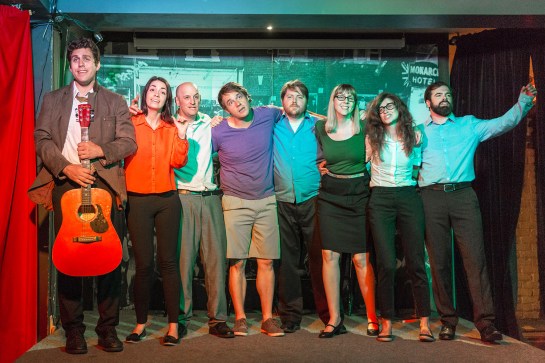
Behold, the Barfly Cast

Seamless casting: (L to R) Hobbs, Thorpe, MacPherson, Miinch, Petrie, Mason, Anacleto, Hanson (Credit: Laura Dittman)

Behold, the Barfly continues at Monarch Tavern until July 10. After that, we can only hope.

When Gods evolve

In the beginning, God created the heaven and the earth.

And the earth was without form, and void; and darkness was upon the face of the deep. And the Spirit of God moved upon the face of the waters.

And God said, Let there be light: and there was light.

Genesis; 1; i-iii

Ancient of Days

Ancient of Days (William Blake)

I know the feeling.

I am the Creator and the Destroyer. I am Fate pulling the strings of Destiny. I am Existence itself. The Void remains until I choose to illuminate it.

A tad full of myself? Perhaps.

But it comes with the territory, because I am a writer.

Despite all present evidence to the contrary, I am an introvert; and as a child, I tended to avoid contact with others out of fear of injury and a touch of self-loathing.

My escape from this fear was my imagination and the worlds I created.

Where the world around me was filled with questions, uncertainty, chaos, the worlds of my mind were clean, certain, orderly. Good was good. Bad was bad…and even bad was good given time and understanding.

And over all of it, I was God.

The world didn’t exist until I put pen to paper, and just as quickly, it blinked out of existence when I lifted that pen.

I am no longer that child—well, perhaps a less fearful child.

The world in which I live is coloured with all shades. It has texture. It has flavour. And while it still has chaos and uncertainty, I am better able to embrace that chaos, to find freedom in uncertainty.

Likewise, the worlds I create have become more nuanced. Nothing is either good or bad, but instead is delicate and needful.

And over all of it, I am God. But even Gods evolve.

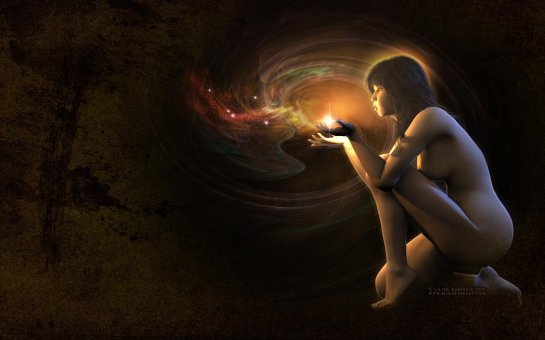
God Creating The Universe

God Creating the Universe (Layne Karkruff)

Where once I enslaved my worlds to my control, I am now more apt to offer degrees of freedom, to allow my worlds to ride the wave of existence.

I completely reserve the right to rain fire and brimstone, but am more likely to use a gentle hand with my charges. What were once caricatures are now sentient beings with a full range of emotions and thoughts, prone to mistake and capable of wonder.

And perhaps, in allowing my worlds to move beyond me, I achieve true Godhead. For as much as I no longer define their existence, they no longer define mine, and I am free to be me.

Ehyeh asher ehyeh.

I am that I am.


NeoHuman podcast, starring me

Willis NeoHuman

My friend Agah Bahari is interested in everything, which is one of the things that I love about him.

Not that long ago, he decided to indulge his interests by starting something he calls the NeoHuman podcast (which matches nicely with his NeoHuman blog), inviting many of the interesting people he knows to discuss pretty much anything that comes up.

Well, seems he ran out of interesting people and so he invited me to participate…and we talked about anything: biotechnology, pharma, global healthcare, designer babies, creativity, writing, screenwriting, 9/11, marketing, and the novel he and I are writing about his life.

But my favourite part is the question he asks all his guest, which is roughly:

If you met an intelligent alien life-form, what would you describe as the greatest human accomplishment and as the worst human accomplishment?

Never boring, my friend Agah.

Agah-me

(Photo stolen with love from Kelly Brienz Showker)

Surprise, but never lie

Roff

I recently saw the following advice from filmmaker and screenwriter Don Roff posted on the Facebook page of the PAGE International Screenwriting Awards:

Always mystify, torture, mislead and surprise the audience as much as possible. — Don Roff

Although I agree with the sentiment, I don’t think it is complete (Note: I was unable to locate the source of the quote to learn if Roff said more on the subject). Thus, I offer the following codicil:

Mislead and surprise, but NEVER lie to your audience. Everything must be possible within the context of the universe you have built in your story. If you lose the trust of the audience, you’ve lost them forever.