Surprise, but never lie

Roff

I recently saw the following advice from filmmaker and screenwriter Don Roff posted on the Facebook page of the PAGE International Screenwriting Awards:

Always mystify, torture, mislead and surprise the audience as much as possible. — Don Roff

Although I agree with the sentiment, I don’t think it is complete (Note: I was unable to locate the source of the quote to learn if Roff said more on the subject). Thus, I offer the following codicil:

Mislead and surprise, but NEVER lie to your audience. Everything must be possible within the context of the universe you have built in your story. If you lose the trust of the audience, you’ve lost them forever.

Pet Park in Peril


SONY DSC

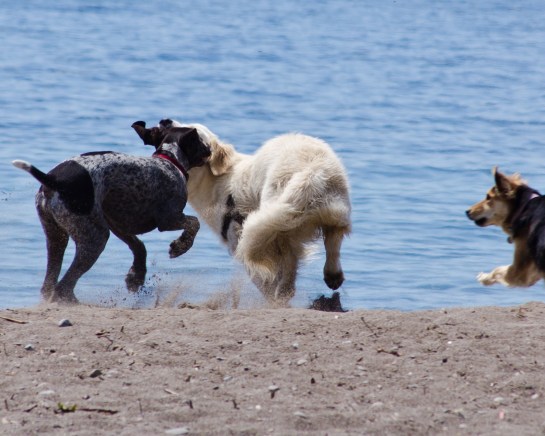
Only chicken wire and wood separate the canines from the under-nines

In what is set to be the battle of the ages, dog owners along Toronto’s Beaches boardwalk are up in arms over an invasion that has them frightened for the safety of their four-legged family members.

A new disease-bearing tick?

Someone leaving poisoned treats?

Marauding coyotes looking for a snack?

Nothing so mundane.

Instead, pet parents are angry that the dog park at the foot of Lee Avenue has been invaded by terrors of the bipedal kind as parents throughout the area have literally unleashed their children within the wood beam and chicken wire compound.

“It’s just not fair,” cries local Peke-a-poo owner Jolene Carpenter. “They have a wooden fortress and wading pool right there in Kew Gardens, and full playgrounds at either end of the boardwalk.”

“How would they like it if we turned their sandboxes into litter boxes?” adds Henry Ratsburg, collie-enthusiast and former cat owner.

As though proving their point, the fence bordering the dog park resembles a sand-covered drive-in as strollers of all sizes, colours and designs sit parked along the fence. Meanwhile, their parental owners relax at the nearby ice cream bar and coffee shop, chatting with other parents while their children run amok beyond the gates.

“I really don’t understand the fuss,” chimes Cyndy Jacobson, mother of two. “My kids need a safe place to run around, and this is the only designated off-leash section of the beach.”

baby_boy_on_leash

Docile when leashed but muscles braced for freedom

Ironically, the dog park, which is actually comprised of an open sandy section and a larger shrub-laden section, was established by the City of Toronto several years ago after many parents in the area complained about dogs littering their waterfront fun.

“It was a total mess out there,” remembers long-time Beaches resident Jackson Brink. “At best, people would just bury the dog droppings in the sand, but it doesn’t take long on a hot summer’s day to realize you’ve parked your beach towel on a fermenting pile left by a mastiff or Great Dane.”

Play time

Frolicking in the sand or burying the evidence?

The park’s transition from canine to kiddie has been a slow but inexorable one that started with delayed summer temperatures last year and parents’ worries about letting their children play in the frigid surf. One by one, as stressed parents discovered the relative calm of the dog park, they began to release their children into its confines.

“The first few actually showed up with both kids and dogs in tow, but they didn’t fool us,” says Carpenter. “Within minutes, you’d see them skulk out of the park with their dogs, the kids nowhere to be found.”

Several residents have demanded the City step in, if only to deal with the potential health and safety risks.

“They bite; they scratch; they’re full of germs. I just don’t feel that my babies are safe in there,” complains Ratsburg, anxiously stroking the fur of his tri-colour collies.

Rebel lake

Ratsburg and friend in better days

Nobody from the City of Toronto was willing to go on the record, but one unnamed source suggests there is little the City can do given the way current bylaws are written.

“All we can do is caution people to make sure their little ones have all their shots and don’t get trampled,” the source suggests. “Residents with children might want to do the same.”

Nudes and Nature

Debbie Boostrom

If ever there was a campaign for “Milk, it does the body good”

A thousand years ago, when I was a much younger man, I found myself in possession of an issue of Playboy, where I discovered a lovely young woman named Debbie Boostrom.

I was smitten (let’s agree to leave it at that).

I remember sharing my discovery of Ms. Boostrom with some school friends at a hockey rink (where all good Canadian things happen). And at some point, as we admired her physique, I found myself saying aloud:

“Man, can you imagine what she looks like in a bathing suit!”

That my friends chose to remain my friends is a testament to their patience…or possibly to their respective inabilities to make friends.

In any event, I too joined them in shock at the idea that it would be good to alter such loveliness…and especially cover it.

Well, a thousand years later, I find myself in similar shock, but less with nudes than with nature.

Recently, on the way to a hockey game (see what I mean), I took an amazing photograph of a sparrow in a thorn bush.

SONY DSC

Given my fascination with nature, my initial inclination is to focus in on the bird, but in this case, I decided to keep the image relatively wide, the bird blending in beautifully with its surroundings.

I was smitten (let’s agree to leave it at that).

As I was discussing the photo with a friend earlier today, I commented that the photo would make a great painting. If I put a wash over it, it might look like something wildlife artist Robert Bateman would paint.

Batemix

Just assumed Bateman was born on a foggy day

Hunh.

Yet again, I want to take something I smit (that’s a word, right?) for its natural beauty and alter it…even cover it. Such delicate detail and I want to blur the lines.

Maybe this is some deep-seated desire to mar the things I love to spare myself the pain of inevitable rejection…although Ms. Boostrom has reportedly passed on and there must be 439 other sparrows in that ruddy bush.

Perhaps I am a closeted Puritan who believes there is evil in anything that brings pleasure. Nah, my love of hockey and bacon, and my Jabba the Hutt-like lair (and body structure) suggest otherwise.

Or maybe I’ve stumbled onto a hybrid art form.

Yes, you too can Batemanize your family portraits!

I don’t know…maybe I’m just weird. I should go to the rink and think about this some more.

To wash or not to wash?

Auto(populate)bots Assemble!

robot-n-women

Reports suggest that within the next two decades, robots will take responsibility for upward of 50% of jobs currently handled by humans, who simply remain inefficient and cannot work 24 hours a day.

Already, we are seeing automation in manufacturing and order-entry kiosks in the services industry. It is assumed the next stage will involve a complete takeover of the social media industry, with timelines auto-filled by trivia and rumour bots.

This post brought to you by the Xorblat 3-11A

Photo stolen without permission from The Robot State blog.

For a legitimate discussion of such topics, check out The NeoHuman Blog.

Malnourished with malinformation

KnowledgeI’d argue that any amount of knowledge is a good thing. It is a little bit of information that is likely to trip you up.

As many of you know, I am a science and medicine writer in another life—the more lucrative one, but that’s not saying much—and so I spend many of my days immersed in the worlds of scientific and medical discoveries and blundering. I even spent several years working at a biochemistry bench as a scientist—you may genuflect, now—so I know the world of which I speak.

For this reason, I tend to view science and medicine as a work-in-progress, as so much noise with moments of signal. Rarely do I herald the hype and equally rarely do I despair the bumps.

To my friends who see every announcement as a breakthrough, I am a cynic. And likewise, to everyone who pounces on every setback as evidence of mass conspiracy, I am a complicit shill. Whatever.

The challenge comes when I engage in a discussion of the topic du jour, because more often than not, the person with whom I am talking is adamant that he or she knows the truth. They are empowered by something they have heard or read from a renown expert. They have information.

(Let me state here that I do not believe that I am the holder of all truths. I do feel, however, that I have a good handle on what I do not know, and just as importantly, what is not yet known for certain.)

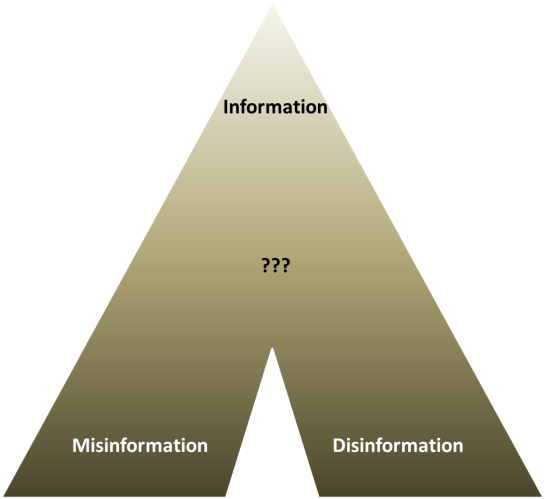
So, let’s start with some definitions (purely mine) of information types:

Information: A collection of facts about a subject upon which someone can formulate a testable theory or postulate a conjecture.

Misinformation: Incorrect declarations that potentially lead one to false conclusions.

Disinformation: Knowingly false declarations for the purposes of misleading another group (e.g., counter-espionage, propaganda).

information triangle

I suggest, however, that we need another category to address the shade of grey between the positives of information and the negatives of mis- and disinformation.

Following the model of nutrition versus starvation, I propose we call this new category malinformation, with the following definition:

Malinformation: A collection of facts that, while true, is insufficient to formulate a definitive conclusion without the support of further facts.

Just as a malnourished person is not starving, but rather suffers the effects of an insufficient blend and quantity of nutrients to experience balanced health, a malinformed individual is not wrong per se, but rather suffers the effects of an insufficient blend and quantity of facts to experience balanced knowledge and understanding.

For example, people who change their eating habits because they read about a single study that showed a specific food extract reduced tumour size in mice. Or a clinician who has created a behavioural modification program to reduce addiction based on a thought exercise using largely unrelated studies.

Any of these decisions are based on legitimate data from legitimate studies, but often ignore (or simply don’t look for) alternative and/or possibly conflicting data from equally legitimate studies. Rather than analyze all available data before generating a theory, they find the malinformation that supports their beliefs and then stop; a little bit of data being taken to conclusions that simply are not supported.

Boom-bust

Maybe they’re right. But more likely, it is much more complicated.

In conversation, I find the malinformed much more intractable than the ill-informed. With the latter, there is a chance you can correct the misinformation. With the former, however, the mere fact that the malinformation is correct seems to be sufficient cause for them to defend the castle they have built in the sky. When you “yes, but” them, all they tend to hear is the “yes”.

In fairness, all information is technically malinformation as we will never have access to the complete knowledge of the universe. We are always going to be forced to make decisions based on limited knowledge.

But where more knowledge is available, I think there is duty to examine and understand it before becoming intractable in our positions.

If there is a newspaper article about a new scientific discovery, efforts should be made to learn more about the limitations of the science that led to the discovery. How far can you realistically extrapolate from those few data points?

In biomedical research, that which occurs in a mouse is, at best, a clue to what might happen in a human. Nothing more.

It could lead to the next step in scientific inquiry—the actual purpose of science—or to a dead end.

Belief is nice, but unless that belief is well founded on broad and balanced information, it is limiting and might be dangerous.

(Or at least, as far as I know based on my understanding of the available information.)

Toronto Marlies crunch Syracuse

As the New Year arrived, my beloved Toronto Marlies played host to their cross-border rivals Syracuse Crunch.

The New York team is well named, with a history of pounding their opponents physically if not always on the scoreboard…and the local boys were ready to give as good as they got.

Saturday, January 2: Toronto 3 – Syracuse 2 (YouTube highlights)

Sunday, January 3: Toronto 3 – Syracuse 2 (OT) (YouTube highlights)

The hard-hitting series sets up an interesting three-quel when Syracuse visits Toronto’s Ricoh Coliseum yet again on Wednesday, January 20.

Substance over volume

ddnews

When you meet someone who does not speak your language, there is a cliché response of talking louder to make yourself understood. There is something within many of us that says if we simply pump up the volume, we can overcome the disconnect.

A couple of months ago, Tufts University released their latest estimates for the average cost of developing a new drug: $2.6 billion (I’ve seen estimates up to $5 billion). Eleven years ago, the same group calculated the costs at $0.8 billion.

Now, every time these estimates arise, the hand-wringing begins over how the costs were calculated, which factors make sense and which are over-reaching. What no one seems to argue, however, is that drugs are less expensive to develop today than they were a decade ago.

So what has this to do with speaking louder?

The same period has seen amazing technological achievements designed to facilitate and accelerate drug discovery and development.

Combinatorial chemistry was heralded as a way to expand compound libraries from hundreds to hundreds of thousands. High-throughput and high-content screening, as well as miniaturization and automation, were lauded as ways to screen all of these compounds faster under the paradigm of “fail early, fail often”. And given the masses of data these technologies would churn out, the informatics revolution was supposed to convert data into knowledge and knowledge into healthcare.

And yet, for all of these improvements in throughput, I question whether we have seen much improvement in the number or quality of drugs being produced. We certainly haven’t made them less expensive.

Please understand, I don’t place any fault in the technologies. These are truly marvels of engineering. Rather, I question the applications and expectations of the technologies.

Almost two years ago, GSK CEO Andrew Witty told a London healthcare conference: “It’s entirely achievable that we can improve the efficiency of the industry and pass that forward in terms of reduced prices.”

The pivotal question here, I believe, is how one defines efficiency.

I wonder how many people simply felt economies-of-scale would improve discovery, much as mass production made Henry Ford a rich man. But drugs are not cars, and where throughput and scale make sense when you have a fully characterized end product, they have their limitations during exploration.

When I was a protein biochemist in an NMR structural biology lab, I spent some time trying to wrap my head around two concepts: precision and accuracy. A 3-Å protein structure is very precise but if the structure isn’t truly reflective of what happens in nature, it is meaningless. A 30-Å protein structure is much less precise, but if it is more accurate, more in tune with nature, then it is likely more useful.

By comparison, I wonder if our zeal to equate efficiency with throughput hasn’t improved our precision at the cost of our accuracy. If you ask the wrong question, all of the throughput in the world won’t get you closer to the right answer.

In researching the DDNews Special Reports over the last couple of years, I have spoken at length to several pharma and biotech specialists about this topic, and many feel that the industrialization of drug discovery and development has underwhelmed if not outright failed. Several have suggested it is time to step back and learn to ask better questions of our technologies.

But getting back to the costs issue.

I know many will rightly point out that the largest expense comes from clinical trials. To address this challenge, new technologies and methodologies are being developed to get the most useful information out of the smallest patient populations.

Here again, however, no one segment of the drug development process stands in isolation, and I think back to the compounds reaching the clinic and question the expense of incremental improvements.

Oncolytics CEO Brad Thompson discussed the challenge in Cancer in the Clinic (June 2014 DDNews).

“If you could double [overall survival], you could show that in a couple of hundred patients. If you want to do a 10-percent improvement, you’re talking thousands of patients to do it to the statistical level that everybody would prefer to see. How do you run a study like that?”

That is a huge difference in financial expenditure that begs the question is an efficacy improvement of just 10 percent of value.

From an individual patient perspective, assuredly. From a pharmacoeconomic perspective, maybe not, and particularly with the growing prevalence of high-cost targeted biologics. Maybe we need to aim for bigger improvements before moving candidates forward, which happens long before the clinic.

Again, I’m not placing blame. The history of any industry is filled with experimentation in different methodologies and technologies. Everyone involved had the best of intentions.

But after a couple of decades of middling results, perhaps it is time to question how and when many of these advancements are applied. Simply yelling at a higher volume doesn’t seem to be enough.

[This piece was originally published in the January 2015 issue of DDNews. A lot has happened in the year since, including some amazing results in the field of immuno-oncology that might just address the demand for high-performance treatments even if only for a select patient population. For more on that, see my June 2015 Special Report “Body, heal thyself”.]

Movie memories for 2015

Posters_1

For a guy trying to make it as a screenwriter, it takes a lot for me to go out and pay to watch a movie. I think it’s, at least in part, because I don’t deal well with disappointment and particularly when I’ve had to pay for it.

Luckily, my friends had some luck dragging me out of the house this year, so below, I offer one-line critiques of the various films I saw in theatres (with hyperlinks to longer reviews I’ve written).

Taken 3: When the hell did I see this, and more importantly, why?

Paddington: Charming and a lot of fun.

Kingsman: A rollicking good time.

It Follows: It bores me

Ex Machina: Oh My Deus, was this written by a robot devoid of emotions?

Age of Ultron: Miss a movie, lose a thread; think I am out of this series.

Mad Max Fury Road: You will believe a man can drive…that is all.

Inside Out: Underwhelmed, but appreciate I am only one.

Self/Less: Flawed but interesting

Posters_2

Trainwreck: Not one, but Schumer can do better

Ant-Man: Most fun I’d had all year…Rudd is perfect for this

Man from UNCLE: Stylish throwback that I liked more than most people did

The Martian: Surprise hit for me; kudos to all including author of book

Steve Jobs: A metaphor for dysfunction…and sadly, not in a good way

In the Heart of the Sea: More like in the heart of my sleep

Star Wars The Force Awakens: Visually stunning, overly sentimental, disappointingly regurgitated story

Spectre: Good movie with a stupid ending…am I outgrowing Bond?

Posters_3