Lessons from bad movies – The Canyons

canyons poster

I believe that you can learn something from every experience you have, and because I am trying to learn more about screenwriting and films, this means watching bad movies. Thus, I was intrigued when I saw Netflix was showing a film called The Canyons.

Written by Bret Easton Ellis (American Psycho) and starring Lindsay Lohan and porn-star-going-legit James Deen, The Canyons shows the decay of Hollywood through the eyes of a struggling young actor who is still in love with his former girlfriend who is now the adornment of an unbalanced but oh-so-controlled producer on a trust fund. Paranoid from birth, the producer eventually learns of rekindled flames between the two and slowly his self-control ebbs. To tell you more would be to spoil the (complete lack of) surprise in this film.

Although the story was straightforward and highly predictable, I have to admit to being confused by one very big thing: I don’t know who the protagonist is. Through whose eyes is the audience supposed to see this story?

Lindsay Lohan’s Tara (the girlfriend) shares almost equal screen time with James Deen’s Christian (producer) and Nolan Gerard Funk’s Ryan (actor), and the story’s perspective seems to shift on a whim. If I go purely by a scale of which character left me feeling least icky in their behaviour, I would have to say Ryan was the protagonist. But he feels more like an unwitting pawn in this film.

Interestingly, however, if I was forced onto a limb, I would actually say Christian was the protagonist despite his antagonist schtick. As a character, he is reminiscent of American Psycho’s Patrick Bateman…possibly his baby brother…although there is no comparison between Christian Bale’s performance and James Deen’s.

Speaking of which, the wooden performances of the actors don’t help my quest for a protagonist. (At her best, Lohan’s glamour-gone-gory Tara was reminiscent of Ann-Margret’s characters in Carnal Knowledge and Tommy at their most strung out.) Without distinct emotive clues and any sense of subtext, I really have no clue what any of the characters hopes to accomplish…there simply aren’t any goals, again with the possible exception of Ryan.

Lohan-Margret

To continue piling on, I would be intrigued to find out what kind of movie director Paul Schrader thought he was making.

On the one hand, with rampant over-use of black & white images of derelict movie houses, it seemed Schrader was going for art-house film, using the photographic decay as a metaphor for the social decay of Hollywood (this is the man who wrote Taxi Driver and directed American Gigolo).

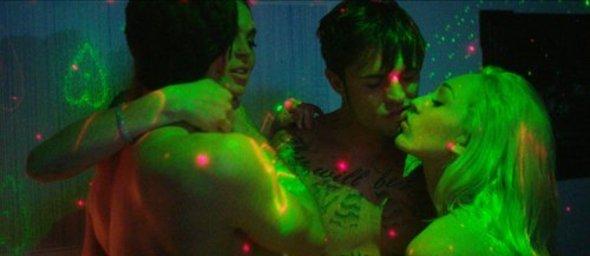
At the same time, his rampant insertion of lengthy scenes of graphic sex gave the film a B-movie, soft-core porn feel. Here, Schrader may have been going for a moral decadence metaphor, but if so, I think he failed terribly. Instead, we were left with a humping morass of buttocks and breasts that a 13-year-old boy couldn’t be bothered to whack off to.
the-canyons-04_article

But the one scene that truly grabbed my attention was a lunch conversation between Tara and Christian’s assistant Gina, played by Amanda Brooks. What caught my attention, however, was not the scintillating or captivating dialogue (there wasn’t any) or the repressed subtextual exchanges (they were incapable) but rather the fact that even the camera was unable to pay attention to the scene.

On either close up, the camera angle perpetually slid to the left or the right, and sometimes back again. Not panned to capture a background element. Slid, as if someone had forgotten to tighten the flange that holds the camera to the tripod. The camera literally nodded off.

So then, if this movie was so bad, how could I learn a lesson?

The lesson of The Canyons is that if you can get an actor of sufficient name recognition who is trying to prove something (e.g., I’m not washed up) interested in your script, you can get anything made.


Postscript:

As I looked up some background facts on this movie, I learned that The Canyons was the first film to be largely funded via crowd-sourcing. Given the performance of subsequent crowd-sourced films like Zach Braff’s Wish I Was Here (poor) and Kristen Bell’s Veronica Mars (modest), I am beginning to wonder if there isn’t some merit in studios having some influence on whether and how a film gets made.
Writing for puppets

Monty meets Muppets!

Monty meets Muppets!

As some of you may know, I am one of the comedy writers for a sketch show called SomeTV!, which is currently in production in Toronto. As our godhead Nic likes to describe it, the show takes the no-sacred-cows approach of Monty Python’s Flying Circus and combines it with the playful anarchy of The Muppet Show (no hubris here, eh?).

Now, for some, that may sound like the greatest writing gig ever. Those some have clearly never written for puppets.

Human actors—or as we call them, Fleshies—can be tricky enough to deal with. Prone to completely misunderstanding the point of a scene or sketch, they tend to have difficulty learning lines that make no sense to them.

Luckily, their natural insecurity, despite the outward facing ego, means that they can be molded into subservience, if only in two- to five-minute chunks, the longest most are willing to go without checking their make-up or cell phones for calls from their managers.

At their core, Fleshies are the rhesus monkeys of the performance world, clinging to each other for some semblance of affection but ultimately willing to give that up for warmth and sustenance.

Not so puppet actors, aka the Felts or Felties.

Flesh v Felt

These are the apex predators of the performance world and should always be treated as such. Sure, they look cute and cuddly, with their giant heads, bulging eyes and disarming colours, but that’s exactly what they want you to think.

You don’t write for Felties so much as start a sentence that is perpetually interrupted with ideas or lines the bastards think are smarter, funnier, crazier.

Fleshies forget their lines because they’re not too bright…Felties “forget” because they are malicious egotists.

Adding to the challenge is the near-impossibility of figuring out a Feltie. He, she or it is the poster-child for multiple personality disorder.

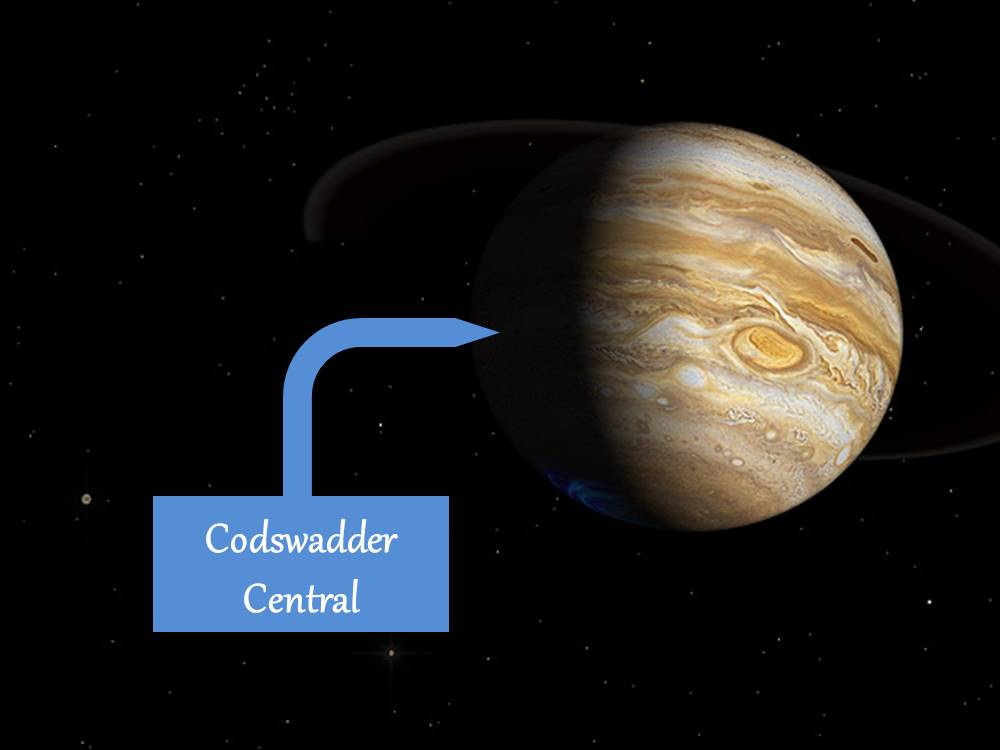
You think you’re writing a scene for a young Spanish girl, when out of nowhere a tall Jovian Codswadder shows up to take the scene in an entirely new direction. (To this day, the only thing I know about Codswadders is they come from Jupiter, where given the crushing gravity, their height makes no sense.)

Not the home of young Spanish girls

NOT the home of young Spanish girls

It’s like dealing with someone with hyperactive comedic Tourettes, and trust me, I’ve taken enough improv classes in Toronto to know what that looks like.

Felties are also astoundingly lazy creatures. Sure, they look frenetic on the television screens, but in reality, these buggers will literally not lift a finger without someone doing it for them. Our show has an entire team of Feltie fluffers whose entire job is to see to the every-last needs of these freaks. We’re talking major OCD: obsessive-compulsive demands.

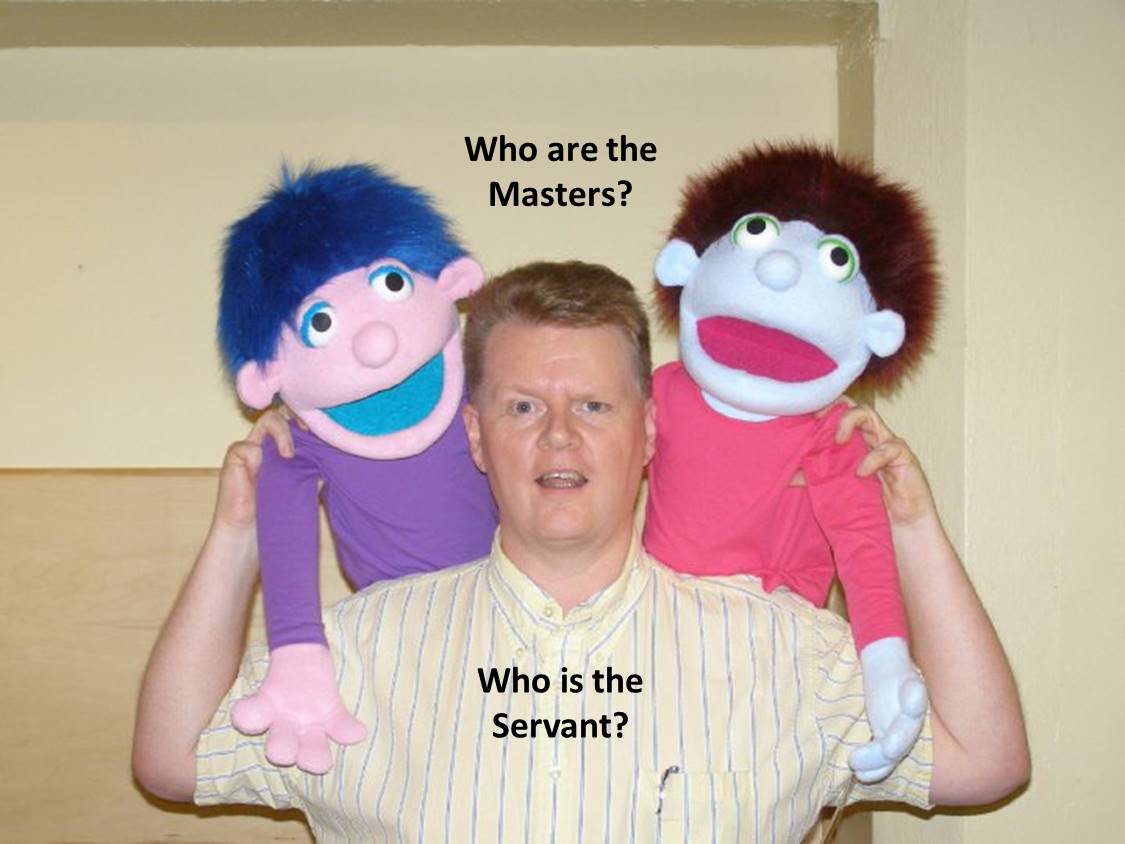
Trust me, the dictionary writers of the world have the concept of “puppet master” completely backwards.

Masterclass

To be fair, the Felties do sometimes come up with lines that are funnier than the stuff I wrote. But on the flip side, they get away with lines that no intelligent Fleshie could ever hope to pull off.

This has two impacts: 1) the Feltie doesn’t have to try very hard to get a laugh, and 2) they can be as crude, rude and insulting as they want, knowing everyone just thinks “awwww, how cute”.

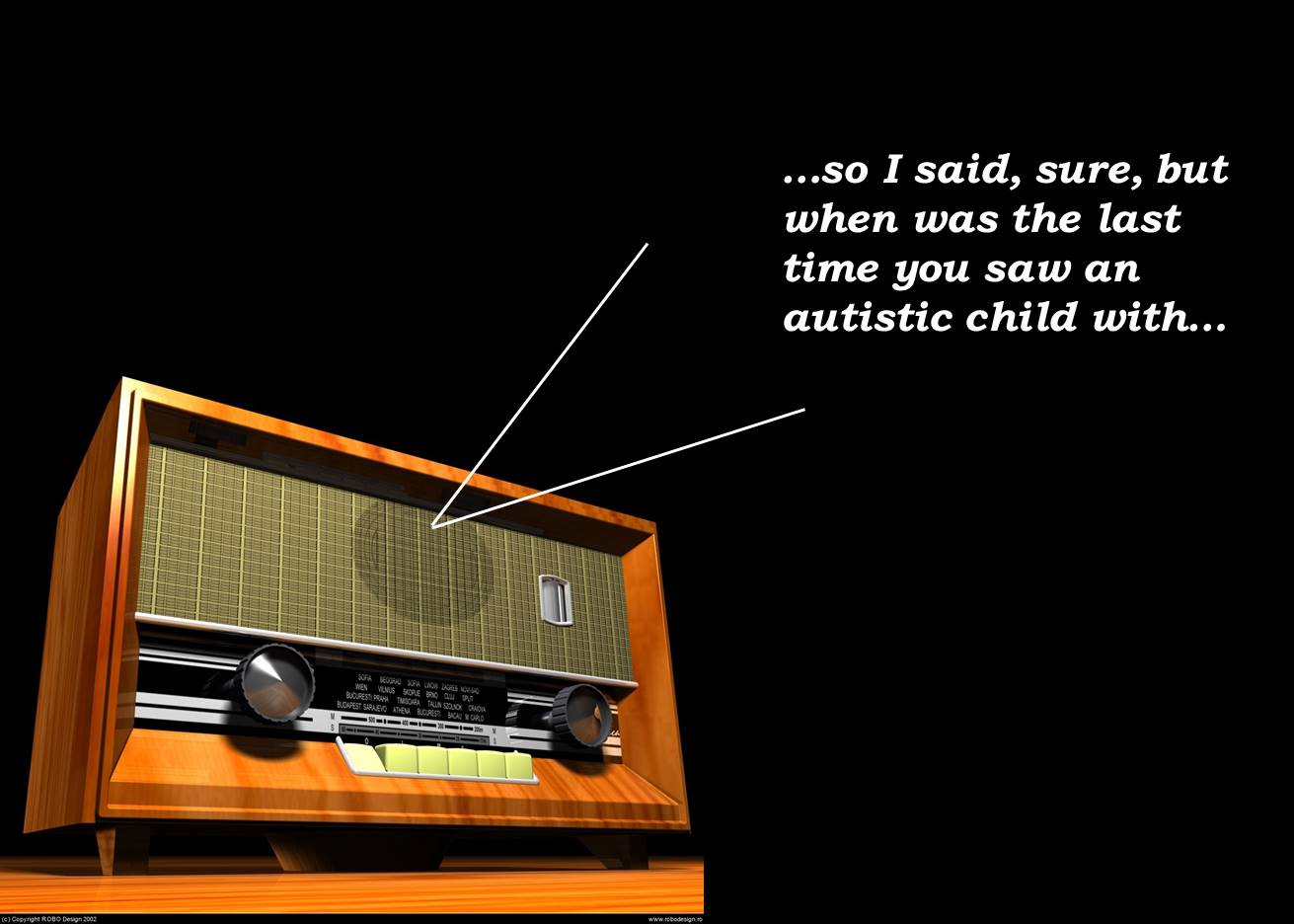
There’s a reason you don’t hear a lot of puppet radio programs…the shit they come up with is repugnant.

NPR = Nasty Puppet Radio

NPR = Nasty Puppet Radio

So, why do I stay? Why do I continue to write for these self-glorified hand-warmers?

Most days, I don’t know.

But then the rent comes due and I realize that my best chances at succeeding as a “comedy writer” is to have my words (or some semblance thereof) come out of a Feltie’s mouth…and those lint-sucking leeches know it, too.


SomeTV! is being produced by Lemon Productions Inc.

Like us on Facebook: SomeTV!Lemon Productions Inc.

Follow us on Twitter: @SomeTVNews

Cadence and Orson Welles

My favourite shot of Welles as I believe that smile and those eyes tell me everything I need to know about the man

My favourite shot of Welles as I believe that smile and those eyes tell me everything I need to know about the man

Being a good writer necessitates having a good eye and a good ear.

The good eye is the attention to details that will help you paint a word-picture of what you have seen with your physical eyes and processed in your mind’s eye. It’s not necessarily about writing long-winded passages of backgrounds or going into minute detail of a character’s physical attributes (I’ve done plenty of that), but rather in choosing the most precise and meaningful words to describe the environment or the person.

The good ear is the attention to how people communication and how they speak, not always the same thing. Again, it involves finding the right words and inflections (at least implied inflections) that give the reader and actor clues as to who this person is. And perhaps just as importantly, it is about finding just the right cadence for your character’s speech patterns.

If you listen really closely to a conversation, you’ll realize that there is little difference between speaking and singing. There is a rhythm, a cadence to speaking. Conversation is an improvised duet sung a capella. But unlike a traditional song which may have a subset of arrangements, each of us sings to our own tune, with our own rhythms and inflections. It is one of the many things that sets us apart from each other.

When writing characters, it is important to keep this in mind as all too often, a group of characters can have a certain monotone, which I use not to imply flatness so much as sameness. Often, I believe, it occurs when the writer neglects to add variety to his characters’ speech patterns and instead writes them with one voice; his or hers.

The best writers don’t make this mistake…or at least minimize its occurrences. Each character he or she presents us is truly unique, jumps off the page or screen, provides his or her own internal musical accompaniment.

One of my favourite writers of the last decade or so is Aaron Sorkin whose overall writing has its cadence but whose characters also tango (or more often tarantella) across the screen. Read the pilot to The West Wing or the screenplay for The Social Network and you will know you’re reading Sorkin.

But for me, perhaps a better example is Orson Welles, the man who would be Kane.

Recently, someone discovered a long-lost unproduced screenplay by Welles called The Way to Santiago, written in 1940-41. Another blogger discussed the find recently, and provided a link to the actual screenplay (see link below). You only have to read a couple of pages to remind yourself (or educate yourself on) how Orson Welles wrote and the energies he imbued in his characters, each one a snowflake of facets and reflections.

The opening page of The Way to Santiago

The opening page of The Way to Santiago

Now, listen to the films or read the screenplays of The Third Man, The Magnificent Ambersons, Touch of Evil. Although you may question the choice of actors, you can clearly hear or see the distinctions in the characters. Bathe in the richness and depth of each one as he or she is captured for this brief moment. This is the stuff of which dreams are made.

It is also interesting to consider that Welles got his start on stage and in radio, where the human voice plays such a larger role in conveying a story than it does in film. There is much less to occupy the mind onstage or in radio and so dialogue carries a significant burden of not only informing but also entrancing the listener.

Although the stories I write are distinctly different from the Wellesian oeuvre, there is much I can and do learn from this master of the written word. He is worth the read and the listen.

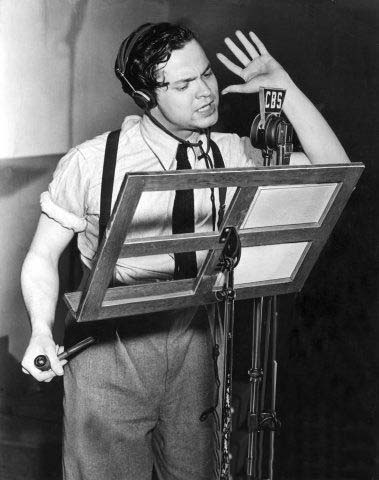
A classic image of Welles in his radio days

A classic image of Welles in his radio days

Links of interest:

The Way to Santiago at Cinephilia and Beyond

The Way to Santiago, starring Howard Hesseman on Vimeo (A valiant but not brilliant attempt)

“Thank You, Mr. Welles: Definitive actor, consummate director, and true auteur” at Curnblog.com

“Screenplays by Orson Welles” (listing) on Wikipedia

Me and Orson Welles A light but adorable movie that probably portrays Welles’ character better than Welles

For my friend Emma

…and all my other female actor friends and colleagues, a simple request to storytellers and writers:

When creating a female character for your story (or any character, for that matter), please describe her in terms that reflect who she is and not in terms of how she relates to another.

Image

Phrases like ex-girlfriend or soccer mom provide only a limited degree of context and tell us nothing at all about your vision for that character.

Is she a psychotic Glen Close type of character or is she a nurturing Barbara Billingsley type of character?

To what does she aspire?

If presented with a spider, she would [fill in the blank].

Around a board room table, her position would be [location], she would be dressed [adjective], her posture would be [adjective] and her eyes would express [noun].

If the character is important enough to move your story along, the character is important enough to be a human being (or whatever species you are dealing with).

If not, then you probably don’t need the character in your story.

Unpacking baggage – Part Two

In Part One, I discussed the idea that to understand any characters you create and to make them more alive to your audience, you need to understand their baggage, the emotional and psychological events of their past that informs/moulds their behaviours and responses today. Today, I want to talk about making sure you let your audience in on the cosmic joke.

A couple years ago, I wrote a pilot episode for a new sitcom that I was developing—and still am; oh producers, where are’t thou?—and I asked my long suffering wife to read the teleplay.

My concern, I explained, was that of the four main characters, I didn’t feel I had a handle on three. The protagonist I nailed—knew him inside and out—but the other three seemed a little superficial. I wanted a second opinion, though, in case I was just being hard on myself.

Upon reading the script, she asked me a question. [SIDEBAR: Keep all friends who ask questions before offering opinions.]

Which of the four characters did I think I was most like? The protagonist, hands down. She smiled.

Based on her single reading without any background information, she proceeded to describe the other three characters in the script. And nailed them! She matched almost perfectly what I had had in mind for them.

But as was her wont—never in a malicious way—she then burst my bubble by telling me that she had almost no clue as to who the protagonist was, other than he was very similar to me. Without the benefit of 10 years of marriage, the protagonist was a black box. A name followed by narrative action or dialogue.

We walked through scenes and I explained motivations. My explanations made sense to her, but they weren’t on the page. My protagonist was so close to me that it never occurred to me that things weren’t obvious.

More recently, I’ve had the pleasure of reading other people’s developing screenplays, and very often, one of the problems I find as a reader is that I don’t have a clear vision of a character’s motivations in a scene. Why did they do what they did, say what they said?

One fellow student in particular I pressed for explanations about some characters in her otherwise amazing script (which horrified the bejeezus out of me btw). She waxed eloquent on her characters’ motivations and histories, offering amazing little vignettes from their pasts that helped explain why her characters were now behaving as they were.

But it wasn’t on the page!

Before I go further, this is NOT a call for more flashbacks (or cowbells). I am addicted to flashbacks, so I understand their power. Please avoid unless it is really there to move your plot along and not just a underhanded form of exposition designed to keep you from having to learn how to write subtext.

My recommendation to my friend, and something I will do on occasion, is to actually write out those vignettes, full narrative and dialogue, but only for myself and not for inclusion with the screenplay. Don’t just think about them, though. Actively write them out. For it is the act of writing that you will find the emotion of the scene, and it is that emotion that will provide the subtext of your screenplay.

That emotion will inform your dialogue and narrative word choice. That emotion will mould the flow and cadence of your dialogue (e.g., short, terse response vs. raving diatribe). It will also help inform how other characters will respond.

As I have experienced, having this information in my head makes it an intellectual exercise, with all of the cold aloofness that goes with it. But putting it on paper forces you to acknowledge and release those demons. It activates your lizard brain, as another friend of mine liked to call it. It is more visceral, more real.

It also has the added benefit of giving you something back to which you can refer when working on the story after six months of doing something else.

When someone reads your work or an actor performs it, you want to make it as easy as possible for them to get your characters, to understand the turmoil in which your characters function. Except at the highest levels of your story, do not ask your audience to think. It takes them out of the story.

You want them to feel the anger; the amusement; the sadness. If your protagonist is being oppressed, you want your audience to feel angry at the mistreatment, frustrated by the inability to change what is happening, and vindicated/exhilarated when your protagonist triumphs.

They can think on the way home from the theatre or after they close the back cover of the book.

If it is not on the page, none of this will happen. You audience will not engage and your story will suffer.

Sure, it sounds like extra work—it is!—but you’ve already invested this much time and effort on your story. Do you really want to risk that being all for nought because you’re the only one who gets why this story is important?

Who is this man and what is he thinking? What is he waiting for? If he looked at me, would I see boredom, anger, fear, joy?

Image

(Taken in Tofino, British Columbia.)

Shoot where the goalie isn’t

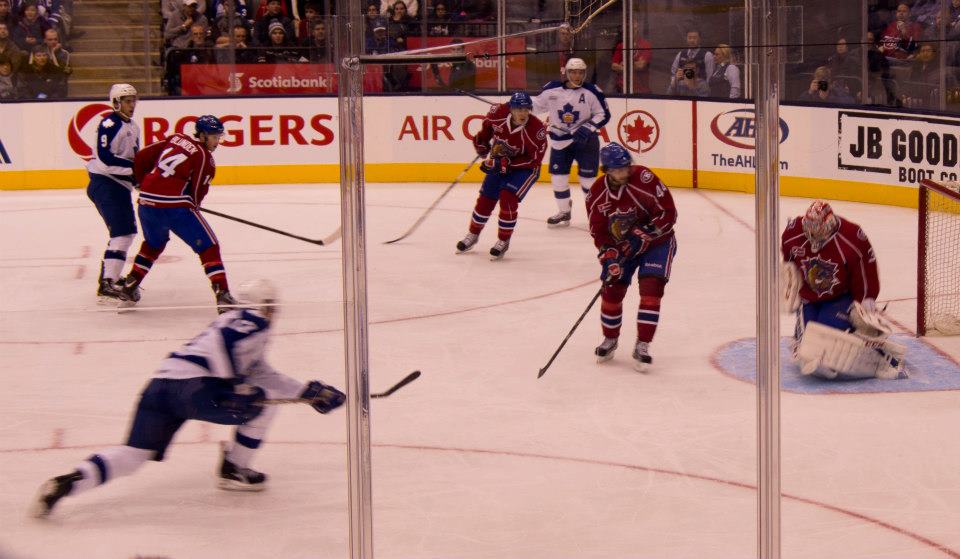
I’ve spent a lot of time in ice rinks watching beer-league and kids hockey and one thing that has amazed me is how often players will shoot the puck into the goalie’s chest. We all know that the object of the game is to get the puck past the goalie, but for whatever reason, our shot is drawn to the goalie rather than to the net. It is as though the goalie secretly inserted a small metal bar in the puck before the game and is now wearing a strong magnet under his or her pads.

Image


(American Hockey League; Toronto Marlies vs. Hamilton Bulldogs)

I’ve also decided that on a typical office trash can, the rim of the can generates a gravitational well. I say this because, no matter how often I throw a wad of paper into the can, from whatever angle or distance, I am more likely to hit the rim of the can than I am to sink the shot or miss completely. Something must bend space because if you look at the volume of the universe taken up by the rim and compare that to the rest of the frickin’ universe, it doesn’t make sense that I would hit the rim so often.

Of course, another explanation for both of these phenomena is that humans have an instinctive fetish for what we can see; that we are unconsciously drawn to the tangible to the detriment of the intangible.

The reason I wax on about this is because I believe what is true for trash cans and hockey games is also true for creativity.

After rehearsals for a sketch comedy show for which I write, I was drinking with some of the actors and one of them asked me how I came up the ideas for my sketches. How did I take a relatively mundane scenario and find just the right moment and way to skew it to elicit humour?

For me, I said, it’s about perspective and being able to ignore the hard edges of reality to see relationships no one else has bothered to see.

Image


(Photo taken in Barbados)

Too many of us get hung up on what we see, what sits before us in all its light-reflecting, retina-stimulating glory. We see reality and get stuck on that being simply what is. Reality just is. There’s nothing else other than it.

Sitting across from her, I described the wide-eyed reality I saw.

In the foreground was sugar packets, salt and pepper shakers, the table, my beer glass, her beer glass. Slightly behind that was her, the barely restrained frenzy of her hair, her facial expression, the curve of her neck, shoulders and arms, her clothes. Behind her, a table of four animated people sharing a night out (won’t go into details) and behind them, a window onto a busy Toronto street; sidewalks, pedestrians, traffic, storefronts.

I then squinted my eyes and all those hard edges faded away to be replaced with a visual melange. I could not tell where my friend ended and the woman behind her started. Vague shapes of pedestrians blebbed out of her head, like animated thoughts or alter-egos escaping into the night.

Image


(Photo of a fountain on Toronto’s Canadian National Exhibition grounds)

My perspective had changed, so my reality had changed. I no longer saw a goalie blocking my shot or a trash can rim siphoning wads of paper from the vaster universe.

However it is accomplished, I think this is what separates open creatives from the rest of humanity, and by creatives, I mean not just artists (writers, painters, photographers, etc) but also entrepreneurs and technology innovators. They understand the lowercase nature of realities rather than Reality.

The altered perspectives are there for anyone to see—and everyone’s perspectives are going to be different—but it is the creatives who choose to look for them. We can see where the goalie isn’t and choose to shoot there.

Image

(The Toronto Marlies beat the Hamilton Bulldogs at Toronto’s Air Canada Centre)


Words in other people’s mouths

I’m not an actor. I cannot act. Actually, that’s not exactly true.

I am an extreme introvert who has learned to live (and thrive) within an extremely extroverted world, so I can technically act aka hide my true identity behind a false façade.

But what I mean by acting is the theatrical form. Give me lines to memorize and my brain fries in mere seconds. I can say the line, I can emote or I can move my body across the stage…ask me to do any two of those at the same time, however, and we have issues.

I can do improvisation. I love improvisation.

The thrill of trying not to anticipate what your stage partners are going to do but instead simply react to what they have done and add to the reality of the situation is an adrenaline high of which I cannot get enough.

And the typical improv audience is a forgiving lot because they know you’re making this up before their very eyes. In fact, they will actually ask you how you prepare for an improv show and sit amazed when you tell them that you arrive at the venue slightly earlier than they did.

But even improv has its self-imposed pressures, because at the end of the day, you have to respond to your colleagues and say or do something. A couple of years ago, however, I found a work-around for that.

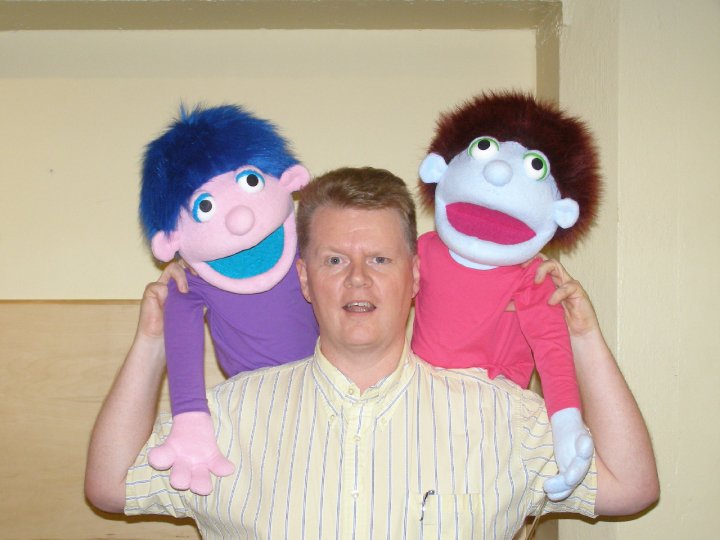
A friend of mine introduced me to puppetry improv. In this case, we put Henson-style puppets onto our hands and created amazing scenes with characters that didn’t exist until mere seconds ago.

It was magical.

Image

The minor act of picking up a puppet and letting it do the talking gave me enough distance that I was free to think and do anything I wanted without fear of recrimination. People stopped watching me and immediately followed the puppet. Whatever the puppet said was funny or poignant or shocking. Even saying nothing spoke volumes.

And if I thought improv audiences were generous, oh my God! Puppets can get away with murder! There are no taboos.

Which brings me to writing.

As it was with the puppet, so it is with writing characters for screenplays, stage plays or novels. I have the freedom to write anything, to say anything, because ultimately the words are the responsibility of the characters I create.

Maybe this is a sign of a need for medication, but when I write a character, I hear his, her or its voice in my head. Change the character and the voice changes.

By moving the focus off of me—my skills or lack thereof, my insecurities, my knowledge—I free myself up to pursue something bigger.

Or at least that’s what I’m telling myself. It seems to be working for me.

A great writers’ blog (by a great writer)

For those interested in reading some interesting perspectives on the creative process, I highly recommend a blog by one of my friends, actor and writer Marsha Mason (not the one from The Goodbye Girl).

Briefly known as WTF (which does not stand for what it may ask frequently), the Why The Face blog tackles a lot of the insecurities that most writers face; in Marsha’s case, from the perspective of screenwriting, but writing’s writing. But she also provides insights and answers gleaned both from her own experiences and those of others whom she has met.

Check it out.