Dialogue v Narrative

Image

Yesterday, my friend Marsha posted a short piece on her blog—Why the Face (WTF)—where she discussed her challenges in writing narrative/action for a scene and how she found scene writing to be so much easier if she started the dialogue.

“On its own, free of formatting and figuring out what characters are doing physically,” she wrote, “it lets me really get into what these people are actually saying to each other.”

When I read this, I thought, what a fascinating approach as mine is the complete opposite.

When I start a scene, I can go on ad nauseum about the setting and what the characters are doing or how they are behaving, but I find actually expressing the characters in dialogue to be daunting. When I do start writing dialogue, I find that I am writing exactly what my characters are thinking (on-the-nose) or that their emotions and motivations are incredibly superficial.

When I describe a character’s behaviour, however, his or her emotions surface more slowly through unconscious tics. The tensions that I intone in my mind’s eye then inform the word choice when I start to write his or her dialogue. It is as though I have to psych myself into the character’s body before I can express his or her desires and impulses to the fullest.

What makes this ironic is that while discussing this with Leela, another friend, she reminded me of the days when I first started writing sketch comedy, and all I could seem to manage were a series of “talking-head” sketches. At that time, action was unimportant to me as I felt the only way to bring my point across was through words.

On paper, my sketches could be very engaging, whereas on stage, they were significantly less so. Thus, I needed to learn the power of the unspoken word. Apparently, the pendulum has swung full tilt and I am now in the process of finding a happy medium. (No wonder writing is so tiring.)

Ultimately, like a good Oreo cookie, the best screenwriting comes from the combination of solid narrative (icing) and solid dialogue (cookie), so I am glad Marsha has my back and I have hers.

I am always right (motivation)

Image

If I move into a beautiful New England home with my beautiful family and on our first night, the walls run red with blood and a disconnected voice cries “Get out!”, I go to a hotel and move the next day.

I do not search for an explanation (or at least not that night). I do not instinctively head for the dusty attic, the dank dark basement or that rather nasty looking shed under the menacing weeping willow in the darkest corner of the back yard.

So when I read about characters doing just that in a novel or screenplay or watch actors do it at the movies, I find myself thinking they deserve whatever comes next because they are idiots. What the hell motivated them to have that stupid response? Out of the gate, I disconnect from the character.

Now, despite the title of this blog post, I am not suggesting that only my instincts should be followed in screenplays, novels, etc.—these would be damned short stories if everyone did—but rather it is a call to writers to help me, as a reader or viewer, understand why the character behaved the way he or she did. Until I do, I cannot really bond with the character.

This isn’t easy, but it is necessary.

Whenever a character responds to something or takes an action, you have to ask yourself, why did he or she do that? And over the course of your story, are all of that character’s choices consistent with his or her personal journey from before your story’s opening to its conclusion?

And as if that isn’t difficult enough, you then have to ask yourself, have I written the story in such a way that the audience can see the logic of the choices, even if only in hindsight?

This last point is crucial, because as writers, we often know or understand things about our characters that never make it to the page. Thus, while everything may seem completely consistent and logical to us, it may still be confusing to our audience, who is not privy to the machinations within the head of the writer god.

At the same time, you never want to spell it out for the audience, because then story reading or watching becomes too passive an exercise and the audience doesn’t engage. You need to feed your audience just enough information that it can begin to make inferences about your characters’ behaviours and so become connected with your characters.

The good news is that this is unlikely to happen in your first draft or at best, will happen in drips and drabs.

As you develop your story past draft one, you will find moments of inconsistency or more likely, your trusted readers and advisers will find inconsistencies. Take those in and mull them over. Odds are, fixing those issues will not require a major refocus of your story…just a heavy-brush rewrite. And your story will improve.

So if the walls run red with blood, a disconnected voice cries “Get out!” and your protagonist doesn’t, I better understand why.

Image

(Images are the property of the owners and are used here without permission.)

For my friend Emma

…and all my other female actor friends and colleagues, a simple request to storytellers and writers:

When creating a female character for your story (or any character, for that matter), please describe her in terms that reflect who she is and not in terms of how she relates to another.

Image

Phrases like ex-girlfriend or soccer mom provide only a limited degree of context and tell us nothing at all about your vision for that character.

Is she a psychotic Glen Close type of character or is she a nurturing Barbara Billingsley type of character?

To what does she aspire?

If presented with a spider, she would [fill in the blank].

Around a board room table, her position would be [location], she would be dressed [adjective], her posture would be [adjective] and her eyes would express [noun].

If the character is important enough to move your story along, the character is important enough to be a human being (or whatever species you are dealing with).

If not, then you probably don’t need the character in your story.

Consciously unconscious

When a writer is on her game, when she has found a creative groove, she writes at two levels.

At the conscious level, she weaves the stories of her various characters and environments into a literary carpet of amazing delicacy. She understands the work won’t be flawless when she’s done, but she knows and is comfortable in the belief that she can surgically pull the extraneous threads later.

This is a beautiful thing. But an even more dazzling spectacle is happening at the unconscious level.

This is the level at which the writer’s subconscious creates delicate near-invisible tendrils of connections between characters and themselves, their surroundings and other characters. It is at this level that amazing nuance and metaphor is added to a story. Without the harsh distractions of planning and plotting (both very important, mind you), the subconscious is free to perform magic that we may not recognize or appreciate until much later in the creative process.

One way you witness this is when you realize that conscious concerns you had before sitting down to write have been miraculously addressed, as though story-writing elves snuck onto our computers overnight.

Interestingly, this is one reason why it’s important to have other people read your stuff. They will see things you cannot. In some cases, it is because of what they bring to the table—their personal biases and experiences. But more importantly, it is because they aren’t encumbered by your blinders.

Other readers see your work more clearly because they are untainted with what comes before and after, whether on the page or in your head.

I witnessed and shared this personally in two reading group sessions where my fellow writers created incredible metaphors that deeply informed their lead characters. Yet, when pressed directly as to whether they were conscious of those decisions, both were the most shocked people in the room.

Both demurred that the incidences were quite accidental, but whereas I might agree that they were unintentional, I don’t believe they were in any way accidental.

We make choices for a reason (or several) even when we don’t know what those reasons are. The truth is our truth no matter how ignorant we may remain to what that truth is. We cannot help but splay that truth across our pages.

To some extent, I think creative harmony lay in not caring what those reasons are. For if we try to dissect them, I fear we run the risk of killing them. It is enough, I think, to let our subconscious guide us while we work consciously.

Let the magic within you happen. Your work will be the better for it.

I never intended to take a photo of someone urinating in a Washington, DC alley way, but am tickled I did...especially as he realizes he's been caught

I never intended to take a photo of someone urinating in a Washington, DC alley way, but am tickled I did… especially as he realizes he’s been caught

Two’s company, three’s a story

As I read through a lot of early-stage screenplays and stage plays (including my own), I have noticed an interesting trend: Any scene that only involves two characters is boring.

No matter what the posturing, no matter how violent or loving, no matter whom the characters are, a scene with only two characters quickly loses steam for me. The dynamic peters out, and I find a lot of writers try to overcompensate for that by simply making the characters’ gestures larger. As though they believe talking louder to someone who does not speak your language will make you any more intelligible.

I speak for the trios: Turns out there may be some behavioural psychology behind this…at least, if you’re a rock hyrax—no, no, not “Lorax”.

Last week, a research paper was published in the journal Animal Behaviour that looked at the dynamics of triad relationships between these small creatures living in the hills of Israel, and the results were fascinating.

In a dyad relationship (two individuals), the authors say, you cannot make any predictions about the future other than friends will likely remain friends and enemies will likely remain enemies. With a triad (3 individuals), however, a social power dynamic is established that can morph in any number of directions, although some directions are inherently more likely and more stable than others.

The researchers found plenty of examples of the standby relationships, such as the friend of my enemy is my enemy (+ – -) or the friend of my friend is my friend (+ + +), and found that these relationships were highly stable in that they were likely to remain unchanged from year to year for any set of three individuals.

Enemy mine: What was fascinating, however, was that the seemingly unstable and counter-intuitive state of the enemy of my enemy is my enemy (- – -) occurred a lot more often than expected by chance and that it could be quite stable from year to year. This completely flies in the face of the standard that the enemy of my enemy is my friend (- – +).

From a story perspective, however, it can make complete sense. What if all 3 of you are vying for the same objective? As one of the enemies, you have to be constantly wary that any effort to thwart one enemy will provide an advantage to the other enemy.

Friend of a friend: What was also interesting was how gender played a role in the evolution of the unstable triad the friend of my friend is my enemy (+ + -). In females, this triad tended to morph toward (+ + +), while in males, it tended toward (+ – -), suggesting the need for female cooperation in raising young and male competitiveness in breeding. Typical men, eh?

From a story perspective, though, consider the power of (+ + -). What if the friend of your friend pushed them to do something contrary to your desires? This would make them your enemy—whether you’re being altruistic or selfish. A much more interesting dynamic as you may inadvertently push your friend into making a choice between the two opposing forces.

Dynamite dynamics: Regardless of the way your scenes play out, the triad dynamic gives you so much more room to play with emotionally and socially than a dyad. At any given moment, one of the trio can switch poles and the dynamic changes. With a dyad, the sudden switching of poles better have a good rationale in your story or it won’t be believable. That brings me to my next point.

Two characters: Now, before you go out and scrub all your two-person scenes from your screenplays, novels and stage plays (because yes, my hubris states I am that influential), let me remind you I said two characters, not two people.

Environment, situation and unseen third parties can also be characters in a scene between two individuals. It is those subtextual elements that convert a vomitously dull scene into one that sizzles. The challenge is in making sure the reader/viewer knows it’s there through carefully selected word choice and narrative (NOT exposition).

Two friends meet, but one hides a secret from a previous conversation that muddies their exchange in ways unexpected by the ill-informed (- + – or + + -) (e.g., plot to every spy movie ever made).

Two men with diametrically opposed viewpoints have to set aside their differences to deal with an external threat (- – -) (e.g., Hooper’s shark to his Quint is his enemy), which turns into (- + -)).

So, when you find yourself creating a scene with only two people, ask yourself who or what is influencing this scene aside from the two people and remember to incorporate them or it into the dialogue and narrative.

As Jed Barlett said to Sam Seaborn while playing chess in a scene from West Wing, “Look at the whole board.”

Didn't want to play your silly games, anyways

Didn’t want to play your silly games, anyways

Dildo out of water

In writing, one of the tips for jazzing up your story is to put your character into an odd situation and watch how he or she deals with the new circumstances. In comedy, we call this being a “fish out of water”.

While traveling through Iceland a year ago, I got to see this on a grand scale. While wandering around a large pond in downtown Reykjavik, I was surprised to find a large dildo in the middle of the sidewalk—it was a few days after the end of Pride Week, so I could only imagine where it came from.

On Golden Dong (near the pond in Reykjavik)

On Golden Dong (near the pond in Reykjavik)

Realizing there was an opportunity here, I sat on a nearby bench and spent an amazing hour or so watching locals and tourists come upon the vulcanized penis. It was a magnificent chance to people-watch and learn about the range of emotions.

Some were disgusted. Some were anxious for their over-inquisitive children. Many were amused. Most arrived quietly and left highly animated.

I’m not sure what this says, but I seemed to be the only one who took a photo of it.

As a North American, I was not used to the beautiful simplicity of a European city (Reykjavik)

As a North American, I was not used to the beautiful simplicity of a European city (Reykjavik)

The pond in Reykjavik was a magical place to write and think

The pond in Reykjavik was a magical place to write and think

Penny Penniston at Toronto Screenwriting Conference 2013

Not Just Talk: How Writers Think About Dialogue

Image

Many people come to screenwriting because they have a good instinct for dialogue, but it is important to look beyond the instinct and understand the theory behind dialogue. If nothing else, this understanding is useful in helping the writer communicate with other artists so that you can articulate why you wrote a specific line a certain way, rather than simply standing there scratching your head saying “I dunno”.

Dialogue vs. conversation: Most people think writing dialogue is easy, Penniston says, because they are under the delusion that dialogue and conversation are the same thing. They are not. In comparing words to the keys of a piano, she loudly showed that conversation is noisy and discordant, while dialogue is musical, it is precise and crafted, it presents voices and themes.

Dialogue gives clear direction to the artist interpreting it, but it also gives the artist a chance to interpret the words in his or her own way, to show off his or her talents.

Like music, you have to develop something of a muscle memory for dialogue through repetition; however, understanding the theory behind dialogue will allow you to step back and analyze your writing with a certain distance.

Using visual cues, Penniston suggested that your story is much like an aerial shot of the Grand Canyon, with long, sweeping turns and deeper and shallower canyons. Dialogue, however, is more like someone kayaking through white water, experiencing the eddies and whorls of the currents and avoiding the rocks where possible.

Forces: Characters, she says, are very lazy. If left to their own devices, they won’t do anything. We need to get them to move and we do that by applying a force on them, which in physics has both a direction and magnitude. You can use physical forces, evolutionary forces (e.g., against death or for sex), cultural or societal forces (e.g., need to conform), or psychological forces (e.g., need for love or respect).

And these forces should be defined in very specific ways, again offering a sense of direction and magnitude. The strongest of all the forces on a character will drive your scene, but she stresses, the other forces are still important. This landscape of forces, she says, is the character’s situation in a scene.

Text and subtext: You want to be sure you put your characters in interesting situations with a network of multiple forces pushing and pulling your characters in different directions. You should always feel that your dialogue is adjusting and moving as these forces shift in strength and direction. A good line of dialogue, she says, manifests the sum of all of the forces acting on the character at a particular moment (e.g., personal baggage, setting, other characters).

In text, only one force acts on your character. In subtext, however, more than one thing is happening at one time. Subtext, she warns, is not the result of something being left unsaid but rather that so many things are trying to be said, but aren’t. It can manifest itself as an odd word choice given the superficial context or self-interruption and rephrasing.

When the forces converge and cancel each other out, she suggests, the character remains silent, unable to communicate anything. The character will look static, but he or she is not. It is a moment of paralysis (in physics, potential energy). And the line after a lengthy silence can be very interesting, she argues, because it is the first sign of which of the forces won. At the same time, she warns that we should look for lengthy pauses within our screenplays that do nothing for the scene or the drama. Those pauses aren’t based on reactions to forces.

Story beats: For Penniston, a story beat transitions when the balance of forces in a scene shifts, and for as a writer, you want to be very clear about the point at which this shift occurs. You should be able to point to the specific line in a scene.

Memorable lines, she says, come when the tension of a beat breaks. She harkens back to the Rule of Threes, suggesting the scene beat should occur in three steps: establish the tension, heighten the tension, and break the tension.

And wonderfully, she suggests, with change, you get an opportunity for surprise, such as the punchline of a joke. These lines can’t come out of left field, however. They must fit the context of the scene, but they can still be unexpected.

Writer Tricks: Create interesting situations in which your scene plays out. Pick a discordant place, person or circumstance. And avoid beat repetition. A specific combination of forces should never occur twice or you’ve just gone back to a previous beat and eliminated the reasons for everything that occurred between them.

Find interesting things within your situation. Add and/or explore details within your scene. Assign random elements and figure out how to make those elements work within your scene. Get insights from others and look for opportune moments to create truly memorable lines that encapsulate your character or the situation.

Tell your story as clearly but as efficiently as possible to avoid distractions. Only add narrative if it is revelatory or adds something new, and don’t direct. Although, she says, if you’re writing for studio readers, you may want to err on the side of too much narrative to make sure your story gets across.

(Aside from being a professor at Northwestern University, Penniston is also a playwright and author of the book: Talk the Talk: A Dialogue Workshop for Scriptwriters)

Dara Marks at Toronto Screenwriting Conference 2013

Engaging the Feminine Heroic

Dara Marks

In a follow-up to her very popular Transformational Arc talk of previous years, Dara Marks took us through another aspect of character development, something she calls the feminine heroic. A counterpart to the well known hero’s journey, the feminine heroic completes the hero’s character and thus is not necessarily tied simply to female heroes. Rather, it encapsulates the feminine side of everyone’s natures.
Transformational Arc

She explains, as writers, we are constantly trying to understand the narrative in which we are living, but we experience that narrative from a very personal perspective. Thus, in her canonical transformational arc, there is both an outer realm, where external forces act upon the hero, and an inner realm, the more personal influences. We grow, she says, only in relationship to demands on us to grow, and the external realm stimulates the internal reckoning.

The union of the feminine and masculine brings about wholeness in the character. It is a combination of the masculine spirit, which represents all that we can be, and the feminine soul, the deepness of our authentic self. Marks offers the example of a tree, which may reach toward the sky, but is only as strong as the root system that provides it nutrients.

Everything we are in life is what comes from deep within ourselves.

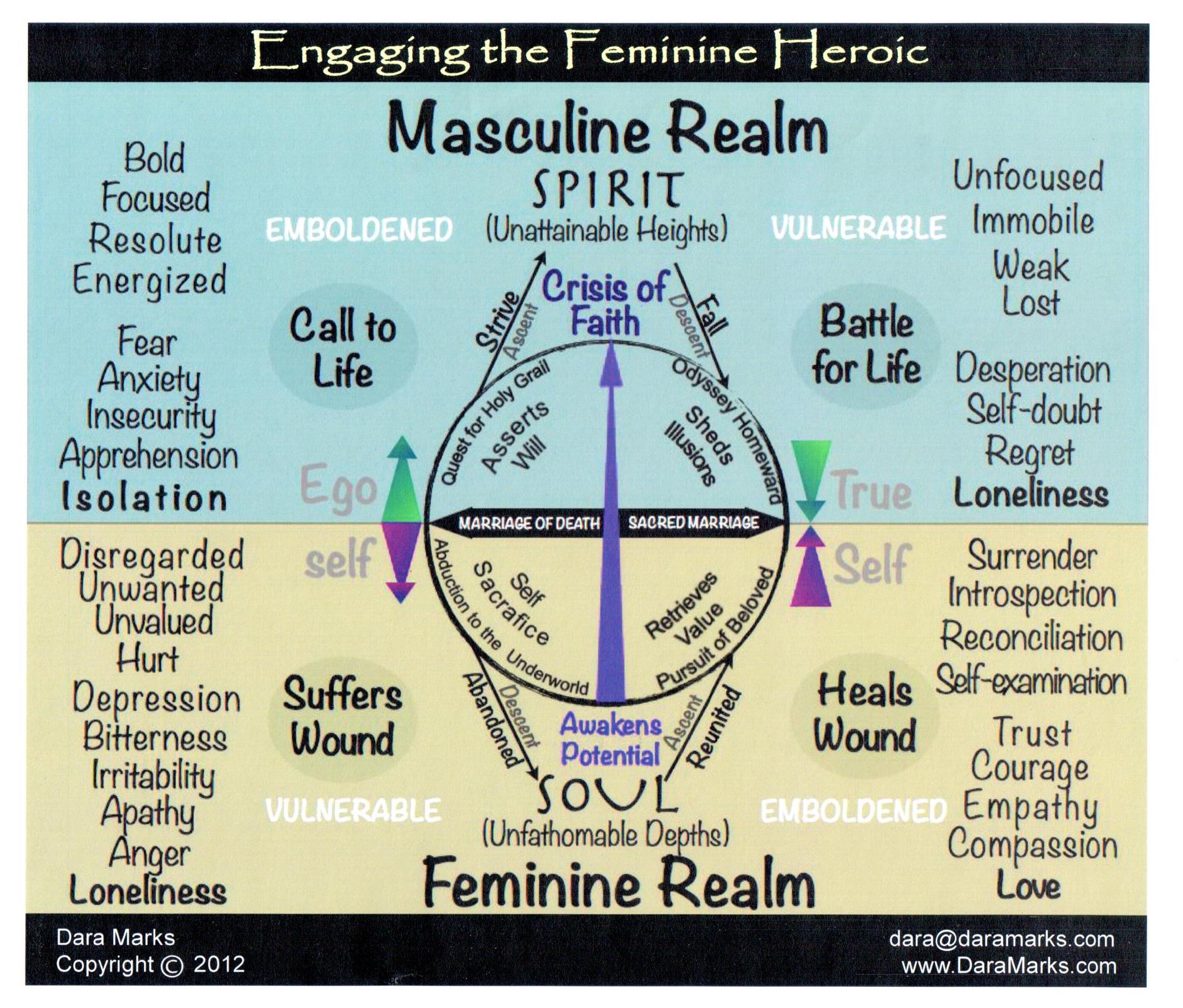
Marks presented this relatively complicated diagram that illustrated the hero’s external and internal journey (and in many ways, reflects our own journey through counseling or life itself). To the left, we find the Ego Self, where the onus is on my aspirations and beliefs of me. To the right is the True Self, which is understood after reflection and denotes my understanding of myself in the universe.
The union of the masculine and feminine sides of a character creates a wholeness

The union of the masculine and feminine sides of a character creates a wholeness

Ego Self: All early development, even that of a child, relies very heavily on the development of the Ego, a sense of will and determination. We believe that we’re in charge, despite all evidence to the contrary.

So if we start the journey in the Ego Self realm, we can look at the External or Masculine side and the Internal or Feminine side of ourselves.

Masculine Ego: In the top left quadrant, we have the Call to Life, the external mission that demands we strive or ascend to a greater level. We assert the force of our will on the universe. This area therefore is associated with a youthful and energetic quality. We have to move forward. We cannot let fear hold us back. To do this, we must sacrifice our feminine side, pushing those feelings down, or we cannot move forward.

Marks suggests that the tragedy of Hamlet was that he couldn’t get beyond his feminine side when he needed to move forward. She also gives the very literal example of Agamemnon, who was forced to sacrifice his daughter Iphigenia before the Greek ships would be allowed to voyage to Troy.

Feminine Ego: In the lower left quadrant of the diagram, we see the influence the masculine decision has on the feminine ego. We suffer a wound because part of us is no longer valued. We are literally abandoning a key part of our self and this will have a lingering effect. While we appear invincible externally, we are very vulnerable internally.

Thus, the feminine side needs to be rescued by the proverbial knight on a white charger. Marks is quick to point out that this is no time for political correctness as at this stage in our development, we just don’t have the internal skills to rescue ourselves.

She goes back to Greek myth to show how this works, focusing on the story of Demeter and her daughter Persephone, the latter of whom was abducted to the underworld by Hades to become his wife. Demeter was distraught at the loss of her daughter and journeyed to the underworld to bring her back to the surface.

The underworld experience may be difficult, but it is educational and we need to journey through it to come out more whole in the next stage.

Marriage of Death: The combination of the masculine and feminine ego is what Marks calls the Marriage of Death. Anytime we strive to become something new, it means the death to other aspects of our being. We just can’t strive at all things at the same time. But this marriage is not designed to last.

As Marks points out, the problem with striving is that it is doomed to failure. We can’t be rich enough, strong enough, famous enough, whatever enough. And it is at the moment of realization that our dreams are doomed that we have a Crisis of Faith (masculine side), which leads to an Awakening of Potential (feminine side). We move closer to the discovery of our true self, the right hand side of the diagram.

Masculine True Self: As the masculine ego passes through its crisis of faith, it suffers a fall from the unattainable heights, which converts the Call to Life into a Battle for Life. For self-renewal, it is essential that our delusions and illusions are shed during this descent, such as the belief that we are in control of our lives. And thus, at this stage, it is the masculine self that needs rescuing.

Marks offers the example of Odysseus (a popular subject at TSC this year) and the knowledge that his journey home was his great undoing as he loses more and more of his ego self (including his ships, crew, etc). The second half of his journey is literally the journey homeward toward his true self.

Feminine True Self: And who rescues the masculine true self? As the masculine side becomes more vulnerable, the feminine side becomes emboldened. We heal our wounds and reunite, turning pain and suffering into love and creativity.

The way out of our self-imposed purgatory is through compassion. We have to hear the story and then feel and acknowledge the pain. And it is only when the pain is given voice that it can move back from the underworld into life.

Marks exemplifies this aspect with the myth of Inanna and Erishkegal (which I do not know as well and so simply provide a link).

Sacred Marriage/True Self: It is at this point, through the sacred marriage of the masculine and feminine that we finally achieve the true self.

NOTE: All images and illustrations are property and copyright of Dara Marks and are used here without permission.

Unpacking baggage – Part Two

In Part One, I discussed the idea that to understand any characters you create and to make them more alive to your audience, you need to understand their baggage, the emotional and psychological events of their past that informs/moulds their behaviours and responses today. Today, I want to talk about making sure you let your audience in on the cosmic joke.

A couple years ago, I wrote a pilot episode for a new sitcom that I was developing—and still am; oh producers, where are’t thou?—and I asked my long suffering wife to read the teleplay.

My concern, I explained, was that of the four main characters, I didn’t feel I had a handle on three. The protagonist I nailed—knew him inside and out—but the other three seemed a little superficial. I wanted a second opinion, though, in case I was just being hard on myself.

Upon reading the script, she asked me a question. [SIDEBAR: Keep all friends who ask questions before offering opinions.]

Which of the four characters did I think I was most like? The protagonist, hands down. She smiled.

Based on her single reading without any background information, she proceeded to describe the other three characters in the script. And nailed them! She matched almost perfectly what I had had in mind for them.

But as was her wont—never in a malicious way—she then burst my bubble by telling me that she had almost no clue as to who the protagonist was, other than he was very similar to me. Without the benefit of 10 years of marriage, the protagonist was a black box. A name followed by narrative action or dialogue.

We walked through scenes and I explained motivations. My explanations made sense to her, but they weren’t on the page. My protagonist was so close to me that it never occurred to me that things weren’t obvious.

More recently, I’ve had the pleasure of reading other people’s developing screenplays, and very often, one of the problems I find as a reader is that I don’t have a clear vision of a character’s motivations in a scene. Why did they do what they did, say what they said?

One fellow student in particular I pressed for explanations about some characters in her otherwise amazing script (which horrified the bejeezus out of me btw). She waxed eloquent on her characters’ motivations and histories, offering amazing little vignettes from their pasts that helped explain why her characters were now behaving as they were.

But it wasn’t on the page!

Before I go further, this is NOT a call for more flashbacks (or cowbells). I am addicted to flashbacks, so I understand their power. Please avoid unless it is really there to move your plot along and not just a underhanded form of exposition designed to keep you from having to learn how to write subtext.

My recommendation to my friend, and something I will do on occasion, is to actually write out those vignettes, full narrative and dialogue, but only for myself and not for inclusion with the screenplay. Don’t just think about them, though. Actively write them out. For it is the act of writing that you will find the emotion of the scene, and it is that emotion that will provide the subtext of your screenplay.

That emotion will inform your dialogue and narrative word choice. That emotion will mould the flow and cadence of your dialogue (e.g., short, terse response vs. raving diatribe). It will also help inform how other characters will respond.

As I have experienced, having this information in my head makes it an intellectual exercise, with all of the cold aloofness that goes with it. But putting it on paper forces you to acknowledge and release those demons. It activates your lizard brain, as another friend of mine liked to call it. It is more visceral, more real.

It also has the added benefit of giving you something back to which you can refer when working on the story after six months of doing something else.

When someone reads your work or an actor performs it, you want to make it as easy as possible for them to get your characters, to understand the turmoil in which your characters function. Except at the highest levels of your story, do not ask your audience to think. It takes them out of the story.

You want them to feel the anger; the amusement; the sadness. If your protagonist is being oppressed, you want your audience to feel angry at the mistreatment, frustrated by the inability to change what is happening, and vindicated/exhilarated when your protagonist triumphs.

They can think on the way home from the theatre or after they close the back cover of the book.

If it is not on the page, none of this will happen. You audience will not engage and your story will suffer.

Sure, it sounds like extra work—it is!—but you’ve already invested this much time and effort on your story. Do you really want to risk that being all for nought because you’re the only one who gets why this story is important?

Who is this man and what is he thinking? What is he waiting for? If he looked at me, would I see boredom, anger, fear, joy?

Image

(Taken in Tofino, British Columbia.)

Book larnin’

Last week, one of my fellow bloggers expressed interest in screenwriting and wondered if I could recommend any good books to help him navigate this format of storytelling, and I promised to do it in a future blog post…well, guess what?

To be honest, my first piece of advice to anyone interested in getting into screenwriting would be to simply tell your story in whatever format comes easiest to you. Because, as I’ve said in a previous post, the most important thing is story. No matter how well formatted your screenplay, if your story doesn’t work, it doesn’t work.

Okay, that soap box being out of the way, my next advice is to take a class in screenwriting, because no matter how much you think you’ll write, there is nothing like the pressure of a deadline for 10 more pages to keep you motivated. And ultimately, until you’ve heard your pages read out loud, you have no idea if you’re getting your thoughts across or using the right words.

So now, on to books. There are few really good books to tell you what a script should look like, so I recommend you simply try to get your hands on several different scripts, whether film or television (although pick your preferred medium, because there are differences in presentation). There are several places on the Internet where you can get free scripts (and when I remember what they are, I will tell you), but for those with a couple of bucks to spare, I highly recommend Planet MegaMall for their breadth of scripts that you can purchase rather cheaply.

No one book will give you everything you need, so I recommend sitting in a bookstore and perusing as many books as possible to see which one fulfills some unconscious need today. Then, repeat the process several weeks later, because your unconscious needs will have changed.

For the best understanding of story as a whole, you can’t go wrong with Chris Vogler’s The Writer’s Journey. Using mythic structure, Vogler breaks down story into its key components and then contextualizes those concepts using popular movies. Knowing almost nothing about screenwriting, I wrote my first screenplay using these elements as a template.

To get more into the structure and execution of screenplays and plots, then Linda Cowgill’s The Art of Plotting is very good. Written very approachably, Cowgill goes through the fundamentals of a good plot (e.g., conflict, character, action) and helps you understand where your story may be faltering or be improved.

A little more into character and how character changes through the screenplay, Dara Marks’ Inside Story helps you understand the concept of theme, which will lead you to better understand the motivations of your characters. In a similar vein is Stanley Williams’ The Moral Premise, which examines how opposing forces within and between your characters will move them forward in your story and more importantly, make them much richer.

Somewhere between individual scenes and broader acts of a screenplay are sequences, which one of my instructors described as being equivalent to book chapters where a single idea is explored before moving to the next one. Paul Joseph Gulino’s Screenwriting: The Sequence Approach is your guide here, helping you pull your scenes together into the right order.

And the chief poobah of screenwriting books is Robert McKee’s Story. I was actually afraid of getting this book for quite some time as people warned me that reading it too early would make me too intimidated to keep writing. I can see where they were going, but it’s not that McKee’s writing is difficult to follow, it’s more that he talks about a huge variety of topics. Suddenly, you realize how many balls you’re juggling when you’re writing a screenplay.

Ellen Sandler’s The TV Writer’s Handbook is a great step-by-step, but you have to do the exercises to make it worth it. Pamela Douglas’s Writing The TV Drama Series is a little dated but still gives a fantastic overview of hour-long programs, spending the bulk of its time on how to break down and analyze a program, before it gets into actually writing an episode.

Scott Sedita’s The Eight Characters of Comedy is an interesting analysis of comedic archetypes in sitcoms. Written more from an actor’s perspective, it still offers valuable insights to the writer trying to understand or create characters. And finally, Peter Desberg and Jeffrey Davis’s Show Me The Funny offers amazing insights into how the minds of comedy writers work, but even more importantly, shows you that no two people will develop the same story from the same premise…so don’t sweat starting with cliché ideas.

That’s a lot for a first kick…I hope you find something in here to get you started.